Paris
193 Gallery
On now
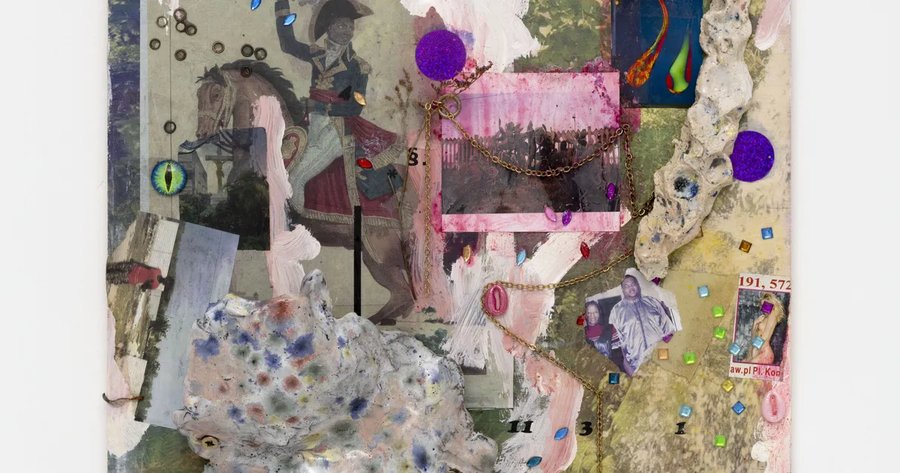
- In 1932, writing in Paris at the heart of what would become the Négritude movement, Paulette Nardal argued that consciousness is not inherited passively but built — constructed through deliberate effort, developed collectively, and transmitted against the grain of erasure. Her insight was fundamentally about memory as labor: the work of preserving, reconstructing, and passing on knowledge that colonial modernity had sought to sever from its bearers. Mémoire Matérielle takes Nardal’s proposition into the field of artistic practice, gathering five artists for whom the hand — patient, repetitive, exacting — is the primary instrument of that construction. The processes assembled here are demanding and slow: ceramic vessels built coil by coil, thread drawn through photographic surfaces, cast and strung ornament, layered pigment, reclaimed matter gathered and assembled into architecture. These are not merely aesthetic gestures. They are acts of material thinking — ways of encoding ancestral knowledge, embodied experience, and collective history into form. In each practice, memory appears not as nostalgic retrieval but as active reconstruction: something made, and made again, in the present tense. Andile Dyalvane’s coil-built ceramics carry the imprint of amaXhosa ancestral knowledge — vessels scarified, incised, and shaped as channels of communion, in which clay itself becomes a medium of dialogue between the living and those who came before. Joana Choumali embroiders directly onto photographs, suturing image and remembrance with thread; her stitched surfaces enact a quiet, durational form of repair in which each pass of the needle is both meditation and testimony. Carla Gueye’s sculptural practice works surface and matter through accumulation and touch, insisting on the body’s presence in the made object. And Gaëlle Choisne, laureate of the 2024 Prix Marcel Duchamp, expands the conversation to the scale of installation: drawing on her Franco-Haitian inheritance, she assembles raw and reclaimed materials — bearers of Creole mythologies, oral traditions, and colonial afterlives — into environments that operate as spaces of offering and repair, moving across floor, wall, and air. Placed in dialogue, these five practices propose that materials themselves are witnesses. Clay holds the pressure of the palm; thread records the rhythm of the wrist; salvaged matter carries the histories of its previous lives. What colonialism attempted to erase — craft traditions, embodied knowledge, cosmologies sustained in the body and the household object — persists here in material form, not as artifact but as living syntax. The exhibition moves deliberately between formal abstraction and narrative urgency, between the individual gesture and its collective resonance, trusting Nardal’s conviction that the personal, worked with sufficient care, becomes a common inheritance. Mémoire Matérielle is, finally, an argument about time. Hand-work refuses the tempo of extraction. To build a vessel over days, to embroider a photograph stitch by stitch, to gather and bind what has been discarded, is to practice a different economy of attention — one in which making is thinking, thinking is remembering, and remembering is a form of resistance. In the hands of these artists, memory is not what remains. It is what is built. — Azu Nwagbogu and Nkhensani Mkhari Curators of the exhibition.Description
Mémoire Matérielle : Gaëlle Choisne, Joana Choumali, Andile Dyalvane and Carla Gueye. Curated by Azu Nwagbogu and Nkhensani Mkhari.
Until 31 Oct 2026
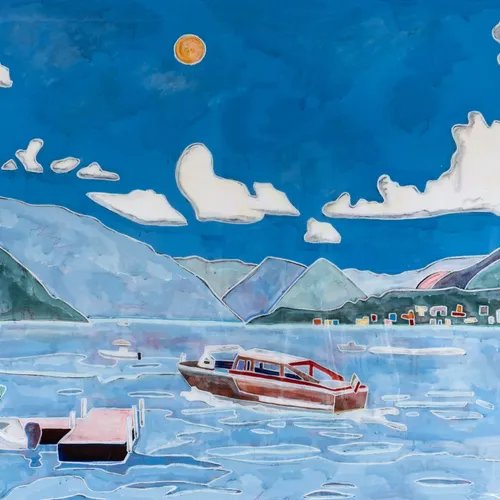
- Rob Tucker’s past exhibitions have explored the enduring influence of David Hockney, Henri Matisse and Giorgio Morandi. For his first solo exhibitions at the gallery, in Paris and subsequently in Venice, he presented landscapes, audacious architectural compositions and natures mortes, establishing a practice deeply attentive to the interplay of space, form and color. In this new body of work, Tucker turns his gaze towards both imagined and real Italian landscapes: mountains and lakes, canals and verdant fields become the setting for a renewed exploration of his pictorial “windows” onto the world. These landscapes occupy an elusive space between observation and invention. Through their dreamlike, almost mystical points of view, they appear less as representations of places than as passages into an imagined reality—one that feels, paradoxically, closer to life than ever before. Tucker’s fascination with space and form is articulated through a distinctive language of bold painted lines, unexpected shapes and vibrant, sometimes exuberant color. These elements are tempered by passages of pastel and softer tonalities, creating a subtle tension between intensity and tranquillity, abstraction and recognition. Tucker’s paintings invite us to pause before the “windows” he constructs—whatever form they may take—and to contemplate the worlds unfolding beyond them. His artworks become openings onto places that are at once familiar and imagined, observed andDescription
Rob Tucker, Echoes of Italy
Until 31 Oct 2026
Recent past exhibitions
- The Road explores the journey of life through the metaphor of the road, an ever-changing space shaped by movement, encounters, uncertainty, and transformation. Like life itself, the road unfolds through challenges and moments of joy, through pauses and progress, through destinations reached and paths still waiting to be discovered. More than a physical route, the road becomes a symbol of human experience. It embodies diversity through the people, cultures, and stories that intersect along the way, while reflecting the complexity of our individual and collective paths. It reminds us that no journey is linear and that every turn, obstacle, and detour contributes to growth, reflection, and understanding. Through this body of work, Sesse Elangwe invites viewers to reflect on their own journeys and the experiences that have shaped them. The Road becomes a meditation on the shared human experience, suggesting that while each path is unique, we are all travellers carrying memories, hopes, and stories that connect us to one another. In this perspective, meaning is found not only in the destination, but in the journey itself.Description
Sesse Elangwe : The Road
Ended 13 Sept 2026
- The Mediterranean Sea has always crossed literature as an interior landscape as much as a real horizon. From Colette to Antoine de Saint-Exupéry, via Françoise Sagan, the sea appears as a territory of light, slowness and contemplation: a sensitive geography made of crossings, silent ports, summer heat and travel memories. But the Mediterranean also summons the idea of an elsewhere—real or imaginary—opening towards other shores, other climates, other narratives bathed by the same light and the same desire for the horizon. Gathered on the occasion of the Mediterranean Season, this exhibition brings together artists whose works seem to share certain common sensations: blue, heat, shores, maritime circulations, open horizons, but also a certain gentleness of the gaze on everyday gestures and inhabited landscapes. From one horizon to another, the paintings and consoles of Ben Arpea display landscapes and still lifes bathed in motionless light. The refined forms of Aldo Chaparro and the silent horizons of Javier Toro Blum prolong this meditation on space, emptiness and clarity. The ceramics of Yoann Estevenin bring forth a discreet bestiary of hedgehogs, frogs, snails and butterflies, like so many presences escaped from a Mediterranean garden or a memory of reading. Further on, the sea appears in the boats of Rob Tucker, in the knots and deep blues of Hyacinthe Ouattara, as well as in the deployed sails of Lorenzo Vitturi, where Issus and his bodies merge into the wind. At the water’s edge, Christa David’s photographs explore the sensitive encounter between female bodies and the ocean. The works of Joana Choumali take a careful look at African coastal territories and their discreet rhythms. At Thandiwe Muriu’s, silhouettes blend with fabrics inspired by the tie and dye fabrics of Mombasa, in a play of patterns and colors that extends those of the sea and sky. The Mediterranean is also a space of circulation, encounters and shared stories. Hassan Hajjaj vividly celebrates the richness of Moroccan culture, between popular traditions and contemporary imaginations. Roxane Mbanga’s paintings evoke the luminous softness of Guadeloupe, the open terraces on the horizon and the suspended moments of summer days. Shourouk Rhaiem’s sculptures evoke the memory of journeys to Tunisia, where everyday objects become fragments of an intimate story. Without seeking to offer a unique vision of the Mediterranean, the exhibition thus composes a sensitive cartography made up of light, manners, memories and movements. The sea appears less as a border than as a common poetic space—an imaginary territory where views, narratives, and horizons meet.Description
Méditerranée
Ended 31 Aug 2026
Group Show: Summer Selection
Ended 19 Aug 2026
Hassan Hajjaj: La Caravane
Ended 3 Jul 2026
- 193 Gallery is pleased to announce the opening of its second exhibition of Hassan Hajjaj at its new Venice space. Titled Venice, 1447, the exhibition takes its name from the Hijri (Islamic) calendar. The year 1447 corresponds to the current year in the Hijri calendar, which follows lunar cycles and begins in 622 CE with the Hijra—the migration of the Prophet Muhammad from Mecca to Medina. This dual temporal framework is central to Hajjaj’s practice: each of his works is dated according to both the Hijri and Gregorian calendars, reflecting the artist’s navigation between cultural contexts and temporalities. The exhibition brings together a selection of the artist’s most iconic works: vibrant, playful portraits framed with plastic mats, motorbike tires, and everyday consumer goods, such as harissa cans. His subjects—depicting everyday scenes such as a veiled woman on a motorbike or a street acrobat—are captured in dynamic poses, dressed in garments designed by the artist himself, merging traditional Moroccan elements with contemporary streetwear influences. Through these compositions, Hajjaj constructs a visual language that is at once celebratory and subversive, challenging stereotypical representations while embracing popular culture and artisanal practices. The exhibition, coinciding with the opening of the Venice Biennale and in dialogue with its theme In Minor Keys, can be understood as a reflection on the complexities of postcolonial identity and cultural fluidity, offering a nuanced exploration of the tensions and possibilities inherent in multiculturalism. Hajjaj’s practice engages with the socio-political realities of our time, yet does so with humor, generosity, and a sense of play, sidestepping the didacticism and rigidity often associated with identity-based discourse.Description
Hassan Hajjaj: Venice, 1447
Ended 28 Jun 2026
- “These are the cues for an exhibition; an exhibition tuned in to the minor keys; an exhibition that invites listening to the persistent signals of earth and life, connecting to soul frequencies. If, in music, the minor keys are often associated with strangeness, melancholy and sorrow, here their joy, solace, hope, and transcendence manifest as well.” — Koyo Kouoh, In Minor Keys Drawing on Koyo Kouoh’s curatorial vision for the 2026 Venice Biennale, Soul Frequencies celebrates jazz, blues, soul, and Black musics more broadly as spaces of circulation—sites where sound becomes a vector of memory, resistance, and liberation. More than a repertoire, they constitute a way of being in the world: a shared frequency capable of connecting bodies, histories, and imaginaries. Bringing together nine contemporary artists from different regions of Africa and its diasporas, the exhibition invites viewers to inhabit these frequencies and experience their resonances. Music first appears here as a living material, an archive in motion. In the work of Modou Dieng Yacine, archival photographs of dances in Saint-Louis are reactivated through a vivid palette he describes as “colonial,” replaying the ambivalence of an imposed visual heritage shaped by a fantasized exoticism, while dance becomes a space of liberation. Responding to this pulse, in resonance, Shourouk Rhaiem transforms record sleeves—from Nina Simone to Marvin Gaye—into intimate refuges, adorned with crystals, revealing the emotional and projective charge of these objects. From this sonic material emerge voices, sometimes silenced—those of women in majesty brought forward by Thandiwe Muriu. Paired with African proverbs, her images affirm the unifying role of women in Kenyan society and underscore the importance of transmitting knowledge in a world moving at increasing speed. This speech, turned into memory, naturally extends into a relationship with ancestry, inherited histories, and the invisible. The sculptures of Mehdi-Georges Lahlou, between totem and self-portrait, unfold through the recurring metaphor of the palm tree narratives of filiation, migration, and resilience: the artist’s body becomes the structural spine of a date palm from which fruits emerge, as signs of continuity. In the work of Christa David, spirituality takes form in cut-out figures in prayer, engaged in an act of reconciliation and care, as if the image itself could mend fractures between the human and the world. In Hyacinthe Ouattara’s sculptures, composed of worn fabrics and used clothing, this reflection continues: they embody a living memory, where a red, almost blood-like thread binds the forms together as vital energy, connecting lives across time. The exhibition then unfolds into a reflection on the collective, where creation becomes a shared space. The project NOIRES by Roxane Mbanga, developed between Guadeloupe and Côte d’Ivoire in search of her origins, brings together drawings placed on handwoven batik textiles made in collaboration with other women, through transmitted gestures and craft traditions. This attention to connection resonates in the works of Joana Choumali, where scenes of everyday life—a mother guiding her child, men gathered through labor—are embroidered with golden thread and bathed in a soft light. The care invested in these images extends the artist’s practice, as she photographs the world each morning at first light to reveal its fragile beauty. In their extension, Adler Guerrier’s photographs, capturing the vegetation of Miami’s urban gardens, shift this idea of community toward an expanded temporality: enhanced with painted color forms named after other geographies (Gris Bamako, Rose Passada), they suggest discreet presences, like traces of souls or markers of community. In the heart of the city, the garden becomes a site of projection and patience—a space where something is cultivated beyond the human scale, a promise of continuity, perhaps a dream of Eden, in any case a form of transcendence. Through these practices, Soul Frequencies sketches a sensitive cartography in which music acts as a principle of circulation and persists as vibration. From one gesture to another, from one image to the next, a shared space emerges where everyday life—sometimes tested—quietly opens onto elsewhere. Perhaps this is where the strength of this gathering of artists lies: in its ability to bring forth, at the very heart of the real, forms of displacement—escapes, breaths—where art, like music, reveals what is common to us and opens up the possibility of making community.Description
Soul Frequencies
Ended 28 Jun 2026
- Hyangmok Baik (born 1990, South Korea) develops a painting practice built on dense, tactile surfaces that engages with traditional hierarchies of representation. His canvases are constructed through layered compositions, flattened perspectives, and shifting colour relationships, resulting in images that feel both immediate and in constant tension. Drawing on biblical, mythological, and art-historical sources, he reactivates familiar motifs—figures, still lifes, fragments of bodies—by displacing and recombining them with banal or anachronistic elements, subtly unsettling their original meanings, while cultivating ambiguity in which fixed narratives dissolve into open pictorial fields where temporal and cultural references overlap. In this exhibition titled Have You Ever Fallen in Love?, Baik explores the emotional turbulence of love through a group of paintings populated by unstable, theatrical figures. One work depicts a man smoking a cigarette in front of the Tree of Eden, under the gaze of Adam, Eve, and the serpent, while another male figure, partially camouflaged in the background, appears to whisper into his ear. Elsewhere, characters appear on their knees in gestures of supplication or desire, are entangled in shifting love triangles that suggest unstable dynamics of attraction and power, or ride white destriers evoking both romantic idealization and its inherent fragility. Across the exhibition, the figure of the white swan recurs as a leitmotif, its Korean pronunciation baegjo (백조) echoing the artist’s own surname and introducing a subtle layer of linguistic and symbolic resonance. Oscillating between vulnerability, excess, and irony, the works stage love as a space of projection, imbalance, and emotional intensity. For the first time, the artist also presents a series of works on paper, extending these concerns into a more immediate and intimate register.Description
Hyangmok Baik / Have You Ever Fallen in Love?
Ended 13 Jun 2026
- 193 Gallery is pleased to present The Mystical Point of View, the third solo exhibition by New Zealand artist Rob Tucker (b. 1987), on view at the gallery’s Paris space. The Mystical Point of View approaches landscape as a space of perception rather than representation. In this exhibition, Rob Tucker articulates a vision informed by Taoist thought, where painting is understood as following a path rather than reaching a destination. What unfolds on the canvas belongs to an inner terrain, shaped by memory, sensation, and intuition. From this position emerge pared-down compositions and an intense palette that seek synthesis rather than narrative. Lines, volumes, and architectural forms appear only to remain in flux, never fully settling. The mysticism referenced in the title is not a matter of belief, but of attentiveness—a way of listening to the world’s subtle rhythms, poised between control and release. Beneath the apparent simplicity of the motifs lies a complex process. Acrylic, fragmented oil stick marks, diluted stains, and watercolor pencils are layered and then sealed beneath an epoxy resin that heightens the colors and lends the surfaces a luminous, almost liquid depth. The materiality of the works becomes a site of dialogue between the tangible and the elusive, inviting viewers to move through the image and allow themselves to be guided by light.Description
Rob Tucker : The Mystical Point of View
Ended 18 Apr 2026
- Pavan Kavitkar’s artworks begin where nature is already under pressure, marked by displacement and constant modification. The landscapes he engages with are neither utterly untouched nor destroyed, but continuously modified — measured, divided, and rebuilt through human intervention. These are not distant sites of extraction, but environments we inhabit and inherit. The violence of new order is felt here as a slow process rather than a single event. As cities extend outward and forests retreat, rural landscapes are fragmented or absorbed into urban infrastructure, altering local ecosystems, social structures, and collective memory. The exhibition Vocabularies of a Shifting Landscape brings together a new series of artworks depicting landscapes shaped by growing tension and changing patterns on land. His compositions depict intricate details of everyday life that exist between imagination and contemporary reality. He works with watercolours, oil colours, and gouache, drawing on a strong technique based on Indian miniature painting and the Bengal School of Art, (emerged in 1905) in resistance to colonial academic realism. The details and anecdotes within his paintings form visual vocabularies of change, observed directly in his surroundings. They appear through buildings under construction, scaffolding, blue metal roofing sheets, barbed wire cutting through land, and irrigation systems extracting water for excessive farming. The lives and routines of migrant workers, villagers, and inhabitants unfold within these conditions. We see nature that remains lush, sometimes secluded and paradoxically peaceful. The surreal and symbolic depiction of architectural and natural spaces act as a place of refuge for him. The precision of his brushwork and the complexity of the narrative provide a sense of connection and intimacy. Without romanticising nature or condemning construction, Pavan Kavitkar shows the land he has lived with — its gestures, rituals, and accumulated traces — and the ways it carries them forward.Description
Pavan Kavitkar : Vocabularies of a Shifting Landscape
Ended 18 Apr 2026
- 193 Gallery is coming to Los Angeles from February 25 to March 1, 2026 for its debut at Felix Art Fair at the Hollywood Roosevelt Hotel. We will be taking over Tower Room 1101 with a solo exhibition presenting new paintings by New Zealand artist Rob Tucker. An adjoining space will feature a curated selection of works by artists represented by the gallery.Description
Felix 2026, Los Angeles ⎮USA
Ended 1 Mar 2026