Rennes
40mcube
On now
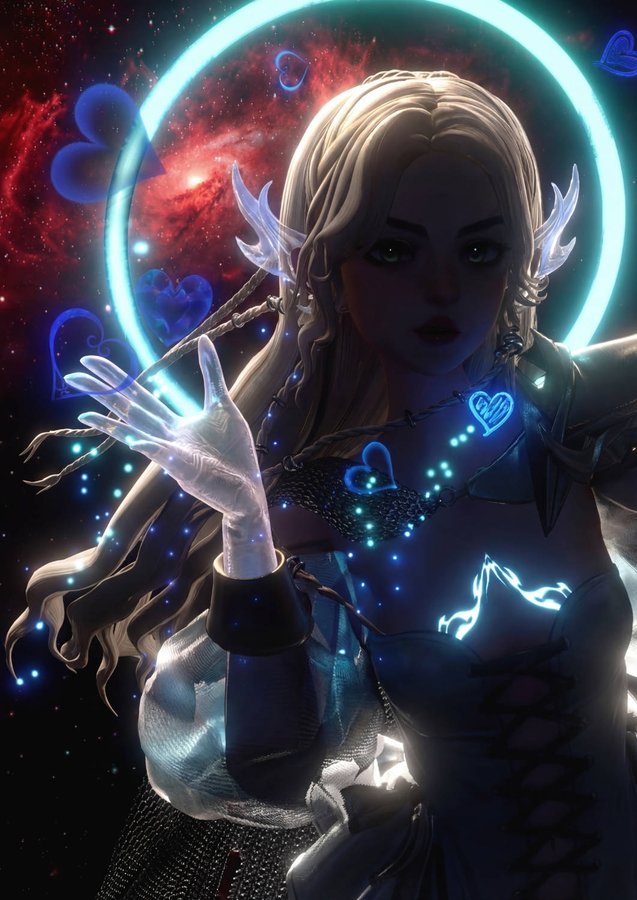
- Émilie Brout & Maxime Marion explore how visual forms on the Internet shape our imaginations, behaviors, and relationships. Through video, installation, and net art, they work with images as spaces of projection, circulation, and fiction, where the connections between intimacy, desire, merchandise, and technology are recreated. By experimenting with popular or mainstream aesthetics, they produce works that are simultaneously embodied and critical, and in which narrative power coexists with the exposure of its own mechanisms. s3lf.tech is the first part of a series developed following the artists’ residency at Villa Kujoyama in Japan in 2025, and features video installations, objects, and online extensions. Central to the exhibition is the figure of Grim3s, loosely inspired by the world of pop star Grimes, who personifies several contradictions inherent in contemporary digital cultures: the promise of empowerment, techno-utopian fantasies, the monetisation of intimacy, and often ambiguous ideological shifts. The project is based in particular on www.elf.tech, a tool created by the singer that allows any voice to be converted into hers, and whose logic is extended here by Émilie Brout & Maxime Marion into a fictional scenario of self-multiplication. Grim3s attempts to emerge as a virtual idol within a saturated ecosystem, thanks to a technology that amplifies presence to a dizzying, dissociative, and exhaustive degree. Gravitating around her are other works that explore what it means to identify with an image, to inhabit a character, or to become attached to a virtual presence—technical objects, effigies, avatars, and fictional bodies that interact within a deliberately unstable ensemble, where no single form definitively defines its meaning. Taking VTubing (a streaming practice in which users represent themselves via an avatar controlled in real time), fan fiction, customization cultures, and BJD communities as their starting point, Émilie Brout & Maxime Marion explore different modes of existence. They are interested in these intermediate forms of presence—somewhere between alter ego, character, synthetic idol, and technical double—which do not simply superimpose themselves onto a preexisting identity but instead act back upon it, shifting and reshaping it. The title s3lf.tech thus freely echoes the idea of “techniques of the self,” transposed here to digital environments, their interfaces, objects, fictions, and modes of incarnations. s3lf.tech creates a world that is both seductive and unsettling, where the boundaries between authenticity, fiction, and reproduction are becoming increasingly blurred. The videos speak directly to viewers, employing shifts that disrupt both the perspectives and the status of the people involved. In this way, the project examines how digital environments affect identities, desires, relationships—as well as belief itself, at a time when images multiply, become distorted, and acquire a form of autonomy online. Finally, the project extends beyond the exhibition space through songs, documents, broadcasts, and various elements published online, notably on the website www.s3lf.tech, which extend fiction into reality and blur the boundaries between them. A second part, also resulting from the residency at Villa Kujoyama, will unfold in parallel at the Zoo centre for contemporary art in Nantes, in a more contemplative form, centered on a digital sanctuary conceived as a space for memory, connection, and collaboration.Description
s3lf.tech – Émilie Brout & Maxime Marion
Until 19 Dec 2026
Recent past exhibitions
latest
Ended 11 Apr 2026
oldest
Ended 11 Apr 2026
alphabetical
Ended 11 Apr 2026
- Artists Mathieu Kleyebe Abonnenc, Arthur Gillet, Anna Holveck, and Marianne Mispelaëre each cultivate, in their own way, a distinctive and personal relationship with language, voice, speech, silence, and listening –elements they approach as political, social, and aesthetic materials. Through their artistic practices, they create spaces for speech, give voice to the unheard, and make the invisible visible, offering an artistic translation of these concerns. Mathieu Kleyebe Abonnenc, a visual artist, researcher, and editor from French Guiana, draws inspiration from the ecological and decolonial vision of Guyanese writer Wilson Harris (1). His film Limbé (2), exhibited in Les voix, refers to one of the poems by Léon-Gontran Damas, the Guianan poet and co-founder of the Négritude (3) movement. Limbé is also a performative Creole expression that activates the notion of limbo through speech. Mathieu Kleyebe Abonnenc tries to shape this state through the recorded and silenced performance of the dancer and choreographer Betty Tchomanga, with whom he often collaborates. In this performance, he speaks about the death of his sister, which brought sorrow and deep melancholy, while echoing Wilson Harris ’ reflections on the Limbo dance. This dance may be a way to embody, through its contortions, the movements that enslaved people had to invent in order to survive the journey across the Atlantic aboard slave ships. Visual artist and singer, Anna Holveck explores through video, performance, and composition, the places of the voice inside the body in the space and in the image. She creates immersive listening situations, at the border between ear and mouth. Their processes, which reveal themselves gradually, involve both the one who makes the sound and the one who receives it. For the opening of the exhibition Les voix, Anna Holveck performs again Singin’in (4), a piece in which the voices of two lyrical singers disturb the identification of sound sources and create diegetic confusion. The video and sound installation À voix off (5) features a woman with motionless lips described by a narrative voice composed of a cut-up of voice-overs talking about women or addressing them, taken from a selection of Hollywood films from the 1950s (6). In these two works, the effects of synchronisation mirror the links that unite the body with the voice, and the sound with the space. The artist identifies these perceptual distortions as places of emancipation for the body and the listening. Since 2017, Marianne Mispelaëre has been interested in alternative modes of communication –corporeal, invisible, discreet…“where the narrative exists while words seem inappropriate.” With La Marseillaise, a work initiated between 2019 and 2022 as part of the New Patrons program with the Collège du Vieux Port in Marseille and thankyouforcoming as mediator structure (7), she collaborated with graphic and character designers So-Hyun Bae and Federico Parra Barrios to create a typography that allows French to be written using the alphabets of all the languages spoken by the pupils. Each of the thirty-eight phonemes of the French language is represented by a sign taken from one of the pupils’ languages, which can also produce a sound. To read this choral typography, multiple speakers of different languages must participate, each contributing their knowledge of pronunciation. Thus, the French language becomes a host, capable of welcoming, articulating, and allowing the coexistence of the languages that live within its territory. Arthur Gillet presents in the exhibition Les voix a work from the most autobiographical part of his practice. In 2025, he conducted a [LINK text='residency' href='https://www.40mcube.org/en/coda/'] in Rennes with the contemporary art centre 40mcube with various deaf audiences and CODA (Children of Deaf Adults). His deep knowledge of the deaf community (gained from growing up in Rennes) as well as his connections with numerous schools and associations that welcome and support this public, enrich his project. The 23-meter-long silk painting titled Tout ce dont vous n’avez jamais entendu parler ( All that you’ve never heard of ) (8), painted in a style reminiscent of the Italian Primitives, particularly Cristoforo de Predis, a 15th century deaf painter. The work depicts the shared histories of people with hearing impairments. Hence, the exhibition, which brings together the artworks and voices of Mathieu Kleyebe Abonnenc, Arthur Gillet, Anna Holveck, and Marianne Mispelaëre, forms a polyphony. It invites us to listen carefully, to sharpen our perception, to see silence, to give shape to language, to enlighten or blur voices. It calls for respect for each voice –and for all the others. Anne LangloisDescription
Les voix
Ended 11 Apr 2026