Madrid
ALBARRÁN BOURDAIS | MADRID
On now
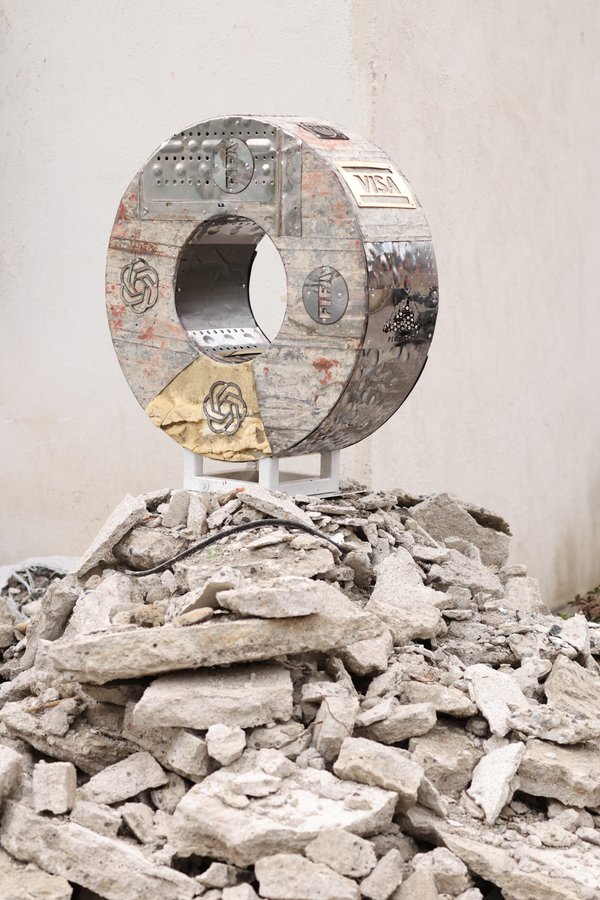
- Albarrán Bourdais is pleased to announce Salvadoran artist Simón Vega’s first exhibition with the gallery. "Tiempos Cíclicos / Futuros Pasados", opening in September at the gallery’s Madrid space, brings together a new body of sculptures and installations that intertwine the monumental pre-Hispanic monoliths of Mesoamerica with contemporary forms of commemoration and propaganda. In the exhibition, the gallery presents a group of newly created works inspired by the towering stelae of Maya rulers and the massive hybrid animal sculptures—known as zoomorphs—found in the ancient city of Quiriguá, in present-day Guatemala. Through these works, Vega develops a non-linear narrative in which past and future, the primitive and the advanced, the indigenous and the foreign converge. Primarily propagandistic in function, these monuments were engraved to commemorate historical and ritual events—astronomical phenomena, symbols of power, and military conquests—that were understood to recur over time. According to these ancestral cultures, time does not unfold in a linear fashion but is cyclical: events repeat themselves throughout history. Indeed, the sophisticated and remarkably precise Maya calendar not only numerically organizes the passage of time but also identifies patterns in past events that make it possible, to some extent, to understand contemporary occurrences and anticipate future ones. "Tiempos Cíclicos / Futuros Pasados", reinterprets monuments of the past to reflect on contemporary worldviews and expressions of power. Emblems of global neoliberalism—such as smartphone icons and the FIFA logo—replace Maya hieroglyphs, proposing a new system of power that brings together knowledge, technology, entertainment, and social control. The exhibition presents new sculptures from the "Futuros Pasados" series, created with metal, found materials, lights, and living plants. Reinterpreting Maya and Mesoamerican monuments, such as the stelae of ancient rulers, the works create an ironic fusion of objects and symbols of power from different eras and cultures. Vega incorporates elements drawn from spaceships and futuristic robots from science fiction films and literature as references to contemporary autocrats and a techno-feudalist system. Meanwhile, "Tiempos Cíclicos / Futuros Pasados" features a sculpture inspired by the stone markers of the Mesoamerican ballgame and by a Mexica commemorative altar known as "La Piedra de Tizoc", which has been interpreted as part of a gladiatorial-style ritual combat. In this work, representations of cosmic and commemorative events intertwine with contemporary global sports culture—such as soccer and boxing—where political strategies, power relations, identity, and territory continue to be performed and contested. Vega’s sculptural landscape within the gallery expands through two new installations made primarily from wooden pallets, symbols of the standardization of trade and the transportation of goods. Following Maya tradition, the "Zoomorfo" represents a hybrid being in constant evolution, upon which life unfolds and which serves as a mediator between different planes of the world. A second installation evokes Mesoamerican funerary traditions and the close relationship between archaeology and cultural looting. Accompanied by a video animation, the installation further explores the cyclical conception of time held by the pre-Hispanic peoples of present-day Central America.Description
Tiempos Cíclicos / Futuros Pasados
Until 17 Oct 2026
Recent past exhibitions
- 05.03 – 18.04.26 In her first solo exhibition in Spain in almost a decade, Albarrán Bourdais presents Désirs/Désordres, a show by French artist Annette Messager bringing together works produced between 1989 and 2024. The exhibition proposes a transversal reading of her practice, placing historical works in dialogue with recent pieces that reveal the persistence of certain formal and conceptual concerns: the body as symbolic territory, desire as an ambivalent force, and fragility as a critical strategy. The title Désirs/Désordres —which translates into English as Desires/Disorders— encapsulates a central tension in Messager’s work: the coexistence of impulse and restraint, eroticism and disturbance, affection and latent violence. From her textile investigations of the late 1980s to recent works such as “Trouble-Doute” (2024) and “Eros” (2024), the artist has developed a visual vocabulary in which the body, desire, and memory become territories of symbolic experimentation. Throughout the exhibition, the female body appears repeatedly fragmented, displaced, or metamorphosed. Works such as “Mains-Utérus” (2016) and “La robe entrailles” (2021) transform corporeality into an ambiguous scene where desire and disorder intertwine, suggesting both potency and vulnerability. Far from presenting a stable or idealized representation, the body in Messager’s work is mutable, expressive, and deeply political. Sensuality and sexuality run through the exhibition as a latent energy — never illustrative, yet intensely symbolic. The uterus, entrails, and hands emerge as recurring motifs oscillating between the erotic and the unsettling. Rather than monumentalizing the body, Messager presents it as a vulnerable and desiring territory, shaped by impulses, affects, and tensions that challenge normative constructions of gender and representation. Nets —filets, meshes, threads— constitute a fundamental and recurring element in her practice, functioning both as physical structures and conceptual metaphors. Since the late 1960s, Messager has used fishing nets, cords, and open weaves to support, envelop, or suspend bodily fragments, stuffed animals, drawings, or photographs. The net does not merely organize space: it captures, protects, exposes, and connects. In Désirs/Désordres, these woven structures generate a simultaneous sense of containment and instability, reinforcing the tension between desire and disorder that gives the exhibition its title. The textile dimension, central to her trajectory, operates not simply as a reference to craft tradition but as a gesture of insistence and repair. Thread and embroidery function as a form of soft writing that subverts notions of monumentality and permanence. In contrast to the rigid hierarchies of art history, Messager proposes an aesthetic of flexibility, instability, and affect. In her works, the use of everyday objects —reused materials, garments, nets, stuffed animals, and elements associated with the domestic sphere— allows her to alter their meanings and the emotions attached to them. Avoiding the so-called “noble materials” prescribed by tradition becomes a way of materializing an alternative way of thinking, speaking, and making. As a result, the selection of everyday objects and elements from the domestic landscape shifts grand narratives toward lived experience, toward individual existence and its needs, desires, concerns, and affections. Throughout Désirs/Désordres, reality and fantasy coexist within a universe where the intimate is never purely private. The artist unsettles material hierarchies and dismantles oppositions between art and craft, high culture and the domestic sphere. Humor, irony, and a persistent unease run through the works, generating an experience that is both sensorial and critical. With an internationally recognized career —including a retrospective at the Centre Pompidou and the Golden Lion at the 51st Venice Biennale in 2005 representing France— Messager has developed a practice that has decisively influenced subsequent generations of artists.Description
Désirs/Désordres, Annette Messager
Ended 18 Apr 2026
- January 17 – February 21, 2026 For his first exhibition at Albarrán Bourdais—one year after the major retrospective devoted to his work at MACBA—Jordi Colomer presents a new body of work that deepens his ongoing investigation of the city as a space of social, political, and symbolic projection. Through sculptures, videos, drawings, and collages, the artist unfolds a series of devices that reactivate some of his recurring concerns: the notions of utopia and dystopia, their capacity to imagine “spaces of the future,” and the ways in which we inhabit them. The exhibition takes as its point of departure Colomer’s fascination with the Linear City project conceived by Arturo Soria, and in particular with a quotation drawn from the project’s first public presentation, in which the architect envisioned a city of the future whose endpoints could be Cádiz and Saint Petersburg, or Beijing and Brussels. Drawing on this premonition of global scope, Jordi Colomer articulates a series of works that function as fragmentary maps, in which names, languages, alphabets, and systems of signage accumulate. These unstable cartographies claim their own space, where identities and territories blur, giving rise to an open, mobile, and ambiguous geography. These cartographies enter into dialogue with a precarious, life-size bus stop painted in bright colors, inviting the viewer to temporarily inhabit a specific point within this imagined linear city. Symbolically located somewhere between Beijing and Brussels, the structure proposes a space of waiting—unlocatable on the map—a remote site of encounter with the other, a shared and ephemeral place within the public realm. The exhibition continues with a new series of sculptural models that assemble fragments of a continuous peripheral city. Positioned midway between construction toys and the Architectons of Kazimir Malevich, these works present anonymous, repetitive, and functional buildings—shopping centers, hangars, blocks, and small apartment towers—that belong to no specific place. Hovering above these architectures is a “supreme” layer composed of advertisements, monumental structures, and slogan-bearing supports that convey vague promises, ambiguous hopes, or absurd prohibitions. Their sometimes humorous tone reveals an underlying will to control, whose apparent lightness proves unsettling. These slogans also infiltrate the exhibition space itself through texts that float across the gallery walls, in a series that references Spain’s tourism promotion abroad across different periods of recent history. Read from the present, these phrases generate new, poetically unexpected meanings, activating a critical distance between language, image, and the territory they claim to represent. In contrast to these imaginary cities, the video Modena Parade documents an action carried out in the Italian city of Modena on March 27, 2022, in a post-pandemic context. Colomer proposed celebrating a festivity—a secular, participatory procession that moved through the city in the reverse direction of the routes experienced during months of lockdown. The action began at the metaphysical cemetery designed by Aldo Rossi and concluded in the Giardini Ducali, bringing together more than 500 participants, including civic collectives, primary schools, percussion and dance groups, and the music conservatory. The procession functioned as a doubly cathartic gesture: on the one hand, the reclaiming of public space and the streets by those who had remained confined; on the other, the possibility of openly addressing death within a shared space, making its plural imaginaries visible. The video captures this collective gesture, transforming an ephemeral action into a reflection on the city as a site of ritual, encounter, and shared experience.Description
Everything Under the Sun?
Ended 21 Feb 2026