Brussel
Almine Rech
On now
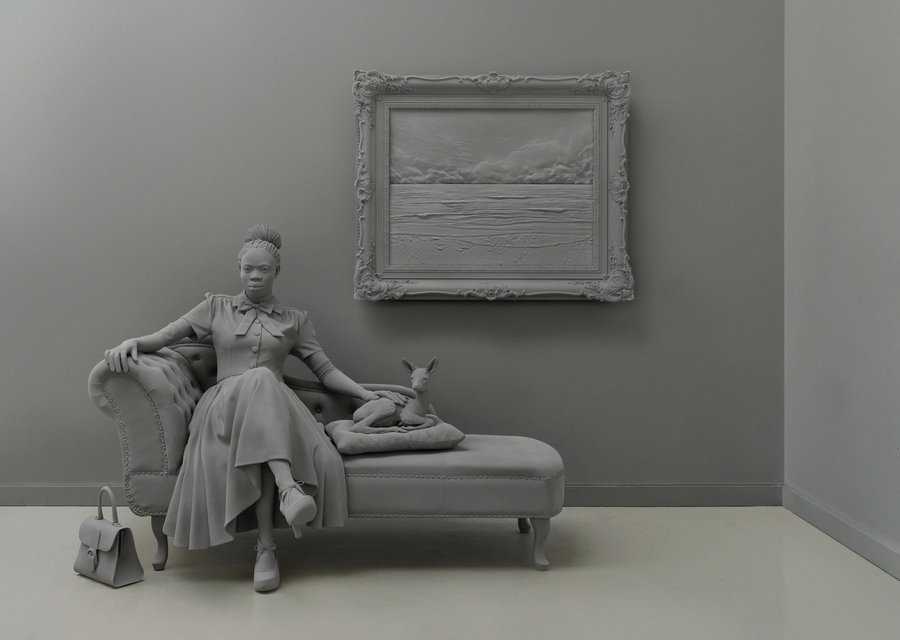
- In a world saturated with images, speed, and constant distraction, the work of Hans Op de Beeck offers something that today seems almost radical: silence. His installations, sculptures, films, and drawings do not loudly demand attention; rather, they slowly draw the viewer into meticulously constructed universes where time appears suspended and meaning unfolds gradually. To look at an Op de Beeck work is less to observe a work of art than to enter a mental space where memory, desire, and imagination converge. His pieces seem frozen in a precise instant; objects remain abandoned yet intact, while narratives hover somewhere just beyond reach. His art does not explain—it suggests. It does not seek to overwhelm; instead, it continues to resonate long afterwards. […] — Ruud Priem, Head of Department and Curator of Fine Arts at the National Museum of Archaeology, History and Art (MNAHA), Luxembourg. Curator of the exhibition 'Erwin Olaf & Hans Op de Beeck. Inspired by Steichen' (2022–2023, National Museum of Archaeology, History and Art, Luxembourg).Description
Hans Op de Beeck Vanishing Point
Until 7 Nov 2026
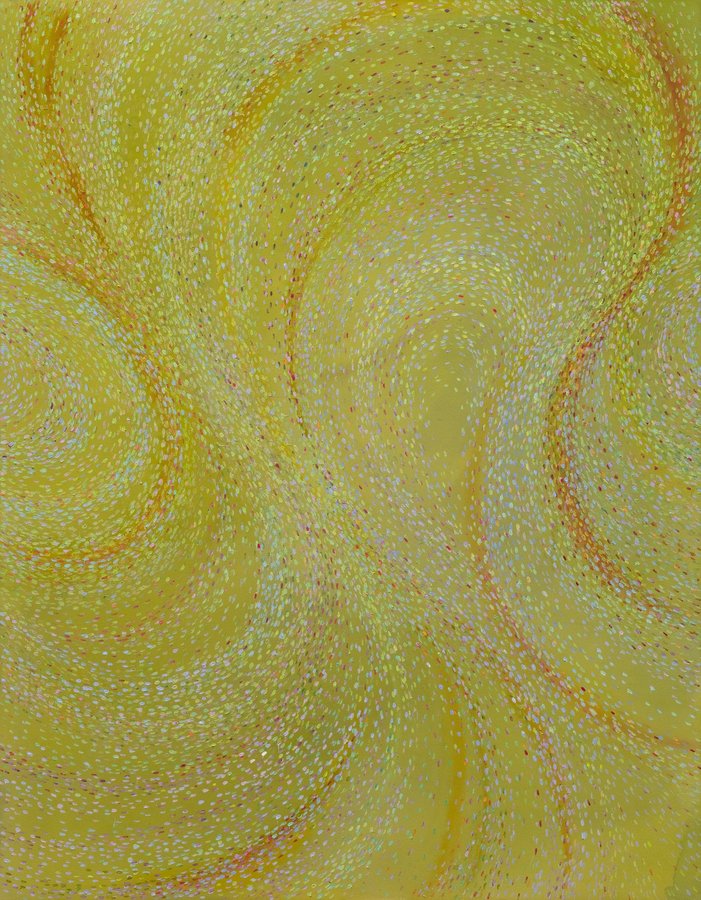
- Gwen O'Neil has come home. After ten years in California, the artist returned east—where she was born and raised—last year. Since moving to Brooklyn, she has been spending more time at her childhood home in East Hampton. A new body of work, presented in the show 'Atlantic Ave' at Almine Rech Monaco, reflects on her newfound yet familiar surroundings, articulating O'Neil's attention and attachment to a place that has only deepened after a decadeDescription
Gwen O'Neil: Atlantic Ave
Until 29 Jan 2027
Recent past exhibitions
- Almine Rech is pleased to announce Leonora Carrington's first solo exhibition at the gallery, presented at the Turenne space in Paris from September 8 to October 10, 2026. Organized in collaboration with the Consejo Leonora Carrington and rossogranada, the exhibition will bring together the full range of mediums explored by the artist throughout her career: drawing, painting, sculpture, tapestry, and writing.Description
Leonora Carrington
Ended 10 Oct 2026
- Theatricality lies at the heart of Genieve Figgis’ practice. Often pushed to frothy extremes, her paintings reimagine art history with sharp wit and a lush command of color and texture. The artist has a longstanding fascination with the eighteenth century—the age of absolutism holds both aesthetic and thematic allure for Figgis, who notes: “I like the costumes, the history and the paintings that were made in this period because they are theatrical. I use painting as a way of exploring different periods of history.” But Figgis’ references are not limited to the 18th century, she also turns to the rites and rituals of more recent eras for inspiration, as seen in this new body of work, where several periods are revisited. If the past is a foreign country, Figgis is an intrepid, expert traveler. A true collector at heart, the artist finds intrigue and inspiration in an ever-expanding range of sources, from film and television to advertisements, from photographs to historical paintings. This magpie-like tendency of gathering material wherever it can be found is a distinguishing feature of Figgis’ process. Guided by her singular imagination and artistic language, these diverse interests coalesce into richly layered works that speak across centuries. Encountering these paintings, one is first struck by the ornament of these worlds and the people who inhabit them, what Henry James described as the “panelled rooms, of precious mahogany, of portraits of women dead, of coloured china glimmering through glass doors and delicate silver reflected on bared tables.” Figures primp, they dine, they seduce each other, they interact in theatrical tableaux that would surely have pleased Denis Diderot. Figgis’ sumptuous style relishes in material splendor, accentuating texture and color through copious, dexterous brushstrokes. Vibrant drips and dabs of paint swirl together, suggesting beauty's inherent tendency towards disorder. Next comes a desire to dig deeper, for Figgis goes beyond merely representing the jet set of yesteryear. Further contemplation reveals the complex psychology behind this world of leisure, revealing the interplay of seduction, power, and control that undergird each work. The dining scenes, a new subject for the artist, pay particular attention to the intersection of materiality and social atmosphere. Then there are Figgis’s women. Unlike much of the art of the past, these women are by no means ornamental. They are not simply there to be looked at; instead, they look back, addressing us with their own agency. If Manet’s women were a turning point through their frank confrontation of the spectator, Figgis seems to be continuing this legacy, bringing a modern sensibility while remaining firmly rooted in her engagement with the past. In Figgis’ world, contradictions abound. Beneath the glamorous lies the ghastly, beneath self-serious artifice, irony. Her paintings are intentionally and delightfully off-kilter, populated by shifting figures, one moment hauntingly beautiful, the next terrifying. And just when we begin to lose our footing, the artist draws us back in, guiding us through her strange and splendid realm. The new body of work presented in 'Drama Club' continues Figgis’ examination of theatrical excess through striking, memorable compositions. — Louisa Mahoney, ResearcherDescription
Genieve Figgis: Drama Club
Ended 25 Sept 2026
- Almine Rech Brussels is pleased to present Ha Chong-Hyun’s sixth solo exhibition with the gallery, on view from April 22 to June 27, 2026. Abstraction and figuration are foundational terms in the context of modern and contemporary art, yet their meanings are all too often taken for granted. The work of Korean artist Ha Chong-Hyun invites us to reconsider these categories beyond simple binaries. In much of Western aesthetic thought, abstraction and figuration are positioned as diametric opposites along the axis of representation. Central to this opposition is the notion of “likeness”, that is, the degree to which an image resembles the subject it depicts. From this perspective, abstraction appears detached from reality, while figuration is assumed to mirror it more truthfully. The problem with this distinction is that it presupposes an ontological primacy of mind over matter, embedded in the conception of the image as a “window” onto reality rather than as a material entity. Ha Chong-Hyun’s practice challenges these assumptions at their very core. His works investigate abstraction as something deeply grounded in materiality, where repeated gestures – dragging, piercing, pressing – give rise to “figures” in their own right. This approach resonates with European Art Informel, but is primarily representative of the Korean Dansaekhwa movement, of which Ha Chong-Hyun is a central figure. Dansaekhwa has long been undervalued, reductively framed as tardive or derivative in relation to Western movements such as Minimalism or Abstract Expressionism. Such readings severely overlook the movement’s distinct material sensibility and the sociopolitical conditions under which it emerged. […] — Pieter Vermeulen, art critic, lecturer, researcher, and curatorDescription
Ha Chong-Hyun
Ended 27 Jun 2026
- The exhibition is organized to celebrate the 140th anniversary of diplomatic relations and friendship between France and Korea (1886-2026). It presents works by Ha Chong-Hyun, Lee Ufan, Park Seo-Bo, Yun Hyong-keun, and Chung Sang-Hwa. The Dansaekhwa movement owes its fame in part to the particular place it occupies in the history of the art scene in South Korea. In the late 1950s, a handful of innovative artists embarked on a rapid process of catching up with Western avant-gardes, breaking with academicism as one of the founding acts of contemporary art in the peninsula. However, their inspiration drawn from abstract expressionism and informel art led them to often be perceived only as epigones of pre-existing international movements. It was not until the 1960s and especially the 1970s that trends were interpreted as transcribing a specifically Korean sensitivity and aesthetics in painting. Several artists, some of whom had already actively participated in the upheavals of the 1950s, moved away from gestural abstraction to conceive new pictorial proposals marked by a taste for purity, repetition, and sometimes long and complex creative processes. These painters did not constitute an organized and claimed group as such, but their productions presented sufficient convergences to be considered as the driving forces of a new movement: Dansaekhwa, that is to say literally 'monochrome painting'. This denomination, partly improper in view of the works, imposed itself because of the sparing use of colors and the reduction of means. These researches entertain obvious links with minimalism, then in full swing in the United States. Such a proximity has fueled a debate relative to their interpretation as local declinations of an international movement or autochthonous creations updating an aesthetics inherited from the Joseon era (1392-1910). The borrowings from the Western art scene are undeniable, not to mention the use of abstract painting on canvas. However, the thorough assimilation of American and European art, undertaken in the 1950s, allowed Korean artists to express a proper voice, on a now common base. Thus, the works produced in the peninsula distinguish themselves as much from the taste for powerful contrasts, vivid colors, and the readability of forms of most American minimalists as from the tendency towards the deconstruction of painting operated by groups like Supports-Surfaces. On the one hand, composition and visual force matter less to Korean artists than the setting up of protocols governing new forms of interaction with tools and materials. On the other hand, these latter, although they break with previous technical habits, still partly inscribe themselves in a traditional conception of painting, resulting in what Lee Yil (1932-1997), eminent art critic, called 'non-pictorial painting'. Ha Chong-hyun (born 1935) and Chung Sang-Hwa (born 1932) produce canvases stretched on frames, but deny the status of two-dimensional image of the works to emphasize their processual dimension and materiality. Ha Chong-hyun applies his paint by the reverse of the canvas and presses on it until it passes through the fabric's mesh. Chung Sang-Hwa, for his part, folds his support to obtain a grid within which he constantly poses, removes, and reapplies layers of paint. One finds this taste for repetition in Park Seo-Bo (1931-2023), who covers his still-wet painting with pencil marks, and Lee Ufan (born 1936) who, in his From point series, repeats the same rhythmic gesture driven by the progressive exhaustion of the brush's charge. This methodical approach is accompanied by Lee Ufan's criticism of his author status, which he perceives as a Western misunderstanding, the works resulting less from a demiurgic act than from a meeting with the support through the means of brushes. Lee Ufan has also emphasized how space, the central theme of his work offering a large place to the void and structured by the concept of relation, is understood in different terms in Asia and the West. These reminders seem all the more necessary as Dansaekhwa proves easily interpretable according to categories obscuring its anchorage in an Eastern tradition. The works of Yun Hyongkeun (1928-2007) can be easily apprehended as simple abstract geometric compositions without grasping the importance, for the artist, of the interaction between support and paint diluted with turpentine or the significant character of the pigments. The umber and ultramarine, thought of as respective symbols of earth and sea, evoke the pairing 'mountain and water', at the base of Eastern landscape painting. These potential misunderstandings facilitate the exportation outside the peninsula of works belonging to Dansaekhwa. They also satisfy an aspiration, now common in developed countries, for a form of spirituality and simplicity. They have therefore naturally been the subject of very intense institutional and commercial revaluation efforts in the 2010s, to the point of being today the main showcase of contemporary Korean art. Moreover, the autonomy of artistic researches affirmed by Dansaekhwa painters has led this latter to be considered as apolitical. Several important members of this movement have thus been able to make very successful institutional careers. While continuing to paint, they trained the next generation, which sometimes contributed to making their aesthetics and principles endure. This is one of the other major reasons for Dansaekhwa's success, having managed to maintain its dynamism and fertility for over half a century, sustained and enriched until today by new actors and new proposals.Description
Forming the Monochrome Masters of Dansaekhwa
Ended 23 May 2026
- Almine Rech Paris, Turenne is pleased to announce 'Kentucky Cols.', Larry Poons’ third solo exhibition with the gallery, on view from March 21 to May 21, 2026. This show, the artist’s first in Paris in nearly forty years, presents a series of new paintings, revealing the new directions in which Poons is taking his work. 'Kentucky Cols.' is organized in cooperation with Yares Art. Larry Poons, describes the strong impression made by a song he heard on the radio in the early 1950s: he compares this unusually intense experience to, smelling a flower for the first time. Looking at Poons’ recent paintings in this exhibition, viewers are seized by a similar sensation : not the representation of a flower, but the very experience of its opening and its blossoming. Ballroom Chassi, Pat Cloud, Clarence White, and How Many Hearts Have You Broken Today deploy imposing chromatic fields whose energy is less a matter of representation than of experience. Together, these works demonstrate Poons’ major role in the history of color-field painting. A little over ten years after that decisive musical experience, Poons made his very first painting, Rock and Roll (1958), an abstract geometric work. The painter musician—who, starting in 1961, got together for informal musical sessions with his friends Walter de Maria, La Monte Young, and Jasper Johns—developed a style of optical abstraction, and his famous dot paintings are some of the first pictorial experimentations of Op art. It is therefore not surprising that he was one of the artists featured in “The Responsive Eye” at MoMA in 1965, with Nixe’s Mate (1961) from his series of Dot Paintings. This exhibition played a key role in the international recognition of Op art, while also counterbalancing the influence of this trend by showing work reflecting post-painterly abstraction and color field painting. […] — Marjolaine Lévy, art historian and curatorDescription
Larry Poons Kentucky Cols.
Ended 21 May 2026
- Almine Rech is pleased to present 'Open Edges: Erik Lindman & Robert Motherwell', a duo exhibition running from March 11 to April 18, 2026. For the duration of the exhibition, the Fundación Almine y Bernard Ruiz-Picasso will loan two works by Pablo Picasso, which will be presented and integrated into the exhibition, anchoring the dialogue in the European modernism that influenced Robert Motherwell and subsequently Erik Lindman. The exhibition explores the shared interest of Erik Lindman and Robert Motherwell in using found materials to generate compositional decisions in their work. This traces back to their common reference, Picasso, and his technique of collage developed at the beginning of the 20th century. Between Picasso's hands, these found elements became devices for generating compositions, radically advancing the modernist project of complicating the question of artistic paternity. The use of collage by Picasso expanded the conception of the artist as someone who imagines. The artist is now considered someone who conceptualizes, selecting elements external to art in order to act as machines generating art. Erik Lindman and Robert Motherwell are two artists who, despite being born seventy years apart, share an interest in using found materials to generate compositional decisions in their work. This traces back to their common reference, Picasso, and his technique of collage developed at the beginning of the 20th century. Between Picasso's hands, these found elements became devices for generating compositions, radically advancing the modernist project of complicating the question of artistic paternity. The use of collage by Picasso expanded the conception of the artist as someone who imagines. The artist is now considered someone who conceptualizes, selecting elements external to art in order to act as machines generating art. The exhibition brings together works by Erik Lindman and Robert Motherwell that explore their shared interest in using found materials to generate compositional decisions in their work. This traces back to their common reference, Picasso, and his technique of collage developed at the beginning of the 20th century. Between Picasso's hands, these found elements became devices for generating compositions, radically advancing the modernist project of complicating the question of artistic paternity. The use of collage by Picasso expanded the conception of the artist as someone who imagines. The artist is now considered someone who conceptualizes, selecting elements external to art in order to act as machines generating art.Description
Open Edges: Erik Lindman & Robert Motherwell
Ended 18 Apr 2026
- In January 2026, Almine Rech is dedicating an exhibition at its rue de Turenne space in Paris to the American painter Emily Mason (1932–2019). This will be the first major monographic exhibition devoted to the artist in Europe, spanning nearly sixty years of her creative output. Featuring around fifty works, this retrospective will cover a period from the late 1950s to the second half of the 2010s, offering the chance to discover her paintings on canvas, clayboard and paper. Although her work is represented in several private collections in Europe, American painter Emily Mason has never been the subject of a solo exhibition here, with the exception of a 2004 presentation of her prints in Venice, the city where she studied and worked between 1956 and 1958. This first monographic presentation in France therefore offers an exceptional opportunity not only to engage with it anew but also to appreciate its distinctiveness within a contemporary context that celebrates painting in all its forms. Mason’s story begins, first and foremost, with a significant artistic heritage. Born in 1932 in New York City, she was the daughter of Alice Trumbull Mason, a poet, painter, printmaker, and co-founder of the American Abstract Artists (AAA) organization in the 1930s. In her various capacities, Alice corresponded with William Carlos Williams, Gertrude Stein, and Alice B. Toklas, and both within the framework of her AAA activities and beyond, maintained close ties with Josef Albers, Piet Mondrian, Joan Miró, David Smith, Arshile Gorky, Ray Johnson, Elaine and Willem de Kooning, Franz Kline, and Ad Reinhardt, before forming deep friendships with John Cage and Merce Cunningham. […] — Erik Verhagen, art historian and curatorDescription
Emily Mason - Other Rooms, Works from 1959-2017
Ended 14 Mar 2026
- Jean-Baptiste Bernadet’s paintings are often discussed through an equivalence with clouds. Like clouds, his all-over compositions sustain an equivocal relationship to abstraction, representation, and interiority. They blend the remnants of late modernism with a tinge of Baroque theatricality while feeding a postmodernist sensibility with the pixelated residues of Impressionism. These aggregates operate a subtle balancing act, resting on unresolved tensions, with every part equal, yet equally distinct. In 'Vetiver (Shanghai)', his cloud-like formations take on a newly latent form akin to colored fumes. Diffused patches of pyrotechnic yellows burst through the canvas like smoke flowers in the midst of an auspicious firework. Meanwhile, darker shades of blue, purple, orange, and green linger, as if searching for a place to settle. From one canvas to the next, the observer is carried through vaporous movements—successive stages in an endless process of evaporation. What lies behind the painter’s artificial sfumato remains unclear. At once phenomenological and allegorical, Bernadet’s luminous smoke gets in your eyes—it is the kind of haze that makes lovers go blind. But what the pictorial smokescreens laid down by the painter primarily conceal is his own labor. It takes hard work for the artist to fade into the background from which he orchestrates his prismatic maneuvers. While painting is often celebrated for its ability to embed value in muddy brushstrokes that signal mediated forms of authenticity, Bernadet’s evanescent presence is both confident and unassuming. Indeed, there is something paradoxical about an artist disguising the labor involved in painting while foregrounding the medium’s expressivity. The quasi-photographic bokeh and chromatic vibrations in 'Vetiver (Shanghai)' also conjure the incidental afterimage left in the eyes of the spectators of a firework following the grand finale, or bouquet final. Like these fleeting harmonies of color, Bernadet’s loose and radiant arrangements seem to glow from within. Just as they resist a clear form, his paintings avoid the cliché of formlessness typically associated with depictions of smoke. Here, smoke isn’t depicted; it is neither symbolic nor realistic. Instead, it arises from the depth of the canvas as an optical experience whose purity flirts gracefully with the decorative pleasures of flatness. — Emile RubinoDescription
Jean-Baptiste Bernadet - Vetiver (Shanghai)
Ended 7 Mar 2026
- Almine Rech is pleased to present ' The Pulse of Ink, Paper, and Fire', the first solo exhibition in Brussels by Korean artist Minjung Kim, bringing together a broad selection of her defining series. The traces of pigment, water, and fire impressed into its surface create a deep texture that evokes the physical imprints of time and process. Fragile yet resilient, hanji embodies the balance between contemplation and expression that defines Kim’s art and bridges her dual cultural sensibilities. Kim’s work unfolds through a cyclical structure in which one painting gives birth to the next. Rather than following a predetermined plan, the artist allows each piece to emerge through the act of making itself. This intuitive rhythm creates organic connections across her series, shaping a practice sustained by repetition and renewal. Within this familiar process, she returns to the surface with the spirit of a new beginning, a continuity that transforms recurrence into discovery. Kim describes her work as “the act of leaving traces of the time I have lived.” […] — Sungyoon Ahn, Writer and CuratorDescription
Minjung Kim - The Pulse of Ink, Paper, and Fire
Ended 7 Mar 2026
- I am obsessed with Ali Cherri’s watercolors. More recently, the artist has described his practice as having "two main branches": sculptural objects and moving-image works. Yet I would gently quibble and propose that—intentional or not—his intimate watercolors, which emerged during the COVID-19 lockdown, constitute a third and crucial branch. Whether understood as studies or private reflection, they serve as an essential entry point into the broader cosmology of Cherri’s concerns: death, violence, occupation, imperialism, and the objects and artifacts through which these histories are sedimented, mediated and retold. Rendered with controlled yet fluid brushwork, Cherri’s watercolors exude a kind of effortless realism. They are startling in their quietude, seductive in their beauty and deeply in conversation with his broader practice. In the series "Dead Inside" (2021-ongoing), for instance, deceased fauna—foxes, fish, birds—alongside wrecked automobiles summon echoes of Andy Warhol’s "Death and Disaster" series (1962–67). In "We Grow Thorns So Flowers Would Bloom" (2023), depictions of prickly-pear cacti, rendered with a scientific precision reminiscent of Hilma af Klint’s botanical works, appear at once diagrammatic and radiant. Encountering them, I was gobsmacked by their disarming elegance and deceptive simplicity. Again, I am utterly obsessed. Motifs from these works resurface in The Watchman (2023), Cherri’s oneiric film following a Turkish-Cypriot soldier—Sergeant Bulut—stationed at the border of the unrecognized Turkish Republic of Northern Cyprus. In the film, the lanky, blue-eyed soldier ritualistically buries robins that repeatedly collide with the glass of his watchtower. Later, he passes a withering wall of prickly-pear cacti—plants historically used as border markers throughout the Mediterranean. The film concludes with Bulut spotting a troupe of larger-than-life, lost soldiers marching along the night horizon. When he asks whether he will return if he marches with them, silence follows. The brigade turns back, and the film cuts to black. The Watchman forms part of Cherri’s ongoing trilogy examining the figure of the soldier—an enduring subject in the artist’s oeuvre. The second installment, The Sentinel (2026), debuts in 'Last Watch Before Dawn', Cherri’s first solo exhibition at Almine Rech, New York. In The Sentinel, Sergeant Lafleur—another spindly, fair-skinned soldier with piercing blue eyes—injures himself while on watch, following a botched suicide attempt. After treatment and evaluation, the garrison’s physician encourages him to leave the barracks for fresh air, suggesting distance from his suicidal thoughts, which Lafleur dismisses as little more than ennui. In what may be a dream sequence, Lafleur wanders through a carefully staged plaza or square punctuated by Cherri’s works, including the large sand-and-clay sculpture Soldier 2 – Weapon on the Shoulder (2024). He then descends into a subterranean bar called Les Survivants (The Survivors), where he encounters the cocktail singer Loula. Singing in Arabic, she performs a song inspired by Oscar Wilde’s "The Ballad of Reading Gaol" (1897), the epic poem chronicling Wilde’s imprisonment and the execution of his fellow inmate, Charles Thomas Wooldridge, who murdered his wife. As the refrain goes—both in Wilde’s poem and in the song written by Rabih Mroué—"Each man kills the thing he loves." Loula and Lafleur sit down afterwards to share a conversation about life and death, as she comments on the satyric wall lanterns that watch over them. Part of Cherri’s new series "Nocturnal Light" (2025), and premiering here in Last Watch Before Dawn, these bacchanalian bronze mask sculptures are eerily piercing—sinister and macabre yet full of folly—marked by a lime-green patina that lends them a charming severity. They leer, grin and sneer—full of mischief, dread and theatrical menace. Cherri’s engagement with bronze began with his 2024 exhibition ‘Envisagement’ at Fondation Giacometti in Paris, which explored the shared preoccupation—between Cherri and Giacometti—with the human face as both subject and site of meaning. Since then, bronze has become a medium through which Cherri stages frictions between the monumental and the vulnerable, permanence and rupture—a welcomed counterpart to his sand-and-clay he is best known for. This should not come as a surprise, but my favorite work in the show is Cherri’s latest watercolor series, To Save What Can Be Saved (2025), also exhibited for the first time. Drowsy soldiers hover in a void—suspended in negative space as if caught mid-fall, mid-dream or perhaps mid-death. The effect is unnerving: we are made witness to their unravelling and to the quiet futility of eternal vigilance. Taken together, Last Watch Before Dawn unfolds as a meditation on fragile bodies caught within immovable systems—where watchfulness corrodes into exhaustion, and history reveals itself not as past tense, but as an unrelenting present. — Terence Trouillot, senior editor of FriezeDescription
Ali Cherri - Last Watch Before Dawn
Ended 28 Feb 2026
- Almine Rech is pleased to invite you to “ I Only Want to Paint Screening and Conversation on Tom Wesselmann,” a Preserving Legacies Colloquium at NYU Steinhardt, with Susan Davidson (author of Tom Wesselmann: The Great American Nude), Jeffrey Sturges (Director of Exhibitions, The Estate of Tom Wesselmann) and Huffa Frobes-Cross (Tom Wesselmann Catalogue Raisonné Project Manager, WPI). Following a screening of Klaus Benden’s documentary I Only Want to Paint, we will consider examples from the more extensive cache of audio footage recorded during the filming to discuss Wesselmann’s processes, his artistic influences, and legacy.Description
I Only Want to Paint Screening and Conversation on Tom Wesselmann
Ended 27 Feb 2026