Kyiv
MYSTETSKYI ARSENAL
On now
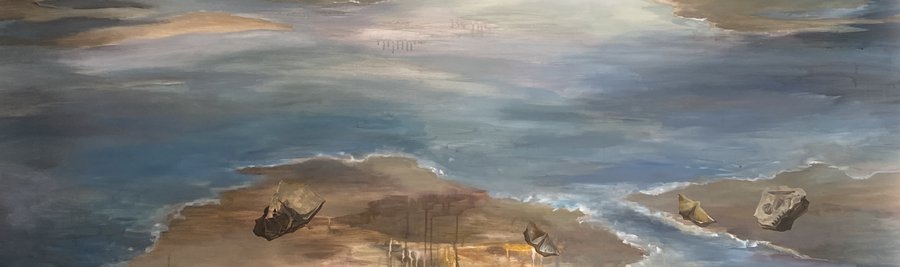
- The children were playing hide-and-seek when they found a cave. And there, among thousand-year-old boulders, they came across some shells that had long since turned to stone. “How old do you think they are? Are they older than Mom? Are they alive? Are we?” The project began with the artist musing on what sort of feelings a paleontological discovery might evoke. There is something special about the moment of discovery itself, an unintentional encounter, and a fascination with something ancient being hidden beneath the earth. The exhibition transports inside a mystification, a fairytale world where such an encounter can occur anywhere: amid an untamed landscape, above or below ground, in outlying Troyeshchyna or in historical Kudryavka. Many of the most important discoveries in the history of paleosciences, such as the Lascaux Cave in France, were made by non-specialists, oftentimes by children. In Karina’s works, the child’s gaze, curious and thirsty for knowledge, turns any place into a space for play, exploration, and discovery. The children’s figures also allude to the story of Mary Anning, an outstanding self-taught paleontologist who began collecting fossils as a child. In her work, Karina Synytsia often draws on Ukrainian monumental art to highlight its significance. In Discovery!, however, monumental sculptures — in particular Ernest Kotkov’s Vodohrai fountain in Troyeshchyna — serve as a backdrop: to the artist their rounded forms and winding contours resemble landscapes from the distant past, where life teemed among seas and cliffs, long before massDescription
Karina Synytsia: Discovery
Until 17 Oct 2026
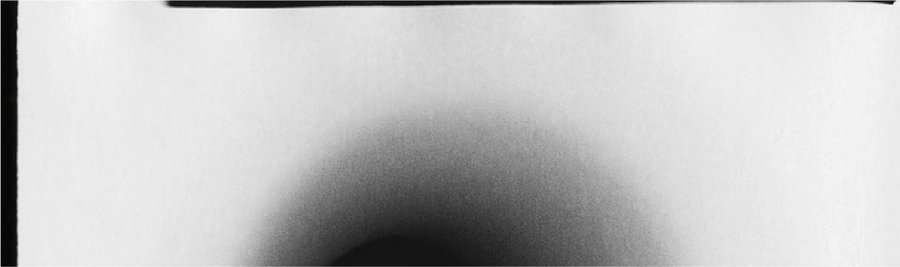
- As part of the Month of Lithuanian Photography in Kyiv, the Laboratory of Contemporary Art Mala Gallery will present the Lost Time exhibition, curated by Darius Vaichekauskas. With the development of technology, means of reflection and transmission of reality, photography moves away from a purely technical function and into a sphere of post-photography. Consequently, photography becomes a source of philosophical meanings and interpretations. Post-photography is characterized by constant manipulation of the image (editing, drawing, deconstruction). It forces us to reconsider the phenomenon of "photography", which has virtually ceased to exist as a "real-time referent". The group exhibition of contemporary Lithuanian photography shows several approaches and interpretations of the post-photography subject. Aurelia Maknite, Darius Vaichekauskas, Vytautas Kumža, Valentin Odnovjun, Deauville Dagene, and Juozapas Kalnius explore completely different photographic strategies. Vytautas Kumža focuses on the first stage of photo development, which he finds much more interesting than rendering or post-processing images. Valentin Odnovjun, in his Process series, shows photographs of discarded photo paper pieces found in the photo laboratory at the Patarei prison in Tallinn, Estonia. Deauville Dagene presents photographs that give the impression of a witness of place and time. However, they are filled with memory.Description
Lost Time — Exhibition of Contemporary Lithuanian Photography
Until 25 Oct 2026
Coming soon
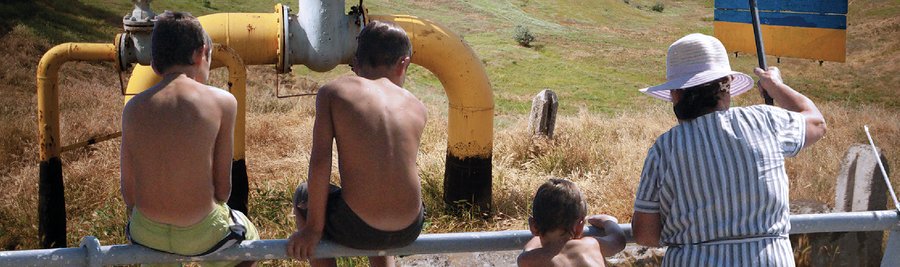
- The exhibition Kherson. The Steppe Holds is the space of resilience, love, loss, cherishing a memory, and the project about the Ukrainian South. It is based on the films Ukrainian Sheriffs, The Editorial Office, and Volcano. This is a tribute to the Kherson region — the homeland of the exhibition’s authors, Roman Bondarchuk and Darya Averchenko. At the heart of the exhibition are unique archives, video, and photographic materials filmed in the Kherson region by the filmmakers and their crews before the full-scale invasion, some of which are being shown publicly for the first time. These materials have taken on new significance in the wake of the region’s and the country’s profound losses and ongoing challenges. The three films form the thematic cores of the exhibition, presented in the space of the Old Arsenal: Ukrainian Sheriffs explores the role of local communities and self-governance; The Editorial Office delves into the tension between truth and post-truth in the political landscape of contemporary Ukraine; Volcano is a reflection on returning to oneself and the world amid the dystopian reality of the Ukrainian South. Today, each of Roman and Darya’s films and all the archival materials for them is a space of memory about something that no longer exists or almost does not exist; something that may not return or may return in a completely different form. The exhibition unfolds across five halls of the Arsenal and also includes a room dedicated to the archival materials of Kherson photojournalist Andriy Matrosov, as well as documentation from the “Ukrainian War Archive”, which records Russian war crimes. The final space of the exhibition invites personal reflection on what has been seen and felt. "For us, these are the memories of our youth, a testimony to what this land once was, to what we lost because of the Russian invasion, and what we continue to lose. These are places where our relatives and friends chose to stay, despite the war. Places where children’s umbilical cords are buried. The things that matter most, the ones we long to rebuild. And the places we return to every night in our dreams. We are deeply grateful for the opportunity to transform our archives into a cohesive artistic work together with the Mystetskyi Arsenal team", Darya Averchenko, on her and Roman Bondarchuk’s decision to create the exhibition. "At this moment in time, it is especially important for Mystetskyi Arsenal to continue engaging with the concepts that matter most to our society. And one of them is the territorial integrity of Ukraine. We invite visitors to reconsider the Kherson region as a space of deep personal and collective meaning. We believe that this documentary and mystical journey carries a special significance today", says Anna Pohribna, Deputy Director for Programming at Mystetskyi Arsenal. Visitors to the exhibition will experience an immersive encounter with the Kherson region seen through the lens of a camera and through the personal memories of its inhabitants, and also key figures in contemporary Ukrainian cinema. The exhibition space will bring together site-specific installations designed by exhibition architect Oleksandr Burlaka, along with video and photo projects, artistic films by the curatorial team, and more than thirty multimedia works inspired by the featured films. "This exhibition is an attempt to view the South not as a marginalized region, but as a vital point for understanding contemporary Ukraine. This research is like the steppe itself: quiet, vast, windy, and yet full of voices. We must rethink the South not only as a geography of losses, but as a space of strength, imagination, community, and renewal. For me, as someone born in the South, this project is deeply personal. It is a work of grief. And a work of hope", says Yana Barinova, Director Ukraine Programme at ERSTE Foundation. According to the curator Kateryna Botanova, the exhibition is an invitation to stay with the Kherson region, which is no longer there and will definitely be there, to think about how natural and cultural landscapes shape our society, how we can remember our losses, and where we can get strength for the future. This time, Mystetskyi Arsenal will present not a historical exhibition, but the history of Kherson region of independent Ukraine.Description
Kherson. The Steppe Holds (Curatorial Text)
22 Oct 2026 – 23 Feb 2027
Recent past exhibitions
- This year, Book Arsenal will be held from May 28 (the evening of the official opening) to May 31. The festival will consist of the program component and the book fair on the first floor of the Old Arsenal building. The curator of the Focus Theme of the festival will be human rights activist, military serviceman, public figure and journalist Maksym Butkevych. Writer, military serviceman and volunteer Andriy Lyubka will curate the Writer’s Program. "We are working hard on Book Arsenal-2026 and believe that it will be exceptional. I am grateful to Maksym and Andriy for their trust and willingness to work with us to make Book Arsenal exactly what we love it for: intelligent, relevant to its time, intellectually profound and aesthetically captivating. We will do everything possible to achieve this and, if necessary, even a little bit of impossible. Because Book Arsenal is the festival that gives us all hope and encourages us all to think, work and experience the joy of being, even in difficult times." - Olesia Ostrovska-Liuta, Director General of the Mystetskyi Arsenal. Publishing houses and bookstores are invited to be sales operators at the exhibition-fair. Bookstores will present selections of books in foreign languages. Special conditions will apply to small publishing houses—those with 2 to 10 published books in their publishing portfolio. We also invite artists to participate in the Illustrators’ Fair. The Book Arsenal program, which will be developed by invited curators, will include events within the Focus Theme of the Festival, the Main Program, the Writer’s Program, the Kids and Teens Program, the Professional Program, as well as performative and musical events. We will also present exhibition projects and special programs of the festival. The Festival will also host the annual professional Book Arsenal Fellowship Program for foreign publishers and literary agents, that contributes to strengthening international cooperation with Ukraine in the book field by establishing direct contacts between professionals from Ukraine and abroad and acquainting with the local literary and book scenes.Description
The 14th International Book Arsenal Festival
Ended 31 May 2026
- To Bear Your Freedom is the Focus Theme of the 14th International Book Arsenal Festival, which will take place on May 28-31 at the Mystetskyi Arsenal. The curator of the Focus Theme is Maksym Butkevych — Ukrainian journalist, human rights activist and war veteran... Every year, we, as the Mystetskyi Arsenal team, ask ourselves the question: who, whose thoughts and ideas embody what we call the nerve of time. Who can ask such a question that resonates with the moment we are living in? Whose life path is a great story in itself? This year, we were unanimous: it is Maksym Butkevych. His judgements about freedom and its weight, even its heaviness, about how much one has to give up for it, about the fragility of a hero and people’s tendency to delegate all responsibility and burdens to this imaginary demigod, about how much strength, perseverance, stubbornness it takes to bear one’s freedom―all of them resonate very deeply. We argued about what would be more accurate: to bear, to bring forth or to endure freedom. However, we have agreed that freedom is a burden, but there is something in this word that resembles the lightness of a gonfalon fluttering in the wind high above your head. That is why we have chosen exactly this variant―to bear your freedom.Description
To Bear Your Freedom: Focus, Theme and Curators of the 14th Book Arsenal
Ended 31 May 2026
- Mystetsky Arsenal is a contemporary art center in Kyiv, Ukraine. It hosts various exhibitions, events, and educational programs.Description
Mystetskyi Arsenal Presents an Electronic Catalog of the Collection
Ended 15 Apr 2026
- The experience of (not) returning is increasingly present in the stories of friends and loved ones. The examination of recently lost places and landscapes through archives, memories, and fragments that have been preserved or recalled has become a familiar practice. The solo exhibition Reverse Motion. Diaries by artist Ruslana Kliuchko foregrounds another* story of such a place. Some Ukrainian regions are particularly unlucky to share a border with Russia. Living in close proximity to constant threats is both terrifying and, oddly enough, calming, akin to the eye of the storm. The town of Khutir-Mykhailivskyi in the Sumy Oblast (formerly known as Druzhba), where the artist comes from, is located 10 km from the border with Russia. Nevertheless, Ruslana continues to return there, despite the risks she herself recognises. Reverse motion is about the cyclical nature of self-return. It seems that an important element of such existence is the very possibility of existing in movement, from and to. The intention to live to the full before the catastrophe (if that is possible at all). The myth of Donbas, with its stories, memories, and remnants of the past coexistence with the region, shared by witnesses, extends beyond its territorial boundaries. When will there arise the myth about Sumy Oblast or about Khutir-Mykhailivskyi? It’s not just a question of time. Ruslana’s photo project The Grey Zone is about this myth-making and admiration for places on the periphery. Since 2022, the artist has been keeping a photographic diary in which, amid the ruins of the full-scale war and the post-Soviet decline intrinsic to Ukrainian cities, she records gentle observations of what is dear to her heart. Dogs left behind by those who have fled, whom the artist looks after during her visits, horses, and other animals all inevitably become helpless witnesses to the impact of war. Nature and landscape in the photographs are no longer a backdrop; instead, they assume the role of observer and active participant, which, in their variability and at the same time silent quiet permanence, will outlive every one of us. Together with the few remaining inhabitants of the city, they continue to live their everyday lives, which, as it turns out, are not so easy to disrupt. This characteristic of the intensity of motion also emerges in another project by the artist, which bears a deliberately direct title, About Return. Created using the artist’s own technique, the triptych extends lengthwise, filling the horizon within the field of vision. The landscape images lack clear markers of a specific place from which they were created, yet a recurring sense of familiarity persists in memory. If not of the landscape itself, then of the experience of dreading its loss. Paying attention to the details of places that are slipping away, but can still be accessed, is at least comforting when wandering through the archives of personal memory. After all, once return becomes unreachable, reverse motion will remain possible only in memory.Description
Ruslana Kliuchko. Reverse Motion. Diaries
Ended 15 Feb 2026
- “As long as we’re here, everything will be fine” was an affirmation coined by Vasyl Stus in a letter to his friend Anatolii Lazorenko in 1962. These words will find purchase with those who crave steadiness amid the whirl of a turbulent world. Ukraine’s past is full of guiding figures; Vasyl Stus, in particular, has become something of a cult icon—a beacon for the restless. At the same time, the project team, through the heroic image of Stus, invites visitors to meet a brilliant intellectual, a poet, critic, and publicist whose work is tightly bound to clear ethical principles. It’s awe-inspiring how, as a young man, the poet shaped lofty moral ideals—and he carried them, unwavering, through the rest of his life. In an effort to “not fall prey to defilement” and steer clear of hypocrisy and falsehood, Stus grew a thorn in the side of those in power. His close circle would find him hard-to-understand, and eventually, weighed down by solitude, he would stand up “alone against the whole world.” The project offers an extensive selection of archival materials to illuminate Vasyl Stus’s oeuvre and delve into the contexts of his era. Tape recordings from the 1960s—Vasyl Holoborodko and Iryna Zhylenko reciting his verses—evoke the ambience of Ivan Svitlychny’s legendary apartment on Umanska Street. The exhibition also features recordings of Vasyl Stus’s own voice, lovingly kept on reel by friends, and Nadiia Svitlychna’s Radio Liberty reading of Palimpsests. Moreover, contemporary cultural leaders bring their own voices to Vasyl Stus’s poetry: Serhii Zhadan, Akhtem Seitablaiev, Oleksandra Matviichuk, Yaryna Chornohuz, Myroslava Barchuk, Kateryna Kalytko, Volodymyr Yermolenko, Tetyana Ogarkova, and Taras Kompanichenko. The exhibition will also feature works by Alla Horska, Opanas Zalyvakha, and Halyna Sevruk. Through documentary reconstructions, visitors will learn how samvydav (resistance through domestic production of banned publications in the USSR—tr.) evolved into tamvydav (its exile-born counterpart—tr.) and how the KGB compiled evidentiary dossiers against dissidents under Operation Bloc. Built on metaphor and allusion, the exhibition’s architecture transports visitors into the 1960s–1980s, allowing them to feel that era’s atmosphere and revealing narrative and thematic continuities echoing today. Olha Melnyk, project curator: “Visitors should not expect this exhibition to retell Vasyl Stus’s well-known biography. Instead, we’ve foregrounded several core stories opening up his poetic, literary, and journalistic worlds. Crucially, all of them are being told by those who experienced them—participants and witnesses to Stus’s life. In the literal sense, their first-hand testimony will constitute a frank and open discussion, unedited and immersing us in the interconnected artistic, political, personal, and social milieu of the 1960s–1980s.” [LINK text='CURATORIAL TEXT' href='https://artarsenal.in.ua/en/things/vasyl-stus-as-long-as-we-re-here-everything-will-be-fine-curatorial-text/']Description
Vasyl Stus. As Long As We’re Here, Everything Will Be Fine (Curatorial Text)
Ended 8 Feb 2026
Mystetsky Arsenal
Ended 8 Feb 2026