Berlin
ART MÛR BERLIN
On now
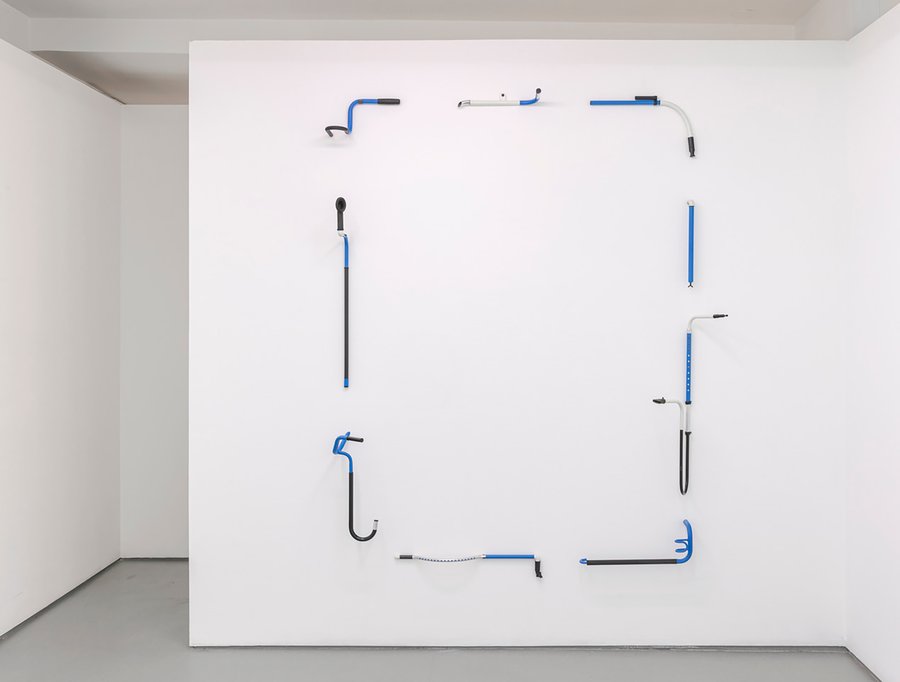
- In the objects that surround us, there are functions that time has rendered obsolete, stories hidden beneath the surface. A forgotten meaning, an interrupted gesture, a material that still bears the memory of a past use. Chairs, magnets, pieces of plastic, scraps of rubber… all familiar elements which, when torn from their context, seem to elude their own definition. The exhibition Triangulations is part of this practice of reconfiguration, like a space where points of reference shift. Much like parallax–that shift in perspective which transforms what we thought was stationary–Ginette Legaré’s work is built upon the instability of perspectives. Here, the object reveals itself and then eludes us. We must therefore learn to observe it differently: to move closer, move further away, circle round it, seek an angle that did not yet exist. In this case, looking is not synonymous with recognising. Legaré is interested in found or salvaged objects and the systems of meaning to which they belong. These discarded materials are thus diverted from their original context and brought together according to different logics, like fragments of a language to be reinvented. What was once intended to assemble, support, close, suspend or contain is thus imbued with a new purpose: that of lending itself to unexpected encounters. However, these encounters (and their interpretations) remain in a state of constant flux. For example, the work Parallactic literally plays on the variation in the viewer’s perspective: constructed from reclaimed wood and a metal fastener, the object appears to change depending on the position from which it is viewed. Perception thus becomes a material in its own right, as malleable as the elements that make up the works. The titles themselves also seem to play a part in these shifts. Either/Or, Under Erasure, As it turns out, From end to end, Upstaged: through suggestion, language becomes, in a sense, an additional material, opening up new possibilities for interpretation. This focus on the gaze ties in with a memory that continues to linger in the artist’s mind: that of a time when understanding the world meant, first and foremost, observing it, before the explanations and knowledge of others came to define its contours. Through this way of approaching the unknown, everything (and its possibilities) thus remains open, undefined. Legaré’s approach remains imbued with this initial openness. Her assemblages seek not so much to resolve the enigmas they raise as to allow them to unfold. For her, this element of uncertainty is not an obstacle; it is a space. Her practice reflects a tactile and intellectual curiosity that prioritises detours over categorical answers and lingers where things cease to be self-evident. Beyond being a series of playful and unconventional constructions, Triangulations functions as a genuine succession of perceptual situations, within which multiple interpretations can coexist. By transforming the ordinary without ever erasing it completely, the artist brings forth a different perspective–not necessarily a more accurate one, but a new one. And in that slight shift of the gaze, the world, for a moment, regains a touch of mystery.Description
Ginette Legaré : Triangulations
Until 31 Oct 2026
- There is something both alluring and ominous about Brigitte Radecki’s latest group of paintings. On each square support, flat, luminous panes of a singular hue—red, green, yellow, blue—appear to float over, slide under, and butt against one another with varying degrees of force. The forms are clearly defined, but their spatial relations are uncertain: will they hold, or shift in the next instant? This sense of potential, of aliveness, is heightened by the optical interactions of carefully calibrated saturations and values. I find myself experiencing something like landscape: the shifting effects of light and atmosphere on perception. There is no “outside” to the forms on the painting, no background to the foreground, and no illusion of separation between image and me. The paint surfaces are almost smooth; if I look at them from just the right angle, with the light raking across the surface, I see the rigour of Radecki’s paint handling as well as the subtle irregularities that come from making with a human hand. I feel close to the paintings, perhaps too close. I instinctively step away. There is a compelling paradox at the heart of Radecki’s approach. She establishes precise conditions for chance and then relinquishes control over what those conditions produce. She haphazardly folds a sheet of construction paper, drops it on the floor, photographs the resulting form, and uploads the digitally transformed image to her computer. She then translates this accidental configuration through an extended process of looking, mixing, adjusting, and painting, layer by layer, in thin washes of pigment. The quick, offhand event that begins the process becomes something slow, drawn out, meditative, and precise: a patiently executed painting whose final appearance could not have been predicted from the process that produced it. Even before reading the titles—Burning 25, Sliding Soil, The Sky is Falling, It Was a Dark and Stormy Night, Greenhouse, and Aftermath—I sensed a portentousness in the works. The titles allude to events: fire, moving earth, a storm, heat trapped in an atmosphere, and what remains after something has happened. They connect me to the world in which I live, and to the uncertainty that increasingly pervades it. In the context of our changing climate, this uncertainty feels particularly charged. The old sublime placed us before the overwhelming power of nature: the mountain, the ocean, the storm. These paintings lead me somewhere else. Their power does not come from grandeur but from uncertainty—from a world in which events unfold through systems too complex to see in their entirety, and whose consequences cannot be fully predicted. We are not simply spectators standing outside these systems; we are implicated in them, even as we struggle to comprehend their effects. Radecki’s paintings ask me to remain in the space between knowing and not knowing, between accident and intention, between beauty and apprehension, between event and aftermath.Description
Brigitte Radecki : It Was a Dark and Stormy Night
Until 31 Oct 2026
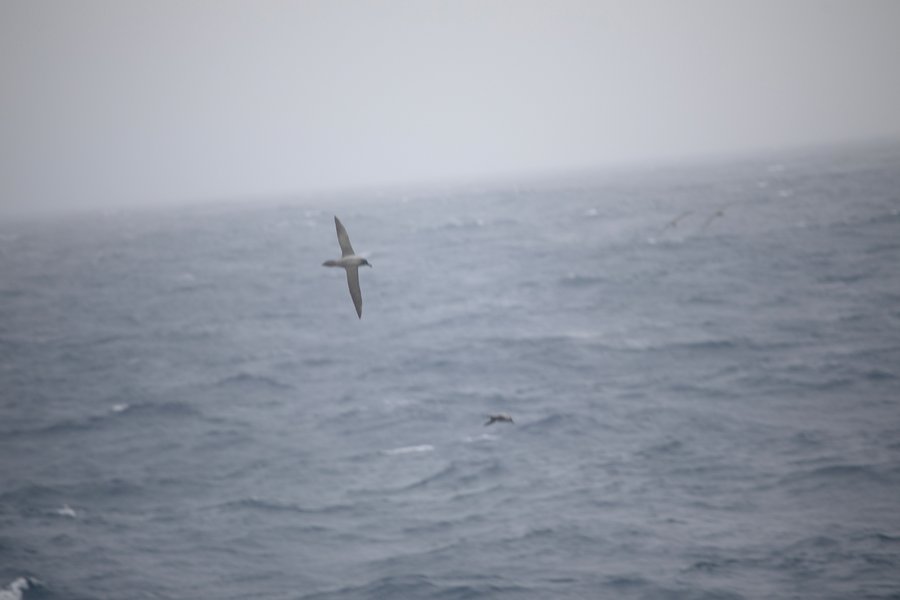
- Shades of Saturation // A Prismatic Antarctica Text by Isabelle Gapp Ice crystals form, freeze, melt, and dissolve; open water courses past the floe edge; icebergs drift along the horizon, their hazy underbellies buried deep in the waves; and new snowflakes are caught up in the frenzy of a blizzard. Water moves and transforms; its materiality cannot be fixed in place. For Jessica Houston, the material realities of Antarctica’s waters saturate the film, photographic prints and monochromatic paintings that make up Water, Water Everywhere. By focusing on the permeability of water, Houston destabilises long-held notions of Antarctica as a place that is pristine, fixed and available to imperial visions of conquest and extraction. Throughout Water, Water Everywhere, colour saturates the senses. Melody Jue and Rafico Ruiz write of “saturation,” where multiple phenomena and senses occur and confound simultaneously. Houston’s Antarctica is similarly saturated: ice crystals melt on a macro lense, casting prisms of light. A prismatic Antarctica. Snowflakes are in themselves prisms, crystal facets that grow and melt together. As if viewed through a microscope, the fractal lines of the snowflake are further captured in isolated paintings; blue, yellow, white, crimson pink and red. Colour is at once symbolic and material. A glowing, sun-like yellow rises over a digital photograph of a cluster of icebergs; this same colour is almost necrotic when transposed over footage of historic whaling. Elsewhere, a crimson red, made of microplastics, submerges mythical creatures; this is “Coleridge’s ominous crimson sea,” as Houston describes. Water, pollution and plastic seep into one another. Pigments made from plastic and liquid waste—PFAS, polystyrene, carbon, Styrofoam, microplastics—are also presented in Victorian-style glass apothecary jars. Now contained, these same colours stain fabric stretched around oversize, geometric wooden frames. These colours are seductive, but their material origins are not innocent. Colour and materiality collapse distances between places and times, connecting the apparently pristine waters of Antarctica to the human-made pollutants that circulate through them. Elsewhere, fissures, cracks and lines mark the icy surface like scratches on a glass plate. As snowflakes take shape in a series of gelatin silver prints, they not only hark back to earlier nineteenth-century photographic practices, but they also return us to the material processes of image-making itself. Imperfections in the image make the snowflakes appear almost microscopic; other microorganisms dance across this frozen realm. The materiality of the print carries with it the memory of water, through the liquid, chemical emulsion central to its process. Throughout, Houston embraces imperfection. Where lines and blemishes mark the gelatin silver print of an albatross, in a digital print the soaring albatross is juxtaposed by the diagonal of the slanted horizon. A crooked view over an open sea. These distortions or “glitches,” as Houston describes them, alter our perception of the frozen continent. Rather than simply reproducing the visual conventions through which Antarctica has historically been made knowable, Houston unsettles them. We have largely constructed a singular narrative of the polar worlds, one of vast, never-ending whiteness, where “aesthetic awe and moral transcendence” are projected onto the landscape. Houston’s Antarctica is instead imperfect, saturated and materially entangled: its ice becomes water, its colours become pollutants, and its images refuse to remain fixed.Description
Jessica Houston : Water, Water, Everywhere | Nor Any Drop to Drink
Until 31 Oct 2026
Recent past exhibitions
- Xenolith /ˈzenəˌliTH/ noun Geol. A piece of rock trapped in another type of rock. – National Geographic Education Our ecological footprints are everywhere. So much so that in 2000, scientists Eugene Stormer and Paul Crutzen coined the term Anthropocene which defines our current age by the lasting impact of human activity on Earth’s geology, climate, and ecosystems. With that in mind, Nicholas Crombach’s Xenolithic explores how materials accumulate, persist, and transform—both as artifacts of the past and as evolving elements within our changing landscape. By amassing a wide array of collected materials, both naturally derived and human-made, Cronbach’s sculptures invite viewers to consider how our complex relationship with “stuff” has impacted the intertwined courses of human history and natural history.Description
Nicholas Crombach / Xenolithic
Ended 25 Apr 2026
- Sociologist Zygmunt Bauman developed the concept of “liquid modernity” to describe our era and the need for individuals to constantly adapt to their environment. Identity is no longer fixed; liquid, it flows and takes the shape of its container. It is this influence of the external world on our intimacy that LA PART DE NOUS seeks to expose. Nine series of works form this exploration. LA PART DE NOUS marks a return to the studio for Kolgen, who is used to creating monumental works. Here, intimacy serves as his central thread. His goal is to invite us into his universe, but also to draw out part of our essence, of who we are. Throughout, the audience participates and is immersed in this amalgam of experiences. Ephemerality is represented through our actions and the media, giving way to a resounding vulnerability. A saliva sample is required to activate the exhibition. This sample will then create a sonic imprint that will reverberate throughout the space for the rest of the day. We are thus invited to leave a part of ourselves behind in order to offer others an immersive experience of the exhibition. Saliva represents our words, our thoughts, our emotions, the most intimate part of our being. Furthermore, the instability and fragility of life are at the heart of the exhibition, shaped into balls through fragile materials, illustrating our share of vulnerability. The effect of technology is also omnipresent, whether through the representation of its influence on our mood or the overconsumption of information. This leads us to want to distance ourselves from the world, to bury our heads in the sand and ignore what is happening around us. The duality of the material is also explored, by superimposing rough, hand-crafted concrete sculptures and luminous panels, which serve to illustrate this desire for weightlessness, to distance ourselves from the world and become castaways in it. Large-scale drawings demonstrate the importance for Kolgen of letting his creativity speak, of letting go and representing his most intimate self – his unconscious. For him, it was this liberating act that sowed the seed for LA PART DE NOUS. Indeed, Kolgen sought “to break the link between thought and action, to short-circuit control and let what is swarming beneath the surface emerge”. Intimacy takes different forms, such as men’s and women’s clothing marked by use, which then become fossilised traces. Kolgen describes them as architectures of the body, a kind of façade for who we are and who we want to be. At the same time, the heart, representing our essence, is stripped of its container, leaving only the flow that shapes it and makes it beat. Finally, just as the heart represents who we are, the navel represents our origins for Kolgen. It is a reminder of our genesis, but also of our separation from a safe place and our vulnerability to the outside world. Different navels create different sonic traces, and we find ourselves faced with images larger than ourselves, confronting us with these markers of life and evolution that we all carry with us. LA PART DE NOUS is a project that invites us to look deep within ourselves and question how the world around us constantly shapes us. At times, Kolgen invites us to confront and question ourselves, but also to take a step back and reground ourselves. He explains that for him, these series represent a “need to act on instinct. To create as we breathe: out of necessity, in order to exist”.Description
Herman Kolgen: La Part de Nous
Ended 25 Apr 2026
Guillaume Lachapelle
Ended 28 Feb 2026
- January 17, 2026 – February 28, 2026 Opening reception: Saturday, January 17, 2026, from 3 p.m. to 5 p.m. Guillaume Lachapelle: Vanishing points (retrospective and new works) 1996 – 2026, 30 years of passion, discovery, and sharing Text by Valeria Márquez Reynoso and Rhéal Olivier Lanthier We still remember our first weeks on Notre Dame Street West. We were excited, full of energy and ready to take on the new challenges that lay ahead. Today, on the eve of our 30th anniversary, we look back with pride on how far we have come. Art Mûr is a dynamic and essential exhibition space on the Canadian art scene. We are aware that we owe the success of our organization to the many people who have joined us over the past thirty years to help us bring to life exceptional exhibitions. Without these immensely talented artists and exceptional collaborators, we would not be who we are today. There are many artists and collaborators we would like to thank, but the list is too long to name them all. However, to those of you who have presented, written, worked and collaborated with us, know that your contribution is part of our history and that our success is also yours. Thus, for our 30th anniversary, we are offering some of our artists the exhibition of their dreams, one that will highlight their years of accumulated creativity. And, at the same time, we are offering you the opportunity to discover the breadth of their contributions. We are therefore kicking off this year of celebration with an artist who has been with our gallery since 2003, Guillaume Lachapelle. For more than 20 years, Lachapelle has continually invited us to enter parallel universes and to question our relationship with everyday life. Each new work offers a gateway to a disturbing and alienating world. Lachapelle begins his career by creating wooden sculptures. His exhibition Project Roundabout (2006) offers a first glance into these objects emptied of all meaning, or rather, turned upside down. From the start, amusement parks and fairs have been part of his approach, offering a parallel to our routine and mundane lives, but distancing them from celebration to give way to an unsettling strangeness, leaving the viewer to their own devices. This is Lachapelle’s goal – to disorient and confuse us, to make us get out of our comfort zone. His rides are anxiety-inducing not because of the thrills they cause, but because of the feeling of impending disaster. His landscapes are often dystopian, without being in ruins. We therefore have the impression of being alone, awaiting the arrival of a transformative event. As of 2009, 3D printing has become increasingly prominent in Lachapelle’s work. His exhibition Machinations (2010) reintroduced the theme of rides and inserted them in these ghost towns, these deserted landscapes. One could speak of parallel universes where almost everything seems intact, presenting the infinite possibilities of representation, of art, but also the limits of our own reality. Untitled (2011), Evasion (2010), and Fissure (2009) each present an entryway towards the unknown, possibly a world parallel to ours. We can find these passages between rows of books, creating a gap in our knowledge of the world around us and offering an escape. In the show Visions (2014), this path deepens and darkens. The infinite is combined with the unsettling strangeness and are represented through the use of one-way mirrors. A subway, a parking, an office – all placed in a space with no end, emphasizing our alienation from the rest of the world. In Night Shift (2016), these endless spaces are perpetuated. The work Lost in reflexion (2015) showcases a corridor between two human-sized rows of books. The title invites us to enter the space, to get lost, and to reflect on our surroundings and where we are headed. The empty parking lots and the interior of deserted buildings are reminiscent of horror movies, places with no escape. In his last exhibition at the gallery, Extrapolations (2023), Lachapelle incorporates representations of his loved ones for the first time using photogrammetry. Although his older works included figures, it’s the first time they’re identifiable. However, to add to this sense of strangeness, Lachapelle accepts and appropriates glitches on some of these individuals, as is the case with Dom (2023). His loved ones interact with machines and technology, creating disturbing and disconcerting combinations. The Lovers (2023) seem about to inhale what is coming out of the heater, together but alone – or is this rather the moment when they realize the danger of their actions and the effects on their relationship? Lachapelle succeeds in representing alienation in this last work. He questions our dependence on technological objects and our use of them. A kind of mutation is taking place, chimeras are quietly coming to life, not animal ones, but mechanical chimeras – what could be more frightening? His new project, Points de fuite ( Vanishing Points ), offers new avenues for exploration and development of previously explored themes and techniques. The use of photogrammetry and zoetropes makes a comeback, giving way to a fantastical and alienating universe. Here, the subject of destroyed cities is linked to the theme of waiting, sometimes with the presence of characters. Past works are referenced in the new ones, which we have taken care to display side by side. The title of the exhibition refers, of course, to the vanishing point, a Renaissance creation that changed the way art was made. However, it also evokes the idea of flight (“fuite” meaning “flee”), the act of leaving a place and distancing oneself, as for the English translation, it recalls the act of disappearing without a trace.Description
Guillaume Lachapelle: Vanishing points (retrospective and new works)
Ended 28 Feb 2026