Alencon
Les Bains Douches
On now
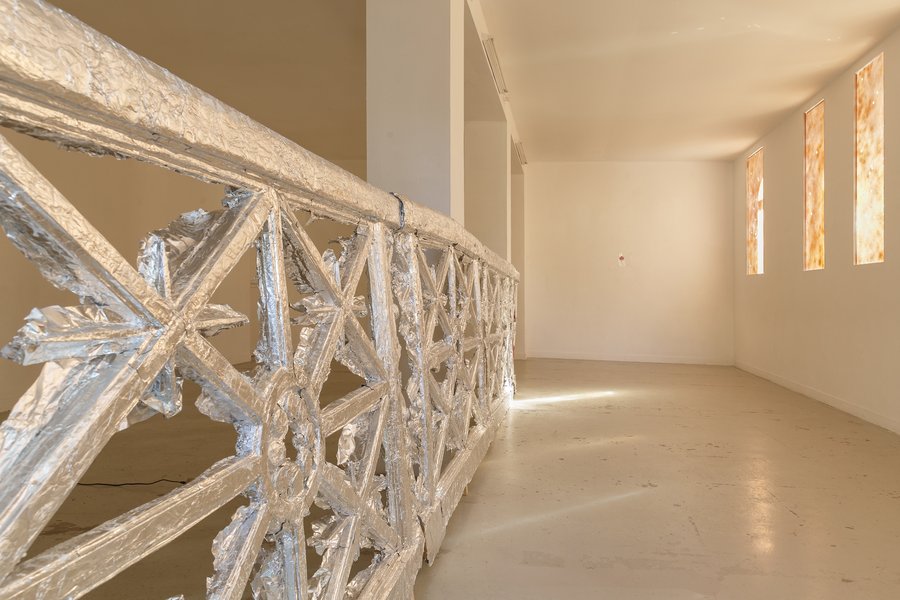
- There is something you have that I want… In the films of Rosa Joly, shot on 16 mm in bedrooms and hotels—sites of the most private exchange—the bulky camera itself appears greedy for closeness. Hardly optimized for the smooth operation of today’s film-making, the analogue device arrives on the scene as a commander of presence. Two hands are barely enough to move it around. Its recording time is limited, there is no monitor to oversee what passes through the lens, and a single strand of hair entering the camera gate can be the downfall of an entire roll. To this alchemy of inconvenience and unpredictability, only partly concealed between the stuttering of frames, Joly surrenders her most photogenic friends and sometimes herself. In exchange for what, one might ask. Vampire teeth and chocolate coins? For experiencing the combustive reaction between artist and machine, between artist and muse—more than occasionally an auto-erotic affair—or, perhaps, for obtaining proof. Long before DNA profiling, the mugshot served to identify repeat offenders. Photographs of crime scenes, objects, and physical traces were brought to the courtroom as evidence. From a forensic perspective, the animation of individual photographs could be considered the reanimation of a corpse; the cutting of film, which Joly undertakes strictly at the level of the negative, a form of autopsy. Her preoccupation with collage, often involving devotional materials such as votive paper, gift wrapping, and rhinestones, bears further testimony of a taste for mutilation and suturing. The subjects that she films loudly affirm the excisionist’s impulse: a large molar dangles from the ceiling above a bed; a decaying tooth, removed from the human at its root; a woman in prosthetic canines. Alongside photography, teeth, the most enduring part of the human body, have been essential for the identification of both victims and perpetrators. For the living, they are evidence of the most fatalistic circumstances: class, environment, chance—hard proof that no one is free to choose their heritage. While the films of Rosa Joly are marked by a pursuit for the partial, her sculpture, Bridge (2026), appears as an ambitious attempt at stealing the whole. Bridge is made up of the positive prints of a cast iron railing from a bridge near Joly’s home, captured in sections, bit by bit, through the frottage of aluminium foil. Fortified with a plaster back, and reconstructed in order, the sequence of reliefs resembles a film strip. The railing’s ornamental design, edges ruffled by silver foil, brings to mind a piece of lace. In his 1978 essay, Positive/Negative: A Note on Degas’s Photographs, the American art historian Douglas Crimp proposes that lace, through its structure of threads and holes, is the perfect metaphor for photography. Curiously, he also mentions that the French word for lace is dentelle, a diminutive form of the word dent, which means tooth. When a tooth is lost, what remains is a gap: a negative between two positives.Description
Travelling
Until 25 Oct 2026
Recent past exhibitions
- It is a crime scene or a camping spree. Shaded faces beneath foliage, illuminated by a sourceless light, hidden by a silhouette in the foreground... (truncated for brevity)Description
Mauvais foins Sebastian Wiegand
Ended 26 Apr 2026
- Over the three years that they ran TV Bar in Berlin, Calla Henkel and Max Pitegoff used the bar as a set to film an episodic series called Paradise. TV Bar was always intended to have two lives: one fictional and one public, both relying on the same infrastructure. The series Paradise takes place in a fictional, eponymous bar in 2023 and follows a group of bartenders as they navigate an absent boss who wants the bar to function as a newsroom. Henkel and Pitegoff selected the year 2023 as a near future — one they could move toward through a blend of speculative fiction and approximate truth. Christmas lights appear. The leaves turn green. The narrative becomes part documentation and has no choice but to follow the queasy timeline of the actual bar. It had always been their intention to close in or around 2023, when the chosen future became the present. Paradise is about labor and performance, and how much one has to give away while working. The bartenders are all forced to read text from a teleprompter to customers, complying with their chronically out-of-touch boss’s hopes of using the bar to spread his own language. When the texts become unhinged, the bartenders decide to take control, but it never quite works out. Instead, the story unfolds through their coping mechanisms — the places the bartenders retreat to in their minds to stay sane. It is a drama about narrative ownership and the struggle to make things in terrible times. It isn’t until the bar gets shut down that the bartenders in Paradise begin using the space as they wish, and a complicated collective unity emerges. In reality, Henkel and Pitegoff had intended to hand over TV Bar to their employees when they finished filming Paradise. However, the company that owns the building on Potsdamer Strasse is in the process of selling it and does not believe the new owners will want a bar, thus refusing to renew the lease. Out of curiosity, Henkel and Pitegoff asked what they thought the new owners would prefer in the space, to which they replied, “an insurance agency.” This is now the ending of Paradise. Paradise is shot on 16mm film and shown with subtitles. The work exists somewhere between photography, theater, and long-form poetry. The actors are all friends of the artists, TV Bar employees, or people who drifted into the bar’s orbit. Previously, while TV Bar was open, Paradise was shown only in other bars, looping on small monitors without sound. In its projected version, it is accompanied by a soundtrack by artist and musician M. K. Frøslev, a former bartender at TV Bar. Calla Henkel (born 1988, United States) and Max Pitegoff (born 1987, United States) have collaborated for more than a decade, exploring the creation and management of venues as social and collaborative artistic spaces. They founded the New Theater in Berlin-Kreuzberg (2013–2015), developed the performance program at the Grüner Salon of the Volksbühne (2017/2018), ran TV Bar — a bar, performance space, and film studio in Berlin-Schöneberg (2020–2022) — and currently run the New Theater in Los Angeles. Courtesy Isabella Bortolozzi, BerlinDescription
Paradise Calla Henkel & Max Pitegoff
Ended 26 Apr 2026
La Piccola Galleria Di Bianchi Montalbano piero heliczer & the dead language press
Ended 8 Mar 2026