Berlin
Künstlerhaus Bethanien
On now
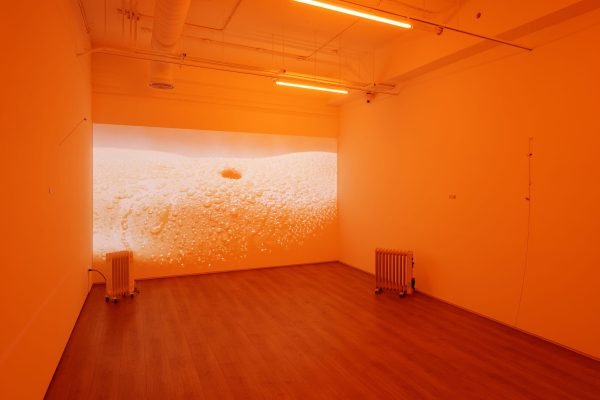
- On entering the exhibition space you are immediately confronted with a sweating belly projected wide onto the wall. Droplets of sweat exude from the pores around the navel. You only notice after a while that your own body is getting warm – and that two heating devices are in operation on this side of the space. Sweating is a metabolic occurrence – a circulation of heat, relaxation and fear – that directly corresponds to the video installation Burning Stones (2022) opposite, in which hands massage body tissue. Esther Yi-Chun Lin’s videos are being juxtaposed for the first time at Künstlerhaus Bethanien. Together they form a sweatbox in which the human body becomes the object of a forensic investigation into identity and the history of Taiwan. They delimit a territory that has been deeply imprinted by geography, memory and history – an effect that can be experienced both symbolically and physically through sweating. How can history be felt? How do landscape, recollection and belonging inscribe themselves into a body? Esther Yi-Chun Lin’s work proceeds from these questions. Body odour as historical analogy: “I think the odour of the body is like a metaphor for history.” The title Burning Stones refers to the etymology of the old word for sulfur, “brimstone”, which derives from the old English ōbryneö (to burn, fire) and ōstŌnö (stone). In Burning Stones: Hot Archives the bodily equivalent of brimstone is sweat. In heat it is broken down by bacteria and sulphurous compounds are released – body odour. Lin equates the sweating body with a sulphur mine. Evaporating sweat fills the air in the space – like the volcanic sulphur springs in the Taiwanese district of Beitou that fill the surroundings with steam. From the sweating belly of a woman worried about her BO, fragments of historical scenes emerge. This is colonial archive material tracked down by Esther Yi-Chun Lin on the internet, where it circulates freely. She has excised portrayals of indigenous Taiwanese communities from these images, calling one of these interventions a “biopsy”. In between there are pictures of the Tatun Volcano Group and measurement data on the sulphur concentration in the air during the pandemic, in which higher numbers mean that organic material is being burnt – including human material. It all gives rise to what, for Esther Yi-Chun Lin, are no longer images but crystals that have gone through a body; exhaled, deformed, with surface deposits. The artistically processed visual material becomes a counter-archive – a recurring practice that the artist continues in this exhibition. On the opposite screen, in Burning Stones (2022), the historical paths of Beitou are transferred to skin by the touch of hands. Esther Yi-Chun Lin invited the performer Ho Zhong-Jun to explore a path through the sulphur mines with her; the result was a performance in the form of a massage. There is no landscape or forest in the video, only massaging hands. But there is a narrative nonetheless: from the body to landscape, map and colony to the transformation of sulphur.Description
Burning Stones
Until 15 Nov 2026
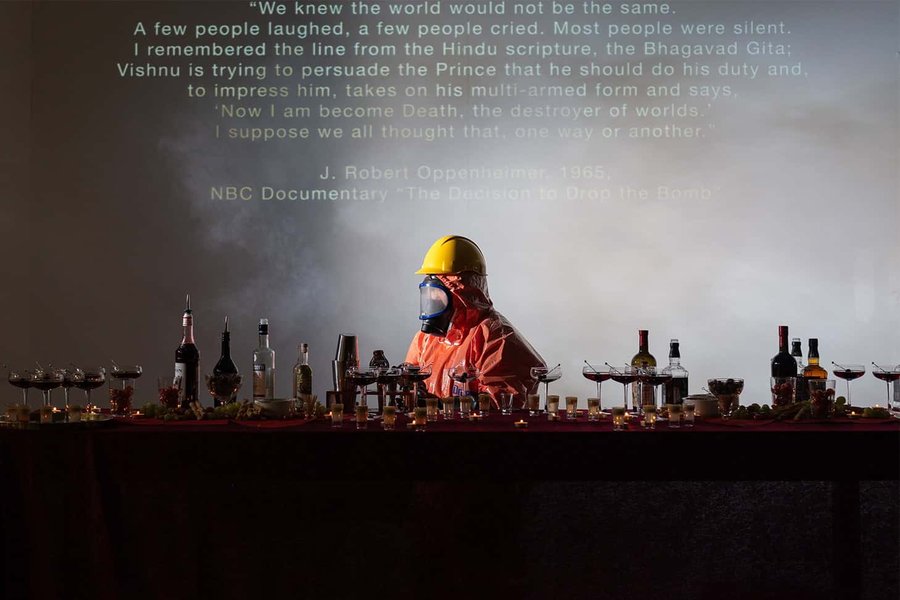
- HYPOCENTER 1945-2025>, 2025, Screening-Performance, 00:20:08, Photo: Karolina Sobel «How has your historical research been going since 2022, when Russia attacked several targets in Ukraine?», Iden Sungyoung Kim asks me. We had both started to focus on the 1960s, on nuclear testing, Cold War international relations and their brutal consequences, at around the same time. In 2018, our interest seemed to belong to a hazy past. But I recall the perceived historical distance collapsing with the increasing militarization of the present – and it continues to do so. The testing of an extremely powerful hydrogen bomb in 2016 as part of North Korea’s nuclear rearmament caused a contemporary Sputnik shock. This was the starting point for Iden Sungyoung Kim’s artistic research into this thematic complex. «The international press was alarmed», she says in her new work Lunch? I Said LAUNCH (2026). Her South Korean friends and family shrugged their shoulders over reports of these renewed experiments by their «very strange neighbour». An intimate relationship to everyday violence and its linguistic forms pervades Iden Sungyoung Kim’s work. How do people deal with violence beyond human comprehension? What are adequate words or emotions? In Lunch? I Said LAUNCH, the artist examines the tortuous complex of history, politics, the contemporary moment and pop culture humorously, weaving together autobiographical experience and commemorative sequences in the genre of a comedy show. Based on the use in South Korean slang of the word «nuclear» for «very much», «ultra» or «brutal» – as in «Nuclear Spicy Chicken» instant soup – she shows how memory reshapes, expands and takes wild twists and turns in consumerist culture and collective memory. «I ate an egg in Fukushima!», Iden Sungyoung Kim tells me in her studio, fascinated by the simultaneity of normalcy and exception that enabled her to undertake a kind of publicity tour to Fukushima. A carefully curated image for an organized group. Kept out of the picture was Japan’s imperial past and its alliance with National Socialist Germany during the Second World War. This journey was the starting point for the performance Hypocenter 1945–2025 (2025). In this work, a person in a hazmat suit and gas mask distributes liquids. Unruffled movements convey an impression of precision. But this is deceptive. The boundaries between interior and exterior, between maximum control and deliberate loss of control, are blurred. The liquids are drinks, whose layered texture brings to mind the heatwaves of an atomic explosion and whose names – «Manhattan» and «B52» – refer to the US nuclear bomb research project and the long-range bomber also used in the Vietnam War. They are extra strong. Here, Iden Sungyoung Kim subtly stages the delayed visceral effects of toxins. Memory and the possibilities of forgetting go hand in hand. Feelings are sometimes enhanced, sometimes numbed. Traces of the performer’s presence remain in the space: a table with glasses, candles, bottles and the hazmat suit and gas mask. A video is playing in the background. The sea glitters in the red light of the setting sun, with only occasional cloudsDescription
Lunch? I Said LAUNCH!
Until 15 Nov 2026
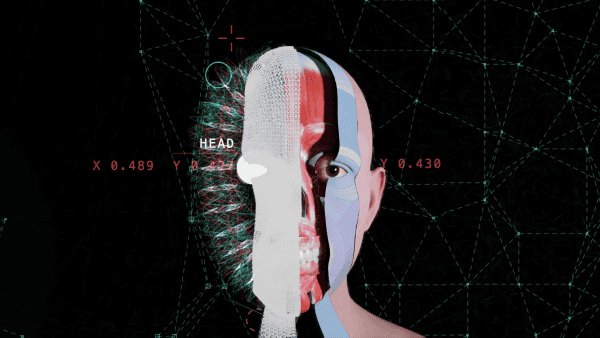
- What is the place of the body and the human in today’s virtual landscapes? How do image-making and image-altering tools affect and transform the value of bodies and human experience? These are the questions that run through Francisco González-Rosas’s installation. Entering the room to the right, we encounter a large graphic print-out on the wall reminiscent of a diagram or a map...Description
Averaged Profile Hallucination
Until 15 Nov 2026
- Reed Still’s exhibition excavates the maintenance labour that structures basic human existence, turning it into a comedy of class relations in which those without property are trapped within an infinite cycle of temporary arrangements. In a passageway on the ground floor, a professionally framed document is displayed on the wall. The Sublet, as it is titled, shows a fixed-term sublease agreement...Description
Comedy
Until 15 Nov 2026

- Moisture Melts. Heat Dissolves In classical Cantonese cuisine, lo foh tong (“old-fire soup”) – a long-simmered soup found across southern China and Southeast Asia – offers a sensory way into the tropicality of the Asian South. Inside the pot, slow, rolling convection gently breaks down gelatin, fat, aromatic oils and alkaloids from meat, bones, dried tangerine peel, angelica root, and other herbs and seafood, folding layers of texture and flavour into a silky, faintly sticky broth. In miniature, this bubbling pot echoes the trade routes and atmospheric circulations that bind South, Southeast and East Asia together. Summoned by the temperature difference between the Asian landmass and the surrounding Indian Ocean, South China Sea and Pacific, the seasonal monsoon carries wind, rain and heat across the region, melting and blending flavours, cultures, beliefs and bodily experience into a sultry, soupy mix we call the tropics. In the spirit of lo foh tong and of this tropical interpenetration of bodies and landscapes, creation and catastrophe, Kent Chan imagines a techno-animist future at the next stage of the climate crisis – one in which disorientation and confusion abound, heat and coolness coexist, control and chaos overlap, with data clouds and AI systems possessed by celestial gods that are, oddly, still sustained by terrestrial elements like minerals and water. In the fictional global tropics of his video Weather Casting, traversing Yogyakarta, Chiang Rai, Yunnan, Shanghai, Beijing, the Changbai Mountains, North Hamgyong Province and Seoul through a series of fictional weather reports, Kent Chan introduces a weather-casting system that manufactures regionally desirable meteorological conditions, reminiscent of “the good old days” and free of climatic hardship. These geoengineering systems are named after political cult figures and regional deities, including Dewi Sri, Longmu, Sungke Enduri, Phaya Naga and Aoma. They argue over territory, negotiate their scope of responsibility, recall past glories, and are bewildered by their own roles as gods and tools. Casting, here, is a deliberate act of shaping. It resonates with the logic of modernity, that is, to manage, control and intervene. But as heatwaves born in the tropics travel outward across the globe, a different strategy may already be in the air – one that is more heated, humid, humorous and humble. After all, the tropics is a place where categorization loses its grip. Here, gods are not divided by geographic or political boundary but form an amorphous whole. Like the flavours dissolving into one broth, the Naga of the Mekong and the Dragon King of the Pearl River are variations on a single ancestral form, carried and reshaped along the same routes as monsoon rain and monsoon trade.Description
Weather Forecast
Until 15 Nov 2026
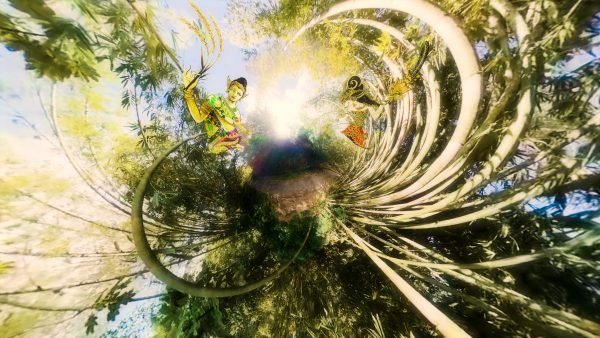
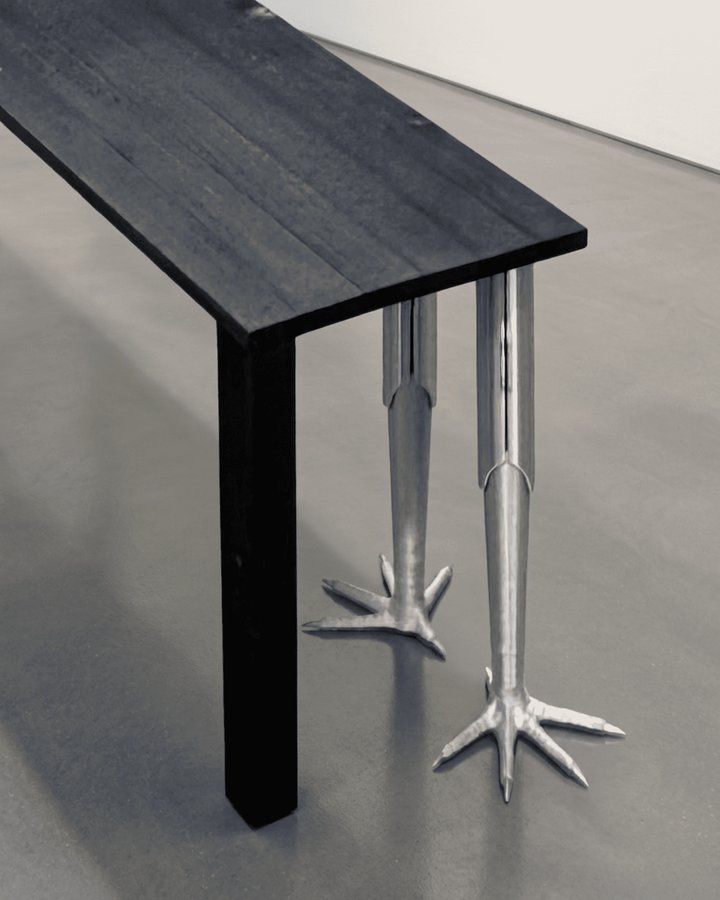
- In her solo exhibition The Flag Bearers, Rachel Monosov draws inspiration from the Surrealist imagery of Edgar Ende (1901–1965). The exhibition takes its title from Edgar Ende’s Die Fahnenträger (1931), one of three paintings which the artist then brings into the present, extracting their symbolic content through sculptural installations and performance. Rachel Monosov looks to Surrealism as a response to the aftermath of the First World War, a movement that abandoned logic and linear views of reality. By turning to dreams and the subconscious, the Surrealist movement offered both a refuge and a means of confronting loss, trauma and human fragility. Through this lens, the artist reflects on the cyclical nature of history while tapping into today’s collective psyche, ultimately exposing the emotional undertones of rising nationalism and the tension between bodies and ideology. The historical distance between the two artists is consequently central to the work. Edgar Ende lived through a period in which national symbols were transformed into instruments of mass mobilisation. He experienced destruction as a byproduct of nationalism, while Rachel Monosov is working within a contemporary context of escalating conflict where questions of geopolitical power and territorial aggression have again become urgent. The sculptural installations create an uncanny sensation. Two unusually long benches seem to stretch between here and elsewhere. Strands of long hair lie on their surface like traces of an erased human presence. Prosthetic bird legs have replaced parts of their original structure. Nearby, a jacket hangs from a metal rack, as if waiting to be worn; it is embroidered with a target motif across the back. On the other side of the room stands a metal sphere. Around it, a series of flags. White. Not tied to any particular nation. Their scale is disproportionate to that of the sphere On the wall, a series of poetic scores written by the artist serves as the common thread; these were intended as choreographic instructions for the performers. Rachell Bo Clark, Cami Brogaard and Victor Dumont activate the sculptural installations through a performative work that acts as the soul of the exhibition. Opening the door to a “mirror within the mirror” universe, they lead visitors into a dreamlike reality where symbolism, exaggeration, the tension between objects and bodies, and free associations compose a metaphor of the collective unconscious through a surrealist perception of space. There is no hierarchy, no beginning or end. Spaces and stories collapse into each other, they are misleading. Everything exists simultaneously, and can only be interpreted through one’s own points of reference and lived experiences. In The Flag Bearers the artist approaches the present as a historical condition that leaves its traces not only on nations and bodies, but also upon the unconscious. Beneath our individual experiences lies a shared terrain of haunting imagery, repressed guilt, and the uneasy question of what could have been done, or what might still be done, otherwise.Description
Rachel Monosov: The Flag Bearers
Until 15 Nov 2026