Berlin
Carlier / Gebauer
On now
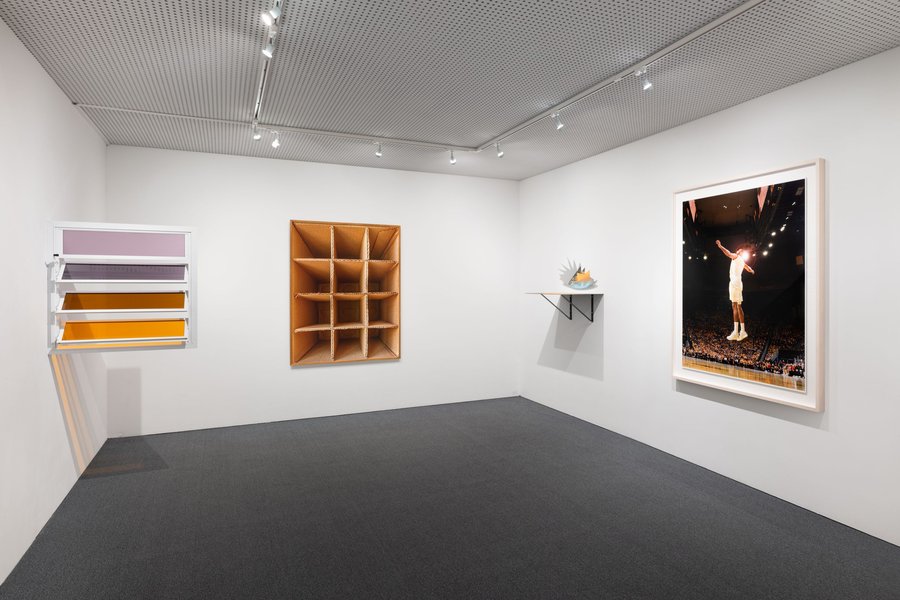
- carlier | gebauer, Berlin, is pleased to present the group exhibition Shine a Light, featuring works by Sebastián Díaz Morales, Dor Guez, Lúcia Koch, Paul Pfeiffer, Laure Prouvost, Jessica Rankin and Nida Sinnokrot. Light is inseparable from the act of seeing, but what it reveals is never fixed. It can sharpen our attention, distort what lies before us, transform a space, or make something perceptible that might otherwise go unnoticed. Across the exhibition, light takes on different material and metaphorical forms, becoming a means through which the artists explore perception, visibility, memory, emotion, and possibility. In the presented photographs, sculptures, and drawings, light is both subject and active element. Sebastián Díaz Morales uses light to construct images that exist somewhere between the visible and the imagined. This presented fragment from a 47-shot video Oracle has been recreated as a light-box drawing, functioning like a reverse storyboard. Dor Guez explores visibility, memory, and trace in his series Khobiza, where wild plants gathered during times of hunger and war are preserved between drying and decay, appearing almost as fragile human silhouettes and becoming testimonies of survival and loss. Lúcia Koch alters the relationship between light and architecture, using colour, scale, and modified structures to unsettle our experience of space. Laure Prouvost similarly plays with perception through reflection, creating images that shift as the viewer moves around them, blurring the boundary between reality and fiction. Paul Pfeiffer’s Four Horsemen of the Apocalypse is a famous photo series derived from Albrecht Dürer´s eponymous woodcuts. The photos show individual basketball players in front of the spectators, freed from all identifying features, in triumphant, thunderous poses. His work examines how the gaze can transform athletes into figures of devotion and admiration. In Jessica Rankin’s work, light enters through language and poetry, carrying associations of guidance and hope. Nida Sinnokrot’s Flight – Jalazone takes this idea into the open air, where tiny LED lights attached to pigeons from local coops send waves of light across the sky becoming gestures of freedom and possibility. Rather than offering a single understanding of light, the exhibition brings together different ways of encountering it: as something physical and intangible, intimate and expansive, fleeting and persistent. What appears in one work as reflection may become atmosphere in another, while elsewhere light functions as a trace, a signal, or a way of imagining what is not yet visible. The works ask us to remain attentive to the conditions through which things become visible, carrying the gaze from one work to another and creating a path through the exhibition. In shifting between what is revealed and what is withheld, Shine a Light leaves perception open-ended. The experience becomes less a matter of finding a definitive image than of allowing our understanding to change with the way we look.Description
Shine a Light
Until 28 Oct 2026
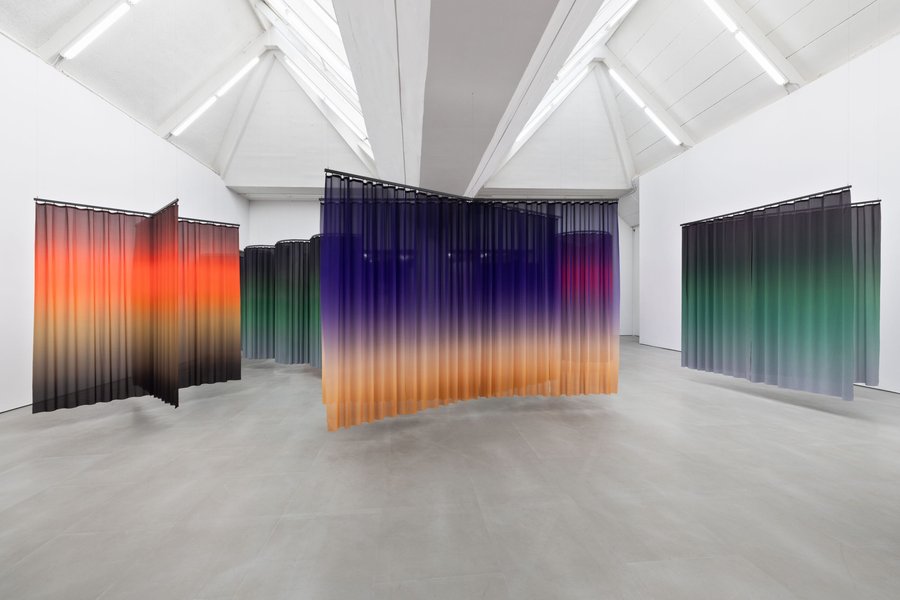
- carlier | gebauer, Berlin, is pleased to announce New Systems (For Relationships), a solo exhibition by Lúcia Koch, opening on the occasion of Berlin Art Week 2026. Lúcia Koch is a Brazilian artist who lives and works in São Paulo. Over the years, she created various bodies of work that co-exist and form an evolving repertoire that is taken by the artist as a source of possible responses to a given context. In her practice, Koch approaches architecture as a language to be explored. By introducing filters, images, additions or subtle acts of subtraction, she transforms familiar spaces into environments where colour, light and human presence continually reshape the experience of place. Since 2022, Koch has been developing New Systems (For Relationships), a body of work centred on autonomous structures that relate more closely to the bodies of viewers than to singular architectural spaces. The works operate with intersubjectivity by acting as communication devices between people. As visitors move through, around and within them, they become part of an ever-changing network of relationships. Every movement generates new constellations of colour, perception and proximity. Like a mathematical equation with infinite variables, each individual brings a unique reality to the work, making every encounter and every possible outcome endlessly renewed. The pieces are composed by mobile structures with fabric-filters, and the shape of each module combines either curved or straight sections of rails, exercises on topology taking the colours and forms as attributes, as it is in the language of logic-mathematics, the artists mother tongue. The modules can be a symmetric cross formed by four straight lines, or an S shape that reminds us of furniture pieces designed for very formal dating, or two straight lines joining each other to form an acute angle. They can also be combined further into more complex tri-dimensional diagrams like the Infinite, with enclosed areas that can be entered by the viewer. The works thus obscure and divide the room they are placed in, imposing an almost overwhelming presence of colour. Within these Systems there are three different sets of colour gradients and degrees of transparency, addressing to different moods and ways to be or act in the space. Since 2010, Koch has produced immersive interventions with fabricated filters, that consist in colour gradients printed on translucent fabrics and installed in curtain rails. Those undulating surfaces give body to the colour transitions, mediating the interactions of viewers with the space and to one another. People can cross or move around the fabric-filters. In Tumulte (2022), a large-scale intervention at Palais de Iéna in Paris, the artist created a sort of turmoil through a massive installation of layers crossing each other. The fabrics seemed to escape through the windows, giving the impression that they could not be contained by the building. Those pieces outside could be seen as flags, hanging for unknown reasons. Other installations using curtain-filters were also presented at Casa de Vidro (São Paulo, Brazil, 2019) and the Islamic Arts Biennale (Saudi Arabia, 2025). Koch’s latest installation with curtain-filters, Dolapdere Suiti, is currently on show at Arter (Istanbul, Turkey). Lucia Koch will present new interventions at Anatomy of presence, curated by Svenja Frank and Jérôme Sans, at Schauwerk Sindelfingen Foundation, which will open in September 2026. She will also participate in the Biennale de l´image in Vevey.Description
New Systems (For Relationships)
Until 28 Oct 2026
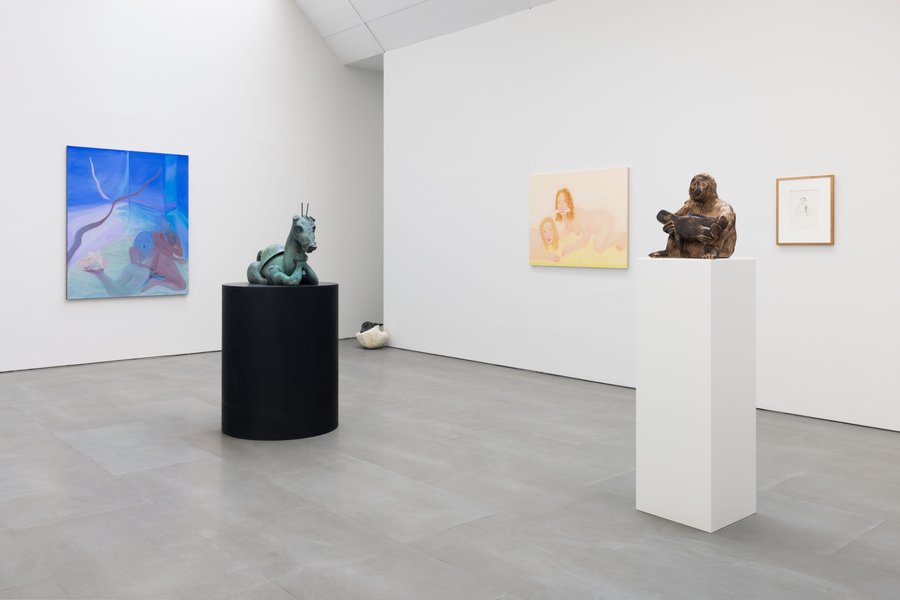
- carlier | gebauer, Berlin, is pleased to announce the group exhibition, Animal Mirror, featuring works by Jelena Bulajić, Diego Delas, Cecilia Edefalk, Asta Gröting, Thibault Hiss, Aki Inomata, Julia Kowalska, Lin May Saeed, Pakui Hardware, Paolo Salvador, Sequoia Scavullo, Erik Schmidt, Thomas Schütte, David Zink Yi, Paloma Varga Weisz. Few relationships are as old, as contradictory, and as unresolved as the one between humans and animals. We share our bed with them and our plate. We worship them and we slaughter them. We search their eyes for an answer they cannot give us, and precisely because of that, we project so much into them. In contemporary art, this field of tension is gaining significance because it allows something to be negotiated that reaches far beyond zoology: our self-understanding as a species, our ethics, our fears, our longings. The exhibition brings together fifteen artistic positions that approach this relationship from very different directions. Here, the animal appears as companion and confidant as much as source of food and sacrificial creature, two roles that in our culture often lie only a few steps apart, yet are rarely thought together. It appears as cuddly toy and as symbol, charged with meanings drawn from mythology, religion, and folklore, and at the same time as a trigger for immediate, barely controllable emotions: affection, disgust, compassion, and fear. At the same time, the exhibition considers the animal as part of a larger ecological and evolutionary fabric: as a fellow inhabitant of a shared planet, as a participant in a biological heritage to which we are more closely related than everyday understanding often allows. And finally, the most radical question arises: what if the animal is not merely subject matter but the author itself? What if animal behaviour, movement, and intelligence themselves become artistic material? Aki Inomata literally lets animals co-create, putting human authorship itself up for debate. Lin May Saeed has devoted her sculptural work for years to questions of empathy and liberation in our relationship to animals. Pakui Hardware address bodies, biotechnology, and the permeability between the organic and the artificial. They explicitly refer to prehistoric organisms whose DNA structures lend new meaning to the fountain of youth today. Asta Gröting and Thomas Schütte place the animal within a matrix of social reflection, while Paloma Varga Weisz draws and sculpts anthropomorphic and hybrid figures. Julia Kowalska depicts figures in ambiguous emotional states and reciprocal relationships, shaped by emotional dependency and contradictory forms of affection. She often begins from an introspective perspective: her paintings extract the physical from the subconscious, creating delicate, dreamlike visual worlds. Intimacy, corporeality, and an enigmatic, ephemeral perception are central to her work. Diego Delas and Paolo Salvador develop their own, often dreamlike and shifted pictorial worlds in painting, in which tactile and emotional experiences flow into one another. Thibault Hiss and David Zink Yi extend the field through material approaches that render the animal tangible as transformed matter or as a presence in space. Cecilia Edefalk works in her paintings with minimal yet meaningful shifts. Content, context, and emphasis raise questions about painting and representation, as well as about the “screen” through which we perceive reality. Erik Schmidt’s work revolves around (queer) identity, social role models, consumption, and social structures. He immerses himself as an intense observer in the rituals and behavioural patterns of social groups. His work Day Gray offers a view of a veiled urban landscape occupied by pigeons. At the very beginning of the exhibition, Jelena Bulajić uses photorealism to create the illusion of an idealised “wildlife.” In doing so, she establishes theDescription
Animal Mirror
Until 14 Nov 2026
Recent past exhibitions
- Above Ground Below unfolds as a field of relations organized across sky, ground and subterranean registers. Throughout the exhibition images, objects, texts, and materials form constellations that shift through aggregation, dispersal, and return as a set of relations between bodies, objects, infrastructures, and the forces that move through them. The Constellation (2026) images introduce one register of this movement. In the original action, pigeons fitted with LED lights moved across the dusk sky above Jalazon refugee camp, producing shifting formations that follow a swarm logic. The emerging constellations remain adaptive and unfixed across multiple registers as framed photographs and as stacks of newsprint on the floor. The stacks extend the work, allowing the birds to leave the exhibition and circulate outward as a dispersed network. Rubber Coated Rocks (RCR), initiated in 2001, is presented here in a 2024–26 iteration. The works draw on the form of the projectile: rubber-coated bullets. Composed of stones, discarded footballs, and other found materials gathered at checkpoints in Palestine, each sculpture binds together elements marked by circulation, impact, and abandonment. The forms recall heads or clustered bodies, worn, weathered, and held in tension, suggesting both vulnerability and persistence. Bound and stabilized, they stand as accumulations of contact between surface and force, object and memory, play and violence. Assembled from what is at hand, and elevated the aggregation of elements forms constellatory groupings that oscillate between the bodily and the architectural. Water Witnesses (2025-2026) extends this inquiry into infrastructure, shifting from the projectile to the conduit. These sculptures assemble ceramic vessels, steel pipes, irrigation valves, and custom-cast fittings into upright configurations that evoke systems of flow, storage, and control. Drawing on vernacular water practices and the sacred geographies documented by Tawfiq Canaan, particularly his accounts of springs, wells, and cisterns as sites of belief, ritual, and guardianship, the works situate infrastructure within a broader cosmological framework. Canaan’s writings on amulets and protective devices inform the logic of assembly: materials are combined, bound, and suspended not only for function but for their capacity to mediate vulnerability and care. Within this field, the works operate as witnesses in the fullest sense of the term, where the Arabic shaheed carries both the meaning of martyr and witness. Open Books (2026), texts by Tawfiq Canaan (1882–1964) and Gustaf Dalman (1855–1941), anchor the installation within an earlier moment of exchange between Palestine and Germany. Writing in the early twentieth century, Canaan, a Palestinian physician and ethnographer, and Dalman, a German theologian and orientalist scholar, documented everyday practices, sacred geographies, and systems of belief at a moment when rapid modernization threatened their erasure. Their work moved between field observation, correspondence, photography, and publication, forming an archive that continues to shape how Palestine has been studied and understood. Their pages, spread low across the ground, begin to resemble wings of birds, while also registering another form of circulation: the movement of knowledge through fieldwork, correspondence, publication, translation, and return. The books become part of the installation’s material field, positioned between archive and ground, text and body, sediment and flight. Presented together, these works trace a movement from impact to flow, from projectile to conduit, from flight to printed circulation, producing a cosmology grounded in resistance, care, and continued movement.Description
Nida Sinnokrot / Above Ground Below
Ended 29 Aug 2026
- For over a decade, Stevie Dix has perfected a muffled, moody painterly universe in perpetual expansion. Gradually, her practice introduced a set of key motifs: fragments of garments, elusive female profiles, paths that led nowhere. These hieratic symbols were rendered in a thick mix of oil and beeswax, establishing a subtle palette of earthy tones that made the outside world disappear as if perceived behind closed blinds—or eyelids. Her second exhibition with carlier | gebauer, and the first in the gallery’s Berlin space, sees the Belgian artist explore uncharted territory. Her new body of work was created in the aftermath of a personal ordeal, the artist having lost her mother as she prepared to welcome her son. Drift, the title of the show, evokes how grief, loss, and joy blend into one another in “a changing state, undesirable and unstable”. When Dix returned to the studio, the medium of painting became akin to a vessel or a loom. Her mother had been an artist herself, a gifted painter and potter who used to document her works in makeshift settings, photographing them with a disposable camera. These hazy, faded snapshots became the starting point for Dix’s new paintings, such as the pale-yellow canvas featured in the exhibition, which turns a staged photograph of a ceramic vase with dried flowers into a biomorphic, incandescent motif. Repeated throughout several works, it acquires the germinating quality of a cell, an atom, or a seed, in ceaseless transformation. As Dix dives deeper into a more abstract register, we are brought back to the spiritual origins of Western abstraction: a way of communicating with the unseen, channeling a repertoire of shapes evocative of rays of light and electromagnetic signals. From 1977 to 1979, Roland Barthes kept a mourning diary (Journal de deuil) recording the subtle flow of sadness, the stages of grief, and the universality of loss. The French semiotician started writing the day after his mother’s death, using small slips of paper in what soon became a daily practice. He felt the need to shift his academic mode of writing toward fiction. As he wished for a new beginning, he named it Vita Nova : new life. For Dix, grief similarly became a catalyst for formal renewal as it led her latest paintings toward a primordial, pared-down form of expression. Throughout the space, the initial references give way to carmine symbols interconnected through pulsating undercurrents. Morphing into bristling tendrils and imploding globes, they take on a cosmic existence of their own.Description
Stevie Dix / Drift
Ended 29 Aug 2026
- carlier | gebauer, Berlin, is pleased to announce Herz, Asta Gröting’s seventh solo exhibition with the gallery. Paradoxically, an atmosphere of emptiness constitutes the heart of this exhibition. Like a delayed echo it alludes to the absent, the intangible, to what remains when seemingly nothing remains. From minimal forms Gröting tells a story: squares on the floor become a double bed, a washing machine performs gentle, rocking movements, all that remains of an intimate moment between two women is an imprint, a cold heart of stainless steel with a needle poses the question under which conditions one/men defends one’s /their country. The pig is deflated. With these gestures, Gröting creates a poetry of space within space, where the material works become protagonists just as much as the relationships between the objects themselves. In this exhibition, Gröting confronts us with the intimate and familiar, the everyday. However, she does so in a subtle way with a slight distortion, so that the ‘homely’ threatens to tip over into the uncanny and alien. Exhibiting a form of inner life, she yet leaves open its precise definition and the question of what exactly it is made up by. In Space Between Two Women Having Sex (2024), Gröting took a direct impression with silicone during the sexual act between two women. The palpable void between the individuals is turned inside out and mirrored from bottom to top – Gröting thus performs a kind of sculptural autopsy, both literally and conceptually. The negative space between two people becomes an object, bringing to light the unspoken, the secret and the hidden. What remains of the moment is the other side, the ‘underside’ of the self. In the laser light installation Atemkurve (2025) Gröting brings to surface a process our bodies perform every moment of our lives, which usually happens automatically: breathing in and out, taking in fresh oxygen and releasing carbon dioxide from the blood. Oxygen, as a shared and vital resource that is invisible to the naked eye, can be seen as a metaphor for the essence of Gröting’s exhibition: her works make visible what seems obvious or hidden, inviting us to rethink this implicitness. With the two works Doppelbett (2025) and Waschmaschine (2024) are barely tangible due to their minimal, suggestive form allude to the domestic sphere, a place of retreat but also of reproductive labour, historically conflated with the feminine. Four slightly curved rectangles become a made but empty double bed. Made of polystyrene, they seem to float feather-light above the exhibition floor. Polystyrene is a moisture-resistant and heat-insulating material used to protect sensitive objects. Waschmaschine, on the other hand, reduces this almost indispensable appliance to a white pedestal with the typical dimensions of household appliances, the so-called white goods. The pedestal performs very slow, barely perceptible horizontal and vertical movements. Instead of retreating into the private sphere, the artist highlights its political dimensions. The pig, is closely linked to the history of human civilization through its domestication. Due to its intelligence and physiological similarity to humans, pigs are frequently used in medicine and research as laboratory animals. Lying flat on its side, Dancing Queen (2024) becomes a projection surface for these controversies, but above all it prompts us to reflect on the human relationship with living beings and the environment. The cold, chrome-coloured ‘heart’ draws on the symbolic imension of this vital organ. It represents a centre, a core, which must also be protected by the rib cage. Combined with the German national colours, this work reveals an ambivalence between a sense of belonging, a certain atmosphere in which one grew up, on the one hand, and the consequences of confronting painful history and political injustices on the other. Gröting puts her finger on the wound of current tensions.Description
Berlin Asta Gröting | Herz
Ended 5 Mar 2026