Venice
CATERINA TOGNON
On now
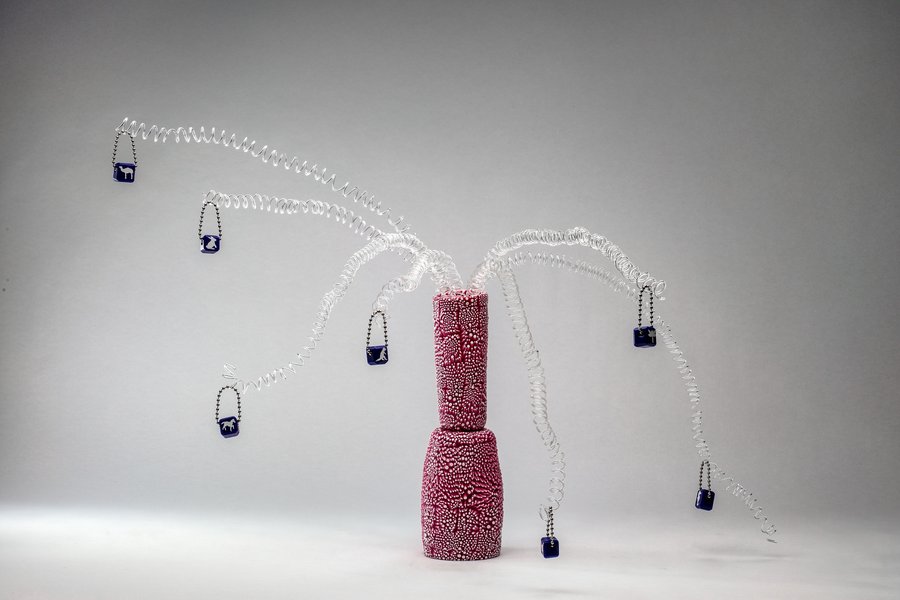
- The exhibition, organized in collaboration with R & Company, NYC, explores Richard Marquis’s research on Murrine, a millennia-old glassmaking technique. In 1969, the American artist worked at Venini furnace, where he learned the art of assembling hot glass canes, later applying it to his experimental sculptures, which became icons of the International Studio Glass Movement. The works on display enter into dialogue with the Murrine of Mathieu Grodet, presenting different contemporary approaches to an ancient glassmaking technique of extraordinary complexity and expressive power. Denise Barr presents her jewelry made from Richard Marquis' murrine.Description
Richard Marquis and his Murrine - featuring Mathieu Grodet and Denise Barr
Until 21 Nov 2026
Recent past exhibitions
- We are happy to announce the participation of Lilla Tabasso and Václav Cigler in the Presentation of Fondazione Dries Van Noten: The Only True Protest is Beauty. The Presentation stands as a journey into beauty understood not as resolution but as tension, an intensity that unsettles the familiar and opens space for the unexpected. With a title inspired by the words of singer and activist Phil Ochs, the Presentation invites us to consider beauty not as simple prettiness but as a form of inquiry and a catalyst for reflection, provocation, and transformation. Set within Palazzo Pisani Moretta, more than two hundred works spanning fashion, jewellery, design, art, photography, glass, ceramics, and material experimentation enter into dialogue with frescoes, ceilings, and the building’s layered histories. Selected pieces from established fashion houses’ archives are presented together with contemporary textile pieces, underscoring an enduring role as medium of cultural expression and affirming its capacity to generate critical and poetic statements. Collectible art and design objects coexist with experimental works – together forging new directions in sensorial storytelling and material exploration. Moreover, Traditional craftsmanship is showcased alongside innovative international voices, reflecting the Fondazione’s commitment to both safeguarding heritage and nurturing new talents and views. Curated by Dries Van Noten, the presentation unfolds as a constellation of affinities and contrasts, where mastery meets discovery and craftsmanship becomes a language of emotion.Description
The Only True Protest Is Beauty
Ended 4 Oct 2026
- In Bloom - Art & Botany will be next year’s major summer season exhibition, and in it, the unique interplay between flowers and art will be brought into focus in its own right. The exhibition will include works and objects in a variety of media and techniques – including paintings, prints, drawings, illustrated books, sculpture, textile art, installations, photography, film, crafts and design from the 16th century to the present day.Description
In Bloom – Art & Botany
Ended 13 Sept 2026
- This exhibition brings together sculptures, works on paper, and the large embroidered NEST (2004), spanning Paul Noble’s career and his sustained engagement with one of Britain’s defining artistic legacies: Henry Moore. Venice is not an incidental setting. In 1948, Moore was awarded the International Prize for Sculpture at the 24th Venice Biennale, where his work was recognised as embodying the humanist values of modernism. Showing Noble’s work at Caterina Tognon—a gallery whose programme is rooted in material craft and process— places this engagement in the very city where that recognition occurred. The exhibition title takes its name from a deliberate misreading. Where Moore placed monumental reclining figures across the world’s piazzas and landscapes, Noble proposes declining figures: forms that slump, accumulate, stack, and compost—his contention that humans, despite behaving as though they sit at the top of the food chain are, in fact, principally responsible for damaging the natural world. Noble's engagement with Moore began in 1996 with scepticism. His issue was less with Moore himself than what he represented: the top-down imposition of public art into communities who had no say in its arrival. Critical too of the scale and industrial processes behind the works, and what he perceived as their adherence to pre-war ideals of the nuclear family, Noble recasts this utopian myth through humour and reworking. The first building in Nobson Newtown (1996-)—Noble’s fictional dystopian city—depicts an architect’s house built on sand, with a pile of discarded Moore sculptures beside it. Drawn entirely in pencil, the project functions as both town plan and self-portrait. Returning to this image years later, Noble created Monument Monument (2007), a large meticulous pencil drawing made from every sculpture in Moore’s six-volume catalogue raisonné, each work re-sized to the same scale, assembled as a single towering form. Drawing Moore from the ground up, sculpture by sculpture, Noble found himself recognising, over time, his foil as a master of form, material and scale. In 2019 he said in an interview: “ I began, at the foot of the mountain, still a critic of Moore but as I slowly ascended I recognised what a master of form and material and scale he was. It took me a while to get to this point and be rid of my prejudices. ” (from: A Cartography of the Self, Interview with Kristen Knupp, Art Vista / Art Decision Magazine, December 2019) The works in this exhibition span nearly three decades of this evolving dialogue. Exhibited widely, the scatological ceramic figures of the mid-2000s play with scale. Formed in variations from ten modular Moore’s—inspired by Chinese scholar stones they were conceived as ornaments for Paul’s Palace the intricately detailed seaside villa that takes centre stage in Nobson. Exhibited here for the first time, The HM’s, mounted on travertine bases: pale, knotted, interlocking forms operate simultaneously as homage and parody. Intricate pencil drawings such as Sixteen Henry Moore Sculptures On Top Of Each Other (2005–2025), subvert Moore’s canonical forms. Compressed into an absurdist monument—Noble recalls Moore’s contemporary Hans Bellmer whose radical dismemberment of the human form stands as modernism’s counterpoint to Moore's idealism. Moore worked within a tradition that placed the body at the centre of meaning—dignified, enduring, and at ease in the landscape. Noble’s Declining Figure drawings (2017), also shown here for the first time, revisit this familiar motif of the reclining figure set against sea and sky. "Declining" rather than "reclining", these forms suggest something getting smaller, deteriorating, and less certain. NEST (2004), modelled on traditional East Asian folding screens, anchors the exhibition. Combining embroidery, appliqué, marquetry, and beadwork, it presents a world of egg-carton buildings and a wool nest enveloping a tiny egg cradled on a dead tree: a landscape caught between formation and collapse. Birth, waste, death, repeat. Its intensely handmade surface stands in direct contrast to the industrial processes associated with monumental sculpture.Description
The Declining Figure
Ended 5 Sept 2026
- Paolo Martinuzzi (Venice IT, 1933 - Venice IT, 2015) was the first artist in Murano to work with glass for specific expressive and artistic purposes, the Italian precursor of the Studio Glass movement. Self-taught in Venice in the early 1970s, Martinuzzi opened the first artist's studio in Murano entirely dedicated to glass artworks, marking a clear break with the Murano artisan tradition. His works emerge from an independent research, free from academic models, and they place glass at the center of a visual language so essential it appears restless and profoundly contemporary. In 1985, openly challenging the predominantly decorative approach of glass production in Italy, the artist chose to relocate his practice to Soest, Germany, where he pursued increasingly free and experimental research. His sculptures are distinguished by their dialoguing use of materials such as iron and wood, often recycled and manually transformed by him. He manages to create a formal and symbolic tension with the transparency and fragility of glass. A distinctive element of Martinuzzi's work is its strong graphic component: deep incisions which are obsessively repeated, clean lines crisscross the glass surface, introducing a sense of restlessness and expressive urgency that brings his work closer to the realms of Art Brut. A type of art understood as a primary gesture, without any mediation, generated by instinctive impulses, by an authentic need to communicate through visual expressions. Just as in Art Brut, Martinuzzi's work is pure and simple creative action, reinvented at every stage, far removed from the conventions of “official” art. In this arduous process, glass loses its decorative aspect to become a place of tension, memory, and new visions, the living body of the work.Description
Paolo Martinuzzi. An exemplary adventure. Art Brut in Murano in the 1970s
Ended 25 Apr 2026
- Paolo Martinuzzi (Venice IT, 1933 - Venice IT, 2015) was the first artist in Murano to work with glass for specific expressive and artistic purposes, the Italian precursor of the Studio Glass movement. Self-taught in Venice in the early 1960s, Martinuzzi opened the first artist's studio in Murano entirely dedicated to glass artworks, marking a clear break with the Murano artisan tradition. His works emerge from an independent research, free from academic models, and they place glass at the center of a visual language so essential it appears restless and profoundly contemporary. In 1976, openly challenging the predominantly decorative approach of glass production in Italy, the artist chose to relocate his practice to Soest, Germany, where he pursued increasingly free and experimental research. His sculptures are distinguished by their dialoguing use of materials such as iron and wood, often recycled and manually transformed by him. He manages to create a formal and symbolic tension with the transparency and fragility of glass. A distinctive element of Martinuzzi's work is its strong graphic component: deep incisions which are obsessively repeated, clean lines crisscross the glass surface, introducing a sense of restlessness and expressive urgency that brings his work closer to the realms of Art Brut. A type of art understood as a primary gesture, without any mediation, generated by instinctive impulses, by an authentic need to communicate through visual expressions. Just as in Art Brut, Martinuzzi's work is pure and simple creative action, reinvented at every stage, far removed from the conventions of “official” art. In this arduous process, glass loses its decorative aspect to become a place of tension, memory, and new visions, the living body of the work.Description
Paolo Martinuzzi. An exemplary adventure in Murano.
Ended 25 Apr 2026
- Caterina Tognon is happy to announce the gallery's participation at TEFAF Maastricht 2026.Description
TEFAF Maastricht 2026
Ended 19 Mar 2026
- Paolo Martinuzzi (Milan, 1933) was the first artist in Murano to work with glass for specific expressive and artistic purposes, the Italian precursor of the Studio Glass movement. Self-taught in Venice in the early 1970s, Martinuzzi opened the first artist's studio in Murano entirely dedicated to glass artworks, marking a clear break with the Murano artisan tradition. His works emerge from an independent research, free from academic models, and they place glass at the center of a visual language so essential it appears restless and profoundly contemporary.Description
Caterina Tognon - Arte Contemporanea
Ended 19 Mar 2026