Berlin
ChertLüdde
On now
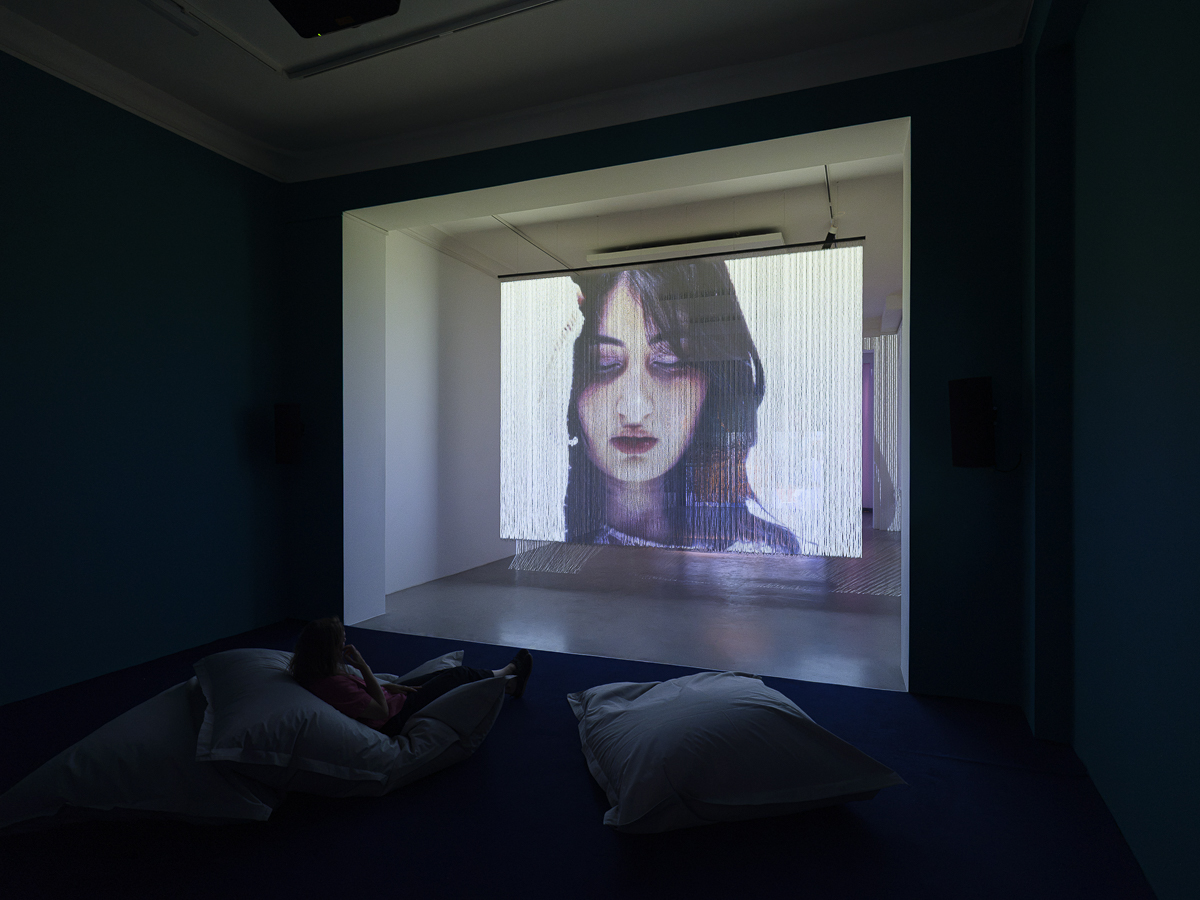
Stephanie Comilang Search for Life
Until 24 Oct 2026
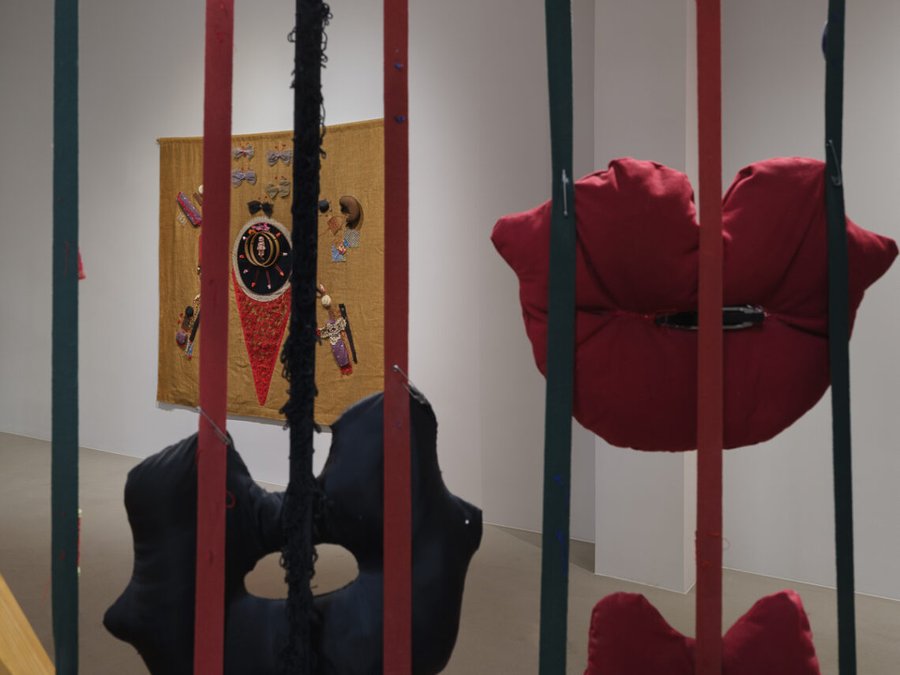
- ChertLüdde presents Un orlo a giorno per il mio diario (A hemstitch a day for my diary), the second exhibition by Clemen Parrocchetti (Milan, 1923–2016) at the gallery. A rebellious and nonconformist artist, Parrocchetti experienced 1968 as a turning point for creative and political change. It was precisely during those years of intense feminist struggles that the artist used the tools and methods of domestic labor to take a stand on the movement’s most controversial issues, including the subjugation of women, emancipation within the household, recognition of domestic work, abortion rights, divorce, the denunciation of domestic violence, and the defense of sexualDescription
Clemen Parrocchetti Un orlo a giorno per il mio diario (A hemstitch a day for my diary)
Until 31 Oct 2026
Recent past exhibitions
- At ChertLüdde, Tunisian-Italian artist Monia Ben Hamouda (b. 1991, Milan) presents After Totality, a continuation of her recent exhibition Path of Totality at Museo Casa Rusca in Locarno. Over the last few years, Ben Hamouda has developed a distinctive artistic landscape encompassing sculpture, installation, and mixed-media painting. Moving between abstraction and figuration, her practice blends together her Islamic and Western cultural heritage, positioning both of her lineages as influences on her work. Within the exhibition, "totality" is observed as a metaphor for the present moment, with the exhibition moving through states of collapse and obscurity, challenging what darkness reveals and withholds. The term was originally taken from the field of astronomy, where the "path of totality" describes the area of the Earth from which a total solar eclipse can be observed and there is a brief collapse of daylight from the moon obscuring the sun. But the word also references the constructed form of totality: that of power and totalitarianism, a term introduced in Europe during the 1920s to describe control over every aspect of public and private life. In her essay 'Totality: The Color of Eclipse', Anne Carson writes, "Hard to know how to go on, after the reversal of color and defeat of the sun." 1 Long feared and mythologized, eclipses have historically revealed how cosmological knowledge operates as power and control. Like Carson, Ben Hamouda turns to this moment of covering-up to describe what is unfolding, using art to navigate collapse, uncertainty, and the possibility of renewal. Against this backdrop, the exhibition opens with Theology of Collapse (The Myth of Past), made from laser-cut steel panels. The title directly links belief itself to total collapse and to a sense of loss rooted in the past. Leaning into the space, the sculpture's intricate designs are reminiscent of both mausoleum and mosque ornamentation. Architectural details traditionally reserved for the burial chambers of the dead become indistinguishable from the decorations found in spaces of worship for the living, creating a delicate balance between one world and the other at a moment that seems to oscillate between the two, when the meaning of life itself is overshadowed by power. Looming over the visitor, a sense of physical collapse is experienced and intensified also through the audio piece playing within the room. It is impossible to ignore the discomfort and awareness evoked by the sound installation as the deep vibrations echo through the gallery. Meant to demonstrate how moments of crisis can profoundly transform language, the audio consists of recordings made between October and December 2023 from two mosques located in Gaza. It creates a haunting soundscape in which religious calls to prayer merge with urgent public security announcements made in wartime, transforming the familiar sounds of the Adhan into an alarming melody. Emphasizing how these sounds shape cultural identity and perception, the result is a powerful commentary on the nature of communication and the emotional strain these warning calls carry. In the second gallery, fragrant, vividly colored powders have settled over a scene of collapse. With spices traditionally used in medicine, cooking, and ritual practices across North Africa and West Asia, Ben Hamouda coats architectural forms and salvaged wooden beams in dense layers that act as both preservation and protection. These spices form a veil over ogee arches inspired by structures the artist encountered in Spain, referencing the Islamic heritage still found in Europe. The spices extend beyond the objects themselves; scent fills the room, heightening the senses and evoking a resilient presence in response to histories of inhuman suffering. What appears as ruin is counterbalanced by acts of care. Titled Reversion (Wudu Diorama), the installation also references wudu, the ritual ablution performed before prayer or reading the Qur'an, while insisting on a complete sense of upside-down reversal. In close dialogue with contemporary political realities, Ben Hamouda frames vulnerability and repair as enmeshed. She sees the myth of antiquity as something active and lived through shared heritage. Collapsed architectures thus emerge not as symbols of defeat, but as forms of resistance—revealing cultural heritage as fractured, lived, and continually renegotiated. Within all of this, reversal remains possible, like the moon reappearing after an eclipse. As if cut directly from the steel sculptures in the first room, the exhibition's final work hangs from the ceiling, with spices scattered below. Drawn from the ongoing series Aniconism as Figuration Urgency, the sculpture engages the Islamic calligraphic tradition of aniconism, borrowing from an ancient strategy of circumvention. Calligraphic brushstrokes echo the visual logic of Arabic script while withholding legibility; the metal forms hover at the threshold of figuration without resolving into either image or text, proposing instead the same rhythm of appearance and disappearance. It is within such rhythms that the moon becomes a structuring metaphor. The moon marks time not as linear progression but as cyclical return, attuning life to phases of rupture and renewal. As a witness to creation, it functions as a measure that is continually reset. The full moon, in particular, signals a moment of heightened reflection—when illumination is complete yet already turning toward disappearance. Reading through this cosmology, totality emerges in Monia Ben Hamouda's exhibition not as an endpoint but as a disturbance of perception itself. "Still," Anne Carson writes, "totality is a phenomenon that can flip one’s ratios inside out." 2 Echoing Carson's words, After Totality insists on the uncertainty of the 'after': a duration in which consequences continue to unfold without resolution.Description
Monia Ben Hamouda After Totality
Ended 2 Apr 2026
- Since dreams can’t be pictures, picture a pond. A pond that’s longer than it is wide, with water lilies on its perimeter and two peninsulas protruding into the placid water. Paint this picture from memory, from daydream, desire. At ChertLüdde, Rodrigo Hernández (b. 1983, Mexico City) presents The Long Pond, a new installation that invites viewers to linger within the artist’s memories. Wading into the liminal space between sleep and wakefulness, the installation stages an encounter that begins at ankle height and rises to eye level through a broken sequence of wall drawings and paintings. Before entering this landscape, Hernández offers a map: a simple drawing of a four-mile-long glacial lake in Acadia National Park, Maine. This is The Long Pond, where the artist traveled with his partner in 2025. Hernández, whose practice often starts with a simple line drawing before expanding it into paintings, reliefs or sculptures, understands drawing as something “closer to memory, or more precisely, the sensation one has before remembering.”1 And by keeping this map of The Long Pond spare and tracing only the contours of the place, he allows memory to surface slowly, sensation giving way to images. At the center of the exhibition, two bronze patinated casts rest on a large platform. These busts depict a couple, figures that mirror one another. Each presses one ear into a hand, poised as if at the threshold of sleep, even though their eyes remain open in search of the other’s gaze. Hernández gives few points of orientation in this installation, but if you stay with the sculptures long enough, they begin to feel buoyant in time. Unmoored to a fixed temporality or the present moment, they allude to a slow drifting—toward and away from one another. Like the pared down diagram of the pond, the narrative is distilled to its barest elements: two figures floating across a surface, evoking distance, but also commonality. Their faces remain deliberately nondescript, reduced to near-generic features, hovering at the edge of recognition and functioning as placeholders for projection, reflection, or desire. Almost identical and mirroring each other, the sculptures evoke an ancient Greek myth about desire. Cursed by unrequited love for himself, it is said Narcissus becomes trapped by a reflection he mistakes for another person, his perfect soulmate. Traditionally interpreted as a tale of vanity, the installation presents Narcissus as not just a character whose desire falls upon himself, but upon someone unattainable: his reflection. For Hernández though, the object of affection is unattainable through distance instead, as he reveals in writing. In a text by the artist accompanying the exhibition, Hernández recalls his partner’s voice as he exits sleep, “‘I was wondering how quickly you will forget about me in Paris.’”2 The text frames this as the final moment before Hernández moved overseas. Yet the memory lingers less on the fact of departure itself than on the intimate, fleeting details that surrounded it. “I remember,” Hernández writes, “touching a wet fig leaf in the garden.”3 Such small, tactile gestures slow time, holding the moment in place by anchoring emotion in the body. These haptic memories, felt also in the oil paintings in the exhibition, insist on the physicality of longing, reminding the viewer that the exhibition’s emotional register is not abstract but intimately felt. Within this attention to touch lies an unspoken fear—that love, separated by distance, might thin out and dissolve, leaving behind nothing more than a fragile reflection. Hernández has also drawn a mosaic floral pattern, inspired by the motif at the entrance to his new Paris studio, directly onto the wall, positioned low to the ground. This wall drawing traces the distance between then and now, there and here, Hernández and his partner—uniting them within the exhibition. Through this overlap, the exhibition lingers in an alternative dreamspace shaped by memory, intimacy, and the tenderness of farewell. In this refusal of resolution and narrative completion, the exhibition remains fragmented and resists closure. Quoting Patrick Modiano, Hernández offers such fragmentation as a site of release: “A great relief, that of being freed from the laws of gravity, as in dreams, when your body floats into the air or in the void.”4 Hernández takes this suspension, drifting his figures out from chronology and certainty; references slide rather than settle; images hover in a state of near-recognition. In The Long Pond, Rodrigo Hernández frames time as a deeply personal, subjective experience, untethered from fixed social or cultural structures. Time stretches and folds here, shaped less by chronology than by desire, memory, and touch. The exhibition lingers in this in-between space, where tenderness resists closure and meaning remains provisional and held in motion, like a dream shared between two people across two places, rather than fixed in one.Description
Rodrigo Hernández The Long Pond
Ended 2 Apr 2026
- At ChertLüdde, David Horvitz presents At the limits of the city, an exhibition that enacts a displacement by transposing the borders of Los Angeles into the gallery space in Berlin. Extending the work of California Conceptualists of the late 1960s and early 1970s, Horvitz uses the exhibition to explore notions of boundaries, land, and identity. The exhibition opens with Other People (2022), a room displaying 310 digital portraits collected through facial recognition software told to search for “David Horvitz.” Though these “other people” are strangers to the artist, their faces evoke an uncanny sense of familiarity. By reappropriating these misidentified versions of himself, he interrogates the murky ethics of image databases, often built from photos collected without consent and, in some cases, sold to law enforcement. Originally presented at Los Angeles’s Wende Museum in dialogue with the surveillance practices of the former German Democratic Republic, the work’s narrative potential resonates far beyond this context. It probes the boundaries between individuals and the social and technological systems that shape their existence, while insisting on the software’s inherent misrecognitions. Encapsulating the entire exhibition is the eponymous work, At the Limits of the City (2025). It comprises four photographs of Horvitz standing with his back to the camera at the northernmost, southernmost, easternmost, and westernmost points of the city of Los Angeles. Installed following their cardinal directions, the artist’s body functions both as a compass and boundary. Through this gesture, Horvitz draws the borders of Los Angeles into the gallery, relocating the city within the exhibition space. The project began at the southernmost point located in San Pedro, the neighborhood where Horvitz grew up and where his mother still resides. To include San Pedro, formerly home to many Japanese-American fishermen and now the nation’s busiest port, the city stretches into a narrow strip to reach the harbor. Next to this port, occupying the site of a former Japanese village destroyed in the 1940s, is now a federal prison used as a staging ground for the U.S. Immigration and Customs Enforcement (ICE). With this work, Horvitz not only conceptually moves the city, but underscores how its borders are constructed, often serving interests far removed from the ones of the people living within them. In moving the boundaries of the city, Hovitz also transplants his garden on 7th Avenue in Arlington Heights to Berlin. Formerly a neglected plot, the site has been transformed into a living community space through collaboration with the landscape architecture firm Terremoto. Plants native to Southern California grow in Horvitz’s garden while small tokens—seeds, shells, stones, bells, and artworks left behind by visitors, both human and animal—lie scattered throughout. A ghostly sculpture, created in collaboration with the Estate of Rosemary Mayer, is slowly being overtaken by morning glory vines. Nearby lie fragments from the recently demolished 1965 building of the Los Angeles County Museum of Art, piles of purple sea urchins gathered from the depleted kelp forests along the California coast, and sculptures made as offerings for gift exchanges with neighborhood crows. Mirrors also trace the fence, marking the garden’s boundary within its surrounding neighborhood. Found on nearby sidewalks, these mirrors form a quiet portrait of the neighbors who once paused to see themselves reflected. In the exhibition, Horvitz lines the gallery’s perimeter with mirrors like those from his Los Angeles garden. Sourced in Berlin, the mirrors scatter reflections across the room, drawing visitors into the shimmering boundary while carrying traces of earlier encounters. These materials reference everyday acts of place-making and the shifting contours of communal space, while invoking the garden’s defining condition—its enclosure. Etymologically, the word garden derives from the Old Northern French gardin, from the Frankish gard or gardo, meaning enclosure or fence. In this sense, a garden is both a cultivated space and a bounded one—its perimeter essential to its form. But while Horvitz’s garden on 7th Avenue is an enclosure, it remains open to the neighborhood and broader public through regular exhibitions, readings, and events. At the center of the gallery stands a replica of the platform found in Horvitz’s garden. Recordings of poets who once performed there play intermittently, carrying traces of that community to Berlin. Throughout the exhibition, the platform also hosts a series of readings curated by Berlin-based writers Susan Finlay and Erin Honeycutt, further activating the installation, and transforming it into a site of collective engagement and exchange. A row of chimes suspended from the ceiling can be activated by visitors to play a regional German lullaby. The work resonates with Horvitz’s ongoing fascination with boundaries of night and day, sleep and dreams—moments of disappearance and transition, “when,” in the artist’s words, “one can disappear from sight, disappear from the daylight as dusk happens.” This poetic impulse works to blur night and day, public and private, Los Angeles and Berlin. Also emerging from his Los Angeles garden are sculptures cast from elements of a sycamore tree. The seeds, leaf, and stick were formed from melted house keys given to Horvitz in exchange for keys to the garden. Embodying an act of trust and reciprocity, these pieces represent openness and connectivity in a sprawling metropolis. One of the final works in the exhibition is a neon sign reading “every small flutter.” Rendered in the artist’s own handwriting, the glowing text continues Horvitz’s exploration of how the exhibition unfolds across time and space. The phrase is drawn from a poignant letter by Dr. Noor Abdalla, whose husband, Mahmoud Khalil, was abducted by ICE in 2025 while they were expecting their first child. Detached from its context, the phrase becomes a meditation on how words drift free of place, untethered and in motion. The artist likens it to a butterfly in a garden—whose effect is small and delicate, yet capable of rippling outward.Description
At the limits of the city
Ended 7 Feb 2026