Brussel
Damien & The Love Guru
On now
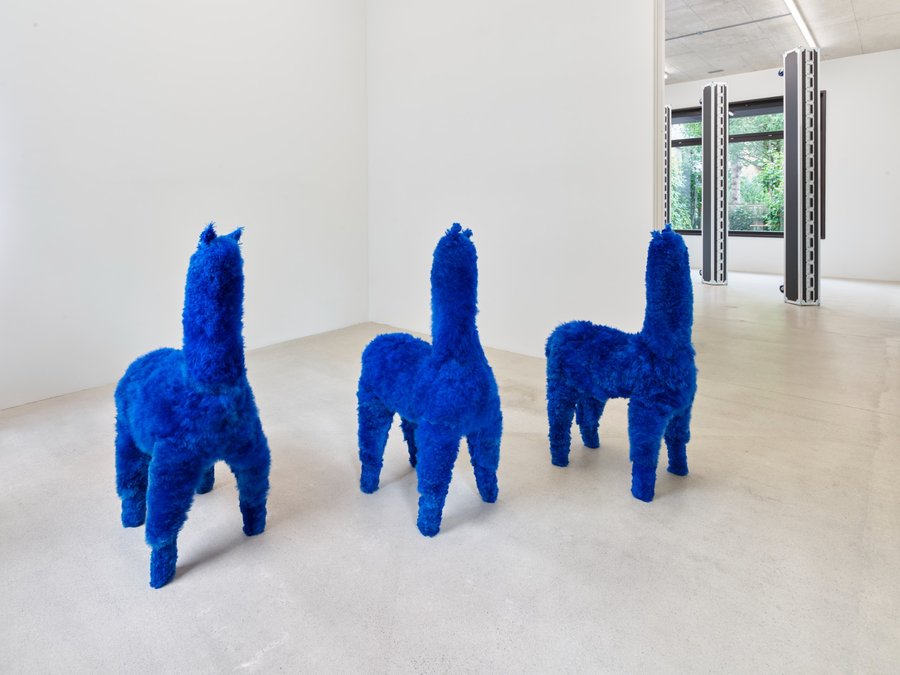
- A catalogue of the show’s physical vocabulary Junk the Plane, Cherry Noise, Crisis of an Ancient Feud, Phenolic Mother, Petty Crime, the Oswald Skeleton in the CIA closet, Handling Instructions for Sisters EDGE PROTECTOR 6105 CASEMAKER 9.5 MM SWIVEL CASTER, UNBRAKED BALL CORNER LARGE THREE-LEGGED CRANKSHAFTS SPRING LOADED HANDLE STANDARD BLIND RIVET POLYAMIDE CASTER PLATE BLACK, LEFT POLYAMIDE CASTER PLATE BLACK, RIGHT PHENOLIC RESIN BOARD SMALL PARTS ALPACA HIDE ACID DYE, BLUE POLYESTER FIBERFILL STEEL ARMATURE COTTON THREAD LEATHER Water, Sodium Hypochlorite, Sodium Chloride, Sodium Carbonate, Poly(Diallyldimethylammonium Chloride), Sodium Hydroxide, Polyacrylic Acid, Sodium Bisulfite Terminated In BLEACH, Wara presents three flight cases and three alpaca forms. The works bring together the language of transport and storage with the language of the animal body. Through repetition, the distinction between container and object is left unstable. BLEACH is Wara’s first exhibition in Zurich. Agatha Wara works across sculpture, installation, moving image, and performance. Her work develops through a recurring cast of objects and components that areDescription
Agatha Wara BLEACH Zurich
Until 30 Oct 2026
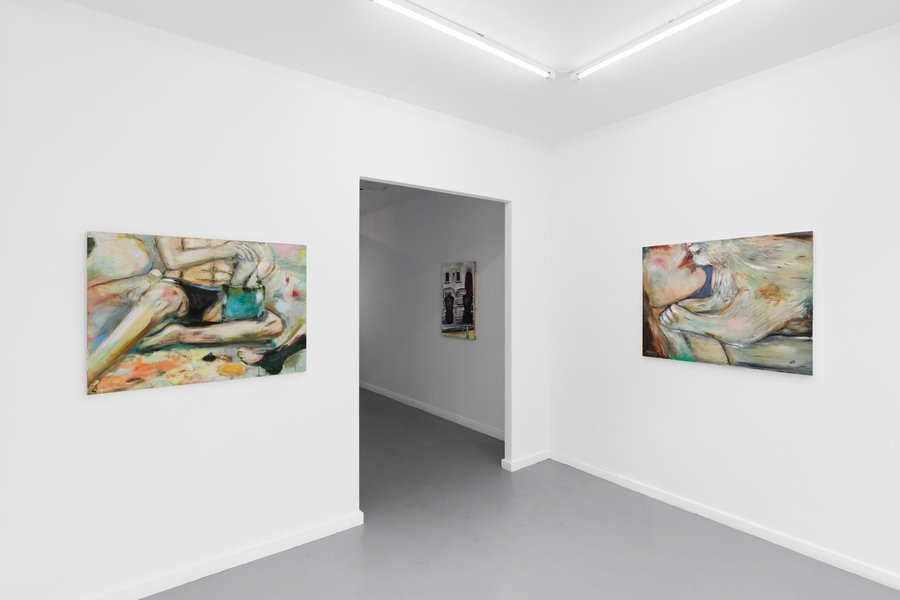
- In Shape of a Heart brings together paintings, sculptures and videos that explore our strange ways of showing affection and the things that merely resemble love. Moving between pets, anatomical figures and bodies inhabited by rooms and passages, the exhibition considers the animal just outside us, and the human just inside the animal. Found digital images are reworked through physical materials and gestures, giving them flesh and friction. Running through the works is a persistent, perhaps inevitably disappointing desire to look inside: to find something more real, intimate or true beneath the surface. Yet opening a body, a sculpture or another person may reveal only more surfaces, seams and constructions—the heart never quite taking the shape we imagined.Description
Mathias Toubro In Shape of a Heart Brussels
Until 31 Oct 2026
Coming soon
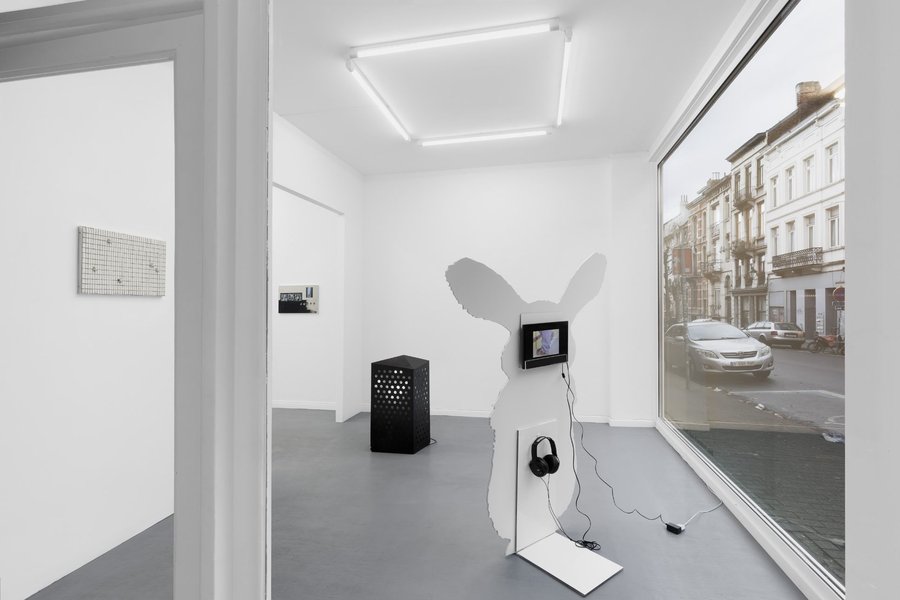
- People are afraid to merge 1, yet they stroll through the city, engulfed by its eloquent urban architecture. Illuminated by moving billboards, flickering screens, rampant advertisements, cutouts, leaflets, and various campaigns—they rush into malls and stores for all sorts of reasons. Perhaps they are seeking escape, or simply looking to warm up and enjoy the comfort of in-real-life window shopping; we all inadvertently fall into certain looping traps. Immuneless and expectant of something special, yet trivial—something close to nothing—the agony of rife branding pokes even more insidiously from our phones. Every app seems infested with a framework of advertisements, infiltrating every moment of our daylight and nightlife. In one thorny 2020 theory, the idea of branding or marketing oneself approaches a kind of self-prostitution. As articulated in original words: “While everyone’s personal brand becomes monetizable, the lines between prostitution and self-promotion are blurred. In 2020, everyone’s a performer, an artist, an escort, and a social worker,” Natasha Stagg allegedly claimed before quitting Instagram and smoking for good. Let’s place a cryptic theory into our constructed reality: both, Jiajia Zhang’s and Béla Feldberg’s works at Damien & The Love Guru in Brussels slam a notoriety of references. Their works harness and study levels of social ennui—That of numbness produced by an industry obsessed with extraction and luxury, the marketing so pervasive, it warps the exterior architecture, and eventually fucks with (our) urban isolation. —You never get to feel lonely while you’re browsing through stuff online. You’ll never get to feel lonely while ordering online. As a result, you emerge from utter exposure either way, confronted with either too much or far too little. Pick your battles, they say. The cityscape’s facade—its composition and depth, heavy black-painted door to a club or a resto, a mascotte toy in the mall—gambling with what you think you see. A shift in scale and perspective occurs. Control and domination: Crushing. How did we get here in the first place? How does one get out of this in the first place? Imagine you’re queuing for one of the most delicious hotdogs in New York City, like the one at Gray’s Papaya on the Upper West Side—and while you wait for your jiffy food, you start to feel a tinge of hesitation. It’s not that a hotdog is the problem! Faced with public commerce and exposure, with all that’s out there gaping at you—you stare back at it. It’s because brands must prioritize branding, not product, in precarity.”—“At work, we had to rebrand ourselves, too.”2 Your mind spurs with existential questions. Sigh. You start composing notes, mindmaps in your head, recklessly thinking that this might help. You’re wrong —“Like microplastics sloughing off the cheap fabrics we wear, it is around us, in us, on us, and being advertised to us, forever. 3 Jiajia Zhang refers to Gruen transfer (also known as the Gruen effect)—the moment when consumers enter a shopping mall or store and, surrounded by an intentionally confusing layout, lose track of their original intentions, making them more susceptible to making impulse buys. In my canned existence, I think of being sealed away at a distance. Like a Poughkeepsie Frozen Yogurt that you buy in one of the bodegas of New York. Everybody gossips, fucks, drives drunk… This is a higher stratum, one of derangement brought on by wealth earned in a culture where nothing is sacred. 4 It had all gone wrong. At long last, I had found myself vulnerable to the worst of New York City, because at 44 my life was not so different from the way it was at 24. Stubbornly and proudly, emphatically and pathetically, I had refused to grow up, and so I was becoming one of those people who refuses to grow up—one of the city’s Lost Boys. I was still subletting in Greenwich Village, instead of owning in Brooklyn Heights. I had loved everything about Yale Law School—especially the part where I graduated at 40—but I spent my life savings on an abiding interest, which is a lot to invest in curiosity. By never marrying, I ended up never divorcing, but I also failed to accumulate that brocade of civility and padlock of security—kids you do or don’t want, Tiffany silver you never use—that makes life complete. Convention serves a purpose: It gives life meaning, and without it, one is in a constant existential crisis. If you don’t have the imposition of family to remind you of what is at stake, something else will. I was alone in a lonely apartment with only a stalker to show for my accomplishments and my years. 5 Notice! Sneaky brands steal my attention, which I so involuntarily provide. Out in the open. Your mall design and cool shopping apps make me wanna buy it all, although I know it’s all wrong. That I’m so wrong. Whenever I woke up, night or day, I’d shuffle through the bright marble foyer of my building and go up the block and around the corner where there was a bodega that never closed. I’d get two large coffees with cream and six sugars each, chug the first one in the elevator on the way back up to my apartment, then sip the second one slowly while I watched movies and ate animal crackers and took trazodone and Ambien and Nembutal until I fell asleep again. I lost track of time in this way. Days passed. Weeks. A few months went by. I ordered delivery from the Thai restaurant across the street, or a tuna salad platter from the diner on First Avenue. I’d wake up to find voice messages on my cell phone from salons or spas confirming appointments I’d booked in my sleep. I always called back to cancel, which I hated doing because I hated talking to people. 6 Meanwhile, men and women in suits, tourists, and teens still queue for Gray’s Papaya’s no-mess, no-fuss hot dogs on the Upper West Side. And some people are afraid to merge and isolate themselves, faintly believing this is what makes them feel better. And maybe it will. To separate is to deter and withhold whatever does not need to include oneself in order to be considered accountable—to appear or render meaningless. …stores, malls, and shopping centers of all kinds… streets and venues, as well as our constructed online verses, all contribute to our own apathetic phoniness. We may also invent a new term for “it’s over.” We may create yet another meme, a new post-era content—something to cover our previous tracks that reek of crassness and delusion, something far beyond mediocre broadcasting—to say, to find a way toward and press EXIT. And I wonder, but then again, it may be only A Rare Kind of Trust —the kind we can still hold toward ourselves, tightly gripped in our hands.Description
Béla Feldberg & Jiajia Zhang A Rare Kind of Trust
22 Oct 2026 – 23 Feb 2027
Recent past exhibitions
- group show in collaboration with Reilly Davidson The fur has teeth. When strung together, these words demonstrate linguistic strangeness. Interlacing soft and hard, severe and benign, the independent clause hovers beyond resolution. If language is taken as malleable, such could also be the case with objects, ideas, and forms. It is apparently the plight of the 21st century to be living after the end of history and within a domain of informational overdrive. Accordingly, collecting and recasting preexisting elements becomes less an act of citation than a method of critical arrangement. Nicolas Bourriaud effectively underscores this quest in Postproduction, writing "the end of the modernist telos (the notions of progress and the avant-garde) opens a new space for thought: now what is at stake is to positivize the remake, to articulate uses, to place forms in relation to each other, rather than to embark on the heroic quest for the forbidden and the sublime that characterized modernism." He points directly to a "deejaying of visual forms" as the new frontier for cultural producers in the twenty-first century. The artists here actively exploit the vault, cataloging and revealing hidden structures that might otherwise go unchecked. Through painterly iteration, Helen Shu largely obscures the autobiographical roots of her compositions. Referents become sublimated through the abstract process, her distillation methods pushing the resulting work into territories that resist outright derivation. Traceable fragments do surface on occasion, as personal scraps and relics intermittently slip into the paintings. These shapes and images are pulled from a growing library, fodder for constant revival and recombination that Shu approaches with clear dexterity. Occupying a more pictorial terrain, Tanja Widmann largely repurposes existing cultural ephemera, redirecting it into new networks of images, space, and time. She manipulates portraits from Richard Prince’s already appropriative "Girlfriends" series, subjecting them to further reassignment. These women are once again taken out of context, funnelled into new discursive ecosystems. Widmann’s interventions, however, are not an attack on the primacy of images, but rather function as negotiations within its economies of circulation and systems of meaning. Rafał Skoczek’s readymade inclinations become the apparatus driving structural inquiry. Across his practice, Skoczek reveals the contours of the everyday through preserving then reorienting disused items as art-objects. He translates structures from the outside to the inside, reconstituting them within the gallery space as a means to evince new territorial possibilities. Plucked from the Wiedikon neighborhood in Zurich, these panels bear the sun-printed shadows of the fence they served to protect. On a previous visit to Brussels, Skoczek stayed in a squat with a troupe of nomadic breakdancers, amongst others. One morning he woke to find a sad clown standing in the center of the room. It became readymade fodder, the artist trailing him through the city to document his meandering rituals and minor performances as they played out. In a different corner, Charlemagne Palestine’s world is populated with dadaist maneuvers, non-hierarchical object play, ecstatic video pieces, and experimental sonic landscapes. Central to this particular exhibition is his "plushie" menagerie; he retrieves and inherits legions of stuffed animals, seeing them not as mere playthings, but as carriers of spiritual energy. These beings float, cling, lay, and perform, their arrangements conducted in harmony with the multifarious works on view. Disposability and circulation are central to Yun Heo’s Aromaboy. Her pileup of objects demonstrates the dissemination or potential obsolescence of certain consumer goods and cast-off materials. The toilet-as-system becomes an antisocial site of flux, where waste, repetition, maintenance, and movement cooperate. Here, a mix of found and fabricated components are clustered, reiterated, and situationalized in reference to these operations. This configuration rests in a somewhat oppositional territory, as the artist leverages assemblage toward the abject and excessive—the stuff that cannot truly be contained. In the waning stages of his essay, Bourriaud insists "to rewrite modernity is the historical task of this early twenty-first century: not to start at zero or find oneself encumbered by the storehouse of history, but to inventory and select, to use and download." He suggests that those practicing within this archive-saturated present are moving beyond sheer appropriation, actively recoding existent semiotic assemblages and flows. This exhibition is thus a testing ground for interference, with artists that take, store, block, reshape, and redefine the archive. Clashes between sleek, dirty, perverse, and cute notions and aesthetics facilitate the evergreen potential of inventories that are ripe for reshuffling.Description
The fur has teeth
Ended 25 Apr 2026
Jannis Marwitz FISH fish
Ended 28 Mar 2026
- Is a gap the opposite of a hole? When we consider a hole, the void, the core, the nothingness, and the emptiness – still assuming the gap might be its opposite – is the gap the place where light shines through? But whereas there might be only one hole, which stands for all the holes existing, a gap is something in between the things. A gap is something that connects, though vague. A gap is something that gives rhythm, is it repeated. It’s flickering. To embody the gap and its repetition in the exhibition, several radiators are depicted in paintings. These works are called Radiator Pieces. A title, that is carried over to other, sculptural works in the show. Even though this choice is made to emphasise a connection of sense over several media - here sculpture and painting - you might consider an agglomeration under the same title a piece of manual or a form of guidance for something that can be easily repeated at home. It may be useful to remember, however, that a gap can also be a cut, a gaping wound. Something difficult to trust. A gap can be dangerous if we underestimate its distance. And if we do, we fall, into the brightest of holes.Description
FISH fish
Ended 28 Mar 2026
- When figures of Romanticism tripped over roots and table legs, they stumbled upon a world in flux. Moving from bohemian to faux-hemian, as influence shifted from aristocratic refinement to capital and social navigation. Over time, efficiency and time management replaced the savoir-vivre, and today, information asymmetries and attention from the savoir per se a pharmacological substance that both stimulates and numbs. From trippy to tragic: surfaces can never be fully smoothed. Panorama brings together five artists whose works can be read as parts of a process of transformation. Through their biographical, (art) historical, or social patination, they unfold as tableaux that shift between narrative construction and situational mise-en-scène ⏤ Dominic MichelDescription
Panorama group show curated by Dominic Michel
Ended 6 Feb 2026