Paris
Galerie Jocelyn Wolff
On now
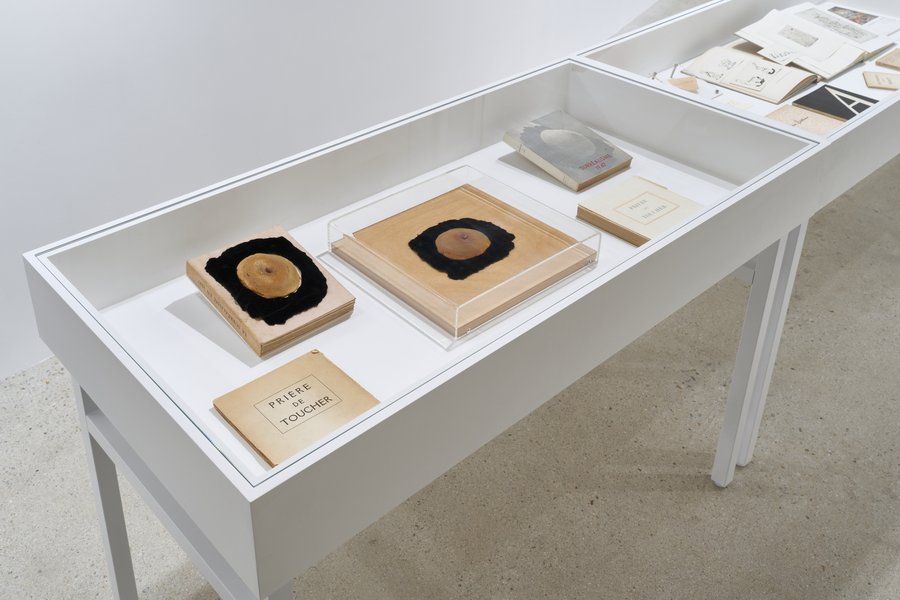
- Meyer Riegger Wolff - Seoul We are pleased to present the first gallery exhibition dedicated to Marcel Duchamp in Seoul, South Korea. Bringing together an exceptional group of nearly 250 works, the exhibition offers a rare immersion into the universe of the artist. Conceived as an ambitious and coherent exploration, the works on display include books created or designed by Duchamp, exhibition catalogues, journals, artist’s books and ephemera. Far from constituting a simple documentary corpus, this ensemble forms a true experience, revealing the richness of a body of thought that profoundly transformed our understanding of art in the twentieth century. Built over nearly thirty years, this private collection stands out in terms of the rigor of its construction and the consistency of its choices. It is not the result of accumulation but of careful selection, with particular attention paid to quality, historical relevance, and the capacity of the different elements to engage in dialogue with one another. Such coherence — now exceedingly difficult to reconstruct — positions this ensemble at an institutional level. Among these works, around fifty stand out for their extreme rarity. Some, scarcely accessible and seldom seen on the market or in institutional contexts, lend the exhibition a unique character. This concentration of rare works represents an exceptional opportunity, for institutions as well as for collectors and informed audiences, to access pieces that are usually dispersed or inaccessible. The exhibition also offers an essential point of entry into understanding the work of Marcel Duchamp — particularly through the fundamental question of editions. Far from being mere vehicles of dissemination, these are considered as works in their own right and were fully integrated into his artistic practice. Duchamp develops a genuine editorial strategy: layout, typography, wordplay and fragmented constructions, all contribute to an overarching aesthetic in which the idea takes precedence over form. The works presented here function both as means of dissemination and as collectible objects. They testify to an artistic practice that constantly shifts, eludes established categories, and anticipates many contemporary concerns: the status of the author, the circulation of images, and the relationship between art and the market. A major and deeply innovative figure, Duchamp redefined the very foundations of art with the invention of the readymade, shifting artistic value towards the intellectual act of designation. Within this framework, the works presented here take on their full significance: they do not belong to the periphery but rather lie at the core of his practice. This approach is now fully recognized by leading international institutions (Philadelphia Museum of Art, Centre Georges Pompidou, Paris, and MoMA, New York), which have integrated these materials into the heart of their collections, granting a central place to archives, editions, and editorial devices in the understanding of his work. This ensemble does not merely constitute a documentary corpus; it forms an active cartography of Duchamp’s mind, where philosophical reflection, humor, language and editorial strategy intersect. Such a complete and structured body of work, whose density, rarity, and coherence meet the highest standards of the international market, represents a particularly strategic opportunity.Description
Marcel Duchamp, Marcel Duchamp: A Parisian Collection
Until 5 Nov 2026
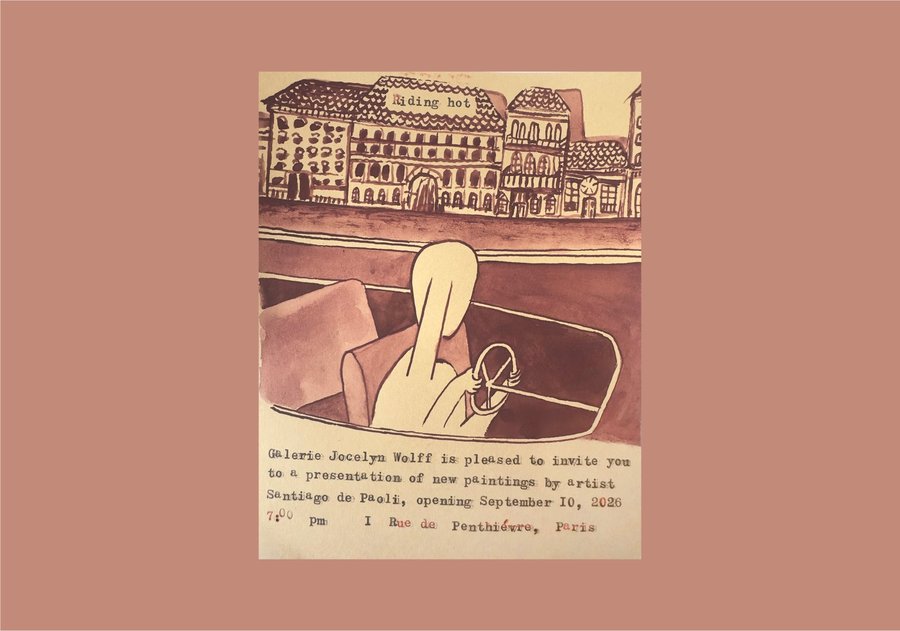
- For his third exhibition at the gallery, Galerie Jocelyn Wolff presents Riding Hot, a solo exhibition by Santiago de Paoli, unfolding across two venues in Paris: Galerie Jocelyn Wolff and Abraham & Wolff. This enigmatic and surreal title is borrowed from a series of paintings made using a variety of unconventional materials: wood, copper, cork stoppers, dried leaves, and even peanuts. Santiago de Paoli continues his painterly exploration, in which images seem to emerge from a dream or a fragmentary memory populated by moons, landscapes, bodies, domestic objects, and organic forms. Oscillating between nature, magic, and abstraction, these elements are permeated by a constant tension between humour, poetry, and strangeness. Riding Hot brings together a new body of monumental works, presented for the first time. The exhibition marks a new stage in the artist’s practice, in which the materiality of the works becomes an increasingly open field of experimentation.Description
Santiago de Paoli: Riding Hot
Until 7 Nov 2026
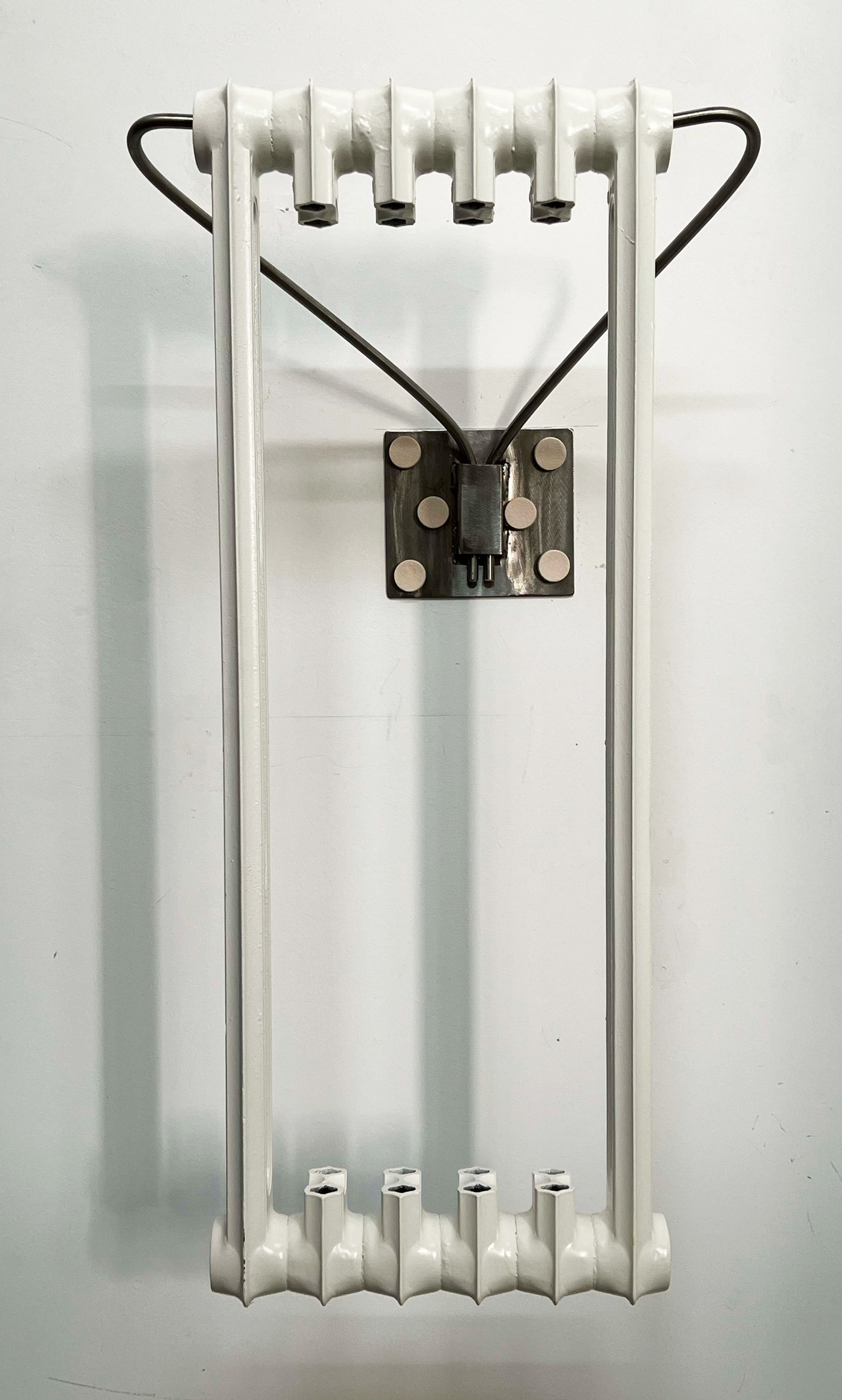
- URANIA Goddess of the sky, protector of astronomy and geometry, daughter of Zeus and Mnemosyne, URANIA is also the title of a cult science fiction book series launched in the early 1950s by the Italian publishing house Mondadori. Guided by the formal language of science fiction and threaded by fragments of the sky, this first collective exhibition in our new space is conceived as a research-based project, bringing together a constellation of contemporary artistic propositions that explore the field of sculpture and foster intergenerational dialogues between artists. Tête noire 2 (2025) by Diego Bianchi is one of the artist’s first bronze works, shown here for the first time. It was created by fusing together various discarded elements — some found on the street — as a reflection on overconsumption: computer cables, fragments of electronic objects, and so on. Katinka Bock presents three new pieces, sculptural collages that, in one case - Horloge (2025), evoke the game of balance and tension integral to the artist’s sculptural language, and in the others ( Cardiogram I (2025) and Cardiogram II (2025)), the relationship between mechanical or domestic elements and the human body. Weeping Rock (2025) by Brazilian artist Paloma Bosquê plays on the illusion of a rock made entirely from non-mineral materials (cotton fiber, layers of resin), and of a fountain whose shape arises directly from the connection between geological nature and the female human body. The use of stained glass is a common thread running throughout the work of Ukrainian artist Daria Koltsova, who explores themes shared with the previously mentioned artists. Witnesses (2024), a pair of black sunflowers, plays with the reflections between the two large flowers/shields; Cracks (2024), metal buckets whose liquid contents have been replaced by stained glass suggesting both the surface of water and a fracture; and the Toys series (2025), created during her residency at the Domaine des Oseraies, features knives made from shards of stained glass, their sharp violence softened by the seductive play of color and iridescence. muses (2025) is a work by Daiga Grantina made from synthetic materials that evoke biological forms such as “buffs,” inflated counter-shapes covered in fabric, suspended by metal mesh. Without any direct natural reference, muses (2025) evokes an iconographic register close to that of science fiction book illustrations. Isa Melsheimer ’s ceramic suspension entitled Feston I (2022) refers to garlands of fresh or sculpted flowers and leaves used as architectural ornamentation, while also evoking the forms of a rosary, a spine or a vine. The two works by Annie Quéméneur Lauras, La grande hostie (2020) originating from animal parts (the mare’s placenta and animal glue) and La pierre fertile (2015) originating from minerals (chalk mixed with animal glue), attest to the artist’s deep connection to the earth and the agricultural world, whose raw materials she sublimates into abstract compositions created through layering and stratification. SR 47348 (2024), the title of Chloé Royer ’s piece, is also the name of a prototype shoe that forms part of the work and reflects the artist’s long-standing friendship and collaboration with Salomé Burstein (Shmorévaz). The carved wooden legs wearing the prototype — evoking both bone and flesh — are held together by silicone straps and outline the shape of a headless body; a body without a full presence but defined solely by its potential for movement. Christoph Weber is fascinated by the qualities of concrete — drawn to its malleability, processability, and creative potential. In these specific works on show, the concrete forms reminiscent of his typical sculptural language are contrasted with a base made of beeswax, an entirely different yet equally malleable and durable material, creating a striking and tactile contrast. The preferred technique of Shanghai-based artist Yunyao Zhang is freehand drawing on felt. Study in Portraiture 4 (after Temple of Love by Rick Owens) (2025) and Hypothesis on Evolution (2025) are two of the exhibited works created using this technique. The first belongs to a series inspired by fashion designer Rick Owens’ recent exhibition at the Palais Galliera; the second, evoking a David Cronenberg–like universe, depicts an alien being (spine, jellyfish, phallus) accompanied by its study drawing on paper. The fourth work exhibited, also titled Hypothesis on Evolution (2025), presents an image inspired by Modigliani and Brancusi’s Cycladic forms, completed with the collage of a dried plant collected in Portugal.Description
Urania
Until 13 Jan 2027
Recent past exhibitions
Art Basel 2026 Fair
Ended 21 Jun 2026
- Paris - Matignon Francisco Tropa’s work is grounded in an imaginary world that is continually nourished by literature, philosophy, history, and conversation, notably through the exploration of themes such as vanitas and representations of the measurement of time. Miss America is the name of an imagined boat, which one boards as soon as the gallery doors are crossed. It is also the title of a narrative, visualised by Tropa. Thus, the exhibition allegorically invokes the maritime world, and more specifically naufragium in its ancient (Roman) sense—that is, an accident or an uncontrolled fall. This word was used to refer both to shipwrecks and to chariot accidents in the Roman circus. The boat, the sailors, and the shipwreck are also figures that have evoked imagery since ancient times, such as Ulysses in the Odyssey, and are associated with the story of a character constantly in motion. At the origin of this exhibition lies an object unearthed by an archaeologist friend: a small bronze tower designed for casting dice. Dropped through an opening at its summit, the dice cascade down an internal staircase before revealing their final arrangement—an orchestrated fall that invokes chance and may be read as an allegory of the Roman notion of naufragium. The first part of this fiction, Miss America, was recently presented at the Palazzo De’ Toschi in Bologna, curated by Simone Menegoi. At Galerie Jocelyn Wolff in Paris, visitors are invited to discover two new chapters that complete the story of Miss America : Poor Captain and Shipwreck. The myth of the sailor is also accompanied by songs. The artist therefore asked a close collaborator from the maritime world to write three songs, each inspired by one of the three chapters of the story. They reflect the language of sailors and provide clues for deciphering the allegory. These songs are made available to the public in a leaflet at the entrance to the gallery.Description
Miss America
Ended 20 Jun 2026
- With STILL LEBEN, Miriam Cahn embarks on a new body of work. In these recent pieces—almost all produced in the past few months—there are hardly any bodies anymore. Only objects, everyday situations, interiors. No more brutality, at least on the surface. Instead, a focus on the domestic world and on what the artist calls le ménage. The pieces are small to medium in scale. Miriam Cahn plays less with effects of scale than she has in the past. There are no violent contrasts, no oversized works that absorb and confront the architecture. Rather, these are works that the body can make, that the body can carry. The things painted and drawn, like the images themselves, all have to do with the body. A body that is almost invisible. A softer, more measured spatiality. Still Leben. A quiet life. Stillleben also means still life in German. In Miriam Cahn’s works we see objects, everyday life, silence. Yet these still lifes are of a particular kind. Or rather, they do not conform to the genre and its codes. They seem barely composed; the framing is often close, direct, sometimes frontal. These things are those the artist has within reach: tools, furniture, clothing. No symbol, no metaphor—just the everyday. The everyday of a woman. Some signs carry no specific gender connotation—a glass, a ladder, a refrigerator. Yet here and there a few clues, very few: a handbag, a sanitary pad, gloves. Once brought into relation with one another, they form a gesture of absolute clarity. It is a matter of showing, without détour, the density of a world: gestures, practices, what concerns women’s bodies—that is, half of the population, the half responsible for taking care of these objects and of the household for the other half. Miriam Cahn’s stillleben are anything but motionless. The silence within the works is alive. Movement is latent. For the ménage the artist speaks about—the subject of these works—refers to the action of things, to the way the organization of the interior opens outward through objects and spaces. Animated bodies, inanimate things. Another way of seeing life in common. In these works, the woman’s body is not confined within the home. It is active there; the tasks of cleaning reveal a body responsible for itself. Hands appear—acting parts of the body—hands that wash, that organize, that arrange. To speak of ménage, in a sense, is to speak of the necessity of order and disorder, of life, of taking care. In one of the works we see a jacket laid down, open. In another, a wardrobe in which clothes are neatly aligned. In TRAUMBEFEHL, Miriam Cahn’s exhibition at Galerie Meyer Riegger in Berlin in November 2025, objects seemed to rebel. The artist described how a knife could suddenly fall, the hand no longer able to hold it as firmly as before. Putting on shoes, tying laces, was sometimes no longer as easy as before for a body that is aging. Miriam Cahn also said in an interview: “old age is my future.” In STILL LEBEN, everything exists on the same level; there is no hierarchy. Yet each object appears roughly only once. The image is unique, and so is the thing represented. The artist speaks in this regard of Einmaligkeit : the uniqueness of the things that surround us, that we care about, that make up our interior world. If the thing disappears, it will be lost forever. For STILL LEBEN is not a series. Each thing, each scene is adjusted, at the scale of the frame, so that it appears to the gaze at a similar dimension. Everything is placed on the same plane. The result is the opposite of flattening: what emerges are differences and relief. The subjects, of different kinds, are also treated through varied means: painting on canvas, on wood, pencil, charcoal, pastel on paper. And yet everything is brought back to the vision of an equal—perhaps even egalitarian—composition. Like the line of a poem. Like a constellation. When I telephoned Miriam Cahn to speak about her upcoming exhibition, she told me: “what is shown is in the image.” I understood: there is nothing to see other than what is represented. But I also understood that each painting, each drawing shows what the artist wished to make visible: material life, the life of women, the body as it matures. But also this: the violence and wars that haunted earlier works have been set aside. The emotions linked to them reside in that space—in the realm of a reality the artist has decided not to paint. I cannot think about these works without imagining what remains in that night, behind the visible. Those bodies that irradiate in Miriam Cahn’s works, and in which I now see the life of these objects. In most of the images, bodies are missing. The clothes seem emptied out. The interiors are uninhabited. Objects sometimes appear abandoned, isolated. Yet the body is omnipresent. It is as if things spoke—without words, in a physical way. Spoke to bodies. During our conversation, Miriam Cahn told me she was haunted by the images of families who had to leave their homes, their neighborhoods, fleeing wars, destruction, catastrophes. They set out along the road carrying their ménage with them—these objects that, in exile, connect them to their history.Description
Miriam Cahn STILL LEBEN
Ended 25 Apr 2026
- For this first edition of Paris Internationale Milano, we present a curated selection of works by Prinz Gholam and Santiago de Paoli. Though emerging from distinct conceptual and geographic contexts, their practices resonate through shared aesthetic affinities and a sustained engagement with physicality, density and tactility. Born in Buenos Aires in 1978 and now based in New York, Santiago de Paoli works with unconventional materials such as plaster, copper and felt. His practice revisits recurring motifs — moons, candles, socks, flowers, clouds — inflected with subtle irony, between intimacy and absurdity. For this presentation, we will focus on four paintings depicting butts at times fused into domestic objects. It evokes a surrealist lineage and echo assemblage, reflecting an artistic heritage rooted in Argentina. In dialogue, drawings by the Berlin-based duo Prinz Gholam extend this focus on the (un)gendered body. Working between performance and drawing, their practice unfolds between the live body and its representation. Some works document enacted gestures; others feature paper masks worn by them. They often reference historical depictions of the male body and contemporary homosocial and sexual imagery, notably in a recent series inspired by Fassbinder’s Querelle. Deeply invested in sensuality as both subject and method, these works engage the body as a site of tension. Installed together, they will create a charged hanging anchored in rigorous theoretical inquiry.Description
Paris Internationale Milano Fair
Ended 21 Apr 2026
Manuel Alvess (estate of) Haute surveillance Paris - Matignon
Ended 7 Mar 2026