Warsaw
GUNIA NOWIK GALLERY
On now
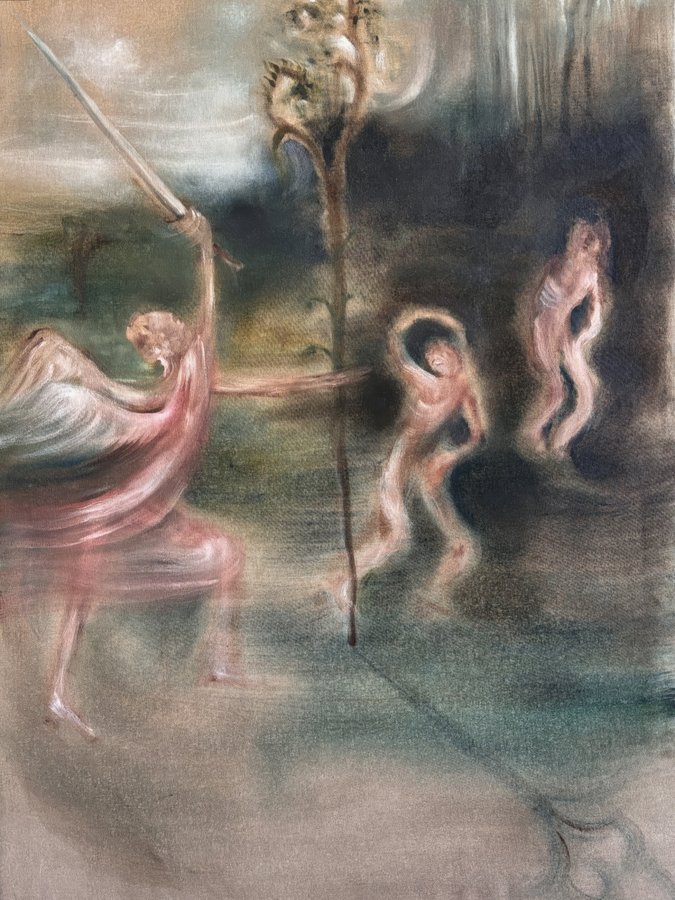
- For her second solo exhibition at Gunia Nowik Gallery, Sana Shahmuradova Tanska presents a new body of works drawing on Ukrainian mythology, ancestral memory, and the lived experience of war. Reflecting on broken promises, inherited histories, and the fragile space between prophecy and political reality, the exhibition imagines what persists after certainty collapses. Rather than offering an escape from history, Shahmuradova Tanska's paintings turn to myth as a way of confronting violence, carrying memory, imagining forms of care and resistance, and opening space for possibilities that dominant historical narratives cannot contain. As the artist writes: "This exhibition begins where promises collapse. Rather than asking What if?, it asks a different question: Who said it was going to be alright? The answer comes from the same voice: We never did. Indeed."Description
Sana Shahmuradova Tanska: Who Promised It Was Going to Be Alright? We Never Did. Indeed (History Knows No “If”)
Until 7 Nov 2026
Coming soon
- We are pleased to feature Eternal Machine, a second solo exhibition by Iza Tarasewicz at Gunia Nowik Gallery, as part of the Warsaw Gallery Weekend 2024. The show delves into the intricate interplay between human identity, technology, and environmental awareness. Amid rising social fragmentation and market-driven encroachments on life, Eternal Machine prompts a vital reassessment of the individual 'self' within a mosaic of collective histories, experiences, and desires. As global challenges like climate change, the rise of fascism, and extreme individualism persist, Tarasewicz's work encourages a reimagining of our connections to an increasingly privatized and divided world. Hand-dyed plant fibers, organic pigments, steel, brass, silicone – Eternal Machine merges natural and engineered elements to reflect the evolving integration of machines, humans, and technologies. Through themes like 'Agropunk' and 'Technopunk', the exhibition paints a narrative of community dissolution and potential reconstruction. It invites us to reconsider the notion of shared space in today’s world and a redefinition of human limits and our interactions with both animate and inanimate surroundings.Description
Iza Tarasewicz Eternal Ma
22 Oct 2026 – 23 Feb 2027

Recent past exhibitions
- Each of us can become a criminal. Not because we have done something wrong, but because we may be named as one. All it takes is becoming caught in the machinery of a certain system, passing through its procedures and submitting to its language, being marked by a stigmatizing label. Daniel Rycharski’s exhibition Wolf’s Hole at Gunia Nowik Gallery grows out of the artist’s and Taras Gembik’s year-long weekly visits to a detention center. Every Friday, they crossed the prison gates, entering a space of isolation in order to speak with incarcerated individuals and observe the workings of the institution from within. The exhibition emerges from this encounter with a system that produces dependency, helplessness, and even guilt itself. The exhibition’s title comes from Władysław Reymont’s The Peasants. “Wolf’s Hole” names the site of a conflict between peasants and a landowner over a forest. The peasants win physically, only to immediately lose to the apparatus of the state: courts, police, prison. Their conflict is taken away from them, translated into the language of law, and turned against them. Rycharski shows that a similar mechanism persists today. One may feel innocent and still become drawn into a machinery that names, classifies, and subordinates. The exhibition begins with Five-Minute Prison, a gesture inspired by the writings of Lech Falandysz, Nils Christie, and Monika Płatek, all of whom questioned punishment grounded in suffering. Rycharski brings this idea into the space of art and asks whether punishment must necessarily involve isolation, humiliation, and revenge. Yet the exhibition points toward something even more unsettling: contemporary society no longer relies solely on prison walls. It produces its own everyday micro-prisons through economic dependency, bureaucracy, institutions, and the language of judgment and exclusion.Description
Daniel Rycharski: Wolf's Hole
Ended 5 Sept 2026
Iza Tarasewicz: Thank You For My Work
Ended 26 Apr 2026
- KINO brings together video works that explore “after the end” as an ongoing condition of erosion and reorganization. Landscapes marked by technological excess, environmental damage, and political upheaval become stages for suspended transformation, while systems of power persist in altered forms. Moving between affect and analysis, the artists often employ seductive imagery, drawing viewers in through atmosphere, while subtly unsettling familiar narratives. Rather than offering clear redemption or finality, the works reflect a liminal present in which established orders lose their authority and other ways of relating—to history, responsibility, and the more-than-human world—begin to take shape. The program consists of 10 films with a total duration of 1 hour 58 minutes, presented on a continuous loop during gallery opening hours (Tuesday–Saturday, 12 – 6 pm). Visitors may enter at any point in the sequence; to experience the full program, we recommend allowing approximately 2 hours.Description
Kino
Ended 1 Apr 2026
- When observing a painting, particularly a figurative one, the eye tends to move between its formal elements (the “how”), its subject matter (the “what”), and its context (the “why”). Beyond these layers—perhaps without our awareness—we are also looking at a vehicle that captures, compresses, or even transcends us through time. Painting’s temporality (let’s call it the “when”) can be represented in the image itself, allowing past, present, and implied futures to coexist on its surface. But perhaps more subtly, it can also be registered as a physical fact in the way the materials and medium age. The fading of pigment, the cracking of paint, scuffs on the edges, or the wear of the frame are unintentional, circumstantial traces that make the painting both an image of time and an object marked by its passage. As an agent that binds time and space into a single, condensed field of meaning, painting can be observed as a chronotope. In this sense, the canvas is not merely a relic or a moment frozen in place, but a site where multiple temporalities are held in suspension and activated through looking. For Jędrzej Bieńko (b. 2000, Warsaw), this activation and the recognition of painting’s temporality are fundamental aspects of his practice. Interested in how meaning is produced, he creates works that surprise and confound, presenting them in ways that challenge habitual modes of viewing. Drawing on personal experiences, life dynamics, emotional states, and imagination, he distills these sources into what he considers their most universally legible form. The resulting images remain deeply personal while becoming open to being anyone else’s. On the one hand, they feel universal while emerging from a very personal place; on the other, they appear timeless and perhaps antique, yet are often presented in a technocentric, perhaps neoteric fashion.Description
Jędrzej Bieńko: Best Before
Ended 14 Mar 2026
- Wystawa "Ukryte parametry" została pomyślana jako zapis aktywności ciała, niestrudzenie zbierającego, gładzącego, wyplatającego i łączącego. Jest ona częścią długofalowego projektu, w ramach którego grupa osób eksperymentuje z różnymi materiałami. Używając metod, które wywodzą się z praktyk rzemieślniczych, czerpie jednocześnie ze strategii konceptualnych. Osią tej wymiany jest próba znalezienia narzędzi do testowania nowych form odczuwania i myślenia. Rozgrywając się na styku nauki, sztuki i rzemiosła, okazuje się częścią programu naprawczego, konstruowanego wobec wyzwań środowiskowych, z którymi się mierzymy.Description
Hidden parameters, OP ENHEIM
Ended 22 Feb 2026