Brussel
Harlan Levey Projects
On now
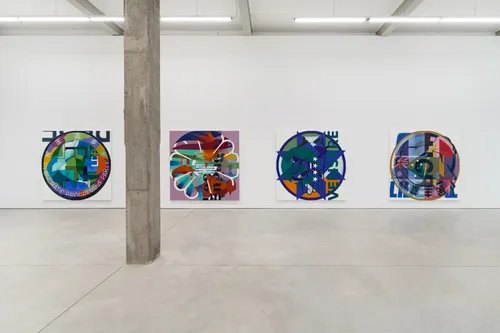
- Sean Crossley's Liberalism transforms the logos of political parties into large-scale, two-by-two-metre paintings, asking what becomes possible when images designed for instant recognition are remade in a medium whose purpose is not...Description
Sean Crossley Liberalism
Until 24 Oct 2026
Coming soon
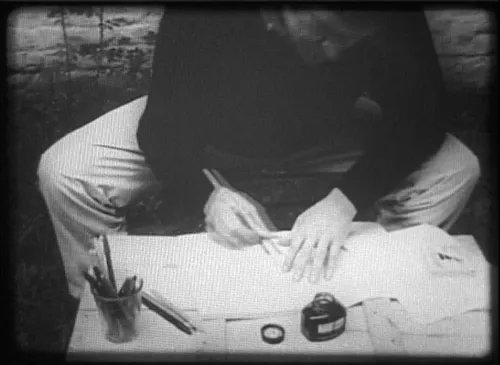
- Taking its title from a term coined by artist Warren Neidich, the exhibition asks...Description
Wet Conceptualism Chapter I
31 Oct 2026 – 19 Dec 2026
Recent past exhibitions
Flyways
Ended 27 Jun 2026
Transparences Liquides
Ended 3 May 2026
Le Monde Selon l'IA / O Mundo Através da IA
Ended 26 Apr 2026
- In her solo exhibition Imaginaire spatial, Amélie Bouvier offers a visual and conceptual exploration of the sky and the cosmos, drawing on past and present representations of the universe. Through works spanning more than a decade, the artist weaves together imagery from science, mythology, popular culture, and archives to address what is distant and inaccessible, yet charged with desires, ambitions, and beliefs. Using drawing, installation, and video, the works reveal what orbits the Earth - meteorites, satellites, and space debris - questioning what humanity projects onto the sky.Description
Imaginaire Spatial
Ended 25 Apr 2026
- Marcin Dudek was ten years old when the Polish People's Republic collapsed, and his childhood unfolded within the turbulence that accompanied Poland's transition to capitalism. In the social housing estates on the outskirts of Kraków, the dismantling of state industries and support systems produced conditions of scarcity, instability, and improvisation that shaped daily life for working-class families. Dudek's practice emerges from this environment, not as a retrospective illustration of hardship, but as a sustained inquiry into how social pressure, precarity, and endurance form subjectivity, memory, and imagination over time. NEST gives this inquiry architectural form. Installed within the gallery is a reconstruction of Dudek's fifty-square-meter family apartment, where he lived with seven relatives across two decades. Visitors ascend a staircase and pass through a narrow corridor before entering a compressed domestic interior. Devoid of furniture, the space resists nostalgia or documentary reconstruction. Instead, it operates as a hybrid structure, part period room, part sculptural installation, part theatrical environment, in which memory is not represented but spatialized. The apartment functions as a psychological and social map, where artifacts, artworks, and gestures accumulate into an environment that feels at once intimate and unsettled, provisional and uncanny. A taxidermied hoopoe (or dudek), suspended at the entrance, marks the passage into this charged interior. Echoing the artist's family name, the bird introduces a logic of doubling and slippage that recurs throughout the installation. Within the apartment, a radiator bears a sculpted hand chained to its surface, while a small painting nearby depicts a snake poised above a clutch of eggs. Meaning circulates between these elements without settling into fixed allegory. Dudek treats memory as mutable and relational, subject to condensation, displacement, and recombination. Trauma is neither narrated nor resolved, but reworked through metaphor, material juxtaposition, and a deliberate openness that allows play and ambiguity to coexist with gravity. The installation preserves material traces of Dudek's youth, including windows, curtains, photographs scorched into the walls, court documents, early sketches, and magazines that once offered a mental escape. These remnants are interwoven with gestures and artworks that summon lived moments rather than reconstruct them: the glow of a television, the repetitive training of a brother in the living room, parcels of dry goods and coins sent through international aid networks, an early oil painting that once hung in the kitchen, the low acoustic presence of hunger and failing infrastructure. Four works from the Klatka series appear as altar-like structures that fold open like manuscripts or journals, recording fragments of life on and around the housing estate. Together, these elements form an environment where memory and imagination overlap, and where the past persists as an affective, dreamlike presence rather than a closed narrative. Throughout Dudek's childhood, the apartment remained in a state of flux. Sleeping arrangements shifted, inhabitants came and went, and privacy was limited. Toward the end of this period, Dudek shared a room with one of his brothers, an arrangement that introduced a fragile continuity. This modest stability made space for repetition and concentration. Drawing, copying, and sustained looking became daily practices, gradually transforming withdrawal into discipline. In NEST, the bedroom is reconfigured as an atelier, where new paintings are shown alongside historic documents and artifacts. Hung on the walls or stacked on the floor, these works reveal the persistence of figuration, narrative, and structure beneath surfaces that might initially appear abstract. Exiting the apartment, visitors encounter a large painting depicting the surrounding housing estate as a single, looming form. The work is painted over a panel which carries almost three hundred thousand tiny cuts of medical tape, remnants of an abandoned attempt to tally each inhabitant individually, before the mass became too large to count. The painting's surface remains animated by this buried labor, its marks suggesting bodies in motion and collective presence. From here, the exhibition extends into a reconstruction of Café Cobra, an underworld bar from Dudek's former neighborhood. Like many such spaces embedded within social housing estates across different geographies, the bar operates as a site of informal community, social ritual, and cultural memory, even as it remains vulnerable to erasure. In returning to Café Cobra last year, Dudek undertook a project without commercial or professional incentive, bringing together local residents, younger generations, and figures from the art world. Archival photographs were installed directly into the space, and new paintings were exhibited, shaped by the bar's atmosphere and social history. Within NEST, this gesture is preserved not as documentation but as continuation, emphasizing the resilience, solidarity, and forms of care that emerge under conditions of constraint. Across painting, sculpture, installation, performance, sound, collage, and photography, Dudek articulates a singular visual language in which abstraction and figuration, process and image, remain inseparable. His practice resonates with the archival and site-specific approaches associated with Harald Szeemann, for whom lived experience functioned as a curatorial and artistic medium. In NEST, personal history becomes a lens through which broader social and historical forces are rendered visible, not as fixed conclusions, but as open, shared terrain shaped by memory, struggle, and imagination.Description
Nest
Ended 4 Apr 2026