Ixelles
Hopstreet
On now
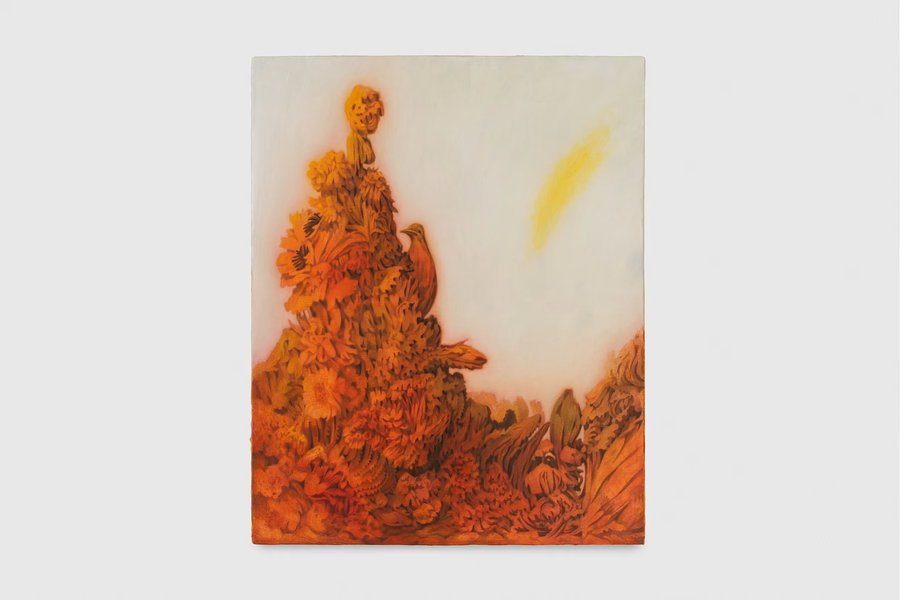
- haystack, which had established a recurring presence in this mythical world, seem to recede into the background as this exploration continues. In the small landscape with a blue sky and a dog, the bird-man is quite literally escorted away by a procession of people. His characteristic Tegumen – an enclosed, pod- or shell-like form – is also undergoing a transformation. The form – which, in a state of constant transformation and assuming countless guises, served as a kind of template for hybrid structures and creatures – is now broken open. The floral and plant motifs that claim the foreground are new. As they grow, they take on one another’s characteristics, as well as those of their surroundings. They form clusters in which individual elements merge into a new whole, caught in a continuous cycle of growth and decay. Uniting opposites within a single image is fundamental to Tinus Vermeersch’s oeuvre. What at first appears recognisable and familiar becomes unsettling. The image invites the viewer in, yet at the same time remains closed; it is narrative without explaining a story, detailed yet inscrutable. The same contradiction is present in his working method. Vermeersch returns to old, time-consuming techniques that seem scarcely suited to the pace of our times. His method consequently takes on an anachronistic quality: classical and idiosyncratic, yet at the same time distinctly contemporary. The title De Atavists, derived from atavism, lends itself to several interpretations. Alongside the other life forms, it may refer to the people who inhabit these anthropomorphic landscapes. We see them in small boats in the background, insignificant in scale, on their way somewhere or nowhere. They lose themselves in the trance of a ritual, or appear as individuals in portraits with partially veiled faces. Are they survivors of a collapsed culture, or ancestors from a distant past? Their name calls to mind that of a tribe, like the Eburones or the Iroquois, and evokes associations with history, anthropology and the adventure stories of Vermeersch’s youth. Perhaps, unconsciously, the title also refers to the artist himself. In his painterly exploration, he repeatedly returns to a kind of primal source, from which he creates new images. The Atavists thus becomes not only a reference to the past, but also to an artistic method: not reconstructing the past, but reactivating and transforming it. Out of a sense of unease in his relationship with modernity, Vermeersch searches for a visual language that is at once archaic and new, familiar and unsettling.Description
The Atavists
Until 24 Oct 2026
Coming soon
Wireless Connection
8 Nov 2026 – 19 Dec 2026
Recent past exhibitions
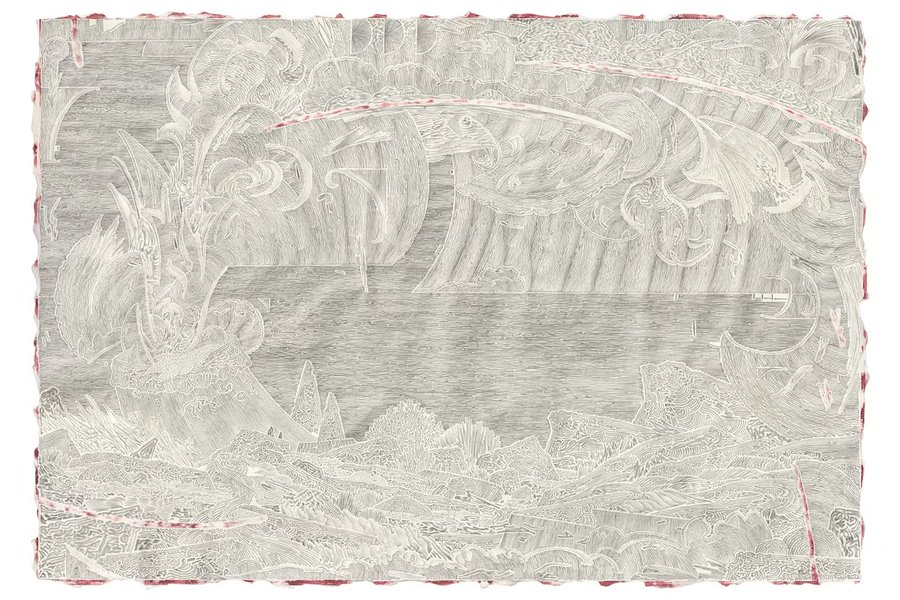
- Press release Dominique De Beir (°1964 F) seeks the depth of the surface, wanting to hollow it out, and chooses materials that are simultaneously firm and soft. She treats the paper as a kind of skin that bears the traces of what it used to be and is ready to receive other traces that will make it look different. She always attacks her materials on the reverse, so that the final form only becomes apparent once they are turned over.Through a series of manipulations, such as cutting, piercing and sanding, she makes traces and streams of colour appear until the surface is almost completely worn away. Her goal is to make the thickness tangible and help the viewer realise that there is a back surface to which they usually have no access. Sometimes she takes the perforations to the limits of what the material can handle. She plays with an inherent ambiguity between building and destroying, opacity and transparency, durability and fragility. For more than twenty years, De Beir has been exploring the possibilities of paper through its reverse side. This artist’s book, entitled Dos à Dos, brings together a selection of drawings reproduced in four-colour printing on a scale of 1:1 and chosen for the plastic power of their reverse sides. What happens on the back side of the paper is fundamental: that is where the forms arise and where the precarious balance between gesture and matter is formed. In a process that is the opposite of how one normally discovers a drawing, the backs are always reproduced first, while the fronts of the drawings — which usually constitute the work itself — appear on the reverse sides. Born in 1964, Dominique De Beir lives and works in Paris and Picardy. She has held a national diploma in Fine Arts from Paris since 1992. She currently teaches at the Rouen School of Art and Design and has been co-director of Friville Éditions since 2011. Her work is featured in numerous public and private collections, including: Frac Picardie, Frac Bretagne, Frac Provence-Alpes-Côte d’Azur, Fr; Frac Haute Normandie, Fr; Musée des Beaux Arts de Caen, Fr; Musée Fabre Montpellier, Fr; Musée d’Arts de Nantes, Fr; Musée Géo-Charles, Échirolles, Fr; Municipality of Vitry, Fr; Galerie municipale Jean-Collet, Vitry-sur-Seine, Fr; Van Abbemuseum, Eindhoven, NL, Kandinsky Library, Fr; Centre Georges Pompidou, Fr; Carré d’Art Library, Nîmes; Fr; Strasbourg Art Library, Fr; Besançon Art Library, Fr; Lot Cahors Art Library, Fr; Danièle and Florence Guerlain Collection, Camille Pontailler Collection, Chronopost, Issy-les-Moulineaux, Fr; Collection Raja, Isle-sur-la-Sorgue, Fr ; Collection R. Patt, Brussels, B ; Galila’s P.O.C., Brussels, B ; etc. [LINK text='Press release – Eng' href='https://wp.assets.sh/uploads/sites/9542/2026/03/Press-release-Dominique-Mise-au-point.pdf'] [LINK text='Press release – Ned' href='https://wp.assets.sh/uploads/sites/9542/2026/03/Perstekst-Dominique-Mise-au-point.pdf'] [LINK text='Press release – Fr' href='https://wp.assets.sh/uploads/sites/9542/2026/03/Dossier-de-presse-Dominique-Mise-au-point-.pdf']Description
Dominique De Beir
Ended 25 Apr 2026
- In January and February 2026, the art galleries HOPSTREET GALLERY BRUSSELS and IN-DEPENDANCE by IBASHO from Antwerp will exchange gallery spaces. The gallery space in Antwerp is located at Waalsekaai 59 in between the FOMU (Foto Museum) and Nieuw Zuid. The concept of the exhibition “ An Eye on Polaroids ” is based on a selection of Polaroid photographs from the Antwerp private collection DOUBLE D COLLECTION. The couple’s art collection focuses on self-portraits by artists with an affinity for photography and painting. The collectors have been passionate about art since their youth. When choosing their studies, both initially considered art history, but ultimately opted for scientific studies. Nevertheless, their passion for art never faded. Their relentless collecting frenzy led them into a carousel of all its possible facets. Flea markets, auctions and, finally, frequent visits to galleries became part of their leisure time. They often develop friendships with gallery owners through one or more artists. In 2015, at Art Brussels they discovered Hopstreet Gallery and the work of German artist Thorsten Brinkmann, whose oeuvre is marked by great versatility. Following “ The Great Cape Rinderhorn,” Thorsten Brinkmann’s solo exhibition at BE-Part Waregem (2016), they added their first work by Brinkmann to their collection. Their passion continued to grow, and the adventure into which Thorsten and Hopstreet Gallery drew them became boundless, extending even to an intervention in their living room. In 2017, Brinkmann created a series of large-format Polaroids based on his 2009 video Se King, of which they acquired several works. This became an ideal starting point for a new initiative in which Hopstreet Gallery enters into direct dialogue with their Polaroid collection, including works by Roger Ballen, Julie Cockburn, Vincent Delbrouck, Lara Gasparotto, Daido Moriyama, Marie Tomanova, as well as Polaroids by anonymous photographers. These Polaroids initiated a dialogue with works by artists represented by Hopstreet Gallery, such as Thorsten Brinkmann, Julie Cockburn, Sara Imloul, Noé Sendas, Berend Strik, and Susanne Wellm. Several artists created new work specifically for this exhibition, using carefully considered and sometimes highly surprising presentation methods. Polaroids were embroidered and drawn upon; alongside the familiar small Polaroid format of 10.8 × 8.5 cm, large-format Polaroid prints and even stitched Polaroid prints are on view.Description
An Eye on Polaroids
Ended 28 Feb 2026