Hannover
Kestner Gesellschaft
On now
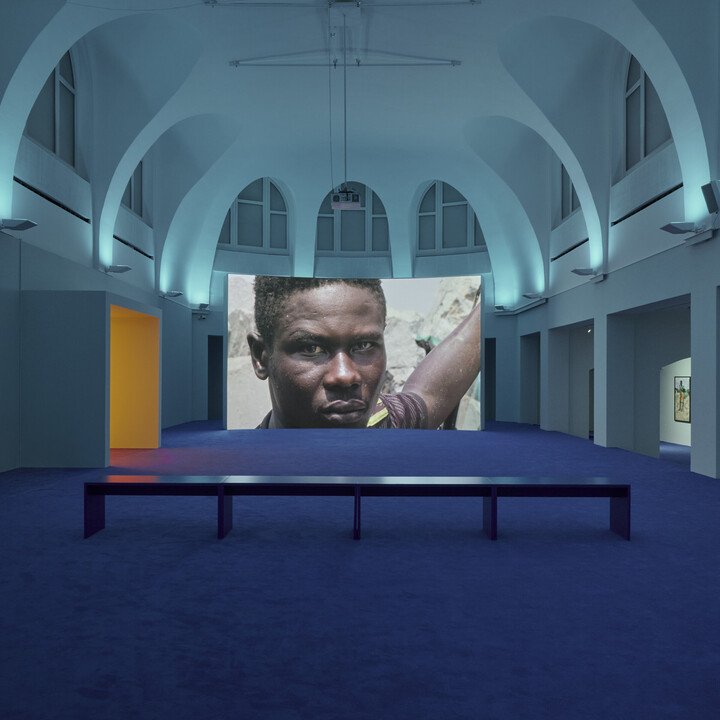
- The Artist and Filmmaker Karimah Ashadu (b. 1985, London) lives and works between Hamburg and Lagos. Since the early 2010s, she has developed a practice that homes in on Nigeria, probing notions of independence and value through individuals who work and live there: butchers, cowboys, miners, motorcycle-taxi drivers, and bodybuilders. Their lives are shaped within the country's informal economies, where daily labor secures survival while carrying the dream of a self-determined life. Film forms the core of her practice, alongside photography, sculpture and painting. With Crystalline, the Kestner Gesellschaft presents her first institutional solo exhibition in Germany. At its center is the world premiere of the film WAVES (2026), on view in the domed hall of the Goseriedebad, a former bathhouse. The film is presented alongside eight new photographs and the sculpture Auric Field (2026) in an installation developed for the Kestner Gesellschaft. Like her films, the exhibition spaces are conceived in painterly terms; through the precise use of color and light, Ashadu's moving images become part of the architecture itself.Description
Crystalline
Until 15 Nov 2026
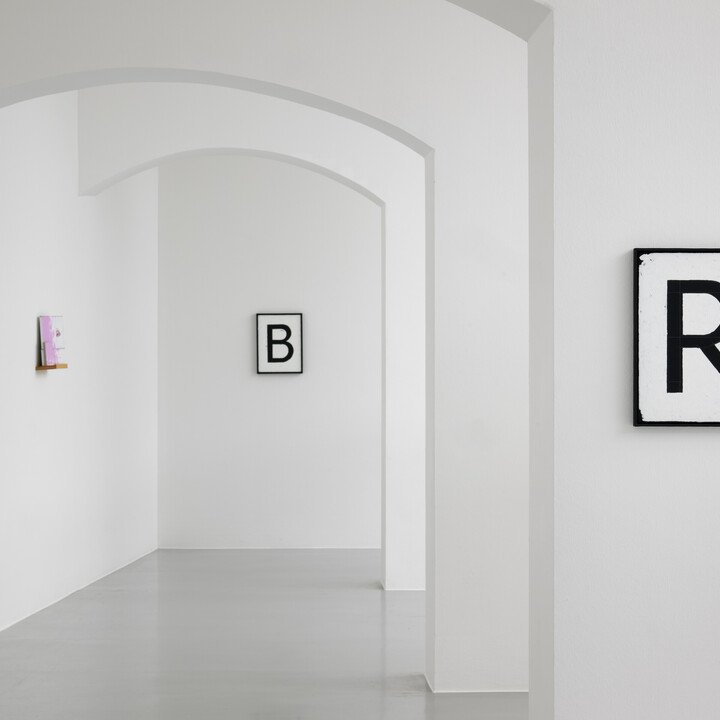
- The Kestner Gesellschaft is pleased to present A Pronoun of B, the first comprehensive solo exhibition by Min Yoon (b. 1986 in Cheonan). Born in South Korea and based in Vienna, Yoon works across drawing, painting, and sculpture to reflect on processes of artmaking and the institutional structures that shape art and its production. His work often expands into exuberant, multipart installations whose playful structures weave together a range of interests, contexts, and materials. The letter “B” in the title of the exhibition at Kestner Gesellschaft is believed to have evolved from an ancient Egyptian hieroglyph and a Proto-Sinaitic sign resembling the floor plan of a house. For Min Yoon, “B” represents a linguistic and spatial abstraction of the idea of one’s own space. Through “B”, he initiates a reconfiguration of Kestner Gesellschaft that begins outside the building, where he alters the institution’s name above the main entrance. Some letters appear to have fallen, while others have been added, together forming the sequence “NA DA UM.” In Korean, this can be read as 나다움( na-da-um ), meaning “being myself” or “being as one is.” In German, by contrast, “na” (“well”), “da” (“there”), and “um” (around)” are perceived as distinct linguistic units. This play with language sets the tone for what unfolds inside the building, where the linguistic, spatial, and temporal dimensions of “B” are further explored through a new site-specific installation and newly created groups of paintings are presented alongside a selection of works from the past three years. Upon entering the building, visitors encounter a stage-like ensemble of sculptures depicting figures: Other Hand (2025), an oversized felt hand puppet, alludes to the processes of artmaking and the labor that takes place behind the scenes. Exit Snail Enter Snail (2024), a large gray snail, evokes a slowed-down, embodied, and individual experience of time. Digest / Wait + ing Time to Emit (2024), a headless figure whose hat is mounted on a curved steel structure, links questions of time and waiting to the pressures of productivity and consumption. “Emit”—“time” read in reverse—means to send out, release, or discharge. Here, what is released are chains of wool and thread that stretch across the room between metal stanchions, imposing a physical distance between viewers and the sculptures. Opposite this ensemble, a new series of eight paintings, 1B Time through 8B Time (2026), depicts hourglasses filled with the letter “B”, turning “B” itself into a unit of time that also registers time’s B-side. The hourglasses’ alternative measure of time opens onto a broader investigation of space and systems of measurement in a new room-encompassing installation, produced specifically for the exhibition and presented for the first time in Hannover. Extending along the walls of the second exhibition hall and across approximately 400 square meters, a sculptural wooden structure incorporates an array of objects, including animals, paintings, clothes hangers, wooden block wagons, and display supports found on site, such as pedestals and an easel. Engraved at intervals of 20.5 centimeters, the structure follows a unit devised by the artist that corresponds to no official standard. The installation instead proposes a personal system of measurement, raising questions about how spaces and bodies are quantified. Measuring devices such as a growth chart and a pantograph for copying and enlarging drawings become part of the sculptural apparatus, linking the abstraction of measurement back to the physical, lived body.Description
A Pronoun of B
Until 15 Nov 2026
Coming soon
Grass Babies, Moon Babies
12 Dec 2026 – 21 Feb 2027

Recent past exhibitions
Richard Hawkins: Potentialities
Ended 2 Aug 2026
- The Kestner Gesellschaft is delighted to present the first institutional solo exhibition by Cauleen Smith in the German-speaking world, starting on 12 December 2025. Over the past two decades, the Los Angeles-based, interdisciplinary artist has developed a unique lyrical, visual, and politically relevant practice at the intersection of independent film and visual art. In addition to films, she produces drawings, sculptures, text objects, assemblages, and performative processions, which she brings together in multi-layered installations. Utopian concepts of community and community-building, as well as contemporary examinations of environmental exploitation, extractivism, and the identity-forming processes of the Black diaspora, form central thematic reference points in her predominantly cinematic narratives. Under the title The Volcano Manifesto, Cauleen Smith will occupy the entire premises of the Kestner Gesellschaft. The title refers to her three film works: My Caldera (2022), Mines to Caves (2023), and The Deep West Assembly (2024), which together open up complex meditations on geological and cinematic time, the abyss of volcanoes, and the depths of mines and caves. Based on this trilogy, visitors will have the unique opportunity to engage with Smith’s works from the last ten years, including large-scale video installations, new textile works, a facade project, drawings, and a space for collective exchange and reflection. The exhibition is curated by Eva Birkenstock, director of the Kestner Gesellschaft. Cauleen Smith (b. 1967 in Riverside, California) lives in Los Angeles, where she is a professor of fine arts at the California Institute of the Arts (CalArts). Her works have been presented internationally in numerous group exhibitions, including at the Studio Museum in Harlem, New York (2013), the Museum of Contemporary Art Chicago (2015), the New Museum in New York (2015), the BALTIC Centre for Contemporary Art in Gateshead, UK (2017), the Prospect Triennial in New Orleans, and the Whitney Biennial in New York (both 2017). Her video work Sojourner is currently part of the exhibition Utopia. The Right to Hope at the Kunstmuseum Wolfsburg, which runs until 11 January 2026. Her solo exhibitions include Remote Viewing (2011) at The Kitchen in New York, Give It or Leave It (2018) at the Institute of Contemporary Art of the University of Pennsylvania, Cauleen Smith: We Already Have What We Need at the Massachusetts Museum of Contemporary Art in North Adams (2019) and the Contemporary Arts Museum Houston (2021), Cauleen Smith: Mines to Caves (2023) at the Aspen Art Museum, and The Deep West Assembly (2024) at the Astrup Fearnley Museum in Oslo. Dusk of Dawn is currently on view at the Joel and Lila Harnett Museum of Art at the University of Richmond. In mid-November 2025, a comprehensive survey exhibition of her work, DawnDescription
Ausstellung Cauleen Smith: The Volcano Manifesto
Ended 22 Mar 2026
- Passage III: To Repel Ghosts accompanies Cauleen Smith’s exhibition The Volcano Manifesto, extending its core ideas: speculative concepts of community and society, extractivism, politics of memory, and the formation of identities within the Black diaspora, as well as the question of how images and narratives produce and perpetuate histories of violence and liberation. Located in the Passage space—an archive and mediation room established in 2025 in collaboration with architect Assaf Kimmel—the project brings together the exhibition’s public program, the kestnerkids activities, and a newly configured archival display, opening up new perspectives on both The Volcano Manifesto and the exhibition history of the institution. Conceived by Kimmel as an open framework for knowledge and memory, the space weaves together research, mediation, institutional memory, and public reflection and is reactivated with each iteration. The title of this third iteration, To Repel Ghosts, refers to Jean-Michel Basquiat. Appearing in several of his paintings from the 1980s, the self-reflexive phrase functions as a response to forces such as colonial violence, racialized projections, and the expectations of the art world. Basquiat’s painting To Repel Ghosts (1986) was shown in his 1987 solo exhibition at the Kestner Gesellschaft and inscribed itself into the institution’s memory through posters, the exhibition catalogue, and the recollections of visitors. This gesture of refusal and self-assertion resonates with the concerns and contemporary strategies of resistance at the heart of Cauleen Smith’s practice. Against this backdrop, the exhibition Kilengi. African Art from the Bareiss Collection (1997) also comes into view, its colonial framing and mechanisms of appropriation subjected to critical scrutiny. The archival presentation focuses on the exhibition projects Jean-Michel Basquiat (1986), Jean-Michel Basquiat: Drawings (1989), True North and Fantôme Afrique by Isaac Julien (2006), The Blue Rider Extended Remix by Chris Ofili (2006), behind the eye is the promise of rain by Helen Cammock (2022), everything I have ever touched by Diedrick Brackens (2023), and BloodLetter by Monilola Olayemi Ilupeju (2024). Together, these positions bring into relation urban iconography, cinematic image-worlds, textiles as carriers of memory, and voice and body as archives of social experience. Blackness appears in these works as a remembering, resistant presence that unfolds through traces, recurrence, and embodied experience. Through the exhibition’s public program, connections emerge between themes that run across all of these projects—and, in particular, across Cauleen Smith’s The Volcano Manifesto : the Black diaspora, the lived history of bodies, and questions of extractivism and collective memory.Description
Passage III To Repel Ghosts
Ended 22 Mar 2026
Öffentlicher Rundgang mit dem Team der Kestner Gesellschaft mit Gabriele Sand
Ended 19 Mar 2026
Volcano Manifesto Kestner-Lesegruppe mit Anmeldung
Ended 19 Mar 2026
kestnerkids machen Kunst – Goes International Kunst für Kids auf Englisch, 5–12 Jahre mit Anmeldung
Ended 7 Feb 2026