Berlin
König Berlin (St. Agnes)
On now
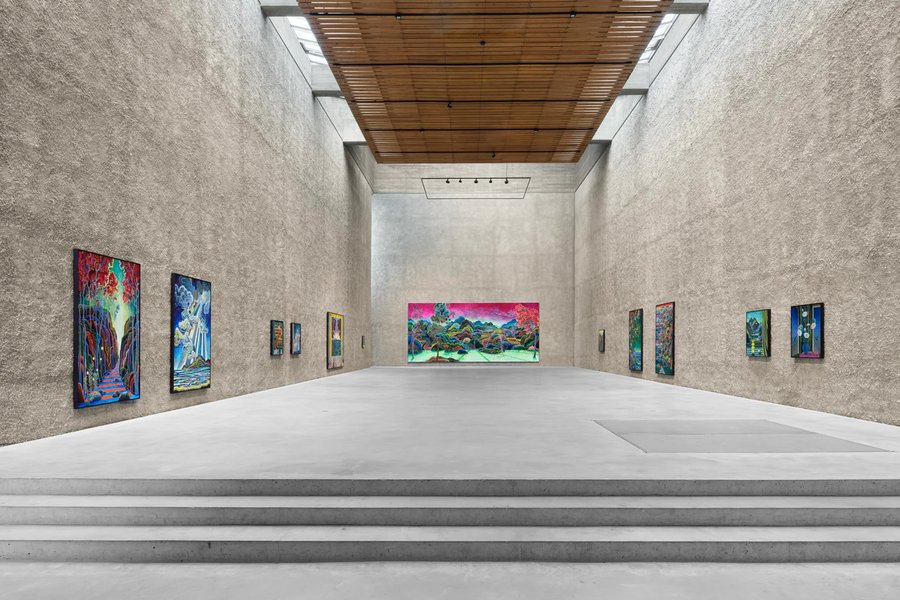
- KÖNIG GALERIE | NAVE ALEXANDRINENSTRASSE 118–121, 10969 BERLIN 9 SEPTEMBER – 8 NOVEMBER 2026 BERLIN ART WEEK OPENING 8 SEPTEMBER 2026 | 6 – 9 PM KÖNIG GALERIE is pleased to present ECHOTROPIA, Christian Achenbach’s third exhibition with the gallery. The exhibition unfolds around GENESIS, a monumental painting created especially for the Nave of St. Agnes. Structured by an extraordinary color palette of bright yellows, saturated oranges, burning reds, deep blues, and rich greens, Achenbach’s paintings open onto timeless landscapes. His wavy, colorful streaks imbue the pictorial plane much as wind and sound drift through the air. He paints places of echoes, where light and shapes reverberate andDescription
Christian Achenbach Echotropia
Until 8 Nov 2026
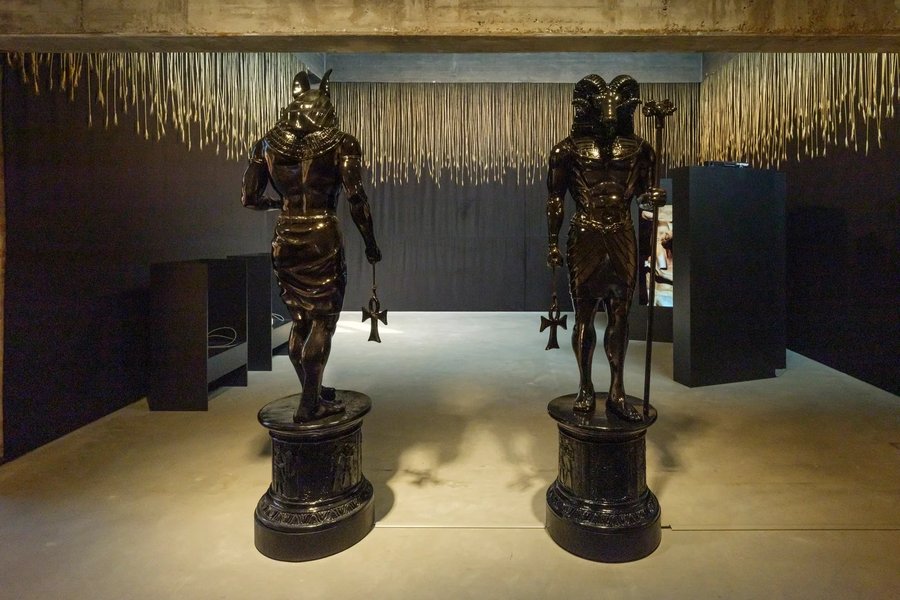
- With this exhibition, Al Qadiri ventures into new territory by turning her attention to ancient Egypt, a subject that has long fascinated her. The works on view were first presented in 2024 at Bozar in Brussels.Description
Monira Al Qadiri the Archaeology of Beasts
Until 8 Nov 2026
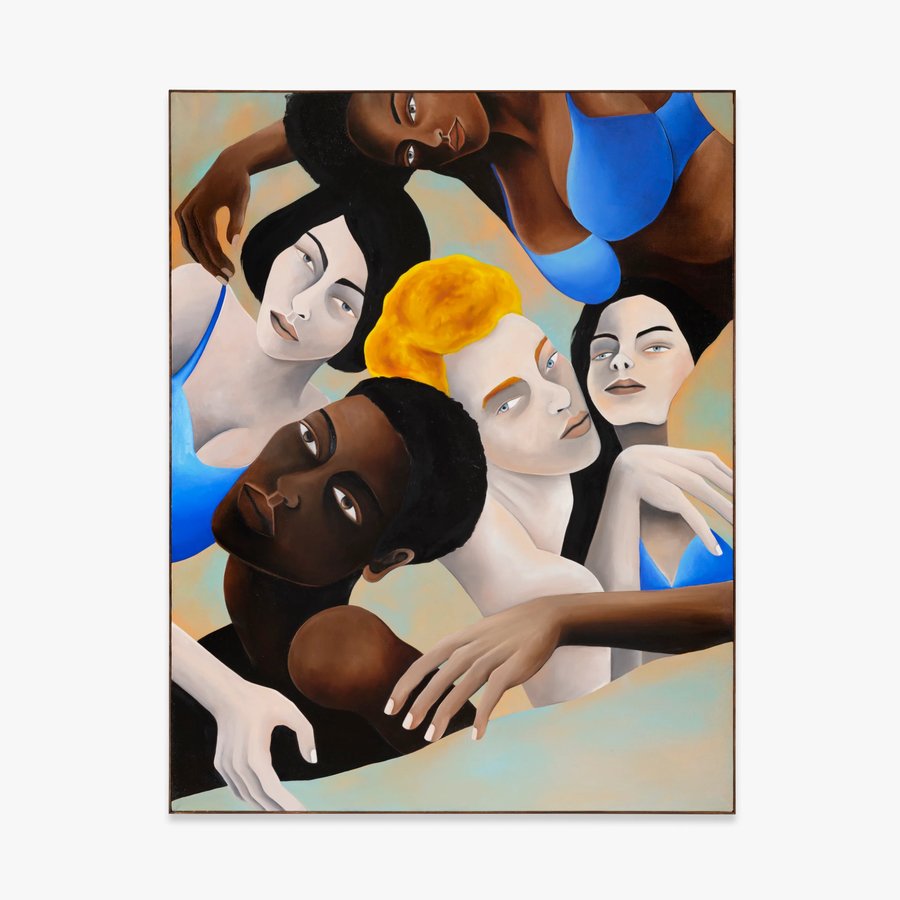
- KÖNIG GALERIE is pleased to present THE LAST ONES AWAKE, a solo exhibition by French artist Rebecca Brodskis in the Vault of St. Agnes. For THE LAST ONES AWAKE, Brodskis turns her attention to those who became her chosen family in Berlin. The portraits that make up the exhibition depict close friends whose presence shaped the years she spent in the city, tracing a community bound less by circumstance than by shared vulnerability, ambition, and care.Description
Rebecca Brodskis the Last Ones Awake
Until 8 Nov 2026
Recent past exhibitions
- KÖNIG TELEGRAPHENAMT presents EEUWEN by Joana Schneider, the artist’s first exhibition with the gallery. Joana Schneider’s works seem to come from another world. They hover between classical media such as painting and sculpture and are created from textiles and fabrics, which Schneider produces from found materials like fishing nets and other marine waste before further processing them. One thinks to recognize something organic: mushroom-like blossoms sprout from the walls, meandering forms resemble cross-sections of tree trunks or aerial views of marshlands, waterfalls and fabric-covered canvases from which richly colored flowers burst. The forms appear to be in a state of growth and becoming, occupying an in-between space and a realm of dreams. A central work of the exhibition—WADDENEINLAND—recalls a classical landscape in both color and format. Through the textile ropes characteristic of Schneider’s practice, which she dyes herself, an impression of blurring emerges, as if the landscape were being viewed through a veil. For this work and others in the exhibition, Schneider drew inspiration from the dune landscape De Slufter on the island of Texel, in the Netherlands, the artist’s adopted home. This unique landscape is the result of a dam breach in the 19th century, which caused land and sea to merge, creating a kind of lagoon landscape. Both visually and symbolically, this phenomenon serves as a source of inspiration for the artist. As the result of a catastrophe, a landscape emerged that today forms a unique ecosystem and diverse habitat: out of chaos and destruction came beauty, and the landscape is shaped by constant processes of becoming and passing away. This openness of form also characterizes Schneider’s works, which appear both strong and delicate, functioning like portals into the imaginary and the collective unconscious.Description
Joana Schneider / Eeuwen
Ended 30 May 2026
- KÖNIG GALERIE ALEXANDRINENSTRASSE 118–121, 10969 BERLIN 17 APRIL – 24 MAY 2026 OPENING 16 APRIL 2026 | 6 – 9 PM KÖNIG GALERIE is pleased to present LUNACY, an exhibition by Emily Weiner in the Nave of St. Agnes, the artist’s third show with the gallery. The title of the exhibition, LUNACY, poetically alludes to the moon as a symbol of cyclical change and eternal recurrence. At the same time, the term can also suggest a lack of balance and universal perspective in contemporary politics—although political themes are not explicitly the subject of the paintings. Instead, Emily Weiner’s works reflect on art history, archetypal symbolism, Buddhist notions of interdependence, and insights from modern physics. Many of the works explore how humans construct meaning from a complex and often incomprehensible world. The painting REBUS (DO NOT DESPAIR), for example, employs the structure of a visual puzzle in which individual motifs are phonetically combined to form a message: “do not despair.” This combination of wordplay and image points to the human tendency to perceive meaning in random patterns and to shape coherent narratives from fragments—a concept reminiscent of Carl Jung’s idea of archetypal symbolic structures. Other works address perception as relational. In NEBULA, a landscape emerges from overlapping shapes that recall the well-known vase-face illusion. The shifting forms suggest that the present always arises from prior conditions—biological, cultural, or cosmic. The title alludes to nebulae in astronomy, linking human existence to the processes of star and matter formation. Several works adopt a cosmic perspective to situate human experience within a larger context. HOW HIGH (ICARUS) connects the ancient myth of Icarus with images from the James Webb Space Telescope, raising questions about limits and ambition. Rather than depicting a fall, the work opens an alternative path: not upward, but “through” limitations. A similar idea appears in ALIGNMENT, whose endless architectural arches evoke the iconic Emerald City from The Wizard of Oz and symbolize an inward journey—the realization that the authority or truth sought ultimately resides within. The infinite corridor serves as a metaphor for the inner journey, where truth is found not in an external goal but inside oneself. PASSING THROUGH presents existence as a series of thresholds—between life and death, memory and forgetfulness, birth and farewell. These transitions are not fixed endpoints but permeable states. Inspired by the Zen teacher Thich Nhat Hanh’s saying, “The way out is in,” the work suggests that transcendence arises more from inner insight than from escape. Other works in the exhibition link art-historical and philosophical references with scientific concepts. CONTINUUM, for example, reflects on the invisible structures that shape the elements we perceive. Space and time are manifestations of the elastic gravitational field in which the events of our lives unfold. This field, imperceptible to human senses but measurable through technology, resembles the surface of an ocean rippling in response to the bodies within it. The spiral form illustrates how massive objects curve spacetime and set surrounding matter and light into continuous motion—much like planets shaping spacetime or galaxies rotating around invisible centers of gravity. In COHERENT SOURCES, vanitas symbolism, references to Gerhard Richter’s painting, and the famous double-slit experiment from quantum physics intersect, echoed in the structure of the painting’s support. Here it becomes clear that both meaning in art and reality in physics arise relationally: through observation, context, and interaction. Several works stage the world as a theatrical space where cosmic perspectives emerge. In EQUANIMITY, curtains are drawn aside to reveal Earth as a tiny “Pale Blue Dot”—a nod to the famous Voyager 1 image and Carl Sagan’s reflections on the fragility of human civilization. In ORACLE and MUNDUS INVERSUS, curtains again serve as theatrical thresholds between the visible world and hidden orders. The universe is presented as a space of mutual relationships in which light, forces, and meaning emerge through interaction. Other works explore resonance, fracture, and the creation of meaning. HOW THE LIGHT GETS IN takes its title from a line in Leonard Cohen’s song Anthem: “There is a crack in everything… that’s how the light gets in,” suggesting that enlightenment arises through rupture. The shaped panel references the curved form of a cello, making the painting both image and object. Its surface transitions from a deep twilight blue to the glowing orange-pink of a hazy city sunset. At its center, two F-holes interrupt the sky like openings—musical, physical, and cosmic—revealing a starry night beyond the sunset. These openings signify both resonance and fracture: points where invisible depth becomes visible. Light is depicted not as something simply falling upon the world, but as entering through cracks, thresholds, and moments of vulnerability. Finally, works such as RECURSIVITY and SOURCE investigate the fundamental ordering principles of nature. Spirals, geometric structures, and recurring patterns visualize mathematical and physical processes such as the Fibonacci sequence or gravitational centers. These images reveal that seemingly infinite structures emerge from simple, repeating relationships. Together, the paintings form a network of connections between art, science, mythology, and personal experience. They suggest that reality—like meaning—is not composed of fixed truths but arises from relationships, resonances, and ongoing processes of interpretation.Description
Emily Weiner / Lunacy
Ended 24 May 2026
- KÖNIG GALERIE presents CHAPEL OF GHOULS, an exhibition of new works by Anselm Reyle in the Chapel of St. Agnes. It is the artist’s sixth solo exhibition at the gallery. The exterior wall of the Chapel, as well as its rear side, were sprayed by Anselm Reyle using a fire extinguisher filled with neon paint. This method originates from street art, but Reyle transfers it into an institutional context, transforming the raw, urban form of expression into an abstract, painterly practice. At the center of the exhibition is a selection of CHROME BRUSH PAINTINGS, Reyle’s most recent series, which he began in 2024. These works continue his ongoing exploration of materiality, gesture, and the aesthetics of industrial production. Characteristic of Anselm Reyle’s work is the use of materials such as neon colors, burlap, or silver foil—materials that could be described as “non-art” and are more commonly associated with an industrial context. Reyle draws inspiration from trash and pop culture as well as from the urban environment. For instance, he first discovered the reflective silver foil that has become characteristic of his work as a shop window decoration and began experimenting with it. The result were his well-known foil paintings. With his works, Reyle occupies a distinctive position within abstraction. Although his materials are strongly charged with associations, the works themselves remain strictly abstract while still developing a certain narrative dimension. At the same time, they move between categories such as painting, sculpture, and object: he treats foil like paint, while on the other hand applying paint so thickly that the surface becomes relief-like. In the CHROME BRUSH PAINTINGS series, thick acrylic paste is first applied gesturally onto the canvas, creating almost sculptural brushstrokes. In addition, cast resin brushstrokes that have been chrome-plated are mounted onto the canvas. What initially appear to be fleeting painterly traces reveal themselves, upon closer inspection, as reflective, relief-like objects. The canvas thus becomes an assemblage that exists between painting and object. The painterly, expressive, and rapid gesture solidifies—creating a visual paradox: spontaneous authenticity meets constructed artificiality. Modernist painting is an important reference point for Anselm Reyle, particularly the expressive power of Art Informel and Abstract Expressionism, as well as the formal clarity of Minimalism. At the same time, he approaches these traditions through strategies of deconstruction and reconfiguration. By transforming the gesture into a chrome-plated object, the artist pushes it to the point of absurdity, thereby questioning the notion of authenticity associated with gestural expression. Exhibited together with the CHROME BRUSH PAINTINGS are two ceramic sculptures. For this series, Reyle drew inspiration from Fat Lava vases, which were popular in the 1970s and later fell into disrepute as kitsch, becoming available at low prices on flea markets. The term Fat Lava originally refers to a specific glazing technique developed in the 1960s, reminiscent of the coarse, porous surface of solidified lava flows. Reyle distorts these vases by greatly enlarging them. As a result, they lose their character as functional objects and enter the realm of sculpture. Moreover, the process-based nature of the objects is clearly visible: during the firing of the clay, Reyle deliberately incorporates chance and unpredictability. What is usually avoided—such as cracking or bursting surfaces or collapsing forms—is intentionally allowed. In addition, he intervenes in the surface before firing with gestural actions such as cuts or scratches. These, in turn, recall gestural marks in painting or even the cuts of Lucio Fontana.Description
Anselm Reyle / Chapel of Ghouls
Ended 24 May 2026
- Kehinde Wiley: An Economy of Grace presents a new body of work by the renowned artist, featuring large-scale paintings and sculptures that explore themes of beauty, power, and identity.Description
Kehinde Wiley: An Economy of Grace
Ended 23 Apr 2026
- KÖNIG GALERIE ALEXANDRINENSTRASSE 118–121, 10969 BERLIN 16 JANUARY – 5 APRIL 2026 OPENING 15 JANUARY 2026 | 6 – 8 PM KÖNIG GALERIE presents Ayako Rokkaku’s fourth solo exhibition SCENERY IN THE PROCESS OF BEING FORMED, with the gallery, on view in the Nave of St. Agnes. Bringing together a wide-ranging sculptural practice alongside a new body of paintings, the exhibition traces the artist’s movement through places, materials, and atmospheres—and how form slowly emerges through her hands. SCENERY IN THE PROCESS OF BEING FORMED reflects Rokkaku’s experience of letting landscapes enter her daily life: the light of a new city, the textures of a market, the rhythm of a coastline. These impressions accumulate quietly, becoming sensations she tends to with the same instinctive, tactile approach that guides her making. Rokkaku works without mediation—paint spread by hand, clay shaped through touch, fabrics gathered, sewn piece by piece, glass guided through fingertip gestures — allowing each material to register the immediacy of her encounter. The works appear gradually, as if formed at the pace of an emotion revealing itself. The glass works, created early 2025 in Murano at the Berengo Studio, hold soft traces of her gestures within their colored surfaces, as though the movement of her hand had settled into the molten material. Nearby, a fabric installation inspired by Seoul’s Namsan hill unfolds from threads and fragments collected at Dongdaemun Market and assembled by hand, its layered textures echoing the density and verticality of the city. Ceramic sculptures made during her stay on Mallorca carry the warmth of their Mediterranean origin; their contours feel shaped by touch, as if the porous clay retained the memory of the artist’s palms and fingertips. These forms reappear in another register in the bronze works realized at the Noack Foundry in Berlin, where the immediacy of her hand-molded clay models are preserved in metal. A new series of paintings accompanies the sculptures. Their drifting colors suggest mountains, sea, and interior terrains without fixing them, arising—like the sculptures—from an interplay between place, sensation, and touch. Through this process, landscapes are not depicted but felt into being. Across the Nave, Rokkaku’s works form an environment where touch and perception move together, giving shape to scenes that are still forming, still gathering themselves into view.Description
Ayako Rokkaku: Scenery in the Process of Being Formed
Ended 5 Apr 2026
- KÖNIG GALERIE ALEXANDRINENSTRASSE 118–121, 10969 BERLIN 16 JANUARY – 5 APRIL 2026 OPENING 15 JANUARY 2026 | 6 – 8 PM KÖNIG GALERIE is pleased to present THE WANDERING DOT, a solo exhibition by London-based artist Bijanka Bacic, on view in the Chapel of St. Agnes. The exhibition brings together a new body of works that examine the mark as a living, active element, one that produces meaning through movement rather than fixed representation. Bacic’s process unfolds through a sequence of translations. Each work begins with a film photograph that serves as an anchor to the external world. These images are then reinterpreted in small gouache drawings where contours soften and color fields shift. When brought onto canvas, the image undergoes a further transformation as stripes of oil paint are introduced, crossing the surface in alternating rhythms that conceal, reveal, and redirect attention. Through these interventions, the initial scene steadily gives way to an exploration of gesture, structure, and material presence. Across the paintings, lines wander and drift. Dense accumulations open into spare passages. Marks appear, dissolve, and reassert themselves, creating a field shaped not by stable forms but by forces in motion. In this environment, the wandering dot becomes both a visual trace and an unfolding event. Here the hand finds purpose through movement, negotiating pressure, resistance, light, and time. Ideas from Paul Klee’s reflections on the active line resonate throughout the exhibition. The simple action of a point moving forward becomes a way for form to emerge through gesture. Bacic extends this principle into her own vocabulary, allowing each mark to shift direction, weave between layers, pause, or deviate in response to the painting as it develops. Structure arises from motion rather than prescription. The works invite viewers into an experience of oscillation. Images hover between recognition and dissolution, intention and chance, figure and field. Rather than delivering a single reading, the exhibition opens a space where gesture, surface, and temporality interact. Meaning emerges through the encounter between viewer and mark. THE WANDERING DOT proposes a way of thinking about painting as a form of inscription shaped by movement and material resistance. In treating the mark as both agent and event, Bacic reveals the conditions through which thought takes shape in matter, offering a contemporary perspective on the evolving language of abstraction.Description
Bijanka Bacic: The Wandering Dot
Ended 5 Apr 2026
- KÖNIG GALERIE ALEXANDRINENSTRASSE 118–121, 10969 BERLIN 16 JANUARY – 5 APRIL 2026 OPENING 15 JANUARY 2026 | 6 – 8 PM KÖNIG GALERIE presents Ayako Rokkaku’s fourth solo exhibition SCENE RY IN THE PROCESS OF BEING FORMED, with the gallery, on view in the Nave of St. Agnes. Bringing together a wide-ranging sculptural practice alongside a new body of paintings, the exhibition traces the artist’s movement through places, materials, and atmospheres—and how form slowly emerges through her hands. SCENERY IN THE PROCESS OF BEING FORMED reflects Rokkaku’s experience of letting landscapes enter her daily life: the light of a new city, the textures of a market, the rhythm of a coastline. These impressions accumulate quietly, becoming sensations she tends to with the same instinctive, tactile approach that guides her making. Rokkaku works without mediation—paint spread by hand, clay shaped through touch, fabrics gathered, sewn piece by piece, glass guided through fingertip gestures — allowing each material to register the immediacy of her encounter. The works appear gradually, as if formed at the pace of an emotion revealing itself. The glass works, created early 2025 in Murano at the Berengo Studio, hold soft traces of her gestures within their colored surfaces, as though the movement of her hand had settled into the molten material. Nearby, a fabric installation inspired by Seoul’s Namsan hill unfolds from threads and fragments collected at Dongdaemun Market and assembled by hand, its layered textures echoing the density and verticality of the city. Ceramic sculptures made during her stay on Mallorca carry the warmth of their Mediterranean origin; their contours feel shaped by touch, as if the porous clay retained the memory of the artist’s palms and fingertips. These forms reappear in another register in the bronze works realized at the Noack Foundry in Berlin, where the immediacy of her hand-molded clay models are preserved in metal. A new series of paintings accompanies the sculptures. Their drifting colors suggest mountains, sea, and interior terrains without fixing them, arising—like the sculptures—from an interplay between place, sensation, and touch. Through this process, landscapes are not depicted but felt into being. Across the Nave, Rokkaku’s works form an environment where touch and perception move together, giving shape to scenes that are still forming, still gathering themselves into view.Description
Ayako Rokkaku - Scenery in the Process of Being Formed
Ended 5 Apr 2026
- KÖNIG MEXICO CITY CALLE YAUTEPEC 111, CONDESA, CUAUHTÉMOC, 06140 CDMX 3 FEBRUARY – 1 APRIL 2026 KÖNIG MEXICO CITY is pleased to present I’m Just Here for the Pool, a solo exhibition by Amir Fattal. Fattal is an artist and curator based in Berlin. His practice is one of reflection grounded in the history of aesthetics and cultural references. In this new exhibition, Fattal deepens his exploration of AI as both a tool and a mirror, an engine that exposes our collective desires around taste, aspiration, and cultural identity. Through architectural scenes, swimming pools, graphic murals, and carefully staged human figures, he examines how aesthetics function as social codes, especially within the visual language of mid-century modernism and contemporary “good taste.” Amir Fattal, UNTITLED, 2024, oil on canvas, 80 x 80 cm, 31 1/2 x 31 1/2 in, unique This exhibition places special attention on Mexico City, where Fattal has lived part-time for the past four years. The influence of Mexican modernist architecture, particularly the geometric clarity and emotional restraint of Luis Barragán, can be felt throughout the works. The paintings unfold like imagined memories of aspirational spaces: modern villas, sunlit courtyards, quiet pools, and curated walls that might exist somewhere between reality, cinema, and a social media feed. Fattal’s protagonists inhabit these environments with a composed awareness, as if already performing for an audience. They are surrounded by architecture, artworks, and atmospheres carefully designed to convey identity. In this way, the paintings investigate how we choose to present ourselves, how desire, self-image, and the aesthetics of the art world are increasingly shaped by algorithms, and how our “good taste” is being learned and repeated through AI. In this exhibition, architecture becomes psychology, and image becomes performance. The paintings invite us to reconsider how we see, how we aspire, and how art now speaks the language of both memory and data.Description
Amir Fattal / I’M Just Here for the Pool
Ended 1 Apr 2026
- KÖNIG GALERIE is pleased to present FEELS LIKE SPRING, a solo exhibition by Franz Stein in the Chapel of St. Agnes, the artist’s second exhibition with the gallery. Franz Stein’s paintings are created through a multi-stage, process-oriented approach. He begins by pouring paint onto the canvas, usually diluted with water and consisting of remnants from previous works. The act of pouring paint onto a pictorial surface has a long tradition in art history, with artists who practice it seeking to relinquish control and allow the flow of paint—rather than controlled brushwork—to determine the pictorial act. For Franz Stein, further steps follow this initial pouring. The treated canvas is subsequently overpainted in white. Applied in varying thicknesses, the white allows the underlying layers of color to show through with differing intensity, creating a vibrant surface. The white field—uneven and at times embedded with lint or small fragments from the studio environment—forms the pictorial space. Through its irregularities, it seems to tremble and appear animated, almost like a landscape. Onto this pictorial ground, with its white folds of paint, Franz Stein applies signs, markings, dots, and loops—mostly in bold colors, sometimes even in neon—that seemingly occupy and probe the space at random. Stein employs a wide range of media, such as chalk, spray paint, and acrylic, resulting in a rich diversity of textures. In Franz Stein’s works, different modes of abstraction converge and overlap: expressive pouring that leaves room for chance; covering, monochrome overpainting in white; and the seemingly spontaneous placement of signs. In this final step, Stein’s approach recalls lyrical abstraction, which explored the expressive potential of color and form with an emphasis on free and personal expression. His method is emotional and intuitive, and the result is a body of work characterized by spontaneity, personal expression, as well as freedom and openness. When viewing the paintings, as one’s eyes follow the differently colored pictorial signs—seemingly placed at random—across the canvas, melodies appear to form in the mind. At the same time, they evoke afterimages: those flickering patterns, dots, and flashes of light one sees after gazing for a long time into the sunny sky on a spring day and then closing one’s eyes.Description
Franz Stein Feels Like Spring
Ended 22 Mar 2026