Münster
Kunsthalle Münster
On now
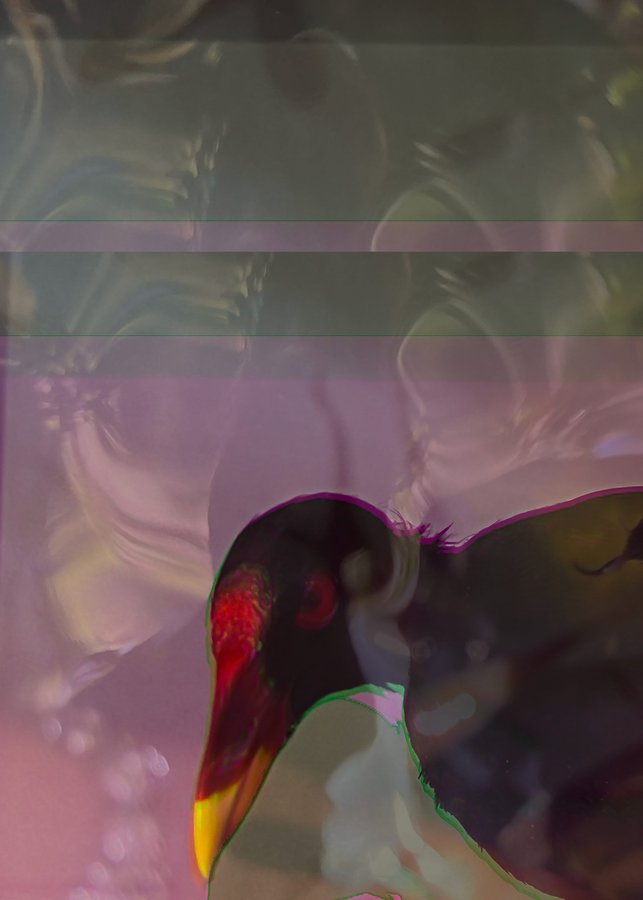
- The Kunsthalle Münster is showing the first solo exhibition of Mozambican artist Euridice Zaituna Kala in a German institution from October 2026 to January 2027. Kala's artistic work emerges from a profound deconstruction, manipulation and reconstruction of cultural and historical metamorphoses. With her works, she invites us to engage with the historical and cultural transformations of (personal and collective) memory. Particular attention is paid to the complex relationship between colonialism and post-colonialism as well as post-colonial remembrance. With her artistic research and creations, she has developed an impressive strategy to engage with the long history of erasure and silencing and to trace invisible subjectivities and communities. The exhibition brings together the voices of numerous struggles—ecological, feminist, indigenous—and connects them with the history of Kala and the places where her exhibition can be seen. It is a dialog between the interior and the exterior, objective and subjective elements, stories and images, a vibrant, sensual and luminous homage to the forces of life. Kala investigates the ambivalence of historical narratives and pursues a constant rewriting of history, filling in its gaps. Her works take the form of installations, performances, paintings, objects and books, in which she combines her research with personal memories to give voice to the unheard and forgotten.Description
Euridice Zaituna Kala . Daylighting: aber es ist Wasser, das spricht
Until 24 Jan 2027
Coming soon
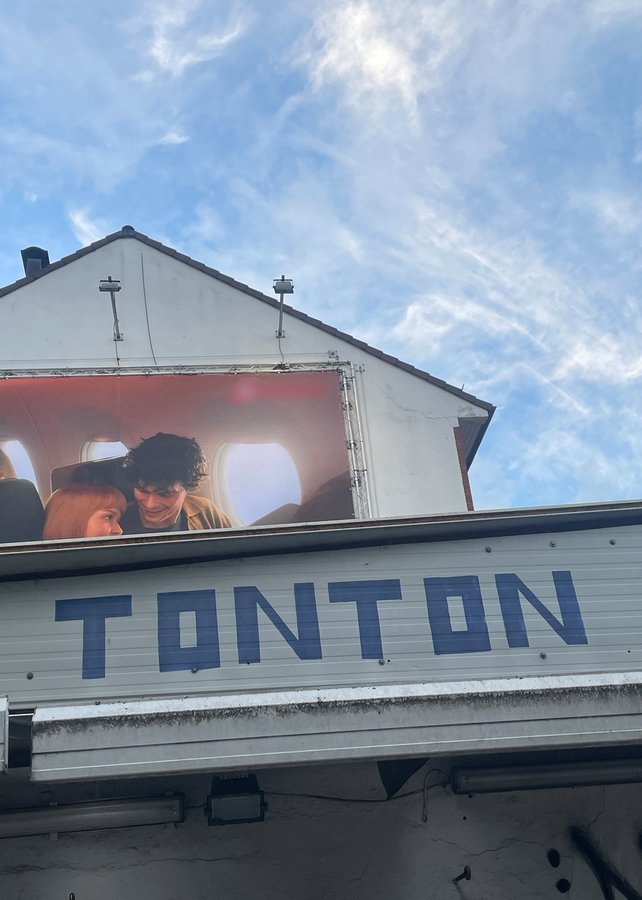
ton not. not ton.
13 Feb 2027 – 9 May 2027
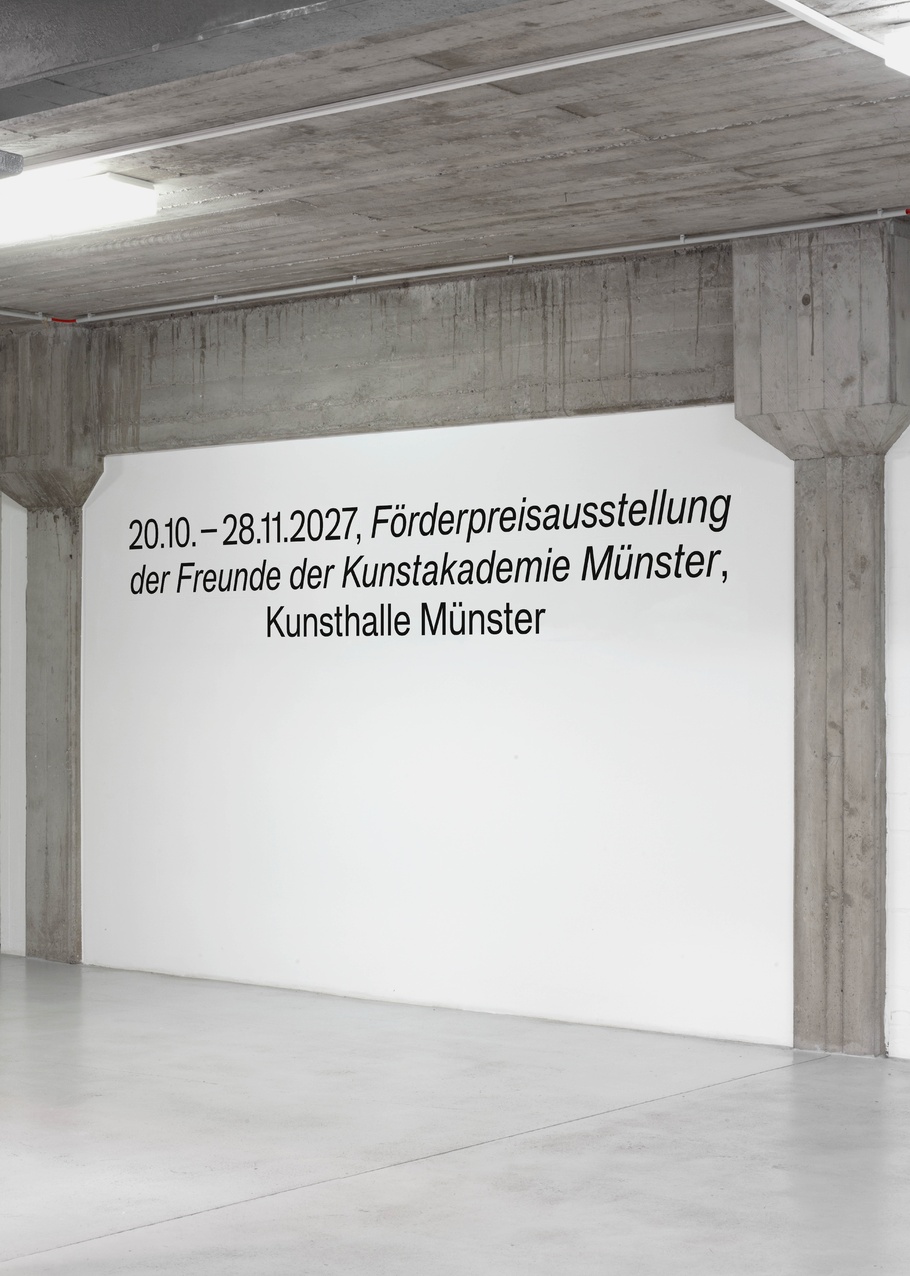
- The Förderpreisausstellung der Freunde der Kunstakademie Münster (award exhibition of the Friends of the University of Fine Arts Münster) is taking place for the 42nd time, showing 13 artistic positions. The award exhibition is a special exhibition format that is not based on any specific theme-related concept. Rather, it is understood as a platform enabling students of the University of Fine Arts Münster to present their works to a broad public in the Kunsthalle’s showrooms. The jury—consisting of Juliane Schickedanz (director of the Kunsthalle Osnabrück) and Noemi Weber (artist, lives and works in Düsseldorf)—will select a total of three prizewinners from the artistic positions. Corresponding to the 13 classes, the exhibition will feature different focal points and various media, such as paintings, sculptures, drawings, installations and videos. A cooperation between Kunsthalle Münster and University of Fine Arts Münster and the Friends of the University of Fine Arts MünsterDescription
Förderpreisausstellung der Freunde der Kunstakademie Münster
20 Oct 2027 – 28 Nov 2027
Recent past exhibitions
- The Kunsthalle Münster is pleased to present the first institutional solo exhibition by Zauri Matikashvili, providing an insight into the work of the Georgian artist, who has lived in Germany since 2003. Both older works and a new production will be shown. Matikashvili's films are usually dedicated to individuals, groups of people or places. He usually encounters strangers in his films and allows them to share their lives with him for a while, sometimes only for a brief moment. He is fascinated by the unpredictable and surprising moments in his encounters with the people he meets, their thoughts, desires, wishes and opinions. And it is precisely these moments that he shares with us. Against the backdrop of current social developments, a democracy under pressure, the confrontation with increasing populism and a general political shift to the right, increasing social inequalities as well as a shift away from social politics, Zauri Matikashvili's films seem to have a special urgency. He turns people who usually receive little attention into protagonists and focuses on minorities. He shares stories that take place beyond the majority society and that urgently need to be heard, addressing topics such as segregation, racism and increasing repression from different perspectives. With films, performances and sculptures, he asks how people's everyday lives are linked to power and resistance, how societies function in detail—or not. Zauri Matikashvili (born in Kvareli, Georgia) lives and works in Münster and Amsterdam. He studied fine arts at the Kunstakademie Münster and the Kunstakademie Düsseldorf. In his films and performances, he questions the socio-cultural and political contexts of different societies and nations that shape the construction of identity in individual realities. He is particularly interested in how narratives and images create community. His works often focus on people who otherwise receive little attention. His work oscillates between observation, testimony, (media) creation and deliberate provocation. Matikashvili's works have been shown at the LWL-Museum für Kunst und Kultur, Münster (2025), at Het Documentaire Paviljoen, Amsterdam (2024), at Antimatter Media Art in Victoria (Canada, 2023), at By Art Matters, Hangzhou (2023), at Eye Filmmuseum, Amsterdam (2023), at the Cité Internationale des Arts, Paris (2022), at the International Short Film Festival Oberhausen (2022), at the Kunstverein Harburger Bahnhof (2021), at the Münster Film Festival (2021), at the HMKV, Dortmund (2021), at Atelier No. 63 at PACT Zollverein, Essen (2020) and at the Philara Collection in cooperation with Filmwerkstatt Düsseldorf (2020), the Theater im Pumpenhaus, Münster (2018), Skulptur Projekte Münster (2017) and Kunstverein Gelsenkirchen (2016). Between 2022 and 2024, he was Artist in Residence at the Rijksakademie van beeldende kunsten, Amsterdam, having previously held residencies at the Cité Internationale des Arts Paris (2022) and at PACT Zollverein in Essen (2021). In 2025 he received the KUNSTFONDS scholarship. Curator: Merle RadtkeDescription
Zauri Matikashvili . You may not want to be here
Ended 13 Sept 2026
- Kunsthalle Münster and Residence NRW⁺ are pleased to present hell is other people (if you’re lucky), an exhibition that understands the public as an affective field, shaped by the ongoing work of being in relation. Borrowing its title from the cultural theorist Lauren Berlant and her book The Inconvenience of Other People (2022), the project takes everyday frictions as its starting point: irritations, (un)solicited glances and touches, misunderstandings and irritations that structure everyday coexistence. Rather than smoothing over these tensions or ignoring inequalities, the exhibition asks how we might stay with them and what forms of attachments and collective imaginations can emerge under these conditions—and what kind of public space we need. The Stadthausgalerie is situated in the inner courtyard of the historic town hall in Münster’s city centre. It functions simultaneously as an election office and an exhibition space—a hybrid site between democratic infrastructure and artistic presentation. The installed works reflect on the increasing privatization and commodification of public space. Behind the glass facade of the Stadthausgalerie, ceramic works by Gaia Vincensini look out onto the city with irony and precision. Motifs of locks, clocks, crosses and chains reference systems of belief, finance and protection. They evoke promises of stability upon which capitalist systems and privatized public spaces are built. Dorota Gawęda and Eglė Kulbokaitė transform the inside of the Stadthausgalerie into a semi-transparent architecture of enclosures and reflections. With their large-scale, translucent work, Enclosure (Lower bound of a landscape) (2023), they blur distinctions between interior and exterior, artwork and surrounding. The monumental installation, consisting of several printed chiffon panels, refers to the historical enclosure of land while drawing parallels to contemporary forms of digital segregation. Yield II (2021) presents a metal flower that oscillates between a nostalgic vanity mirror and a surveillance camera, its gaze dependent on the movement of visitors and confronting them with their own reflection. Alexandra Sheherazade Salem contributes with a poetic work that mobilizes language and scent to explore the entanglement of spirituality and economies of profit. Developed specifically for the exhibition, her piece unfolds as a sensorial meditation on belief, exchange, and the architectural structures of the space. For her site-specific work, she draws on practices of spiritual cleansing and fumigation. In dialogue with the space and its function as an election office, Sinaida Michalskaja’s large-scale work HANNAH (Deutsche Wärme) recalls the necessity of civic engagement. Referencing the tradition of monumental portraiture, it depicts political theorist Hannah Arendt (1906–1975). By overlaying two tapestries, her smile appears almost physically present. Michalskaja’s video work SOPHIE is dedicated to another public figure, the transfeminist electropop musician SOPHIE (1986–2021). Drawing on the track Forever, the work translates the lyrics into a visual rhythm and brings the struggle for bodily self-determination into focus. With three performative works by Chloe Chignell, Ewa Dziarnowska and Liina Magnea as well as an intervention in the public space by Abdoul Karim Martens and Dominik Sartor, the exhibition opens a space for narratives of moving bodies and temporary gatherings. Curators: Anneliese Ostertag + Antoine Simeão SchalkDescription
hell is other people (if you're lucky)
Ended 10 May 2026
- With Untitled (after) the Kunsthalle Münster will present the first solo exhibition by Jelena Bulajić in a German institution, providing an overview of the work of the Serbian artist. Bulajić's works are tools for exploring the media-mediated view of the world, speculations about dimensions of reality. They possess their own logic of showing and revealing, emerging from an intensive engagement with the pictorial, its conditions and possibilities. The exhibition brings together various groups of works by the artist, including new pieces created especially for the presentation at the Kunsthalle and, for the first time, sculptures. The juxtaposition of the different groups of works and the interplay of figuration and abstraction reveal a concept of image-making that invites viewers to engage with perception. At a time when we are constantly surrounded by digital images and confronted with the same reception on the screen, Bulajić uses the conditions of painting and sculpture to see. In doing so, an examination of what we call images, as the artist carries it out, questioning their narrative and truth content, seems to be of particular importance, especially against the backdrop of the ubiquitous flood of images. It is about training the senses. Her play with reality requires concentration, close observation, and questioning of what we see. Bulajić explores the medium of painting in its various facets. While it is primarily the motif that attracts the viewer's attention at first glance, on closer inspection it is above all the tactility and surface that are significant. Painted with a mixture of marble dust, ground granite, limestone, and kaolin, the existential spirit of the works is not a contemplation of mortality, but rather a formal exploration of tactility and surface. In recent years, Bulajić has expanded traditional notions of portraiture beyond the human figure and extended her treatment of surface as a dualistic reflection of physical layers: structures of the human skin, water, rocks and the paint itself with all its physical qualities, are the “raw material” of her works and constitute their physicality, the skin of the picture. The sky, the water, and the abstract works are “mere surfaces of paint and pigment,” according to Bulajić. When comparing or viewing her photorealistic works alongside her supposedly abstract series White on Black, one is confronted with the question of what media-mediated realism actually means. In different ways, both groups of works are declarations of faith in the medium of painting and its qualities in relation to photography. It is not representational realism, but rather a questioning of it. It is the deception that fascinates her, the disappointment with which she herself works. Her pictures reveal their artificiality. Given her preoccupation with the materiality of paint and the surface of painting, Bulajić's turn to sculpture seems like a logical next step. Her series After Stone (2025) reflects on the ambivalence of fragility and stability and explores questions of permanence and transience. Jelena Bulajić was born in 1990 in Vrbas, Serbia; she lives and works in Belgrade, Serbia and Herceg Novi, Montenegro. Her works have been shown in numerous international solo and group exhibitions: Salon of the Museum of Contemporary Art, Belgrade (2024), carlier | gebauer, Madrid (2024), Dots Gallery, Belgrade (2023), Museum of Contemporary Art of Vojvodina, Novi Sad (2019), The Saatchi Gallery, London (2016), Workshop, London (2016). Among the awards she has received are the GAM MA Fine Art Prize, City & Guilds of London Art School (2013), the Niš Art Foundation Award (2013), the Elizabeth Greenshields Foundation Grant (2012) and the Grand Diploma for Drawing, XIV INTERBIFEP (2011).Description
Jelena Bulajić: Untitled (after)
Ended 29 Mar 2026