Rotterdam
Kunstinstituut Melly
On now
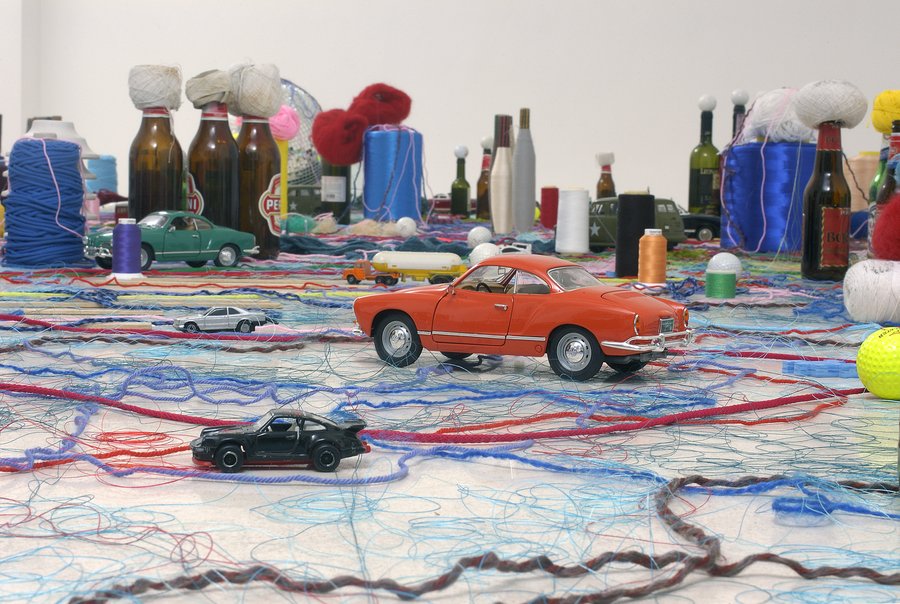
- Emerging in the early years of post-apartheid South Africa, Moshekwa belongs to a generation of artists who worked with the new enthusiasm sweeping through the country at the time and the curiosity toward a world that was opening up after decades of international solidarity through cultural sanctions and boycotts. His work was widely exhibited at international biennials beginning in 1997 with his participation in the Johannesburg Biennale, the Havana Biennial, and the Istanbul Biennial, and followed by biennials in São Paulo (1998 and 2010), Gwangju (2000), and Venice (2003 and 2009). In 1997, Moshekwa moved to the Netherlands to join the Rijksakademie van Beeldende Kunsten residency, where he sought an international artistic community that would challenge and inform his practice, while allowing his work to remain resistant to easy categorization. His meteoric rise was due in part to his fearless handling of materials from his immediate environment. Using what is considered banal and “everyday” to create complex imagery, his work is characterized by wit and irreverence, while his astute awareness of material is reflected in the layers of meaning that emerge through repeated encounters with unconventional materials such as coffee, nail polish, lipstick, staples, yarn, car varnish, newspaper, coal, refuse bags, and tape. Having grown up in Bakenberg in the province of Limpopo, Moshekwa later encountered official South African maps that did not feature his hometown. His recurring interest in mapping reflects apartheid South Africa’s selective cartographies and has informed a conceptual concern with the politics of landlessness, mapping, and borders. These concerns take different forms throughout his oeuvre, from lines woven across paper to installations of spools of thread, bodies of water, childhood memories and observations of a landscape shaped by history. Rather than reaching conclusions, ideas in Moshekwa ’s practice return, repeat, and begin again. Works may start and only be finished years later; chronology and linearity are not employed, things begin again, beginnings are continuous, and instead of conclusions there are pauses and ellipses. Time is nebulous and elastic. Curated by Gabi Ngcobo, director of Kunstinstituut Melly, with curator Kabelo Malatsie, You will find us in the best places offers a pause to reflect on Moshekwa ’s practice across three decades. The exhibition is choreographed to reveal recurring themes, questions, and interests, marking time not linearly, but through their continuous unfolding across Moshekwa’s practice.Description
You will find us in the best places: a survey exhibition of Moshekwa Langa
Until 28 Mar 2027
Recent past exhibitions
- Draw Withdraw Redraw, a group exhibition featuring work by AYO, Bani Abidi, Cinthia Marcelle, Felipe Mujica, Misheck Masamvu, Nohemi Perez, and Thierry Oussou. To draw, drawing from, drawing with, drawn to, to being drawn in, a draw–returning to the drawing board as a space to rethink and make new plans for a desired waywardness. Drawing to leave a mark on paper, on fabric, on the ground [...] drawing to create movement [...] drawing to extract [...] drawing in the game of chance [...] drawing to neither lose nor win [...] Departing from the extended sense of drawing, Draw Withdraw Redraw foregrounds recognition, resistance, and reinvention. To draw withdraw redraw situates us in a state of ongoingness, returning to the same that is not the same. Movement seeks flight without yearning to land. There is constant negotiation, chance-taking and self-preservation, because we never left drawing... because drawing is where we can always pull from...To draw, drawing from, drawing with, drawn to, to being drawn in, a draw.Description
Draw Withdraw Redraw
Ended 4 Oct 2026
- THE ORGAN is a playful space on the first floor, where we collect tactile and visual source materials from artworks presented in our exhibitions. In THE ORGAN, visitors can immerse themselves in the practices of the exhibiting artists, engage with their materials, and learn about their thematic concepts and research frameworks. Currently, THE ORGAN presents materials and sources connected to our ongoing exhibitions by donna Kukama, Riet Wijnen, and Marilyn Nance. The materials and sources shown in THE ORGAN in 2025 were contributed by the artists exhibiting with us: Liz Johnson Artur, Madiha Sikander and Zara Julius, Cihad Caner, Jabu Arnell, Luana Vitra, Nolan Oswald Dennis and Sara Sejin Chang (Sara van der Heide), Ola Hassanain, Simnikiwe Buhlungu, and Paulo Nimer Pjota. In addition, materials related to the exhibition 35 Years Minds and Matter were presented. Alongside source materials, artist-recommended books are displayed and available for purchase in our bookshop on the ground floor.Description
The Organ
Ended 6 Sept 2026
- Suitcase Economy is a project by Riet Wijnen that explores the themes of interdependence, symbiosis, and diversity through processes of fermentation and preservation. The project aims to support self-sustainability and resist capitalist logics in food production.Description
Riet Wijnen: Suitcase Economy
Ended 6 Sept 2026
- Spring 2026 at Kunstinstituut Melly This spring, Kunstinstituut Melly presents a new season of exhibitions opening across April and May 2026. On 18 April, two solo exhibitions open as part of the ongoing series Call & Response. A group exhibition, Draw Redraw Withdraw, will follow on 23 May. Call & Response Call & Response brings artists into proximity whose practices resonate with one another. The series reflects Kunstinstituut Melly’s commitment to supporting artists whose work engages with geopolitical demands while imagining new possibilities. This season presents exhibitions by Hajra Waheed and by Basel Abbas and Ruanne Abou-Rahme. In both, the artists situate viewers within ongoing conditions that call for sustained attention and attunement, attesting to sound as both a political and liberatory force. Prisoners of Love: Until the Sun of Freedom Opening 18 April 2026 Basel Abbas and Ruanne Abou-Rahme create multimedia installations that engage the politics and poetics of anti-colonial resistance while tracing struggles against dispossession and oppression in Palestine. Working together since 2007, their practice combines moving image, sound, and text to explore how histories of resistance are carried across time. Prisoners of Love: Until the Sun of Freedom draws on a process of study: learning with and from former Palestinian prisoners, poets, revolutionary thinkers, and the many practices of refusal that continue to shape daily life in Palestine. Through this approach, the installation traces connections across generations, approaching resistance as an ongoing practice of study while acknowledging a broader indebtedness to those who have resisted before us. In this new commission, Basel and Ruanne ask: what does it mean to resist in impossible conditions, to breathe where one should not breathe, and to emerge from sites of exclusion unbound? Writing, storytelling, and song emerge as life-affirming acts that sustain the capacity to continue resisting, even within conditions designed to confine the body and imagination. Through the sampling and layering of moving image and sound, the pair construct what they describe as “new scripts,” forming a poetics of resistance. Prisoners of Love: Until the Sun of Freedom is co-commissioned by Kunstinstituut Melly in collaboration with The Bell / Brown Arts Institute, Brown University; MACBA Museu d’Art Contemporani de Barcelona; and Nottingham Contemporary.Description
Basel Abbas & Ruanne Abou-Rahme: Prisoners of Love: Until the Sun of Freedom
Ended 6 Sept 2026
- Spring 2026 at Kunstinstituut Melly This spring, Kunstinstituut Melly presents a new season of exhibitions opening across April and May 2026. On 18 April, two solo exhibitions open as part of the ongoing series Call & Response. A group exhibition, Draw Redraw Withdraw, will follow on 23 May. Call & Response Call & Response brings artists into proximity whose practices resonate with one another. The series reflects Kunstinstituut Melly’s commitment to supporting artists whose work engages with geopolitical demands while imagining new possibilities. This season presents exhibitions by Hajra Waheed and by Basel Abbas and Ruanne Abou-Rahme. In both, the artists situate viewers within ongoing conditions that call for sustained attention and attunement, attesting to sound as both a political and liberatory force. There Is a Fountain Even If Pale That Flows Beneath Us All Opening 18 April 2026 Guest curated by [LINK text='Hera Chan' href='https://www.kunstinstituutmelly.nl/en/people/9228-hera-chan'] [LINK text='Hajra Waheed' href='https://www.kunstinstituutmelly.nl/en/people/9227-hajra-waheed'] is a multidisciplinary artist working across drawing, painting, sound, sculpture, video, and installation. Her practice explores the nature of power, the human impact of displacement and incarceration, and the transformative possibilities of liberation struggles. There Is a Fountain Even If Pale That Flows Beneath Us All brings together newly commissioned and recent works that approach listening as an embodied, collective, and political practice. The title invokes an undercurrent that persists beneath regimes of repression, where expression defiantly circulates despite attempts to silence it. At the center is HUM (2020), the first volume in Waheed ’s trilogy of multichannel sound installations, which foregrounds political prisoners as leaders of liberation struggles and traces voice under conditions of incarceration. The singers and songwriters featured in the work have all been imprisoned—their work censored, with many forced into exile for mobilizing collective voice. The songs are drawn from a period, as today, marked by state violence and genocide, mass uprisings, and crackdowns. From this shared condition of silencing, the work turns to humming as both a compositional method and a language of resistance. In parallel to HUM, the exhibition presents a series of sound studies; drawings, paintings, handbound artist books, and leporellos—many shown for the first time. Created over the years alongside sound chamber designs for HUM, these works extend Waheed’s sonic practice across mediums, where line, mark, and landscape become shared fields of attunement.Description
Hajra Waheed: There Is a Fountain Even If Pale That Flows Beneath Us All
Ended 6 Sept 2026
- A New Space for Education & Participation We are proud to announce the brand-new Education & Participation Space at Kunstinstituut Melly: a vibrant and flexible environment dedicated to learning, meeting, creativity, and community exchange. Situated on the ground floor of our building, this space is designed as a visible and active pillar of our institution, ensuring that education, knowledge sharing, and collective learning remain central to our mission. Whether you’re a child, student, artist, educator, or visitor, this is a space for curiosity, care, and connection. Built with core values of inclusivity, accessibility, flexibility, and ecological awareness, the space features organic forms, natural materials, and a modular layout that easily adapts to different programs and needs. It is a place where ideas grow, people gather, and creativity flourishes. Here, we host a range of activities, including: CLiP sessions (Collective Learning in Practice), Educational residencies and student collaborations, Children’s workshops and family programs, Masterclasses, public talks, and community initiatives. Every Saturday, visitors can join us for free workshops inspired by our exhibitions, welcoming all ages and backgrounds to participate in meaningful, creative dialogue.Description
Space for Education and Participation
Ended 19 Jul 2026
- The Imaginary Stage: Rehearsing through Puppets, Play, and Other Tools [LINK text='TOOLSHED' href='https://www.kunstinstituutmelly.nl/en/series/8499-toolshed'] is a residency and research initiative by Kunstinstituut Melly that explores the tools we use today to build, question, and transform cultural institutions. The programme invites artists, cultural practitioners, researchers, and collectives to critically reflect on conventional institutional frameworks while developing interdisciplinary practices that expand the capacity of art spaces to engage meaningfully with their surroundings. Located on the second floor of Melly, TOOLSHED is a dynamic experimental space for reflection, discussion, experimentation, and action. Building on our programs: [LINK text='Tools for Collective Learning' href='https://www.kunstinstituutmelly.nl/en/connect/6721-tools-for-collective-learning'], [LINK text='Tools for Demodernizing' href='https://www.kunstinstituutmelly.nl/en/programs/7277-tools-for-demodernizing-chapbook-launch-and-conversation-with-naomi-beckwith'], and [LINK text='Tools for Conviviality' href='https://www.kunstinstituutmelly.nl/en/exhibitions/8159-melly-tools-for-conviviality'], TOOLSHED extends our commitment to institutional practices rooted in accessibility, criticality, and care. For its pilot edition, TOOLSHED welcomed Listening at Pungwe, the collective comprising artist and historian [LINK text='Memory Biwa' href='https://www.kunstinstituutmelly.nl/en/people/8514?'] and music and sound researcher [LINK text='Robert Machiri' href='https://www.kunstinstituutmelly.nl/en/people/8416?']. For its second edition, TOOLSHED welcomes artists [LINK text='Andrea Celeste La Forgia' href='https://www.kunstinstituutmelly.nl/en/people/9166-andrea-celeste-la-forgia'] and [LINK text='Kerem Akar' href='https://www.kunstinstituutmelly.nl/en/people/9168-kerem-akar'], whose joint residency focuses on the relationship between labour, social class, migration, and collective forms of learning and making. Working from distinct yet complementary practices, they approach art and performance as tools to question existing structures and to explore alternative ways of gathering, sharing knowledge, and imagining together. During their TOOLSHED residency, Andrea Celeste and Kerem explore how artistic and pedagogical practices can function as tools for emancipation, solidarity, and institutional imagination. Through performance, collaboration, and research, they develop situations in which labour, knowledge, and creativity are collectively rethought and activated.Description
TOOLSHED #2 : The Imaginary Stage
Ended 31 May 2026
- Join us at Kunstinstituut Melly on Saturday, December 13, 2025, to mark the opening of Spirit Faith Grace Rage, the first comprehensive exhibition of Marilyn Nance ’s work from the past five decades. Spirit Faith Grace Rage presents a selection of photographs, sounds, and printed matter that Marilyn Nance meticulously gathers to open up connections between the United States, the African continent, and African diasporas. From churches and concert halls to the streets, she links New York to cities across the world, amplifying the past century into the one we are living in. Marilyn Nance is a photographer, digital innovator, and archivist. She channels the power of personal archives to counter the narratives emerging from state and colonial archives by keeping her archive safe, organizing it, and making it accessible. Spirit Faith Grace Rage is Marilyn’s first solo exhibition in Europe.Description
Marilyn Nance: Spirit Faith Grace Rage
Ended 26 Apr 2026
- I Breathe, You Breathe brings together donna Kukama's sound, videos, paintings, drawings, sculptures, and performance documentation spanning two decades of her artistic practice, along with a newly commissioned mural and performances that will take place throughout the exhibition period. Approaching history as a living and breathing body, donna invites us to breathe in the company of lesser-known stories, reimagine what it means to write a historical text, and to fluidly inhabit spaces of contradiction, plurality, and becoming, reflecting and mirroring the messiness of history. donna is an interdisciplinary artist and creative researcher whose practice is grounded in breath as a grammar for storytelling and memory work. Known for her performance practice, her continued engagement with the medium, alongside its translations and transmutations into other forms, remains a tool to invent and reimagine the conventions and institutions of art, historical writing, and monument-making. Aligning with donna's approach to engaging with history, the exhibition is intentionally unchronological and layered, echoing her multiplicity and non-linear storytelling methods that weave and intertwine histories, rumors, gossip, and poetic ruptures into socio-political contexts. In her drawings and paintings, she rhythmically and repetitively renders written language obsolete, leaning instead toward gestural and invisibilized forms of knowledge-making 'go kgapha' from her maternal lineage. Her sculptural works, which document moments in her performances, become miniature monuments drawn from the earth and rendered in clay, copper, and steel. In her sound works, the presence of breath, the human voice, the wind, and oceans transform the exhibition into a living archive of survival, resistance, and reclamation. I Breathe, You Breathe is donna Kukama's first solo exhibition in the Netherlands. The exhibition is supported by Ammodo. With thanks to blank projects, Galerie Tschudi, and private collectors across Europe.Description
donna Kukama: I Breathe, You Breathe
Ended 29 Mar 2026