Wolfsburg
Kunstmuseum Wolfsburg
On now
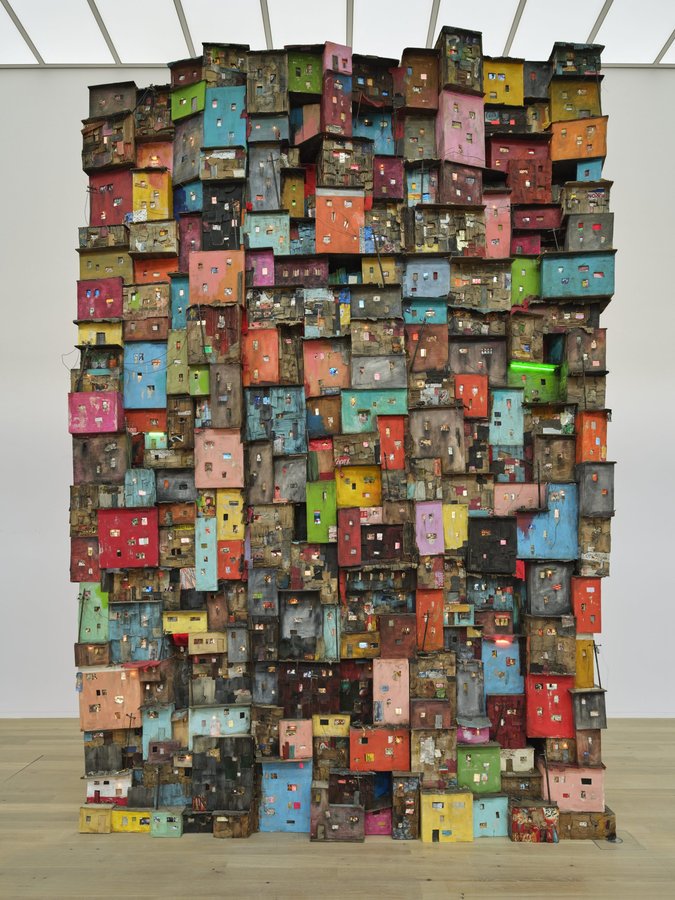
- How do people define Heimat (“home”) in the 21st century? Can you still speak of home in the singular, when concepts of home have become increasingly plural in the present time? Has home as a geographical location had its day? How do people continually form new homes for themselves? Even our globalized and digitized societies harbor a longing for home—despite, or perhaps precisely because they are shaped by migration and constant change. The spectrum of reasons for forced and voluntary migration are manifold, and ongoing processes of forming a sense of home have long become the social normality.Description
Tell Me Where Home Is
Until 17 Jan 2027
Recent past exhibitions
- own emotions. Political and social tensions are plunging people into a collective state of nervousness and vulnerability. On the threshold between delusion and reality, between the self and the external world, the exhibition On Nervous Grounds explores the moment when ambivalent emotions arise. According to the sociologist Eva Illouz, most emotions are a dialogue we conduct with the world. But how can such a dialogue be consciously initiated, and how can an emotional state be made visible? The artist Ariel Reichman engages intensively with human vulnerability and, through his interactive light installation I AM (NOT) SAFE, has found a way to give expression to individual experience. The light of the shifting neon lettering points to the fact that emotions are always fleeting and unstable. The artists Heinkuhn Oh and Sylvain Couzinet-Jacques remind us that emotions are mostly social in nature. They generally relate to other people or to one’s own self and manifest with particular intensity during times of existential change. The two artists offer insight into the emotional state of a young generation that feels isolated and disconnected in theDescription
On Nervous Grounds Between Delusion and Reality
Ended 27 Sept 2026
- A dazzling light shines through a rotating Fresnel lens in the depths of the Pacific Ocean, gigantic submerged glaciers tower above the viewer, and divers float seemingly weightless in Mexican cenotes—the solo exhibition Midnight Zone by the French-Swiss artist Julian Charrière (b. 1987) presents a fascinating investigation into the mysterious world of water. Julian Charrière’s multimedia works consistently combine art, environment, and science. At the heart of the exhibition is the most important element for life on Earth: water. It is the basis of our planet’s biosphere, the habitat of countless organisms and, at the same time, a highly contested resource. Thus, the exhibition highlights not only the sensual and metaphorical aspects associated with water but also a number of the political issues that surround it, such as water pollution and acidification, the melting of glaciers and polar ice caps due to the human-induced climate catastrophe, or the threat to the seabed posed by deep-sea mining. "Midnight zone," the scientific term for the part of the ocean between 1,000 and 4,000 meters below the surface that is completely devoid of light, lends the exhibition its title and serves as its conceptual point of departure. The video installation of the same name shows rays of light transmitted by a turning Fresnel lens—once commonly used in lighthouses—as it is lowered into the jet-black water of the Pacific Sea. Swarms of various fish species are magically attracted to the light and circle the lens, revealing a wealth of lives in the process. It is a descent through which Charrière invites us to consider the rich biodiversity of places still largely unknown and the urgent need to protect them. Julian Charrière: Midnight Zone is the largest solo show to date by the internationally renowned artist. The exhibition, realized in cooperation with the Museum Tinguely in Basel, Switzerland, stages an immersive experience through a scenography developed especially for the Kunstmuseum Wolfsburg, in which image, sound, and body merge. The examination of the significance of water, oceans, and the biodiversity that occupies their depths can be encountered in a multisensory way, mediated through the artist’s transformative use of video, sound, sculpture, photography, and installation. A scientifically substantiated and richly illustrated publication has been produced in close collaboration with the artist to accompany the exhibition. With essays by Stacy Alaimo, Rachel Carson, Susan Casey, Peter H. Gleick, Peter Godfrey-Smith, Amorina Kingdon, Geraldine Kirrihi Barlow, Sara A. Rich, and Helen M. Rozwadowski, as well as an in-depth interview with Julian Charrière, conducted by Andreas Beitin and Roland Wetzel. (Edited by Andreas Beitin and Roland Wetzel, English, with German translations via QR code), 272 pages, available in the museum shop and at [LINK text='kunstmuseum.ticketfritz.de' href='https://kunstmuseum.ticketfritz.de/Shop/Detail/67659/54363'] for €45.Description
Julian Charrière - Midnight Zone
Ended 12 Jul 2026
Małgorzata Mirga-Tas . Eine alternative Geschichte
Ended 15 Mar 2026
Malgorzata Mirga-Tas . Eine alternative Geschichte
Ended 15 Mar 2026