Paris
Musée d'Art et d'Histoire du Judaisme
On now
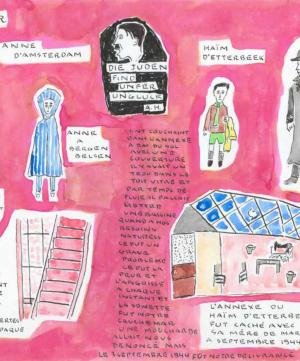
- The eldest of four children, he was born in Brussels in 1929 between the Midi railway station and the slaughterhouses, into a Polish Jewish family. His father, Abraham, was a leatherworker, and his mother, Fradla, a seamstress. The occupation of Belgium in May 1940 turned their lives upside down. After fleeing to France ahead of the advancing Wehrmacht, the Kaliski family returned to the Belgian capital due to a lack of resources. This marked the beginning of a miraculous survival story, as they managed to escape the checks, denunciations and the great round-up of the Jewish quarter of Cureghem on 3 September 1942. However, Abraham was arrested on 12 February 1944. Fradla managed to find refuge for her youngest children and went into hiding with Chaïm until the Liberation in September 1944. For Chaïm, life came to a halt on the day his father was arrested, and he would relive the trauma for the rest of his life. It was at the age of sixty, in 1989, on the advice of his sister Sarah, herself a painter, that he began to draw their story, to which he devoted himself for eighteen years, producing thousands of drawings. The style, which at first glance appears childlike, is nonetheless confident: scenes of arrests and roundups that haunt the artist, who remained forever a "hidden child", marked by the fear and anxiety linked to the images imprinted on his retina. Drawn mainly in Indian ink, these heart-wrenching scenes combine text and image. They consist of "very sonorous" drawings that evoke screams of terror, howls, the noise of truck engines or the clatter of weapons during roundups, forming a whirlwind to which are added recurring refrains, like haunting litanies. The reader discovers a Jewish community on the verge of annihilation through conversations between the artist's father and acquaintances he meets during his wanderings. Chaïm Kaliski's drawings are a moving chronicle of a Jewish childhood and an infinitely accurate account of the Jews of Brussels during the Occupation. A perfect example of art brut, his work is that of a hypermnesic man with an immense historical culture, traces of which can be found in the 120 drawings presented in this first monographic exhibition organised in France. Curators of the exhibition Curator: Virginie Michel, attachée de conservation au mahJ Scientific advisers: Joël Kotek et Laurence Schram With the help of Jonathan Zaccaï and William Henne Based on an idea by Didier Pasamonik #expoKaliskiDescription
Chaïm Kaliski. « Jim d’Etterbeek »
Until 13 Dec 2026
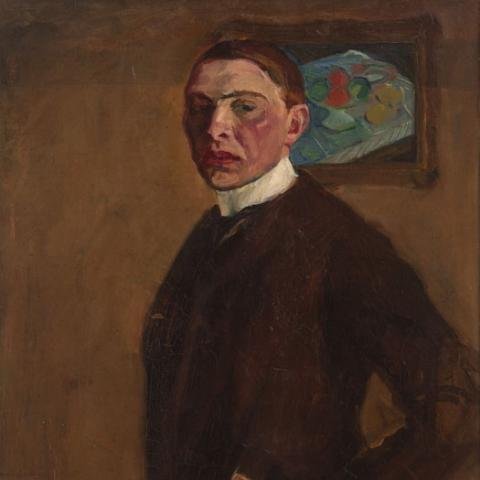
- Peintre majeur de l'École de Paris aujourd'hui largement méconnu, le tchèque Georges Kars retrouve toute sa place au mahJ dans cette première grande rétrospective depuis plus de quarante ans. Lire la suite Georges Kars (Prague, 1880 – Genève, 1945) appartient à cette génération d'artistes venus d'Europe centrale qui firent de Paris l'un des principaux foyers de la modernité artistique. Formé à Munich avant de s'installer définitivement en France en 1919, il développe une œuvre originale où l'héritage de l'expressionnisme et du cubisme laisse progressivement place à une figuration profondément personnelle, fondée sur la robustesse des constructions et la plénitude des formes. Entouré de Guillaume Apollinaire, Max Jacob, Berthe Weill, Paul Poiret, Jules Pascin, Juan Gris, Suzanne Valadon ou Chana Orloff, il participe pleinement à la vie artistique de l'entre-deux-guerres. Pourtant, son œuvre tombe peu à peu dans l'oubli après son suicide à Genève en 1945. Réunissant des prêts exceptionnels des plus grandes institutions tchèques, cette exposition retrace son parcours, met en lumière les liens entre les scènes artistiques de Prague et de Paris et redonne à Georges Kars la place qu'il occupe dans l'histoire de l'art du XXe siècle. Commissaires : Anna Pravdová, conservatrice de la collection d’art moderne de la Galerie nationale de Prague Pascale Samuel, conservatrice de la collection moderne et contemporaine du mahJDescription
Georges Kars, 1880-1945. Un Bohémien à Paris
Until 14 Mar 2027
Recent past exhibitions
- Born in Paris to a Jewish family originally from Alsace and Germany, Denise Hulmann worked at Studio Zuber, then helped found Alliance Photo, the first photographic agency between the two world wars. Influenced by the aesthetics of the "New Vision" movement, she produced numerous reports abroad, in the Balkans, Finland and sub-Saharan Africa, as well as highly creative advertising commissions. In 1940, she married Armand Labin, a Jewish journalist of Romanian origin who joined the Resistance. Hiding her Jewish identity in Lyon during the Second World War, Denise Bellon continued her work there and left behind a remarkable collection of images of the city under the Occupation. At the end of 1944, she covered the Spanish Republican maquis retreating to the Aude region for the Midi Libre newspaper, founded by Armand Labin at the request of the National Liberation Movement. In 1945, she produced a moving report in Moissac (south of France) on the Maison des Éclaireurs Israélites, which was a refuge for Jewish children until 1943 and took in Holocaust orphans after the Liberation. In 1947, she brought back a remarkable collection of images of the island's Jewish community from Djerba. Having been friends with the Maklès sisters since her teenage years – Sylvia, who married the writer Georges Bataille and then the psychoanalyst Jacques Lacan, and Rose, who married the painter André Masson – Denise Bellon frequented the Octobre group and the Surrealists before the war. André Breton entrusted her with covering Surrealist exhibitions from 1938 to 1965. We discover the works of Victor Brauner, Frederik Kiesler, Wolfgang Paalen, and Sonia Mossé (deported to Sobibor in 1943). Denise Bellon also left behind portraits of many Jewish artists from the School of Paris – Moïse Kisling, Kurt Seligmann, Antoine Pevsner Bezalel Schatz – and writers with whom she was close: Joë Bousquet, Simone de Beauvoir, Paul Bénichou, Joseph Delteil, Henry Miller and Jacques Prévert. Thanks to her familiarity with the film world, we also find the faces of Paul Grimault, Joseph Kosma, Nico Papatakis, and the young Marcel Marceau and Serge Reggiani. Her daughters also pursued careers in cinema, Yannick as a director and Loleh as an actress and playwright. In 1972, Denise Bellon's last works were photographs taken on the set of Quelque part quelqu'un, directed by Yannick. Her work is exceptionally diverse and characterised by a strong independence in the world of photography and a keen curiosity, both for ‘elsewhere’, as seen in her reports from abroad, and for the unusual closer to home, whether it be a gypsy wedding in the Zone surrounding pre-war Paris or the surrealism whose developments she followed. Breaking with the bourgeois conventions of her family, she had a wandering eye on the world, which can also be found in other Jewish photographers of her generation, such as Lore Krüger, Gerda Taro, Denise Colomb and Gisèle Freund.Description
Denise Bellon. A Wandering Gaze
Ended 8 Mar 2026