Brussel
Maruani Mercier
On now
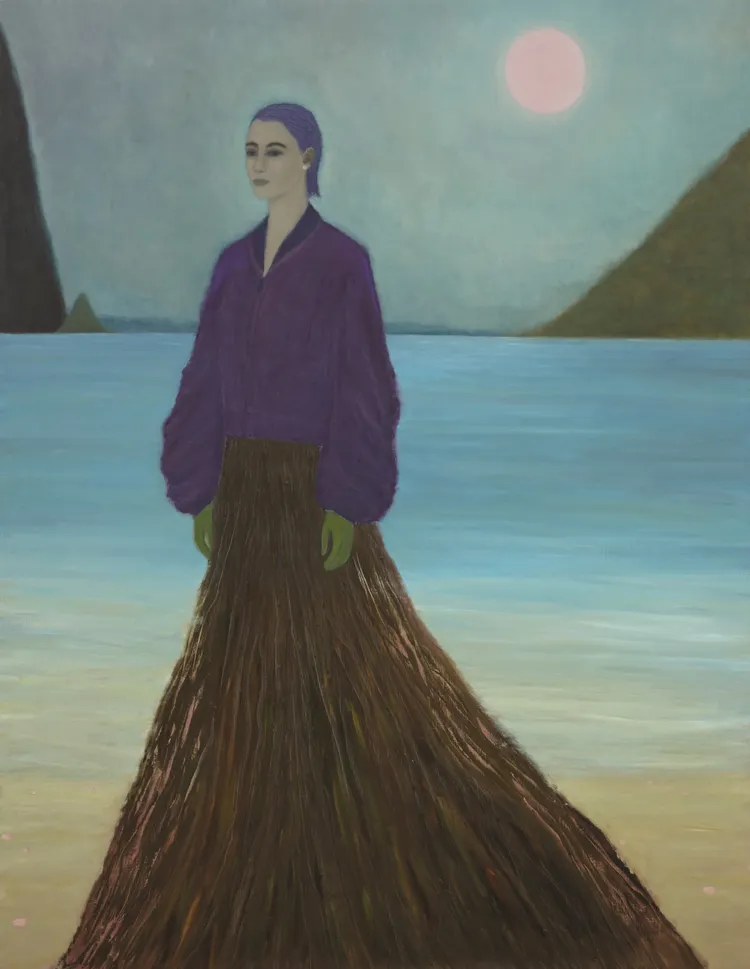
- MARUANI MERCIER is delighted to present Kasper Sonne: People Are Strange, the second solo exhibition of the artist with the gallery, opening on 10 September 2026 in Brussels. Elegant...Description
Kasper Sonne / People are strange
Until 31 Oct 2026
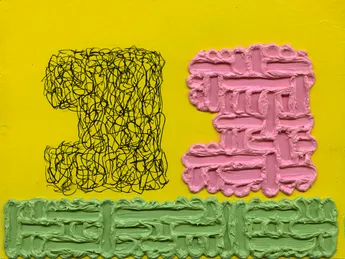
Jonathan Lasker / A Survey of the Maquettes 1986-2026
Until 31 Oct 2026
Recent past exhibitions
- MARUANI MERCIER is delighted to present Tony Matelli: Sideways Dinner, the second solo exhibition of the artist, opening in our Knokke gallery on 8 August 2026. Presenting a series of new sculptures, from an extraordinary life-size self-portrait to his iconic series of Weeds and Arrangements of inverted flowers painstakingly executed in painted bronze, the works in Sideways Dinner reorient one’s perception of the everyday and upend the ordinary angle of visual and social experience. The exhibition takes its title from a new sculptural work that stages an upright arrangement of dinner plates, bottles, and glasses in a humorous take on the iconography of still-life painting. Forming a kind of pictorial plane or relief, the traces of human gathering in Sideways Dinner are at once resolutely familiar and uncanny in their defiance of the laws of physics and time. Drawing on readymade objects, the artist employs a wide range of techniques and materials, such as bronze, silicone and resin, to achieve exacting recreations that separate the trompe l’oeil realism of the surface from the object’s intended function. The works in the exhibition thus hover between the opposites of immediacy and reflection, the permanence and transience of both objects and human relations. In the series of Arrangements of flowers and Weeds that open the exhibition, one further encounters a sense of a shift in the expected continuum of the real. Palpably lifelike, Arrangement (658) presents a deep purple inverted orchid balancing on a single bamboo stick, as if staging an idea of an object, rather than its physical counterpart. Seemingly unrestrained by gravity, the work nevertheless evinces powerful material quality, achieved through meticulous craftsmanship of painted bronze. The dialectic between matter and thought is particularly evident in Matelli’s striking self-portrait, which presents the figure of the artist in his actual studio clothes. Here, the steadfast realism of the composition is undermined by the twist in the head disjointed from the body, and resting sideways on the shoulder. Echoing classical Greek sculpture in its elegant contrapposto stance, the work fuses deadpan humour with a philosophical enquiry into the dualism of body and mind that has dominated Western culture since Descartes. In doing so, Matelli transforms the familiar into a site of perceptual uncertainty, inviting the viewer to consider the nature of human impermanence and experience.Description
Tony Matelli: Sideways Dinner
Ended 6 Sept 2026
Ordered Movement George Rickey
Ended 6 Jun 2026
- For more than thirty years, Arne Quinze has pushed his practice to the edge of what diversity in our contemporary world can reveal. His new exhibition, In the Crossfire: Brutal Harmony and the Fragility of Hope, at MARUANI MERCIER, confronts this tension head-on. Quinze responds to a society increasingly defined by uniformity and the systematic erasure of difference — drawing inspiration instead from the multiplicity and resilience that nature embodies. Here, he transforms his lifelong investigation of the fractured relationship between humanity and the world into a vibrant, refreshing insight into our cultural and social landscape. Quinze celebrates pure beauty, vitality, and possibility. Diversity, in all its facets, fuels his vision: flowers will always break through concrete, hope will always endure, and multiplicity will always assert itself against uniformity. At the core of Quinze’s work is an uncompromising belief in diversity. He challenges the monotony of streamlined behavior, standardized aesthetics, predictable thinking, and shrinking tolerance for experimentation. This enforced uniformity transforms cities into grey, inhuman spaces dominated by concrete and rigid systems. Public life becomes sterile; our connection to plants, insects, animals — to life itself — is gradually severed. Even human expression falls into conformity: similar clothes, similar postures, similar lives. Quinze’s response is not critique alone but an active artistic counter-movement. Rather than moralizing, he turns toward the principles revealed in nature — as a living system of multiplicity, contradiction, fragility, and force in constant harmony. Nature teaches, heals, and inspires: a raw, divine diversity that thrives precisely because it allows difference and transformation to coexist. Through vibrant, often surprising sculptural and painted works, Quinze channels this multiplicity into forms that radiate beauty, tension, and life. The exhibition brings together new and previously unseen works — oil paintings, standing structures — each forged through a process as brutal as it is delicate. Quinze kneads, fractures, bends, and reconstructs matter, revealing the thresholds of its existence. Construction and deconstruction are inseparable in his atelier; they are gestures that mirror growth and decay in the natural world. Materials themselves become protagonists in this choreography of diversity. Murano glass, developed through his ongoing collaboration with Berengo Studio, trembles between lightness and collapse. Raw clay and ceramics carry the memory of the earth. Roughly sculpted aluminum and bronze bear the marks of pressure, impact, and manipulation. Each material occupies a precise place in Quinze’s expanding vocabulary reflecting his conviction that true strength lies in multiplicity rather than uniformity. This process begins in Quinze’s wildflower garden, an open-air laboratory where growth unfolds without hierarchy and decay is never failure. It continues across decades of travel to the world’s most diverse landscapes, where asymmetry, adaptation, and unapologetic multiplicity inform every work. These observations guide everything from intimate paper models to monumental public installations. Quinze positions himself as a mediator between the living natural world and a society he describes as trapped in a “four-walls religion” — confined by structures, detached from complexity and organic life. His works act as ruptures, tearing open space to reintroduce chaos, tenderness, and generosity into our urban and mental landscapes. In the Crossfire: Brutal Harmony and the Fragility of Hope is an exhibition of thresholds — material, social, and perceptual. Each work carries the visible traces of its becoming: compressed clay, molten glass, bent metal, and painted surfaces charged with tension. Together, the works form a landscape where brutality and fragility are complementary forces, and where diversity emerges as the essential condition for life, growth, and imagination.Description
In the Crossfire: Brutal Harmony and the Fragility of Hope
Ended 23 May 2026
- MARUANI MERCIER is thrilled to present The Aesthetics of Possibility, the second solo exhibition of Samuel de Saboia with the gallery, opening on April 4, 2026 in Knokke. In the new body of work, dynamic arcing lines interweave and dance across each composition, configuring into a gathering of multitudinous faces and bodies in space. Gaining renewed intensity and rhythm, the gestural outlines evince both harmony and tension, freedom and restraint. For de Saboia, they embody the multiplicity of identities and histories that shape his personal background, embracing complexity without losing their sensorial generosity. Executed in deeper palette, the works in The Aesthetics of Possibility mark a shift in de Saboia’s practice towards an unbridled gesture and deliberate layering of distinct narratives, reinforcing the paintings’ explorations of identity, collectivity, and transformation.Description
The Aesthetics of Possibility
Ended 26 Apr 2026
- MARUANI MERCIER is delighted to present Ron Gorchov: Painter, Sculptor, Painter, an exhibition of important works by the artist spanning four decades of his artistic production. At once advancing and retreating, convex and concave, Gorchov’s spatially dynamic works manifest the materiality of painting and powerfully probe the notion of the pictorial plane. Gorchov created his first shaped canvas in 1967, at a time when Clement Greenberg’s assertion of ‘flatness’ in modernist abstraction was being dismantled by artists associated with Minimalism. Integrating curved supports with painterly abstract surfaces of stretched canvas, Gorchov’s works offered a nuanced response to the critical debates around abstraction at the time, advancing an intentionality of shape and an awareness of the relations between volume and surface. Establishing a palpable physical presence, each painting stages a corporeal, rather than purely visual encounter, making the viewer become aware of their body in space. Gorchov considerably varied his works in scale – in smaller works, he intuitively heightened the curvature and volume of the support, echoing modes of rendering architectural and bodily proportions. As the artist remarked in a later interview, “I'm very interested in Palladio and his idea of asymmetry, or where symmetry and asymmetry play. And all these spaces have relations - they have, what in music they call 'rubato', a give and take, so you don't have too accurate a beat. So I keep changing the intervals. All these intervals have to change in order to look the same.” Often featuring dual oblong marks that are inspired by the space between the arm and torso in Ancient Greek kouroi sculptures of frontally posed youths, the compositions present an interplay between symmetry and asymmetry of upright shapes. In Agron (2012), the marks in blue fluctuate between depth and flatness on the curving dark ground, directing our awareness from an illusion of spatial opening to the perception of volume and weight. Thinning the paint and applying the pigment in layers, Gorchov achieves a luminous and fluid quality of surface, foregrounding the physicality of marks and drips in the composition. Considering the spatial possibilities of both painterly and sculptural mediums, the works in the exhibition thus evince Gorchov’s singular visual language, inviting the viewer to experience abstraction as a lived, physical encounter. Ron Gorchov (1930-2020) studied at the University of Mississippi before settling in New York in the 1950s. Gorchov has been the subject of institutional solo exhibitions at Hall Art Foundation, Reading (2023); Contemporary Art Museum St. Louis (2014); Centro Atlántico de Arte Moderno, Las Palmas de Gran Canaria, Spain (2011); MoMA PS1, New York (2006 and 1979); Berkeley Art Museum and Pacific Film Archive (BAMPFA), California (1978); and Everson Museum of Art, Syracuse (1972). He participated in major institutional group exhibitions such as Artist’s Choice: Amy Sillman / The Shape of Shape, Museum of Modern Art, New York (2019); 1975 and 1977 Whitney Biennials, Whitney Museum of American Art, New York; and The 1970’s: New American Painting, New Museum, New York (1979). His work is held in numerous public collections internationally, including The Metropolitan Museum of Art, New York; Museum of Modern Art, New York; Whitney Museum of American Art, New York; Solomon R. Guggenheim Museum, New York; Art Institute of Chicago; and Philadelphia Museum of Art.Description
Ron Gorchov: Painter, Sculptor, Painter
Ended 15 Apr 2026
- MARUANI MERCIER is delighted to present The Glass Dream Game, the first solo exhibition of Æmen Ededéen (Joshua Hagler) with the gallery, opening in Brussels on 15 January 2026. Composed of contending layers and strokes of pigment, the works in The Glass Dream Game unfold into echoes of figures in a dream-like realm. Now adding, now scraping away the paint, each gesture reveals disparate elements gradually taking shape in our visual field, assembled through the artist’s continued exploration of the unconscious. The title of the exhibition references Hermann Hesse’s renowned novel The Glass Bead Game, in which the players exercise their in-depth scholarship to unearth elegant associations across the breadth of human knowledge. Ededéen, for whom both Hesse and I Ching arrive through a long-time fascination with Jungian thought and psychoanalysis, assumes the often uncanny synchronicities between texts to have deep significance. Thus, he understands himself and his library to be entangled in an ongoing collaboration through which the Unconscious unveils itself. Ededéen begins each painting with a chance selection of six books, called a Hexagram, from his personal library inspired by the ancient divination practice of I Ching, which the artist practices in his personal life. Through working with these books, he writes what he calls Dreams, and from the Dreams, come the paintings, or Visions. Spanning references from every subject – from art history and philosophy, to religion and science – each painting stages a singular vision, hovering between the subjective and the universal, wrought in collaboration with the parameters of the game. As the artist notes, “I don’t actually want to know more; I want to know less. I don’t know what the work is about, and maybe that’s why I go to all this trouble inventing a game. So I have something to hang this love of unknowing on.” In The Koan is in the Stomach, the Demand is Inconvenient, the painting begins with connections between books such as Wisdom of No Escape by Buddhist teacher Pema Chödron and, comically, even the pregnancy book What to Expect When You’re Expecting. In the course of making the painting, Ededéen struggled with a months-long bacteria-born stomach illness for which he spent a night in the hospital. Thus the meanings of passages from such books change for the artist as his life circumstances change. For Ededéen, The Glass Dream Game itself is a kind of query into mystery and an attempt at integrating art and daily life into a single experience, while creating language to express it. Painting itself, for the artist, is just one aspect of a contemplative life for which all activity aims toward deeper awakening and transformation. Portraying two figures reaching towards one another, The Garden is Trembling but the Dreamer is Still turns to the garden of creation. Drawing on the alternative narrative of Adam and Eve from the mystical book the Zohar, in which they were originally one being that was separated into two, the diptych stages the unattainable longing for human connection. Interweaving echoes of found texts and images – including a painting by Vuillard and a poem by Seamus Heaney – the composition coalesces these found fragments around a meditation on companionship and the origins of human knowledge. Reflecting on the interconnectedness of writings and images across disciplines and geographies, the paintings in The Glass Dream Game present a space for meditation. Eschewing direct argument, each work reveals a multitude of visions into the workings of human thought and our present cultural moment.Description
The Glass Dream Game Æmen Ededéen
Ended 28 Feb 2026