Paris
Galerie Max Hetzler
On now
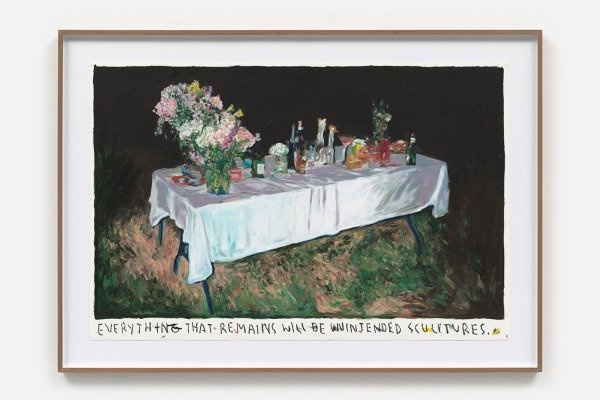
- Hetzler | Marfa is pleased to announce The Dinner, a solo exhibition of new works by Rinus Van de Velde, for the gallery’s annual presentation in Marfa, Texas. Bringing together oil pastels, charcoals, sculpture, and film, the exhibition presents the most comprehensive overview of Van de Velde’s practice in the US to date. Across his oeuvre, Van de Velde explores the porous boundaries between reality and imagination, viewing them not as opposing forces but rather as intimately connected. A self-proclaimed ‘armchair voyager’, Van de Velde interweaves elements of truth and fantasy to narrate his own fictional autobiography from the comfort of his studio. Featuring a selection of oil pastels in a ‘salon-style’ display, alongside the artist’s charcoal paintings, sculptures, and two films, The Dinner opens a new chapter of the artist’s fictional world. The exhibition centres around an imagined gallery dinner, which brings together an eclectic gathering of artists and cultural figures, both living and deceased, where playful and reflective conversations unfold, and humour, scrutiny, reality and illusion become inextricably entwined. Van de Velde’s intricately rendered oil pastel on paper composition, Everything that remains will be unintended sculptures., 2025, offers a thematic starting point for the exhibition. Portrayed in the dead of night, the work presents a table situated in an empty field of grass, and plunged in darkness. The pristine white tablecloth bears the traces of a party: vases of flowers, bottles of champagne, and the dim glow of fading candles. Situated in an ambiguous location, with no chairs or party dwellers in sight, the painting remains as the only trace or aftermath of Van de Velde’s imagined rendezvous. The table becomes an emblem of lingering memory which, as the artist poetically conveys, lives on as unintended sculpture. In this way, it alludes to the snare-pictures of Daniel Spoerri (1930–2024), in which assemblages of leftover meals become sculptural objects. The work further resonates with Van de Velde’s cardboard sculpture, The dinner, 2025, which presents a model of a table surrounded by vacant chairs, as if waiting eternally for its guests to arrive. Unfolding in some remote far-away place, the setting of Van de Velde’s dinner has an uncanny resonance with the unique landscape of Marfa. Each painting offers an imagined scenario in which guests make their way to the dinner, often through surreal or unexpected means – rowing a boat through choppy waters, galloping on horseback like a Texan cowboy through barren land, or driving a car through lush, overgrown fields. One guest, in Unfortunately, I won’t be able to make it. …, 2025, appears to politely decline from a tiny hut in an absurdly isolated location, whilst in Some of you will not be invited. …, 2025, the artist presents a once hopeful gate-crasher who is met with a tangled web of foliage and nowhere to turn. The works reference a multitude of figures spanning different eras from art history and beyond. Drawing from a source photograph of Albert Oehlen (b. 1954) painting en plein air, I know you’d also like to take care of the music…, 2025, alludes to the German artist’s love of music. Referencing Norbert Schwontkowski (1949–2013), Rodney Graham (1949–2022), and Maurizio Cattelan (b. 1960) in It’s got to be Norbert, Maurizio or Rodney., 2025, Van de Velde’s depiction of a bicycle – a recurring motif in his work – becomes a poignant symbol of mental travel. The act of walking or riding a bike, he explains, sets the mind adrift, prompting daydreams and inspiration to flow. The exhibition culminates in the artist’s monumental charcoal on canvas painting, Bill, Bob, Alice, …, 2025. Rendered in black and white, the work takes on a more serious tone. The artist’s guests are gathered together in a space which lies somewhere between a conference room and a courtroom. Van de Velde himself stands at the podium, addressing some of the most renowned names in art history, before concluding his speech with ‘ A warm welcome to you all ’ – a direct reference to the iconic scene in the film The Godfather (1972), in which Frank Pentangeli testifies in court. Dissipating into the black-and-white language of the past, Van de Velde’s dinner party seems to draw to a close. ‘In the end,’ the artist notes, ‘it’s only echoes in your head’. In his cardboard sculptures, Van de Velde depicts fictional scenes from his studio and everyday life. A number of them present miniature versions of the life-size sculptures he creates as props for his films, further blurring the distinctions between reality and illusion. Like the drawings, they tell stories that feed Van de Velde’s fictional world, envisaging dialogues with artists such as Alfred Wallis (1855–1942) in A Studio for a pleinairist, 2025, or David Hockney (b. 1937) in I’ll take one more dive, David, 2025. Portraying a rendition of Hockney’s famous swimming pool, Van de Velde here imagines himself as the model for Hockney’s The Bigger Splash, 1967. The exhibition also features two of Van de Velde’s films, both shot entirely in his studio, which play on a loop. La Ruta Natural, 2019–2021, a palindrome, follows the artist’s alter ego, portrayed by his studio assistant who wears a mask of his face, as he wanders endlessly through a dreamlike world. A Life in a Day, 2021–2023, presents Van de Velde’s work as an intimate self-portrait, immersing the viewer in the artist’s internal process as we follow a plein air painter’s journey through a tropical jungle and into a swimming pool, before emerging in an underground archive. It layers multiple realities: the artist’s everyday life, his imaginative wanderings in nature, and the depths of his personal archive, revealing how Van de Velde moves seamlessly between disparate realms. Rinus Van de Velde (b. 1983, Leuven) lives and works in Antwerp, Belgium. Solo exhibitions of the artist’s work have been held at Art Sonje Center, Seoul (2024); Museum Voorlinden, Wassenaar (2023); BOZAR, Centre for Fine Arts, Brussels (2022); Kunstmuseum Luzern; FRAC des Pays de la Loire, Nantes (both 2021); KWM artcentre, Beijing; Bærum Kulturhus, Sandvika (both 2019); Kunstpalais Erlangen (2018); Nest, The Hague (2017); Kunstmuseum Den Haag, The Hague (2016); S.M.A.K, Ghent (2015, 2008); Kunsthalle São Paulo (2015); Centro de Arte Contemporáneo, Malaga (2013); Stedelijk Museum Schiedam (2012); Institut für zeitgenössische Kunst, Nürnberg (2010); and Lokaal 001, Antwerp (2008). Van de Velde’s works are in the collections of Belfius Art Collection, Brussels; CAC Malaga; Colección SOLO, Madrid; Erasmus University Rotterdam; FRAC des Pays de la Loire, Nantes; Ghisla Art Collection, Locarno; Karel De Grote Hogeschool, Antwerp; Kunsthalle São Paulo; Kunstmuseum Den Haag, The Hague; Kunstmuseum Luzern; KWM artcenter, Beijing; M HKA, Antwerp; Museum Voorlinden, Wassenaar; and S.M.A.K., Ghent, among others. Press contact: Hetzler | Marfa Sabrina Lejeanvre sabrina@maxhetzler.com +1 432 703-3430 Honor Westmacott honor@maxhetzler.com +49 30 346 497 85-0 [LINK text='www.facebook.com/galeriemaxhetzler' href='http://www.facebook.com/galeriemaxhetzler'] [LINK text='www.instagram.com/galeriemaxhetzler' href='http://www.instagram.com/galeriemaxhetzler']Description
Rinus Van De Velde the Dinner
Until 6 Dec 2026
Recent past exhibitions
- Galerie Max Hetzler, Paris, is pleased to present On A Clear Day I Can See You Forever, a solo exhibition of new paintings and a sculpture by Friedrich Kunath. This is the artist’s third exhibition with the gallery and his first in the Paris space. German-born artist Friedrich Kunath works across painting, drawing, sculpture, installation, and video. Kunath considers himself a composer of images. Drawing from a wealth of references spanning personal history, music, German Romanticism, and pop culture, he creates dense narratives and rich pictorial worlds. His works often emerge from an initial emotional impulse that gradually unfolds through the act of painting. The exhibition opens with a depiction of a tropical landscape. Titled I Think I've Made It, 2022–2026, the painting presents a lake surrounded by lush vegetation. Humorously upending the viewer’s expectations, a snowman stands on an island in the middle of the lake sending a text message. A recurring figure in Kunath’s work, the snowman reappears in the artist’s monumental triptych, On A Clear Day I Can See You Forever, 2025–2026, which depicts an open stretch of beach veiled in mist. While Kunath is known for his dense and contrasting compositions, brimming with vibrant colour and texture, this ironically-titled, fog-shrouded shore appears restrained and pared-down. Lending the exhibition its title, the work references The Peddlers’ song, On A Clear Day You Can See Forever. In an act of wordplay, Kunath transforms the song’s original title, playfully amplifying its wistful and romantic resonance. For his creative process, Kunath works in layers, slowly building up his compositions through rich, impasto underpaintings. He subsequently inscribes small drawings, notations, a phone number, to-do lists, song lyrics, and so forth, that capture an array of fleeting thoughts and emotions. Once this first layer has hardened, an appropriated image is painted on top. Encouraging a slow and deliberate process of looking, the viewer may uncover these cathartic details, which represent most readily the unconscious stage of the artist’s creative output. Embedded within the layers of paint, they invite a personal and psychological reading of the work. In Dear Uncertainty, 2025, a stretch of highway, set against a flaming sunset, encapsulates Kunath’s intuitive approach to image-making. The vast openness of the image draws the viewer in, immersing us in a sense of unbridled natural wonder. Capturing these moments of ephemeral beauty in nature, Kunath’s works point towards the fundamental enigma of such aesthetic encounters, underscoring a sense of mystery and uncertainty as their ultimate gift. Describing his technique, Kunath often refers to the psychological dynamic between the unconscious and the conscious mind. As a central theme of the exhibition, this dichotomy is reflected in the way the two gallery spaces interact: the works in the first smaller space possess an abstract, instinctive, and unconscious quality. They are the amoebic jetsam from which Kunath's entire practice is born. The works in the second, larger space emerge fully formed, ‘conscious’, and mediated by precise, relatable images. Surrounded by a selection of abstract paintings, Kunath’s bronze sculpture, Sorry I Thought I Was Someone Else, 2026, depicts a ghost seemingly preparing for the day ahead, as he irons out a fresh new sheet to inhabit. Like the other characters in Kunath’s pictorial universe, the figure represents one of the many archetypes of the artist’s personality – and perhaps of our own. Indeed, immersed in a flow of images and symbols throughout the exhibition, we become confronted with our own beliefs and complex inner landscapes. Friedrich Kunath (b. 1974, Chemnitz, Germany) lives and works in Los Angeles and Berlin. The artist’s work has been the subject of solo exhibitions in institutions including Stiftung zur Förderung zeitgenössischer Kunst in Weidingen (2025); G2 Kunsthalle, Leipzig (2024); Kunsthalle Düsseldorf (duo show, 2024); KINDL, Berlin; Centro de Arte Contemporáneo, Malaga (both 2023); Kunstsammlung Jena (2021); Philara Collection, Düsseldorf (2016); Centre d’art contemporain d’Ivry - le Crédac, Ivry- sur-Seine; Kunsthalle Bremerhaven; CAPRI, Düsseldorf; Nassau County Museum of Art, New York (all 2014); Modern Art Oxford (2013); Sprengel Museum, Hanover (2012); Schinkel Pavillon, Berlin (2011); Hammer Museum, Los Angeles; Kunstsaele, Berlin (both 2010); Staatliche Kunsthalle Baden-Baden; Kunstverein Hannover (both 2009); Kunsthaus NRW Kornelimünster, Aachen (2007); Bonner Kunstverein, Bonn (2002); and The Modern Institute, Glasgow (2000), among others. Kunath’s work is included in the collections of Carnegie Museum of Art, Pittsburgh; Centre Pompidou, Paris; Deji Art Museum, Nanjing; DESTE Foundation for Contemporary Art, Athens; Fondation Louis Vuitton, Paris; Frans Hals Museum, Haarlem; Hammer Museum, Los Angeles; Hessel Museum of Art, Annandale-On-Hudson; Kunstverein Reutlingen; Los Angeles County Museum of Art; The Museum of Contemporary Art, Los Angeles; Museum of Contemporary Art, San Diego; The Museum of Modern Art, New York; Pinault Collection, Paris; and Walker Art Center, Minneapolis, among others. Press contact: Galerie Max Hetzler Honor Westmacott honor@maxhetzler.com +49 30 346 497 85-0 [LINK text='www.facebook.com/galeriemaxhetzler' href='http://www.facebook.com/galeriemaxhetzler'] [LINK text='www.instagram.com/galeriemaxhetzler' href='http://www.instagram.com/galeriemaxhetzler'] [LINK text='WeChat ID: max_hetzler' href='https://www.maxhetzler.com/wechat']Description
FRIEDRICH KUNATH On A Clear Day I Can See You Forever
Ended 16 May 2026
- W ir freuen uns, Sie auf Where We’re Going We Need Roads hinweisen zu dürfen, eine Einzelausstellung mit neuen Gemälden und Arbeiten auf Papier von Jake Longstreth. Es ist die dritte Ausstellung des Künstlers in der Galerie und seine zweite in Berlin. Longstreth präsentiert in dieser Ausstellung eine Reihe neuer Ölgemälde auf Leinwand und Arbeiten auf Papier aus den Jahren 2025 und 2026. Weit entfernte Autobahnen, auf denen winzige, ameisenähnliche Autos fahren, liegen inmitten riesiger, verschleierter Weiten. Im Vordergrund sind zahlreiche Bäume und Pflanzen zu sehen: kalifornischer Buchweizen, Rotbeeren-Toyons, Flieder, Manzanita, Canyon-Eichen und Eukalyptus. In diesen neuen Gemälden hat sich Longstreth weiter in die Büsche und Dornensträucher der Hügel dieser Region vorgewagt und die jahreszeitlichen Veränderungen – von der unerwarteten Frische des Frühlings bis zur spröden Trockenheit des Herbstes – festgehalten. Doch die Straßen bleiben bestehen, immer in der Ferne präsent, und tragen das angedeutete Umgebungsrauschen des Verkehrs mit sich. Selbst an erhöhten, scheinbar abgelegenen Orten herrscht ein ständiger Lärm. ‚Um hier so zu leben, wie wir es tun, brauchen wir Straßen‘, erklärt Longstreth, ‚aber natürlich sind die Gemälde lautlos. ‘ Die Ansichten, die in diesen Werken zusammengestellt sind, entstanden während Longstreths Streifzügen durch das dichte Netz von Wanderwegen, das sich durch fast jede Schlucht der Region schlängelt. Im Gegensatz zu seinen früheren Gemälden – Ansichten aus dem Autofenster von Restaurant- und Einzelhandelsketten – sind diese Bilder von einer langsameren, körperlichen Begegnung mit der Landschaft geprägt. Dennoch bleibt die grundlegende Frage: Was ist schön? Ein entfernter Golfplatz, ein weißer Lexus, der über die Autobahn rast; darüber eine alte Eiche, verworrenes Unterholz, ein im Schatten versteckter Puma. Der Schrei eines Falken, Wind, der durch die Blätter weht, ein rückwärtsfahrender Muldenkipper. Die Gemälde betonen Tiefe und räumliche Schichtung, entfernen sich vom flachen architektonischen Raum und konzentrieren sich stattdessen auf sorgfältig beobachtete, liebevoll wiedergegebene Blätter und Pflanzen. Natur und Infrastruktur koexistieren in einer zarten Nähe und verstärken sich gegenseitig. In den Gemälden auf Leinwand verfolgt Longstreth einen formal anspruchsvolleren Ansatz als in bisherigen Werken, indem er Vorder-, Mittel- und Hintergrund präzise artikuliert und gleichzeitig räumliche Distanzen sanft verschwimmen lässt. Lichtflecken der Sonne, die auf entfernte Autos fallen, unterbrechen die Autobahnen, während dichtes Laubwerk in den Vordergrund drängt. Die Gemälde entfalten sich in dem gedämpften Dunst, der für einen Morgen in Los Angeles typisch ist, einem sanften atmosphärischen Schleier, der noch eine Weile anhält, bevor er im Laufe des Tages allmählich verschwindet. Diese Leinwände, die zu einer früheren Tageszeit als Longstreths bisherige Werke entstanden sind, schweben in einem Moment des stillen Übergangs, in dem die bekannte Helligkeit Südkaliforniens einer gemäßigteren, kontemplativen Stimmung Platz lässt. Die Autobahnen, die sich durch diese Gemälde ziehen, geben der Ausstellung ihren Titel Where We’re Going We Need Roads, eine Umkehrung des berühmten Schlusssatzes aus Robert Zemeckis’ Film Back to the Future von 1985. Trotz jahrzehntelanger Innovationen und dem Versprechen autonomer Mobilität bleibt die Fortbewegung an eine der beständigsten Erfindungen der Menschheit gebunden: das Rad. Und das Rad benötigt zwangsläufig Straßen. Longstreths Landschaften verankern uns in der Gegenwart, in der Autobahnen und Autos das lebendige Terrain durchschneiden und natürliche Kreisläufe mit den Infrastrukturen verbinden, die das zeitgenössische Leben aufrechterhalten. In den Arbeiten auf Papier mit dem Titel Eucalyptus Leaves 1-8 überlagert Longstreth die verschwommenen Konturen eines grauen Tages in Los Angeles mit Nahaufnahmen von sich im Wind wiegenden Ästen. Die Eukalyptusblätter erscheinen in einer vielfältigen Farbpalette: kühle Minztöne, warme Olivfarben, gedämpfte Brauntöne, Kürbisorange und unerwartete Magentatöne. Diese Arbeiten auf Papier bieten Raum für improvisierte Kompositionen. Longstreth malte die Blattformen schnell und ohne Überarbeitung; auf Papier gibt es immer nur eine einzige Versuchsmöglichkeit. Die fein abgestimmten Kompositionen der Leinwände, die Blicke durch die Zweige und Blätter freigeben, treten in den Hintergrund und werden durch eine leichtere, verspieltere Sensibilität ersetzt. Zusammen betrachtet regen diese Werke zum Nachdenken über Aufmerksamkeit, Nähe und Beständigkeit an und zeigen, wie natürliche und konstruierte Landschaften unsere Bewegung, unsere Sichtweise und unseren Platz in der Welt weiterhin prägen. Jake Longstreth (geb. 1977 in Sharon, USA) lebt und arbeitet in Los Angeles, USA. Der Künstler erhielt 2005 seinen MFA vom California College of the Arts in San Francisco. Seine Arbeiten wurden 2017 in einer Einzelausstellung im Crisp Ellert Museum, Flagler College, St. Augustine, gezeigt. Longstreths Werke befinden sich unter anderem in den öffentlichen Sammlungen der Aïshti Foundation, Beirut, und des Crocker Art Museum, Sacramento.Description
JAKE LONGSTRETH Where We’re Going We Need Roads
Ended 25 Apr 2026
- Galerie Max Hetzler, Berlin, is pleased to announce X-Rated (1972–1974), a solo exhibition of paintings and works on paper by William N. Copley. This is the fourth presentation of the artist’s work at the gallery. Copley came to painting from an unusual position. He had ambitions to become a writer before becoming a painter, and, for a brief period in the late 1940s, he co-founded and operated a gallery in Beverly Hills that focused on the Surrealists. The Copley Galleries – which he ran with his brother-in-law, the artist John Ployardt – brought him into close contact with exiled Surrealists such as Man Ray, Max Ernst and Marcel Duchamp, as well as the dealer Alexander Iolas, who encouraged him to pursue his nascent art practice. Adopting the signature CPLY around the time the gallery closed, he debuted his first exhibition at a bookstore in Los Angeles in 1951, shortly before he moved to France. Even though he was a generation younger than the Surrealists, Copley’s work is deeply informed by the movement on a conceptual and personal level. While his bold black outlines and self-taught figurative style recall comics and Pop art, Copley approached painting with a literary sensibility, using narrative strategies that both embodied Surrealist principles and drove the structural evolution of his compositions. Like many Surrealists, Copley embraced humour, psychology and eroticism as fundamental to his creative process, yet his engagement with overtly sexual subjects went far beyond the playful eroticism of his peers. On view in the exhibition are works from Copley’s prolific ‘X-Rated’ series, created between 1972 and 1975, and first exhibited in 1974 in an eponymous show at the New York Cultural Center. This body of work draws on erotic imagery and ritualised motifs from adult magazines, seeking, in the artist’s own words, to ‘break through the barrier of pornography into the area of joy.’ 1 In a decade when the sale of hardcore pornography was still illegal in the United States, Copley would buy ‘adult magazines’ under the counter, using them as a source for inventive figurative and narrative paintings that explored eroticism, sexual politics and the pursuit of pleasure. The artist was able to convey a wide range of tone in the ‘X-Rated’ paintings: some, such as The Seven Year Itch, 1973, are tender; others, including Viridiana, 1973, are exuberant; and almost all of them are openly humorous. Underscoring the open-endedness of sexual expression, Copley stated: ‘That’s what makes sex so much fun: since nobody really understands it, the possibilities for originality are endless.’ 2 Copley typically produced two stages of preparatory drawings before starting a painting: an initial, small-scale study, followed by a larger version in which he refined the composition, introduced changes, and heightened the work’s pictorial dynamism. The resulting paintings maintain a deliberately slapdash style, with figures treated loosely rather than meticulously rendered. The exhibition makes this developmental process visible through multiple pairings of preparatory drawings and completed paintings, including Calcutta, 1973, and its counterpart Untitled, 1973. Scenes of copulations and orgies are set against vivid, brightly coloured backgrounds animated by bold, geometric patterns, making them almost ‘too artful to be libidinous, let alone lascivious’, as critic James R. Mellow has remarked. 3 It is both this treatment of the backgrounds and the contorted, entwined bodies with their attenuated limbs and schematic outlines that has prompted critics to draw a link between Copley and Henri Matisse more than once. Yet, while depictions of the nude and sexual imagery throughout art history have traditionally relied on suggestion and idealisation, Copley presents the sexual act directly, leaving nothing to the imagination. With titles borrowed from Hollywood movies such as Les Quatre Cent Coups, The Exorcist or Tobacco Road, Copley tempered the shock of the pornographic image through comic playfulness and pop cultural sensibility. Manifesting a Surrealist disjunction, the movies rarely align explicitly with the images’ content, but the titles nevertheless set in motion a cascade of associations for the viewer. The title of the series, likewise, draws on terminology from the film industry: until the 1990s, the film-classification term ‘X-rated’ was used in the US for films only suitable for adults. Despite the cautionary notices that some visitors might find the subject matter offensive, the 1974 exhibition at the Cultural Center – curated by the newly appointed and strikingly progressive director Mario Amaya – received a notably positive critical response. Art in America writer Peter Schjeldahl hailed the presentation as a ‘uniformly gorgeous exhibition,’ noting that it marked ‘a highly satisfying development in Copley’s work’. 4 William N. Copley (1919–1996), known by the name CPLY, lived and worked in Paris, New York, and Roxbury, Connecticut, among other places. Copley’s works have been exhibited in renowned institutions worldwide, including the Philara Collection, Düsseldorf (2023); Institute of Contemporary Art, Miami (2018); The Menil Collection, Houston, travelling to Fondazione Prada, Milan (2016–2017); Museum Frieder Burda, Baden-Baden, travelling to Max Ernst Museum Brühl, Hannover (2012); Bonnefantemuseum, Maastricht (2001); L.A.C. Lieu d'Art Contemporain, Sigean; Herning Kunstmuseum; Forum of Contemporary Art, St. Louis (all 1999); Ulmer Museum, Ulm (1997); Kestner-Gesellschaft, Hanover (1995); The New Museum, New York (1986); Künstlerwerkstatt Lothringerstrasse, Munich (1981); Kunsthalle Bern, travelling to Centre Pompidou, Paris; Stedelijk Van Abbemuseum, Eindhoven; Badischer Kunstverein, Karlsruhe (1980); New York Cultural Center (1974); Stedelijk Museum, Amsterdam (1966); and Institute of Contemporary Arts, London (1961), among others. Copley’s work is held in major public collections worldwide, including the Art Institute of Chicago; Centre Pompidou, Paris; Denver Art Museum; Fondazione Prada, Milan; Los Angeles County Museum of Art; The Menil Collection, Houston; Moderna Museet, Stockholm; Museum of Contemporary Art Chicago; The Museum of Modern Art, New York; Museum Ludwig, Cologne; Museum Moderner Kunst Stiftung Ludwig Wien, Vienna; Philadelphia Museum of Art; Power Institute, Sydney; Städel Museum, Frankfurt; Stedelijk Museum, Amsterdam; Tate, London; and Whitney Museum of American Art, New York, among others. 1 W. N. Copley, ‘CPLY: An Interview by Sam Hunter’, in William N. Copley: Selected Writings, Cologne: Verlag der Buchhandlung Walther König, 2020. 2 W. N. Copley, ‘A Conversation with William Copley by Alan Jones’, in ibid. 3 J. R. Mellow, ‘The X-Rated World of William Copley’ in The New York Times, 30 March 1974. 4 P. Schjeldahl, ‘William Copley at N.Y. Cultural Center’, in Art in America, May–June 1974. Press contact: Galerie Max Hetzler Honor Westmacott honor@maxhetzler.com Berlin: +49 30 346 497 85-0 [LINK text='www.facebook.com/galeriemaxhetzler' href='http://www.facebook.com/galeriemaxhetzler'] [LINK text='www.instagram.com/galeriemaxhetzler' href='http://www.instagram.com/galeriemaxhetzler'] [LINK text='WeChat ID: max_hetzler' href='https://www.maxhetzler.com/wechat']Description
William N. Copley X-Rated (1972–1974)
Ended 22 Apr 2026
André Butzer
Ended 18 Apr 2026
KAREL APPEL Variations on a Theme
Ended 16 Apr 2026
- G alerie Max Hetzler, Berlin, is pleased to present the third iteration of On Paper, a group show exploring the enduring relevance of paper as medium. Bringing together works spanning several generations, the exhibition reveals how paper remains a vital ground for artistic innovation, critical reflection, and material exploration. Across their respective practices, artists including Katharina Grosse (b. 1961), Eddie Martinez (b. 1977), and Tursic & Mille (both b. 1974) all utilise paper as a site of dynamic experimentation. In Grosse’s prismatic dispersions, Martinez’s instinctive, automatic lines, and Tursic & Mille’s colourful abstract works, the artists harness the immediacy of gesture and form. In the practices of Bridget Riley (b. 1931) and Günther Förg (1952–2013), paper offers fertile ground for meticulous drawing and planning. This is encapsulated in Riley’s geometric investigation into the harmonies and dissonances of colour and form, as much as in Förg’s sixteen-part acrylic on paper composition from 1992. Belonging to his ‘Farbfeld’ series, the work offers an investigation into monochrome abstraction. Each utilising paper’s materiality to different ends, Mark Grotjahn (b. 1968) performs mark-making as an act of rhythm and repetition, Sarah Crowner (b. 1974) presents an abstract, labyrinthine drawing which operates as a compositional map for her larger ‘Tableaux en Laine’, and Vivien Zhang (b. 1990) draws from diverse source material – from migrating butterflies to world map projections – to address themes of diaspora and identity. Gestures of the body find a distinct material resonance in the drawings of Grace Weaver (b. 1989) and Louise Bonnet (b. 1970), who depict the female figure with tenderness or temerity. Paper acts as vessel for history and memory in the portraits of Giulia Andreani (b. 1985), composed in her signature Payne’s grey. For Victor Man (b. 1974), his recurring skull motif, etched in crayon on paper, acts as a memento mori. Carroll Dunham (b. 1949) and William N. Copley ’s (1919–1996) anatomically reduced figures are situated between movement and stillness, the mundane and the phantasmagorical. In his crude treatment of the drawn line, Karel Appel (1921–2006) reveals a sense of primal energy and emotive immediacy in his compositions of humans and animals, whilst Paul McCarthy (b. 1942) employs the medium of paper to probe questions of our deeper consciousness and desires. Evoking scenes of contemplation, Eleanor Swordy (b. 1987) mirrors the inward turn of thought in her intricate pastel compositions. The archival nature of paper reveals the capacity to hold memories of process and narrative. To this end, Rinus Van de Velde (b. 1983) constructs fictional biographies, Glenn Brown (b. 1966) distends, distorts and reimagines art historical sources, creating juxtaposing narratives of past and present, and Friedrich Kunat h (b. 1974) creates fantasy-infused landscapes where sentiment is met with introspection. Working solely on paper, Walton Ford (b. 1960) merges historical fact with fantastical imagination in his luminous watercolours. Standing as autonomous investigations of psychological states and memory, Sabine Moritz ’s (b. 1969) rich, abstracted surfaces are achieved without preliminary sketches. Rendered in delicate pencil, KAWS ’s (b. 1974) iconic CHUM character moves through a classical landscape suggested by cracked stone and distant trees. With characteristic emotional complexity, CHUM’s posture conveys determination tempered by resignation. Using the medium to articulate systems and characters that underpin their broader practices, Martin Kippenberge r (1953–1997), Albert Oehlen (b. 1954), André Butzer (b. 1973), and Matthew Barney (b. 1967) each work between figuration and abstraction, channelling paper’s responsiveness to function as a correspondent to their wider oeuvre. Paper, as a material, is a sediment of our organic environment. Ida Ekblad ’s (b. 1980) fluid constellations, Janaina Tschäpe ’s (b. 1973) morphogenic compositions, and Jake Longstreth ’s (b. 1977) sun-drenched landscapes situate paper within the ecology of matter. Tal R (b. 1967) presents two large, colourful fruit bowls, from a new body of still lifes within his series of ‘domestics’. Jeremy Demester (b. 1988) depicts intimate moments from daily life and transforms optical phenomena into painterly terrains using earthy pigments and vivid colours, with a focus on paper’s materiality and its close relationship to natural topographies. Exploring themes ranging from the conceptual to the material, from tradition to experimentation, and from abstraction to figuration, On Paper foregrounds the versatility and continued relevance of its titular medium.Description
On Paper
Ended 7 Mar 2026
PIÈCE UNIQUE: GRACE WEAVER Untitled (Mourner), 2025
Ended 7 Mar 2026
Katharina Grosse
Ended 28 Feb 2026
TAL R / domestic
Ended 28 Feb 2026
BARRY FLANAGAN / On the other hand
Ended 28 Feb 2026