Düsseldorf
Galerie Max Mayer
On now
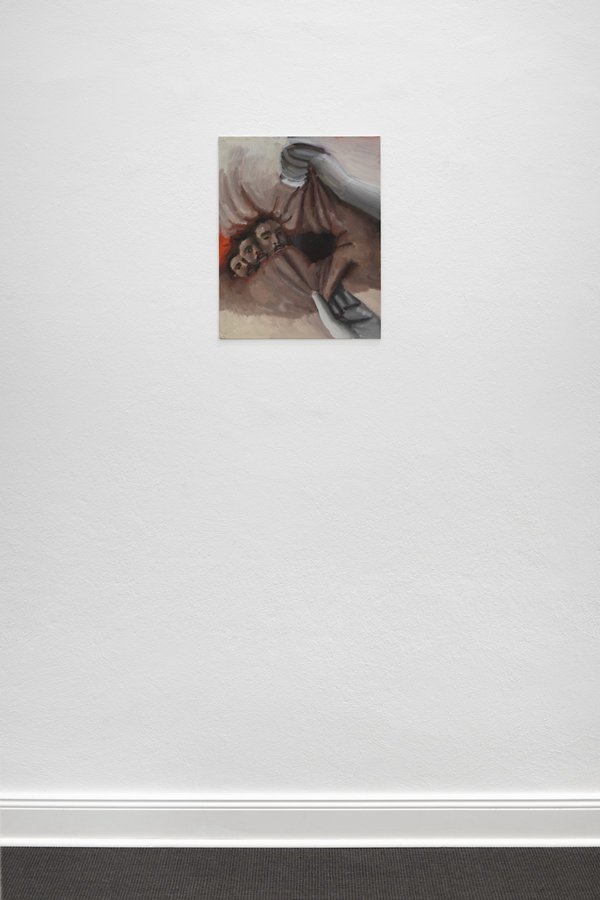
- An anal fistula comes out of a kind of anger connected to a situation I wanted to hold on to, but could not keep inside of me. It is like trying to hold on to ‘scrap’ from the past (thoughts, feelings and desires) but ultimately failing. I carry feelings of revenge towards someone or something, while at the same time holding on to resentment that I bring with me from the past. The result is a fistula - an abnormal channel that creates a connection between an internal organ and the surface of the body. At the beginning of the year, I had surgery on my ass twice, which made me think a lot about healing. At first, I started illustrating the situations around the operations, but I quickly realized that this approach was not taking me any further. Instead, I became more and more interested in the idea of interventions and openings. I ordered a green surgical drape, which eventually became, together with the painted holes, the starting point for my new work. The shapes developed into squares, becoming a recurring element in the paintings that can be read as an object, an intervention, a form of censorship, or space. This element helped me to distance myself somewhat from the narrative and instead show a state in which I could explore the different possibilities of painting. I gradually moved away from art-historical references and began developing a new vocabulary through a reduced visual language. I am still trying to make the conflict itself the subject - the struggle between control and letting go. Despite their different aesthetics, I want the paintings to remain connected and to be read as different states within a shared process. Raw Umber plays an important role in this. It is a colour that was often used by the Old Masters as an underpainting. I deliberately left parts of the underpainting visible, while developing others into a more abstract visual language. At the same time, I decided to return to working directly and without photographic references - painting myself in front of a mirror or inviting people to sit for me and painting them live. In the gallery’s smaller exhibition room, I am trying to bring these different aspects of my work together. The individual paintings do not only stand on their own, but enter into a relationship with one another, forming a kind of experimental setup in which different states and possibilities can exist side by side. Working with only a few art-historical references has helped me to move away from what is already familiar and to arrive more fully in the present. In the exhibition room, I wanted to deliberately push myself and try something new. For about a year and a half, I have been studying classical Turkish singing and taking singing lessons. Through this, I have been learning a lot about traditional Turkish music and the different Makams used to evoke particular emotions. The sound in the exhibition grew out of this learning process: I took individual passages from songs I had sung during my lessons and edited them together; my teacher played the kanun alongside them. The installation extends my exploration of voice and expression beyond painting. [PARA_DATE_HINT] As I write this text, I still do not know exactly what the whole thing will look like in the end. I am interested in different aspects of making art, and I want to use the opportunity and the space I have been given to find new ways of working and to try them out. Maybe it is also about giving myself permission to fail. But most importantly, I want to find my own voice. Murat Önen, August 2026 [/PARA_DATE_HINT]Description
Murat Önen: trennt euch
Until 24 Oct 2026
Recent past exhibitions
- Galerie Max Mayer is pleased to present Positive Aesthetics, a group exhibition drawn from the gallery's program and inspired by the pedagogical principles of Jef Geys. Between 1963 and 1989, Geys taught at a state secondary school in Balen, where he developed a wide range of significant artworks alongside his teaching. His approach brought together aesthetic inquiry and political thinking, aiming to make seemingly self-evident assumptions visible and open to discussion. A key example is the body of work!Vrouwenvragen? (!Women’s Questions?), which compiled questions on women and feminism and was openly displayed in the classroom. Whenever a student referred to it, the lesson would pause and the question would be discussed collectively. In this way, the classroom became a space where learning, art, and social reflection intersected. The spatial arrangement of artworks was also central to Geys’s concept of Positive Aesthetics. As seen in the documentary black-and-white photographs included in the exhibition, he used the back wall of his classroom to present artworks that illustrated artistic movements and aesthetic principles. The exhibition adopts and reinterprets this approach in the gallery space: works are placed in dialogue with one another, forming an open network of relationships. This is exemplified by the juxtaposition of Fruit Bowl, a modernist, participatory work that can be continually rearranged, and the documentary photograph Classroom with Lili Dujourie, which shows the artist Lili Dujourie standing at the blackboard, with Jef Geys seated on a school desk. At the center of one of the exhibition rooms is the Gevoelsspeeldoos, a key example of Geys’s effort to situate the forms of modernism within an everyday, pedagogical context. For Geys, art was always a distinct category, yet one that remained inseparable from lived political reality. The work combines geometric and tactile elements shaped by the history of modernism, while also functioning as a toy through which children could develop a sense of form and composition. Here, art emerges as an autonomous field that nonetheless remains deeply connected to social life. We are delighted to present the Gevoelsspeeldoos in this exhibition. The exhibition also brings together other artists from the gallery’s program whose practices engage with pedagogy, play, and social roles. Maximiliane Baumgartner, for instance, closely connects her work to various educational initiatives, particularly the project Der Fahrende Raum in Munich-Freimann. Her paintings are shaped by specific places and social contexts. The work shown here, Das Sprechende Eck, relates to the project Ruhr Ding: Schlaf, presented as part of Urbane Künste Ruhr in Essen-Steele. Ei Arakawa-Nash have, over several years, most recently in their solo exhibition Non-Gestational Co-Nursing at the gallery, explored new understandings of family and care work. These questions will also be central to their upcoming exhibition Grass Babies, Moon Babies at the Japanese Pavilion of the Venice Biennale 2026. The work Don’t Give Up (Mary Cassatt, Mother and Child, ca. 1889, & The Family, ca. 1886) belongs to a series in which they engage with artists from art history while reflecting on the social conditions that shaped their work. Mary Cassatt’s Impressionist paintings, which often depict domestic life, reveal, also through their spatial constraints, the exclusions faced by women and female artists in the 19th century. In his work series Decommissioned Games, Adam Harrison presents paintings of board games stripped of language and imagery. These works reflect on the role of games in early socialization, through which children rehearse future roles in playful ways. Reduced to abstract geometric compositions, the Decommissioned Games invite viewers to imagine new forms of interaction and relation. Nicolás Guagnini’s new pedagogical series of letter sculptures engages with his young son’s process of language acquisition. This work captures the poetic foundations of language, the formation of meaning and, with it, of the world, while reflecting a parent’s attempt to grasp and revisit this almost magical stage of life. Finally, we are pleased to present, as a first collaboration with the Archiv Reinhard Mende, three photographs from the 1960s. These images, taken in kindergartens and schools, were produced as part of a commission to document aspects of everyday life in East German society. Created around the same time as Geys’s early years in Balen, they offer a valuable glimpse into pedagogical practice under socialism.Description
POSITIVE AESTHETICS with works by Ei Arakawa-Nash, Maximiliane Baumgartner, Jef Geys, Nicolás Guagnini, Adam Harrison and Archiv Reinhard Mende
Ended 20 Jun 2026
- Galerie Max Mayer is pleased to announce Eat Pay Love, the second exhibition of Tobias Hohn & Stanton Taylor with the gallery. For more than a decade the artist duo has been working with and through the orchestration of social spaces. Emerging from a range of project spaces, performances and institutional interventions, Eat Pay Love stands within a history of critical reflection on the social conditions of art and engages the audience to a high degree. In this process the boundaries between author and recipient are subverted in order to get a shared concept of production. The exhibition Eat Pay Love transforms the gallery into a space where interaction, feedback, and decision-making can be experienced directly. Through a series of spatial interventions, it both enables and restricts forms of participation, shifting the roles between visitors and other actors. The recent works by Tobias Hohn & Stanton Taylor take their cue from theories of learning developed in early behavioral psychology and cybernetics, where learning is understood less as a subjective phenomenon, and more as the product of predetermined environments and routine interactions. Applied across the exhibition, this logic treats the gallery’s architecture and infrastructure as active material rather than neutral support. Mazes and labyrinths recur as central motifs. While labyrinths have long served as ritual architectures within human culture, mazes have increasingly been deployed to test and design learning processes for non-human intelligences. The works from the Reinforcement series translate these structures into collages made from newspapers and advertising brochures. They foreground a tension within contemporary information flows that appear novel, while remaining entirely ritualized. Through layering and repetition, the artists exhaust the instructive clarity of content in order to make space for another approach. The sculpture The Nature of Love reproduces part of a classic experiment on attachment in behavioral psychology, originally conducted with rhesus monkeys. Elsewhere, an installation of mirrors placed behind the desks of gallery staff makes their work processes visible to viewers, conjuring a situation of reciprocal observation. This strategy also extends to a barrier with an observation window that separates the gallery’s 'professional' and 'social' spaces. Eat Pay Love invites visitors to reflect on their own path through a system of expectation and control. In reiterating the gallery’s own mechanisms, the artists also open them up to renegotiation as a social and cognitive experiment.Description
Tobias Hohn & Stanton Taylor: Eat Pay Love
Ended 7 Mar 2026