Berlin
Galerie Nagel Draxler
On now
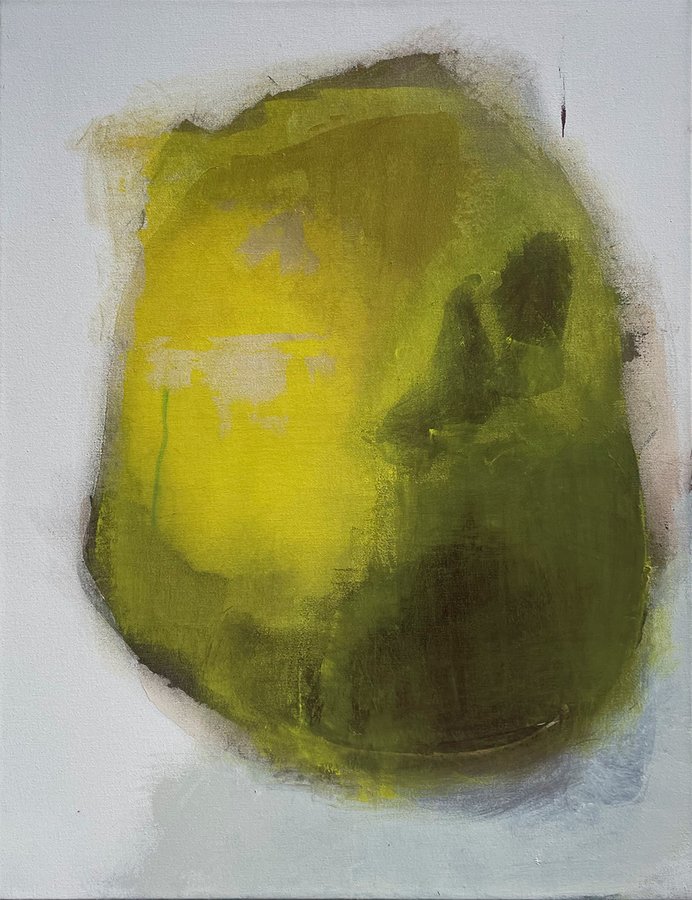
- Lone Haugaard Madsen (born in 1974 in Silkeborg, Denmark) is one of the most relevant female artists of her generation in Scandinavia and beyond. Departing from her studies in humanistic theory of science at Aarhus University and at the Jutland Art Academy in the 1990s, she joined art school at the Vienna Academy of Fine Arts in the early 2000s with a deep skepticism regarding the question of what art can be today, and oriented towards radical institutional critique in the vein of Michael Asher or Gordon Matta-Clark. In her work, which encompasses sculpture, performance, painting and installation, she has been exploring the format she refers to as ‘spaces’ – constellations of found objects and paintings that have been ‘rubbed’ onto found canvases. Skepticism can never be eradicated from the mind of a true artist. Haugaard Madsen is not an artist who is guided by ideas, but rather by a thought process rooted in experience. Gradually, her work is shifting away from the use of various materials in space toward capturing and concentrating the aesthetic presence of these materials and spaces on the canvas using raw painterly techniques. The result is a series of profoundly deep and beautiful paintings—works of art capable of keeping pace with the doubts surrounding contemporary art in a world where contemporary thinking is in decline.Description
Raum#428-Fumus
Until 14 Nov 2026
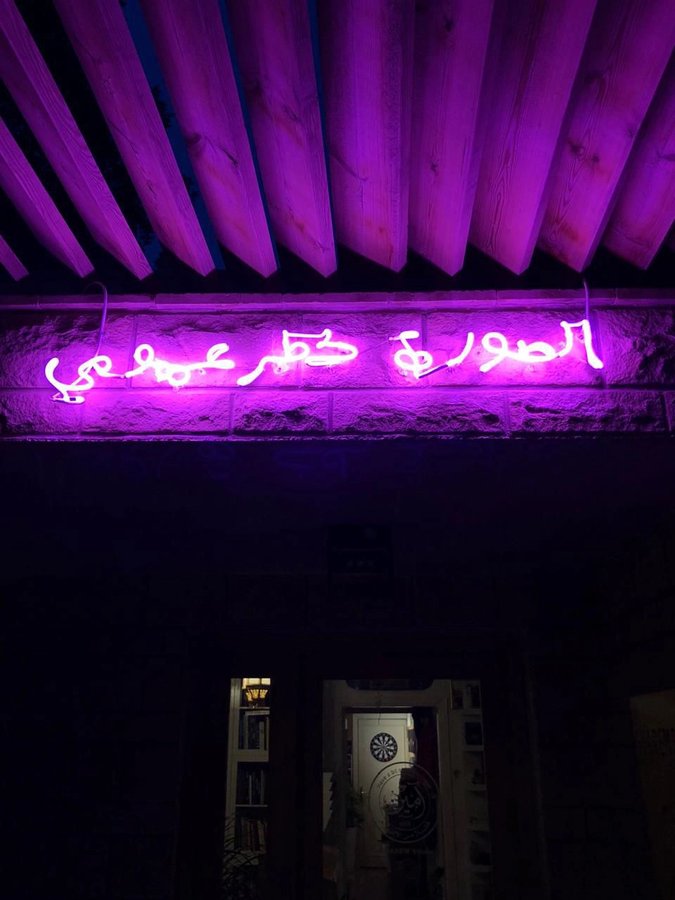
- This greatly anticipated solo exhibition by Abdulnasser Gharem, one of the most influential contemporary artists in the Gulf region, features three new projects: Aniconism 2026, The Unscored Goal, 2026, and The Image is a Public Menace (Neon), 2026. The term "Aniconism" (Anikonismus) was coined by the 19th-century German classical archaeologist Johannes Adolph Overbeck in 1864. It means the practice or belief of avoiding the visual representation of divine beings, sacred figures, or living creatures in art and worship. Often rooted in religious doctrine, it aims to prevent idolatry by substituting direct imagery with symbols, abstract shapes, calligraphy, or empty space. In 2015, Abdulnasser Gharem found an unusual way to transport a female mannequin sculpture to Riyadh, where the display of such figures was considered inappropriate. The mannequin was taken to a workshop in Dubai, where it was cut into small pieces, which were then reassembled in Riyadh. Gharem then invited his fellow artists to take part in an "art class" in which they re-enacted a famous work by Martin Ferdinand Quadal from 1787 titled "The Nude Drawing Room of the Vienna Academy." A large "tableau vivant" photograph captures this scene. An earlier version of Aniconism was presented at Sharjah Art Museum in a joint exhibition with Austrian artist Heimo Zobernig, *Subversive Forms of Social Sculpture*, 2018, curated by Amira Gad. We are most delighted that Heimo Zoberning has agreed to design the exhibition space for Gharem’s exhibition in Berlin - with one of his signature curtains made of "Video Green Trevira", a material that was used in the film industry to create spatial effects long before the age of AI. After Gharem received the invitation to *The Great Michelangelo Is Dead!*—an exhibition that explores the fascinating tension and the possible correlations and processes of repulsion between the avant-garde and the academy—the artist added several crucial layers to the project. He asked a Vienna based copyist who was trained in the Vienna Academy to paint his photograph of the art class from 2015 in the same technique used by Martin Ferdinand Quadal in 1787. Gharem documented every step in video, in the copyist's studio as well as on site at the Academy, next to the original Quadal painting. In a second large-format painting, we see the scene in which the art class participants are assembling the mannequin. Abdulnasser Gharem’s Aniconism is a brilliant reworking of history painting. With a frontrow seat to profound changes in the role of art in daily life across the region, Gharem brings his artistic vision to bear on a historic moment. By moving a contemporary scene from a Riyadh studio through the visual language of European painting and into the hands of painters in Vienna, he asks how history is pictured, who possesses the authority to represent it, and what changes when an image moves between cultures. The work stands as a pivot point, deeply rooted in the transformations unfolding around him while claiming the scale and ambition of grand history painting. – Nato Thompson (excerpt from the essay Abdulnasser Gharem: Aniconism, 2026)Description
The Image Is a Public Menace
Until 14 Nov 2026
Recent past exhibitions
- Anna Fasshauer (born 1975, Cologne) forms the material with her own physical strength into large sculptures, painted in color. Precisely expressed, she transforms material into forms that she places in space. She does not design or draw, does not commission the production. The artist produces herself, expending energy bending and flexing and reworking the large, heavy works. She improvises, the works ‚emerge in the making‘. The tension between light and heavy, solid and provisional, form and expression is unique. Yet works emerge that echo the tradition of abstract modernism as if it were a continuum.Description
HALLEN 07 – Toshihiko Mitsuya
Ended 13 Sept 2026
- Anna Fasshauer (born 1975, Cologne) forms the material with her own physical strength into large sculptures, painted in color. Precisely expressed, she transforms material into forms that she places in space. She does not design or draw, does not commission the production. The artist produces herself, expending energy bending and flexing and reworking the large, heavy works. She improvises, the works ‚emerge in the making‘. The tension between light and heavy, solid and provisional, form and expression is unique. Yet works emerge that echo the tradition of abstract modernism as if it were a continuum.Description
HALLEN 07 - Digital Art Wall
Ended 13 Sept 2026
- Anna Fasshauer (born 1975, Cologne) forms the material with her own physical strength into large sculptures, painted in color. Precisely expressed, she transforms material into forms that she places in space. She does not design or draw, does not commission the production. The artist produces herself, expending energy bending and flexing and reworking the large, heavy works. She improvises, the works ‚emerge in the making‘. The tension between light and heavy, solid and provisional, form and expression is unique. Yet works emerge that echo the tradition of abstract modernism as if it were a continuum.Description
Anna Fasshauer
Ended 13 Sept 2026
- Tomorrow, I Become a Woman turns toward a difficult inheritance carried by many Buffalo women whose girlhoods were shaped or shattered in the long shadow of civil war, tradition, religion and the 32 Battalion. Here, becoming a woman is not a gentle transition but an abrupt crossing, marked by displacement, militarised landscapes, and the unspoken violences that threaded through daily life during and after the conflict. The paintings hold space for those whose childhoods were shortened by war, whose bodies were read through political lenses before they were fully their own, and whose stories were often erased in official histories. In this domestic interior, the loss is intimate: the vigilance learned too young, the gendered expectations intensified under militarised rule, the weight of survival passed down as quiet instruction. Yet within the stillness, the figure insists on something more, a future not defined by the battalion’s legacy, but by her own remembering, her own reconstruction, her own imagination. She becomes a woman not through the trauma imposed on her, but through the courage to reclaim her narrative from the institutions that sought to control it. Her rebellion lives through her daughters and granddaughters, reclaiming what was lost. Who is she one may ask : She is Tchulu, Kwakwete, Njuju, Kutala and those whose names were never passed down. Tomorrow, I Become a Woman examines the accelerated loss of girlhood among Angolan women whose lives intersected with the militarised structures of 32 Battalion during and after the South African Border War. Rather than presenting womanhood as a biologically determined transition, the work frames it as a coerced social and political shift shaped by displacement, precarity, and gendered expectations within militarised communities. The composition foregrounds the domestic interior as a site where military and patriarchal logics converge. Here, the everyday routines of girls were structured by surveillance, constrained mobility, and the silent pedagogies of fear. Girlhood was not merely interrupted; it was reorganised to serve the demands of a patriarchal, colonial military apparatus that instrumentalised women’s labour, bodies, and emotional endurance. By centring the figure’s interiority, the painting challenges dominant narratives that marginalise women’s experiences in official histories of 32 Battalion. It repositions Buffalo women not as peripheral witnesses but as subjects whose constrained futures, strategies of survival, and modes of resistance form an essential archive of the region’s militarised past.Description
Tomorrow, I become a Woman
Ended 13 May 2026
- A shadow confirms presence. It binds a body to the ground, stabilizing its place in the world. Where shadow fails, this certainty begins to loosen. The installation unfolds as a garden that cannot be fixed in time. Plant-like forms made of aluminium reflect light and their surroundings, their outlines shifting with movement and changing conditions. Metallic yet fragile, they resist clear states of growth or decay, remaining suspended between the living and the non-living. In this space, the loss of shadow is not merely visual. It marks a moment in which life and death are no longer opposed. Death does not appear as an ending, but as something already folded into the continuity of life. What emerges is not a defined boundary, but a threshold where distinctions loosen and remain unresolved. Here, form does not insist on stability, and presence persists without the need for clear contours.Description
Where Shadow Fails
Ended 18 Apr 2026
Nightmarket
Ended 18 Apr 2026
- Ingeborg Gabriel (1951–1996) studied at the University of Fine Arts Hamburg from 1974 to 1978. Early on, she was closely associated with post-avant-garde artists such as Albert Oehlen, Werner Büttner, and Michael Krebber; however, her own work remained in the background for a long time. After completing her studies, she moved into a studio at Künstlerhaus Hamburg, where she organized, among other projects, Martin Kippenberger’s first solo exhibition. Later, she relocated with her family to Kürten in the Bergisches Land region, where she once again established a studio. From the late 1980s onward, Ingeborg Gabriel devoted herself primarily to the flexible and versatile medium of drawing, which she explored with great conscientiousness and an experimental spirit—without expecting clear or immediately tangible results. Gabriel produced hundreds of drawings and worked more or less in seclusion. Her motifs and subjects—houses, heads, portraits, and glasses—were usually drawn from her immediate surroundings, always maintaining a connection to nature. At the same time, she examined the formal aspects of drawing. Across an unusually broad range of versions, materials, and techniques, she captured plants and living creatures on paper. Between 1989 and 1990, she created works that lend themselves beautifully to storytelling—depicting dragonflies, caterpillars, salamanders, flies, and frogs. At other times, roses, mushrooms, fir trees, landscapes, moles, snails, and birds served as points of departure for her drawings, as did exotic animals such as monkeys and bears. Some forms are rendered in color with brushwork, others with a confident line; occasionally, a subtle sense of humor emerges. For her works, she chose papers of widely varying quality and character. Alongside her drawing materials, paper itself became an essential element of her graphic laboratory experiments, understood as a malleable material in its own right. She employed simple notepaper as well as used, printed, or lined sheets, cardboard, and smooth or rough papers in both light and heavy weights. Although she largely operated quietly, she and her husband Uwe were firmly embedded in Cologne’s art scene of the 1980s and 1990s. Cosima von Bonin gave up her second exhibition at Galerie Christian Nagel in Cologne to Ingeborg Gabriel, enabling Gabriel to hold her first solo exhibition there. Prior to that, Cosima von Bonin had adapted two of Gabriel’s works as her own in a solo exhibition at Andrea Rosen. Her works are held in the Kippenberger Collection and in the Judith Rothschild Collection at MoMA, New York. After her death, curators Susanne Pfleger and Ellen Seifermann organized the first posthumous solo exhibitions—at the Städtische Galerie Wolfsburg (March 7–June 7, 1998) and at Kunstverein Heilbronn (September 13–October 25, 1998).Description
Lempertz, Brussels
Ended 28 Mar 2026