Basel
NICOLAS KRUPP
On now
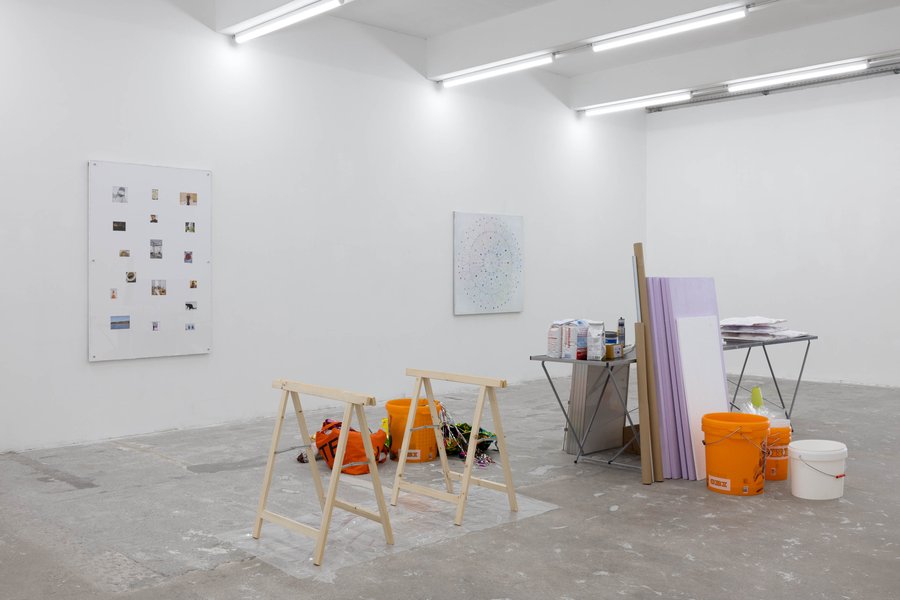
- Maintenance 3 stellt den prekären ontologischen Status von Kunstwerken (und Alltagsgegenständen) zur Schau.(1) Eigene Werke, Fragmente aus der Produktion, Ready-Mades, private Aufnahmen und Zeichnungen, die bis in Müllers Jugend zurückreichen, sind angeordnet wie in einem Studio-/Lagerraum. Es ist ein barockes Projekt, überbordend und hinfällig; kühle, auto-referentielle Dekonstruktion und Elegie über die Entropie. Die Vergänglichkeit jegliches symbolischen Systems und jeglichen kommunikativen lebensweltlichen Zusammenhangs schwebt über der Ausstellung. Sie feiert «Das dunkle Fest des Lebens» (Gerhard Meier). Die Arbeiten an den Wänden geben Einblick in Müllers Interesse an der stetigen Re-Organisation und Re-Medialisierung einzelner Werkgruppen. Skulpturen tauchen als Zeichnungen auf, Filmstills und Fotos werden zu neuen Sinneinheiten montiert, visuell opulente «Mandala»-Paintings mit Dispersion geweisst. Es finden sich (auto-)aggressive Elemente. Die Werke im Raum operieren ähnlich: Auch sie entstammen diversen vergangenen Ausstellungskontexten, sind Fragmente aus bestehenden Werkzusammenhängen. Ein Verkehrshut aus einer Ausstellung ist halbiert und in Glas gegossen. Material eines Workshops mit Kindern liegt herum. Glänzende neue OBI-Eimer und Ballons reflektieren unseren Blick. Die Ausstellung liesse sich so auch als Reihe von «Anekdoten zu einer Topographie des Zufalls» (Daniel Spoerri) erzählen. Jedes Stück in der Ausstellung trägt eine Geschichte in sich, die sich den zugewandten Betrachter:innen erschliessen liesse wie bei einem tableau-piège. Sie verweisen auf vergangene soziale Interaktionen/symbolische Transaktionen. In Kaspar Müllers Ausstellung sind die Objekte in ihrer Stummhaftigkeit, in ihrer Nicht-Beredtheit, unheimlich präsent. Dieter Roth äussert sich 1968 im Vorwort der «Topographie anecdotée du hasard», die er ins Deutsche übertragen hat, zum menschlichen Umgang mit Objekten jedweder Art wie folgt und, wie mir scheint, abschliessend:Description
Kaspar Müller: Maintenance 328
Until 31 Oct 2026
Recent past exhibitions
- Mit Werken von Silvia Bächli, Sabian Baumann, Beni Bischof, Chloé Delarue, Bonaventura Genelli, Hans Baldun Grien, Judith Kakon, Käthe Kollwitz, Esther Mathis, Ulrich Meister, Alexandra Meyer, Kaspar Müller, Peter Paul Rubens, Filib Schürmann, Markus Schwander, Ludwig Stocker, Christian Vetter Die aktuelle Sammlungspräsentation Gegenwartskunst besteht aus Neuankäufen und Beständen, die schon lange nicht mehr gezeigt wurden. Ausgangspunkt bildet die Zeichnung "Ohne Titel (Stelzen)" von Ulrich Meister. Zu sehen ist ein Paar Stelzen, ein in Vergessenheit geratenes Kinderspielzeug. Heute erinnert die Form vielmehr an Krücken. Das Schwanken zwischen humorvoller Leichtigkeit und düsterem Ernst wirkt in allen Ausstellungsräumen nach. Ausgewählte Werke aus der kunsthistorischen Sammlung stellen epochenübergreifende Querverbindungen her. Immer wieder verhandeln die Exponate auch den Versuch, Räume, Hindernisse, gesellschaftliche Zuschreibungen und Krisen zu überwinden. Wer heutzutage hoffnungsvoll ist, benötigt womöglich helfende Stützen. Oder sind am Ende gar jene besser aufgestellt, welche die Hoffnung bereits verloren haben?Description
Hoffnung als Krücke. Neupräsentation Sammlung Gegenwartskunst
Ended 6 Sept 2026
- Das bewegte Bild ist allgegenwärtig – auf unseren Bildschirmen, in den sozialen Medien, auf der Strasse. Was einst auf flimmernden Röhrenbildschirmen begann, hat sich zu einer der spannendsten Ausdrucksformen zeitgenössischer Kunst entwickelt: Videokunst sprengt Grenzen, spielt mit Wahrnehmungen, erzählt Geschichten – mal poetisch, mal radikal. Die zwei komplementären Ausstellungen im Aargauer Kunsthaus und im Kunstmuseum Solothurn zeigen, welche Spuren die Videokunst in der Schweiz und in den beiden Häusern hinterlassen hat. Die Ausstellungen vereinen Leihgaben aus öffentlichen wie privaten Sammlungen, schliessen Neuproduktionen mit ein und werden ergänzt durch eigene Sammlungsbestände, in denen sich zentrale Werke der Videokunst befinden.Description
Mehr Licht. Video in der Kunst
Ended 17 May 2026
- Kunsthalle Bern freut sich, eine neue Ausstellung von Lin May Saeed zu präsentieren. Lin May Saeed (1973–2023) war eine deutsch-irakische Künstlerin und Tierrechtsaktivistin. Die Frage nach einer Koexistenz zwischen Mensch und Tier fand auch Eingang in Saeeds künstlerische Praxis. Sie arbeitete vor allem mit Skulpturen, oft aus einfachen Materialien wie Styropor, und entwickelte eine Bildsprache, die mythologische, religiöse und aktivistische Erzählungen miteinander verknüpft. Ihre Werke und Schriften schlugen eine mitfühlende Neukonzeption der Beziehungen zwischen den Spezies vor und stellten Befreiung und Versöhnung als skulpturale und soziale Akte dar.Description
Lin May Saeed: Kunsthalle Bern
Ended 10 May 2026
- An exhibition that invites you to rediscover the past and share memories. Featuring works from the Helvetia Art Collection, an intervention by Monica Studer and Christoph van den Berg, and iconic everyday objects from decades past.Description
Weisch no?
Ended 7 May 2026
- How does an AI hallucinate? The HALLUC project, conceived by the fictional research institute FOWDIB ( [LINK text='http:studervandenberg.ch/fowdib' href='http:studervandenberg.ch/fowdib'] ), seeks to offer answers that artistically reflect on the current state of research on digital consciousness and transcendence. Based on reports by researchers experimenting with mind-enhancing substances, new image spaces open up – not only for humans, but also for machine intelligences – in which various entities swirl around in a wild cosmic dance, attempting to make contact with the observer. The presentation features current pictorial material from the interactive VR installation that forms the core of the project: a series of high-resolution screenshots as digital prints, groups of 3D prints in white resin, large-scale textile digital prints, as well as a version of the VR work adapted for projection. The HALLUC cycle was developed between 2023 and 2026 (ongoing) and was first presented in this form in 2025 at TOKAS, Tokyo.Description
Monica Studer / Christoph van den Berg
Ended 25 Apr 2026
- Few subjects reflect a society’s values and norms, and how they change over time, as clearly as depictions of children. The exhibition Kids! Between Representation and Reality, at the Bucerius Kunst Forum, focuses on the portrayal of children in art from the 16th to the 21st century. Approaching the topic from different perspectives, six chapters present not only paintings, but also photographs, works on paper, media art and sculptures. The starting point for the images of children in the exhibition are depictions of the Virgin Mary and Child, which still characterize social perceptions of mother-child relationships today. The portrayal of children has had various functions over the centuries. Created in circles of the high nobility around 1500, portraits of children were intended to underpin the continuity and claim to power. Against this backdrop, portraits often depicted young boys in armor as small adults. In this way, they were prepared for their future role as generals and rulers. A playful variant is the portrait historié, in which, for instance, children were clothed in pseudo-historical dress and poses ancient gods. Particularly in the 17th century Dutch and Spanish genre painters picked up the motif of poor children, which survives to this day. The artists were not necessarily concerned with adopting a socially critical stance. After all, it is not uncommon to see children from financially disadvantaged and often precarious backgrounds smiling. Child labor was not fundamentally rejected, either. Rather, it was viewed as a valuable way for children to contribute to their family's income. The exhibition presents a wide range of images illustrating how the portrayal of children has changed over the centuries. Today, for instance, there are no longer any portraits depicting deceased children. In earlier times, however, this was a way to preserve the memory of the little ones. Nowadays, this remembrance is rather captured in lifelike portraits, for example in photographs that show children in happy life situations. The most significant change, reflecting a different understanding and definition of childhood, took place at the end of the 17th century and in the 18th century. Children should develop on their own terms – preferably in nature and away from the adult world. As a result, childhood as a subject is still one of the most popular pictorial themes in the visual arts today: Testing oneself, pushing boundaries, drawing, playing and togetherness are formative experiences for this most important of life phases. This exhibition presents works by artists such as Titian, Anthony van Dyck, Thomas Lawrence, Joshua Reynolds, Gerrit van Honthorst, François Boucher, Paula Modersohn-Becker, Oskar Kokoschka, Gerhard Richter, Rineke Dijkstra and Nobuyoshi Araki.Description
Group show: Kinder, Kinder!
Ended 6 Apr 2026
- Die ALBERTINA beherbergt eine der weltweit größten Sammlungen von Kunst auf Papier: Zeichnungen, Druckgrafiken und Aquarelle. 2026 feiert sie ihr 250-jähriges Jubiläum – ein idealer Anlass, diesem reichen Schatz aus 600 Jahren Kunstgeschichte eine große eigene Ausstellung zu widmen. Faszination Papier richtet den Blick auf die mehr als eine Million Objekte umfassende Sammlung und zeigt sowohl herausragende Kunstwerke als auch die erstaunliche Vielfalt des Materials Papier: von faltbaren Sonnenuhren über Zeichnungen und Skulpturen bis hin zu kunstvollen Spielkarten. Über die Grenzen der Jahrhunderte hinweg begegnen sich historische und zeitgenössische Positionen. Bekannte Meisterwerke treten in Beziehung zu neu entdeckten, selten oder noch nie gezeigten Arbeiten und eröffnen neue Perspektiven auf die Sammlung. In zehn technischen und thematischen Kapiteln, die wie ein Parcours angelegt sind, lädt die Ausstellung zum Entdecken dieser faszinierenden Welt aus Papier ein.Description
Faszination Papier. Rembrandt bis Kiefer
Ended 23 Mar 2026
- Nam Kim (b.1991) is an American-born Korean artist living and working in Vienna. Nam attended Ewha Womens University in Seoul from 2010 to 2015 and earned her Bachelor degree of fine arts (painting) and art history. Between 2017 and 2023 she studied with Professor Kirsi Mikkola and Alastair Mackinveb in Academy of fine arts Vienna. Nam Kim mainly use painting for her artistic practice. Nam’s painting is about self-reflection, a process of learning about oneself. She attempts to understand and examine what the essence and the core of humanity are, focusing on capturing psychological fragments that occur in human relationships.Description
Nam Kim
Ended 28 Feb 2026
- Nam Kim's exhibition 'The World is a Forest' features a collection of vibrant paintings that explore the artist's unique perspective on nature and human connection. The exhibition runs from September 1, 2023 to October 31, 2023 at the Nicolaskrupp Gallery in Vienna.Description
Nam Kim: The world is a forest
Ended 28 Feb 2026
- Why Look at Animals? A Case for the Rights of Non-Human Lives centres on animal rights and animal well-being, highlighting the urgent need to recognise and defend the lives of non-human animals in an anthropocentric world that exploits, oppresses and brutalises them. The exhibition is inspired by John Berger’s seminal essay of the same name, “Why Look at Animals?” (1980), which explores the changing relationship between humans and animals, particularly in the context of modernity. The essay reflects on how animals, once deeply integrated into human life, have become increasingly distanced, objectified and commodified. Why Look at Animals? A Case for the Rights of Non-Human Lives aims to engender a discussion around the ethics and politics of how we treat animals. By exposing the exploitative, violent mechanisms behind systemic animal abuse, it renders what is shamefully invisible visible. The exhibition and its public programme hope to raise awareness of the conditions of non-human animal life today, from the home, the street and the factory to their threatened natural habitats. Why Look at Animals? invites us to consider the non-human animal not as “Other”, but as a being with a “voice” and intrinsic value of its own, capable of artfulness, play, socialisation and transformation, pleasure, inventiveness, pain and grief. The exhibition begins on the museum’s lower ground floor where the focus is on the deeply interconnected phenomena of colonialism, industrialism, and technological “progress”, which led to the first large-scale destruction of habitats as well as the violent exploitation of animals. As visitors ascend through the museum, they will encounter works that examine the present state of things: how animals exist and survive in urban environments, examples of animal activism, and new forms of animal knowledge, among other themes. Finally, on the fourth floor of the museum, the exhibition shifts in tone; here, poetics, ecofeminism, animism, play, animal creativity, and humour intersect. Animals reclaim their dignity, and we are prompted to imagine a future world in which there will be more harmonious interspecies co-existence and collaboration. Advances in animal studies continue to show that more and more species of non-human animals possess intelligence and sentience; that they feel pleasure, pain, grief and fear. The exhibition puts into question human exceptionalism, and aims to confront one of the carefully hidden and largely unspoken crimes of humanity on a mass scale: that of the daily, institutionalised, systematic violence against animals – whether directly or indirectly – a violence that denies them their basic natural rights. Why Look at Animals? highlights the fact that the myriad species that exist alongside us are an integral part of our biosphere and ecosystems, not products and automata, separate from and subordinate to us. With this project EMΣT places ecological justice and the rights of non-human life at the heart of its programming for the months to come. Any serious engagement with climate justice and environmental protection must therefore involve animals as an integral part of the conversation.Description
Group show: Why Look at Animals?
Ended 15 Feb 2026
- Why Look at Animals? A Case for the Rights of Non-Human Lives centres on animal rights and animal well-being, highlighting the urgent need to recognise and defend the lives of non-human animals in an anthropocentric world that exploits, oppresses and brutalises them. The exhibition is inspired by John Berger’s seminal essay of the same name, “Why Look at Animals?” (1980), which explores the changing relationship between humans and animals, particularly in the context of modernity. The essay reflects on how animals, once deeply integrated into human life, have become increasingly distanced, objectified and commodified. Why Look at Animals? A Case for the Rights of Non-Human Lives aims to engender a discussion around the ethics and politics of how we treat animals. By exposing the exploitative, violent mechanisms behind systemic animal abuse, it renders what is shamefully invisible visible. The exhibition and its public programme hope to raise awareness of the conditions of non-human animal life today, from the home, the street and the factory to their threatened natural habitats. Why Look at Animals? invites us to consider the non-human animal not as “Other”, but as a being with a “voice” and intrinsic value of its own, capable of artfulness, play, socialisation and transformation, pleasure, inventiveness, pain and grief. The exhibition begins on the museum’s lower ground floor where the focus is on the deeply interconnected phenomena of colonialism, industrialism, and technological “progress”, which led to the first large-scale destruction of habitats as well as the violent exploitation of animals. As visitors ascend through the museum, they will encounter works that examine the present state of things: how animals exist and survive in urban environments, examples of animal activism, and new forms of animal knowledge, among other themes. Finally, on the fourth floor of the museum, the exhibition shifts in tone; here, poetics, ecofeminism, animism, play, animal creativity, and humour intersect. Animals reclaim their dignity, and we are prompted to imagine a future world in which there will be more harmonious interspecies co-existence and collaboration. Advances in animal studies continue to show that more and more species of non-human animals possess intelligence and sentience; that they feel pleasure, pain, grief and fear. The exhibition puts into question human exceptionalism, and aims to confront one of the carefully hidden and largely unspoken crimes of humanity on a mass scale: that of the daily, institutionalised, systematic violence against animals – whether directly or indirectly – a violence that denies them their basic natural rights. Why Look at Animals? highlights the fact that the myriad species that exist alongside us are an integral part of our biosphere and ecosystems, not products and automata, separate from and subordinate to us. With this project EMΣT places ecological justice and the rights of non-human life at the heart of its programming for the months to come. Any serious engagement with climate justice and environmental protection must therefore involve animals as an integral part of the conversation.Description
Why Look at Animals?
Ended 15 Feb 2026