Berlin
Galerie Nordenhake
On now
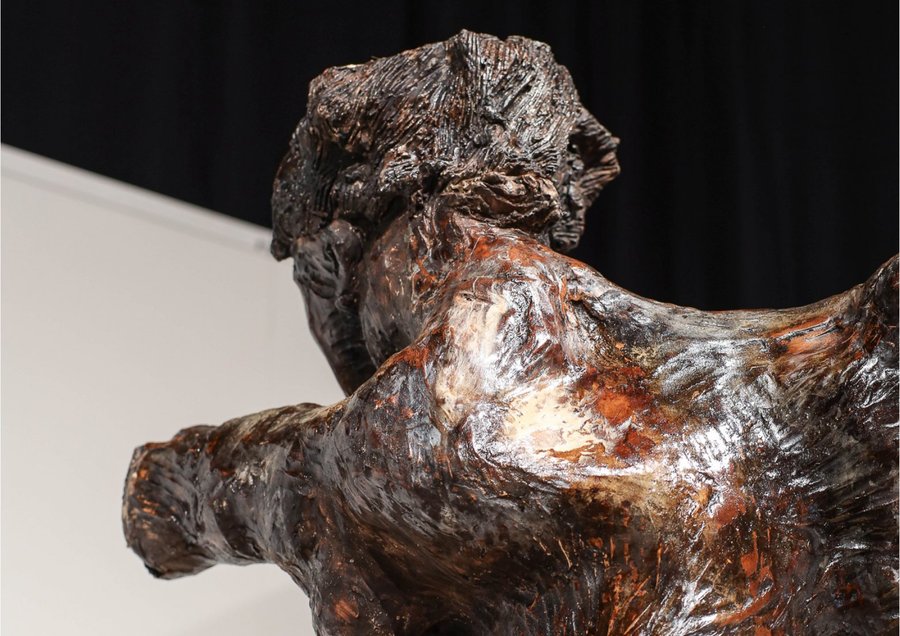
- Benjamin Orlow’s monumental sculptures combine references to classical sculpture, ritual and mythology while presenting the human body as a site of continuous transformation. At the centre of the exhibition, Ritual City serves as both its physical and conceptual anchor. Caught between formation and dissolution, its fragmented figures resist fixed definition, giving form to processes that would otherwise remain imperceptible. Like Orlow, Munch depicts the body as anything but stable. Distorted figures, dissolving contours and expressive brushwork transform it into a register of psychological experience. In George Grosz’s early drawing, grief is inscribed in the body of an elderly man collapsed beside an empty dog bowl, speaking with remarkable reduction about loss and aging. John Coplans likewise fragments the body in enlarged self-portraits, where age, vulnerability and lived experience become palpable through physical presence. In the works of Karin Mamma Andersson and Michael Schmidt, psychological space becomes a manifestation of memory and inner experience. Andersson transforms domestic interiors and landscapes into uncanny spaces, drawing on childhood memories and archival photographs to evoke realities just beyond the visible. Schmidt approaches the city as a psychological landscape in which memory, history and political division remain embedded in the urban fabric. Sophie Reinhold’s paintings question inherited visual codes by disrupting familiar iconographies and materials. Marble dust embedded in the painted surface lends the works a tactile presence, suggesting that meaning is materially as well as visually inscribed. Similarly, Frida Orupabo fragments and reassembles archival photographs of Black bodies to expose the violence embedded in colonial histories of representation. Her collages reveal how these histories continue to shape the present. Taken together, the works the works in the exhibition echo the term’s original sense of a symptom as a co-occurrence: not a representation, but something that emerges alongside an underlying condition that remains hidden.Description
Symptoms: Inaugural group exhibition at our new space at Goethestraße 2–3
Until 24 Oct 2026
Coming soon
Paul Fägerskiöld
21 Nov 2026 – 9 Jan 2027
Recent past exhibitions
- Some of the oldest poems in the Anglo and Norse languages are riddles. They take an ordinary object – an onion, a crucifix, a key – and describe it in a new way, making it unfamiliar. The pleasure of these puzzles is not in being baffled but in being interested…the familiar objects come to life when you find a new way to see them. (In the poems, they often speak in the first person.) A new relation makes the subject reappear. Patricia Treib’s paintings are not riddles. There is no solution hidden in their mobile inky forms. The collection of works on view at Galerie Nordenhake, Stockholm, (August-September 2026) brings to mind that old art form because of the particular method through which Treib addresses her subjects. All the paintings she makes have an anchor in the real world – she begins with a picture, object, or found arrangement – and she looks at it seriously, over an extended period of time. She returns repeatedly to repaint it, discovering different visions of it with each new picture. The anchors themselves are often small or apparently incidental views, because these are the subjects she gravitates towards. An icon depicts St George–but on his shoulder there are small patches of cloth, a helmet, bevelled leather and metal. An ancient, pleated marble sculpture stands on a tall concrete museum plinth–but below it, a little girl looks in the other direction, her soft toy tucked under one arm, her fist clenched. Two models pose on a vintage Simplicity pattern packet–but under their long draped sleeves, skewed elbows and arms mirror one another. There are also personal memories–of a grandmother sewing from patterns; a father repairing clocks in his small Midwestern shop during Treib's own early childhood. In the paintings, bright, lively forms reprise the shapes of these origins, even as they come to a point at which they barely contain them. ‘Saturated’, a word often used to describe Treib’s deep bright rinsed paints, holds a sense of fullness, of completion, together with a sense of over-fullness, almost drowning. The originary materials are powerfully evocative precisely because they are receded in memory or background – as a whispered aside is more intimate than a speech, or the hint of a body, glimpsed through clothing, is sexier than nakedness. Treib’s paintings extend towards that flooding presence. This is an exploratory process (she describes ‘burrowing into’ a source material or image) but also contemplative: a practice of devoting time. She creates small paintings and then larger. Sometimes pictures emerge in sequences; sometimes a work will stitch back over several previous versions of itself to draw directly from an earlier source. The larger works are made on studio floor. During long sessions, she paints forms one by one on canvas or paper, each form emerging in relationship to another, and another, in an unbroken flow. Her movements in the studio on that day remain traceable on her canvases, in swept brush-marks and fingertip squiggles. When you look at her work you can follow those movements. She takes her time over the points at which the forms meet. She works at the boundaries so that bodies and spaces overlap, edge under, or merge into one another. Elsewhere, the distinction is crisp. This creates a mobile, weaving experience of the field, wherein points of conflict are also moments of connection and everything is always coming out of its depths. A red capital swallows the blue that enfolds it, like a dress, hanging on the clothesline, twisted into baffling bodymorphic shapes by the wind. Subject and medium animate one another, like the body in the dress that is made of thin air. Her paintings hover on the point of revelation – as though the clouds of colour are parting to expose a pale form that reveals itself to be…a pale cloud, hovering over bodies of colour.Description
Patricia Treib »Simultaneous Armor«
Ended 30 Sept 2026
- Galerie Nordenhake celebrates its 50th anniversary with a major exhibition unfolding simultaneously across its three spaces in Stockholm, Berlin, and Mexico City. Opening during the first weekend of July, Galerie Nordenhake Stockholm, Berlin, Mexico City, 50 years brings together historical pieces and newly commissioned works by more than 90 artists. Functioning as both an exhibition and a living archive, it traces the history of the gallery from its inception in 1976 to the present day. Rather than following a chronological framework, the exhibition centers on the artists, their work and interwoven relationships cultivated by the gallery over five decades.Description
Galerie Nordenhake 50 Years – Berlin
Ended 29 Aug 2026
»ektor garcia« March 20 - May 08
Ended 8 May 2026
Sofia Hultén March 21 - April 24
Ended 24 Apr 2026
Jerónimo Rüedi March 05 - April 11
Ended 11 Apr 2026
- Galerie Nordenhake is pleased to present Armscye, Patricia Treib’s fourth solo exhibition with the gallery and her first in Germany. Armscye, or arm’s eye, is a dressmaking term for the armhole opening in a garment through which the hand, and then the arm, passes, and to which a sleeve may be attached. While the word comes from the history of garment construction, it aptly links sight and touch, resonating with Treib’s visual plays on dress and bodily adornments and how they correspond historically to painted gestures. In addition to apertures, Treib’s paintings are composed around sensuous details, absences, and shifts in perspective. Despite their broad, sweeping gestures, the paintings can be seen as attentive meditations. Gleaned from sources that hold personal significance, Treib focuses on the space between forms, making in-betweenness a primary motif. Her paintings disclose these interspaces by transforming ephemeral non-things into iconic presences, whose highly pigmented color correspondences radiate an inner luminosity reminiscent of stained glass. The temporal aspects of image making are central to Treib’s work. The paintings seek to be a record of observation through time—noting the irregularities and fluctuations that are part of bodily perception. As with the historical process of fresco, which required completion while the lime plaster was still damp, Treib limits the time of making—or performing—each painting to a single day. Partially concealed behind this decisive act are the innumerable rehearsals and revisions that lead up to the painting, both in the evolution of a motif over several years, developed through various works on paper, and in the removals, adjustments, and erasures that take place on the surface of the canvas itself. While her work draws on far-ranging references—a detail from a 16th century Greek icon, an anniversary clock, shards from a ruined farmhouse in Southern Italy, a 1940s Vogue sewing pattern envelope—Treib’s true subject is the process of looking, through which she discovers new relationships while dismantling what is merely recognizable. We can follow the calligraphic route of each mark through Treib’s use of wide hake brushes and oil paints thinned to a fluid, ink-like consistency. Ripe, suspended forms nestle among accentuated flourishes, suggesting linguistic units or punctuation, and evoke medieval illuminations and 18th century Swedish Kurbits painting.Description
Patricia Treib »Armscye«
Ended 14 Mar 2026
- The presentation at Galerie Nordenhake Mexico City brings together a selection of works developed by Sarah Crowner in close dialogue with Galerie Nordenhake Mexico City partner Toni Sadurni, reflecting years of shared travel and research across Mexico and Latin America. Hard-edge geometries and linear structures recur throughout the installation, where zigzags and angular rhythms operate as both formal devices and compositional strategies. Participating artists include, Lygia Clark (Belo Horizonte, Brazil, 1920- 1988), Sandú Darié (Roman, Romania 1908 - Habana, Cuba 1991), Frida Escobedo (Mexico City, Mexico, 1979), Gerda Gruber (Bratislava, Austria, 1940), Graciela Iturbide (Mexico City, Mexico, 1942), Elena Izcue (Lima, Peru, 1889-1970), Thembi Nala (Kwa-Zulu-Natal, South Africa, 1973), Celso Renato (Rio de Janeiro, Brazil, 1919-1992), Fanny Sanín (Bogotá, Colombia, 1938), and John Zurier (Santa Monica, California, USA, 1956). Concepts such as gradient, scenario, and stagecraft become integral to the exhibition, echoing Crowner’s interest in how color and form operate physically and temporally. Yellow carpets and curtains introduce a scenographic dimension that activates movement through the space, while the graphic language of the zigzag draws from motifs encountered during Crowner’s extended stays in Mexico, including patterns found in pre-Hispanic visual languages and architectural sites such as Mitla and Tajín. The exhibition continues at Casa Roja, located at Palmas 1535 in Lomas de Chapultepec, where Crowner presents of series of new paintings. Responding directly to the architecture of the mid-century house, the work engages the site’s curved ceiling panels and fully red interior, unfolding an exploration of organic, biomorphic forms and fully red interior. Casa Roja’s monochromatic environment intensifies the bodily and perceptual experi- ence of the exhibition, echoing Crowner’s ceramic practice and her interest in color as a spatial condition rather than a surface. The interaction between the artworks and the domestic architecture generates an environment in which form and color unfold gradually, integrating art into the spatial structure of the house. Both venues employ natural lighting, a decisive factor for the artist, as light—being non- static—shifts throughout the day, constantly transforming our perception of the work and the environment, achieving a unity in chorus with nature. Taken as a whole, Zigzags and Curves project, as well as the artist’s broader approach, working with art history as a medium that allows her to choreograph proximities between Mexican culture, the historical revision of modernity, geometry, theater, and design. The project places special emphasis on the premises of Neo-Concretism, where two-dimensional works cease to be mere plans to become total artistic and pictorial experiences.Description
Sarah Crowner »Zigzags and Curves«
Ended 14 Mar 2026
- Stockholm, January 15, 2026 - February 28, 2026 Opening: Thursday, January 15, 5 – 8 PM Carl Milles’ Aviator Monument, installed at Karlaplan in 1931, is a short two-minute walk from Galerie Nordenhake. Large slabs of diabase form both an impressive plinth for the bronze sculpture of an eagle, its broad wings outstretched, and the stolid frame for a series of bas-relief sculptures in white marble. One of these depicts the famous “Eagle” hydrogen balloon that polar researcher Salomon August Andrée and two others used to fly to their untimely death on the arctic island of Vitön near Svalbard in 1897. The balloon, in Milles’ sculpture, is still cheerfully aloft and accompanied by an orderly fleet of war planes from the First World War. Another marble stele depicts Icarus, the tragic hero of Greek mythology who disregarded his father’s advice and flew too close to the sun, which melted his wings and sent him plummeting to his death in the Aegen Sea. Milles’ monument shows Icarus before he fulfils his mythological role, while he is still flying triumphantly. Commissioned by the Swedish Aeronautical Society, the work honors pioneers in aviation—Andrée’s remains had been discovered in 1930, just a year before the sculpture’s inauguration—but it subsequently has become infamous as a rallying point for the supporters of National Socialism and neo-Nazis. This history and Milles’ reputation as a Nazi sympathizer are well-known, but I rehearse them here to tease out forms of embodied defiance in Runo Lagomarsino’s exhibition Violence is Harder than a Stone. Lagomarsino made frottages from Milles’ sculpture, lifting Icarus’ arrogant flight out of the stone and installing the different versions of his hand-made copy across Galerie Nordenhake’s walls. The effect is to reverse the narrative: suddenly, it is Icarus’s fall that is foregrounded. If the purpose of Milles’ sculpture is to capture and immobilize dynamic movement, to monumentalize flight and tie it inextricably to the triumph of nationalism, Lagomarsino repeats its motifs with difference. His charcoal rubbings restore a measure of contingency to the monument’s story, resisting its closure of history. It is no simple thing to undermine the stability of the semiotic order that fascism deploys. In deferring to the performative gesture, the artist refuses to reproduce the monument’s violence, to unmake it or indulge in fantasies of destruction. Instead, he stages another formal (embodied) language, a way of speaking back that leverages the stability of the gallery space without ceding to it entirely. Lagomarsino’s investment in the performative is sensible even in his treatment of materials that appear inexorably stable. The massive granite base of the lamp post that stood sentry at the entrance of Malmö’s former central police station, for example, which was discarded when the building was converted into luxury condominiums. Lagomarsino acquired it and had it sliced into individual panels, transmuting the authority of the block into something transitional, like cladding. The slabs leaning against the gallery walls might be beautiful minimalist objects, perfect in their irreducible materiality, but they are also a prompt for this question: what force is necessary to transform the infrastructure of the State? This question, in turn, opens onto the problem of the body, its gestures, its fundamental contingency. An appropriated tabletop from another Malmö police station, this one dedicated to people seeking State identification and passports, is covered with the graffiti of countless people filing out forms and waiting. What force is necessary for the State to build borders, demand authentication of belonging from its residents, construct police stations and other offices in which many thousands of people spend many hundreds of thousands of hours for their turn to prove legitimacy? What gestures of resistance are possible within that kind of edifice, which is invested with the physical time of so many? The stone, sliced open so that it covers the base of Galerie Nordenhake’s walls, could be read as a futile attempt to destabilize the State’s structural violence, perhaps to the same degree that defacing its office furniture while waiting for your papers is futile. Yet these works nevertheless respond to both the State’s stone and its violence with the language available to the gesturing hand.Description
Runo Lagomarsino »Violence is Harder than a Stone«
Ended 21 Feb 2026