Helsinki
SINNE
On now
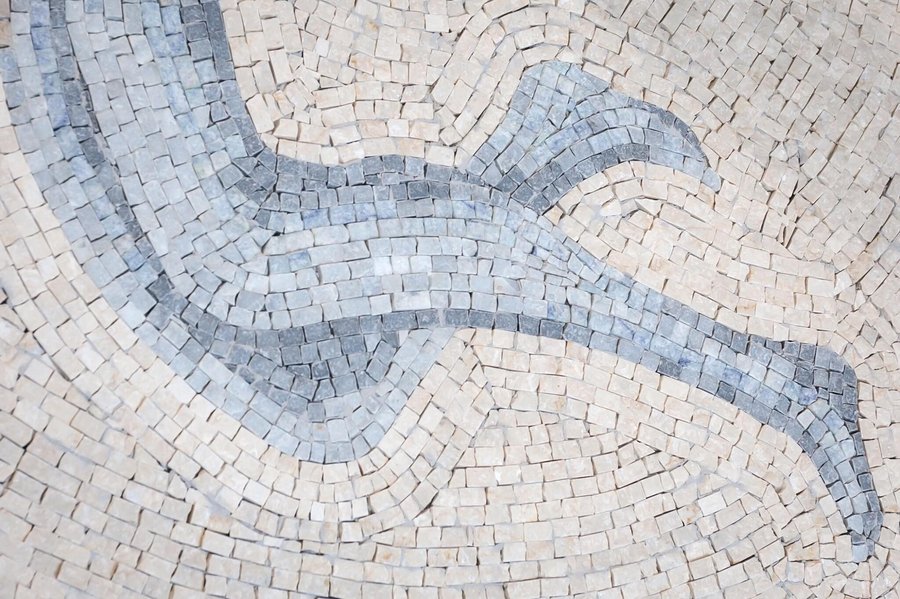
- In Vertere Riikka Anttonen takes a step further and deeper into the world of ideas, thoughts and questions that have surfaced during previous processes. The work on the exhibition has been rooted in queer experiences and exploring ways of illuminating, extending and opening up the boundaries that spring up around norms and normative thinking. In order to make room and to create a basis for working with queer issues, Anttonen adopts an extended time perspective and uses historical examples. Much of the inspiration and visual expression here is drawn from the culture of ancient Rome. The exhibition’s title, Vertere, is Latin for “to turn, twist or reverse” something. It takes its starting point in the Roman poet Ovid’s lyrical work Metamorphoses, the various narrators’ employing leitmotifs that each revolve around some sort of transformation. The exhibition consists of a series of sculptures shaped like spinning tops with surfaces covered in relief patterns and marble mosaic. In previous exhibitions, Anttonen has made site-specific installations that also comment on the exhibition space and its architecture. Vertere is a step away from that. Here Anttonen disrupts and is less attentive to the room’s dictates. The sculptures have been allowed to come about free of the room’s often tone-setting grip and influence. Vertere makes its entrance in the guise of a more unpredictable, chaotic character. The main concept behind the design of the sculptures is the spinning top. Spinning tops are one of our oldest toys and have been found in archaeological excavations around the world. In different cultures their history is charged with a fascinating mystery and spiritual power. They have not only been children’s toys – in ancient Rome spinning tops were used by adults in gambling and fortune telling. A stationary spinning top rarely feels passive, instead it seems to anticipate an interaction. Like dice, spinning tops carry an alluring charge filled with potential for spontaneous play with fate. The motifs in the marble mosaics adorning the surfaces of the sculptures are directly inspired by Metamorphoses, in which the protagonists are transformed, changing shape and appearance between animal, plant and matter. Ovid emphasizes the idea that the only constant is change itself, that the world is a dynamic place – and we along with it. The themes of Anttonen’s sculptures can also be seen as being purely symbolic, with the spinning top’s state of equilibrium actually residing in the movement itself, in the rotation that keeps its mass upright. In Vertere Anttonen captures the idea of movement and change of state as a route to transformation. Change opens up new situations, perspectives and insights. The effect of the movement becomes an active counterforce to the unnaturally static and cozy. Norms begin to appear as temporary doldrums in the stream. This brings to mind Octavia E. Butler’s novel Parable of the Sower, where she addresses ecological, social and existential issues, highlighting the individual’s position, responsibility and ability to influence and navigate the course of nature and life, where even the tiniest action matters. Butler opens the book with: “ All that you touch, you change. All that you change, changes you. The only lasting truth is change. ” That quotation takes us back to Anttonen’s work and to Vertere, both centred on transformation. We find ourselves in a zone where entropy begins to come into play; perhaps seeing identity, both individual and collective, as something that is in a state of disorder, continually rearranging itself and changing shape? Anttonen refers to queer opacity; a queer strategy in which the opaque (non-transparent) is visually present, but remains indefinable. This type of presence both disarms and challenges normative identity categorizations and power structures. That is why Anttonen works to cover the surfaces of the sculptures, thus highlighting what is going on beneath, and the way that queer identity often reveals only a part of itself. Marble mosaic is a visual link to ancient Rome, to a time when queer and trans culture was very widely accepted, even celebrated. Reaching back over the millennia to find traces to identify with is extremely important for many queer people. At the same time, historical examples are an important counterargument to what is, still today, a common assumption, that queer and trans identities are a modern phenomenon. Markus Åström CuratorDescription
Riikka Anttonen: Vertere
Until 18 Oct 2026
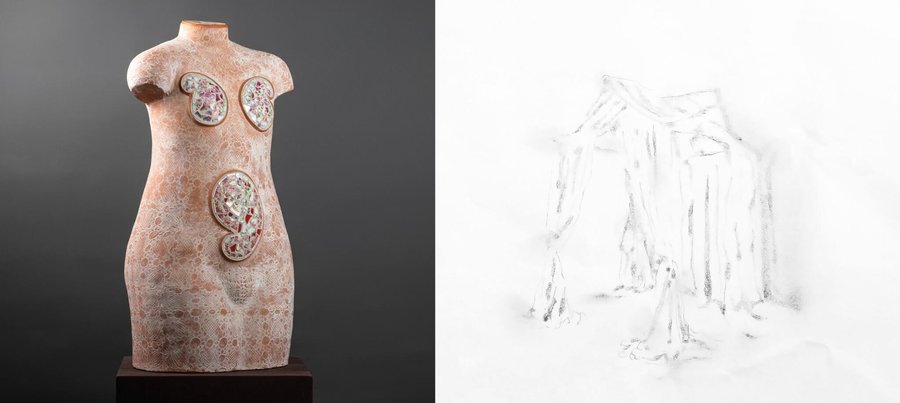
- Samutställningen I dialog: Catharina Kajander och Haliz Yosef i Galleri Elverket ger nya perspektiv på båda konstnärernas produktion. På utställningen visas skulpturer, installationer, målningar och teckningar.Description
In Dialogue: Catharina Kajander and Haliz Yosef
Until 18 Apr 2027
Recent past exhibitions
- Gallery Elverket’s summer 2026 exhibition is a retrospective of Erik Creutziger’s enchanting colour paintings. Earlier this spring, he moved into Pro Artibus’ Villa Snäcksund residency in Ekenäs, and his first retrospective exhibition is opening now. It features works from his student days right up to newly completed paintings. In recent years, Creutziger has been working on a series of paintings on the theme of secret pleasures. The pictures in the series depict swimming pools, lush landscapes with palm trees, and groups of people. They reflect the way that his production combines his own observations, experiences and memories with free imaginings. In the Hulda’s house series (2017), Creutziger’s own experience of an abandoned house and the related associations provided the initial impetus for paintings that display his characteristic imaginativeness. His art is emotionally charged, added to which his paintings seem to inhabit their own reality: a place where fantasies, memories and dreams happen. One of the red threads running through the exhibition is made up of animal motifs, of which there are a plentiful variety. Creutziger’s bird paintings, which comment creatively on constructivism, show a series of bird-identification images. Another important theme consists of various rider-and-mount themes, in which the connection between mount and rider evokes allusions to both ancient centaurs and cowboys. In Creutziger’s works the animals are the companions and partners of human beings, but also distinct individuals. Creutziger notes that his working process is characterised by the alternation of pleasure and melancholy. When viewing his art, we frequently notice how sensual orgies of colour are accompanied by a discordant sense of melancholy or a feeling that not everything is as it seems. His paintings are alluring, like fly traps, and they open up feelings in many different directions. They are materially enticing and tantalise the eye, while also seeming to tell diverse stories, with only some of them revealed to the viewer, while the rest remain hidden. Ambiguity and escapism are crucial to the charm of his art.Description
Erik Creutziger: A Shadow of Paradise: Works from 2003–2026
Ended 13 Sept 2026
- Tygtrycksverkstad fredagen 21.8 kl. 14–17 – måla din egen Pride-skjorta med konstnär Erik Creutziger 🌈 🌈 Om en vecka under Raseborg Pride kan du på Galleri Elverket måla ditt eget motiv på en t-shirt eller annat tyg eller plagg. Vi använder monotypi som metod och tar inspiration i färgvärlden inne i galleriet. 🌈 Vi har ett sortiment av olika skjortor och plagg att trycka på som vi i huvudsak har fyndat på loppis och förberett för tryck. Du kan också ta med dig ett eget plagg att trycka på. Plagget ska vara ljust till färgen, av bomull och vara rent och torrt. 🌈 Verkstaden är öppen för alla åldrar. Deltagande är gratis. Tryckverkstaden sker under tak på Galleri Elverkets gård. 🌈 Verkstaden ordnas som en del av publikprogrammet under utställningen Erik Creutziger: 𝗦𝗰𝘂𝗴𝗴𝗮𝗻 𝗮𝘃 𝗲𝘁𝘁 𝗽𝗮𝗿𝗮𝗱𝗶𝘀: 𝘃𝗲𝗿𝗸 𝗳𝗿å𝗻 𝟮𝟬𝟬𝟯–𝟮𝟬𝟮𝟲. Delta samma dag kl. 13–14 före verkstaden i en rundvandring och pratstund i utställningen med konstnär Erik Creutziger och kurator Juha-Heikki Tihinen. 📷: Bilderna är från personalens testverkstad. @raseborgpride @erik.creutzigerDescription
Pride på Galleri Elverket: Tygtrycksverkstad
Ended 13 Sept 2026
- Personae – Pictures of Personalities from the Art Collections of Åbo Akademi University Foundation at the Sibelius Museum 11.2–31.5.2026 Personae presents portraits from Åbo Akademi University Foundations art collection, as well as works from Casa Haartman, Museum Ett Hem, Åbo Akademi, and the collections of Pro Artibus Foundation. Personae is a new version of Pro Artibus exhibition displayed in Gallery Elverket in spring 2025. The exhibition has been produced by Åbo Akademi University Foundation and Pro Artibus Foundation. The exhibition features around 60 works from 40 artists, spanning from 1840s to 2010s. The selection of works covers the entire spectrum of portraits from medals to video portraits and busts to photographs – not to mention paintings and caricatures. The works include official portraits as well as artists’ self-portraits. The exhibition honours the tradition of the university portrait as one of the oldest forms of art collections. The tradition is alive and renewing, which can be seen in the newest acquisitions of Åbo Akademi University Foundation. The name of the exhibition comes from the Latin word persona, originally referred to a mask worn by an actor. Even before the Ancient Romans, the Greeks wore masks in theatre performances, letting the audience know that the wearer on stage was a comic or tragic figure. The mask told them how the character and their behaviour were to be interpreted. Today, personality is defined as a complex whole made up of thoughts, feelings, and behaviours. It is seen as being more or less permanent, but can also change. In our age worshipping individuality and pictures of oneself have become the path of self-expression for all. An exhibition depicting the history of the portrait adds understanding of our own time. Both historical and contemporary artists have wondered how to depict a person as whole. How are they to capture the landscape of the mind and soul, and not restrict themselves solely to depicting facial features? Artists often portray themselves, their loved ones, or make commissioned works on personal themes. Self-portraits, portraits and personal themes vary a lot in style and manner of presentation. Official portraits are among the most formal works, while portraits of loved ones can be very intimate. On the other hand, an unexpected, seemingly personal feature can have a major effect in a portrait or self-portrait of a famous person. Artists make self-portraits for several reasons. The subject is close and personal, besides which artistic work involves a personal quality, which also makes the question of selfhood and its various forms a tempting subject for depiction. A self-portrait is a depiction of artistry, either an identity or a role. What is an artist supposed to look like? Official portraiture is considered the most traditional genre in portrait making and regrettably frequently the least interesting one. For many people, official portraits are only a forced way of keeping a tradition alive, and not a living art at all. But it can still be said that there is life in tradition, too, and a portrait is still both proof that a person lived and a depiction of them. This is the basis for the attraction exerted by old portraits: it is as if the person there were alive, even though they are dead and gone. A portrait muddles our concept of time, because the past comes concretely into the present moment and situation. Portraits can show the person themselves, or some object or place associated with them. A group portrait can reflect the dynamics of its members or present them to the outside world. Sometimes, a portrait is propagandistic, while at other times it is like saying: They were here. In front of you is a personality, but what is the personality like? Personae offers encounters with our contemporaries, but also acquaints you with historical personalities. Welcome to witness a human comedy the length of past centuries. PhD Juha-Heikki TihinenDescription
Collaborative exhibition Personae at Sibelius Museum
Ended 31 May 2026
- In her Hard Shoulders exhibition, Maija Fox addresses the relationship between our culture, labour, and the individual. Her large sculptural installation is mainly constructed out of aluminium and steel and is an interaction with the gallery space and its architectural elements. Fox has been inspired by Finland’s Highway 4 and, more precisely, by a specific motorway bridge that stands in a marsh. Hard Shoulders refers to the motorway verges or breakdown lanes intended for stopping in an emergency. With this title, Fox brings up an existing emergency situation in our society, where the pace and pressure of advances in our surroundings create an ever-growing sense of unease and hopelessness on a personal, but also on a collective, level. She opens out our narrow field of vision to reveal an emptiness that moves in parallel with us on the margins. With her large-scale, technically challenging installation, she urges us to find an entry point to a sideways movement into a sense of security and enveloping calm. Fox’s emphatically material-based art occupies the zone where humans and nature meet. In her art we can see traces of agriculture and heavy industry, both of which are directly rooted in Fox’s own upbringing in the countryside. She incorporates different elements from this setting, including tools, machinery, and structures with which human beings at work interact and influence their environment. Metals are a key, recurring material that Fox reworks using various techniques. She has developed her own poetic form language, in which she makes open-minded, creative use of the techniques and methods of the artisan, engineer, and artist. She combines various familiar mechanisms and structures, producing something that is evidently intended to elicit new functions and even to attain dreamlike states. The bridge is something of a symbol of the engineer’s art — it combines civic construction with good infrastructure planning that not only sustains but also lays the foundation for continued growth. A bridge reduces distances and eases our movement across difficult terrain and “inhospitable” landscapes. In Hard Shoulders, Fox brings together two worlds and rhythms: above, the human being’s energy-craving, accelerating forward motion; below, the stillness of the swamp, where time thickens and the restless pace overhead begins to recede. We can see here our own drive to optimise, to streamline, and our ability to reshape the landscape and to exploit the resources contained in it. Fox’s installation still seems to point to a coincidence — that Hard Shoulders simultaneously carries a silence. Traffic on the asphalt road, the machines on the construction site, and the machinery in the factories have come to a standstill for a moment. She tentatively steers our gaze to one side, toward the ranunculus flowers and other wetland plants cast in aluminium. She awakens our senses to see the marsh that surrounds the entire construction. Rosehip bushes stand bleached by exhaust fumes, while velvety mullein presses upward between the margins of the road. Like the coming and going of memories, fragments of tear plate and orange peel appear between the road and the swamp. The flower of a white water-crowfoot rests on the water, while the rest of the plant reaches down and clings to a world beneath the surface. This fragile biotope and its slow processes become a manifestation of an existence outside the system. Like thickets and climbing plants, the interknitted metal wire grows upward and, like a sturdy weed, penetrates the hard surface of the asphalt, becoming part of the road’s painted centre line. In the pockets of the knitting lie worn, empty key chains — memories of previous entries and of keys that once opened doors and gates, and which once started machines. This textile dimension of the work is a break and a shift away from the monumental and robust that is forever seen as development and progress. These small intertwined fibres embody a different way of thinking based on responsiveness, care, and warmth. The colossal construction becomes a lesson, a basis and fuel for something small to slowly and patiently grow into something that, we hope, will give us a sense of community, hope, and courage. Markus Åström CuratorDescription
Maija Fox: Hard Shoulders
Ended 10 May 2026
- Gallery Elverket’s autumn and winter will be filled with an abundant, magical selection from a Finnish private collection. The Finnish-Swedish Lassi Löylypoika Auterinen’s (b. 1964) catalogued art collection comprises approximately 600 artworks, 140 of which will be on display at Gallery Elverket. Löylypoika first became interested in visual art in the 1980s. His collection has grown especially in the last 15 years, when he noticed how affordably older art, in particular, could be bought at auction. He acquired his first artwork while on a summer job in the late 1980s. Participating in the activities of the Plastic Pony group, which occupied the middle ground between fashion and contemporary art in the early 1990s made him see art in a new way. Getting to know the visual artist Axel Sutinen at the start of the 1990s was a pivotal experience and made Löylypoika Auterinen an art collector. The Löylypoika Collection is a diverse, highly personal selection of contemporary and older art. Besides paintings and sculptures, it includes numerous prints and photographs, as well as street art. The artworks date from the 18th century to the present day. They are primarily Finnish, along with some pieces by international artists, including from Sweden and the USA. The art in the Löylypoika Collection occupies many different emotional registers: among them works with a dash of black humour or melancholy. Having himself suffered from depression, and still occasionally living with anxiety and panic attacks, Löylypoika finds art and collecting it consoling and empowering. For Löylypoika, personal experiences and contacts with artists have been of paramount importance. Getting to know artists, making friends with them, and keeping in touch are an integral part of his collection, while also conjuring up an image of different worlds meeting. Elverket’s exhibition will put the spotlight on a band of artists who have been important for him. These include Maija and Kristoffer Albrecht, Tuija Arminen, Jaana Erkkilä-Hill, Nora Helsinki, Anki Krooks, Axel Sutinen and Anni Viitasaari. Personal relationships with both artists and artworks are reflected in the collection. The works of contemporary artists – one focus of Löylypoika’s collecting – could be seen as a red connecting thread running through the collection. He further sees women artists as representing a force for change. The collection mostly contains art that Löylypoika has acquired very affordably at auction. Occasionally, he has sought out works by specific artists whose art has touched him deeply. For example, he sees Ragnar Ungern is an important depicter of the maritime nature and clouds of the Finnish Archipelago Sea. Löylypoika’s other enduring interests include pieces by the artists of the November Group. He has also acquired numerous works by women artists of the Turku School. Artworks linked to his immediate family and relatives add an extra dimension to the collection, whether they be portraits, works they have made, or which are otherwise linked to his personal history and background. The exhibition will also contain some of Löylypoika’s own art, including needle-felt works and an installation. The exhibition speaks of how, even today, a long-standing acquaintance with art and its makers, and an open mind, can result in a bold, multidimensional art collection. Gallery Elverket’s exhibition will be the first public showing of the collection. A self-contained, three-channel video work, Löylypoika – A print on the wall (2025), by visual artist Elisa Alaluusua will be shown alongside the Löylypoika Auterinen Collection. Juha-Heikki Tihinen, Ph.DDescription
Elverket Collection Löylypoika Auterinen
Ended 19 Apr 2026
- Welcome to En Kul Tur – A day of art activities for the whole family in the Ekenäs Culture Quarter and Villa Skeppet! The program is on-going between 11:00 and 15:00 with drop-in workshops for both younger and older kids. Waffles will be sold in the yard of Ekenäs Culture Quarter. Free entrance to all workshops and program. Welcome!Description
En Kul Tur – A day of art activities for the whole family
Ended 18 Apr 2026
- Lassi Löylypoika Auterinens samling är ett personligt och mångsidigt urval av samtida och äldre konst. Förutom målningar och skulpturer innehåller samlingen också mycket konstgrafik och fotografi samt en del gatukonst. Tidsmässigt sträcker den sig från 1700-talet till idag. Samlingen innehåller framför allt inhemsk konst, men också verk av utländska konstnärer från bland annat Sverige och Förenta staterna. Konstverken i Löylypoikas samling rör sig över ett brett känslospektrum, och det finns exempel på allt från svart humor till melankoli.Description
Collection Löylypoika Auterinen
Ended 4 Apr 2026
- Public guided tours of the exhibition Collection Löylypoika Auterinen at 12 noon on the first Saturday of each month. You are invited to join public guided tours at Gallery Elverket at 12 noon on 1.11.2025, 3.1, 7.2, 7.3 and 4.4.2026. The guided tours are in Swedish, Finnish and/or English, depending on the language of the participants. Join in a tour of the exhibition where our guides will give insights into the exhibition’s themes and the individual works. Admission to the gallery and public events is free.Description
Guided tours of the exhibition Collection Löylypoika Auterinen
Ended 4 Apr 2026
- Sinne opens the year with The Great Meeting by Ruben Risholm. The focus of the exhibition is a sculptural ensemble consisting of a group of life-size human figures and a series of reliefs. Risholm works in wood, and for this exhibition he has only used elm. In his art we can see an affinity with folk art, traditional crafts, and folklore, but his themes also include a vein that extends all the way back to Antiquity and Egypt. Risholm’s wooden sculptures are imbued with a strong feel and respect for wood. By embracing the wood-handicraft tradition he also approaches sculpture from a folk perspective, in which the artisan’s experience and knowledge of the material serve as a basis for developing a personal mode of artistic expression. In so doing, Risholm brings out in his art something that feels familiar and yet deeply rooted in our own place and history. He creates a kind of mythology, a private visual language that plays with small gestures and symbols for us to decipher. These are not big fairy tales and narratives, but a window that opens onto something of his own, something personal. At the beginning of an exhibition process, Risholm works freely. He lets ensembles and ideas grow organically. One sculpture leads on to another. The Great Meeting has taken shape around a group of human figures who form a collective. He has been interested in seeing what kinds of tension and contact arises between the disparate figures. The natural size, the 1:1 scale, has been important for giving them a presence in the room. Most of the sculptures here are each carved and chiselled out of a single log. This is an artistic choice in which the dimensions of the log and the way the tree has grown form the basis for the shapes of the sculptures. Consequently, all the sculptures in the exhibition have a closed posture, and the connection between the figure itself and the tree becomes as clear as possible. Risholm is also interested in the frontality found in ancient Egyptian sculpture. In The Great Meeting he has accentuated this, with the face and, above all, the gaze in focus. His diverse characters all seem to have an inner calm, perhaps even a conviction. The agenda for the gathering is not articulated and is left vague. But their neutral, expressionless faces and their gazes – which either meet you, bypass you, or seem to go straight through you – awaken something individual, something mysteriously alive and real. In his art, Risholm creates space for unconscious narratives to manifest. The Great Meeting further includes reliefs that serve to give us an insight into the world from which the sculptures here are visiting us. Our sense of the order in which things are created begins to falter. Is it the image or the sculpture that was the original? One of the reliefs also contains a text that takes its inspiration from the riddles and paradoxes of ancient Greece. It is as if Risholm has produced a script or a game in which all the parts seem to have a place and a logical function. He creates a tension in which the story is on the tip of the tongue, waiting to be told. Finally, he brings in the Hammer of Fate – a work that sets the seal on destiny, like the three hammer blows in Mahler’s 6 th symphony. Markus Åström CuratorDescription
Ruben Risholm: The Great Meeting
Ended 8 Mar 2026
- Come and listen to experts from different fields share their views on the exhibition’s theme and works.Description
Discussion series – A look into the Collection Löylypoika Auterinen
Ended 7 Mar 2026
- The Art of Light explores the relationship between light and art. Featuring works by local and international artists, this exhibition showcases how light can be used as a medium to create stunning visual effects.Description
The Art of Light
Ended 5 Mar 2026