Hamburg
SFEIR-SEMLER GALLERY | HAMBURG
On now
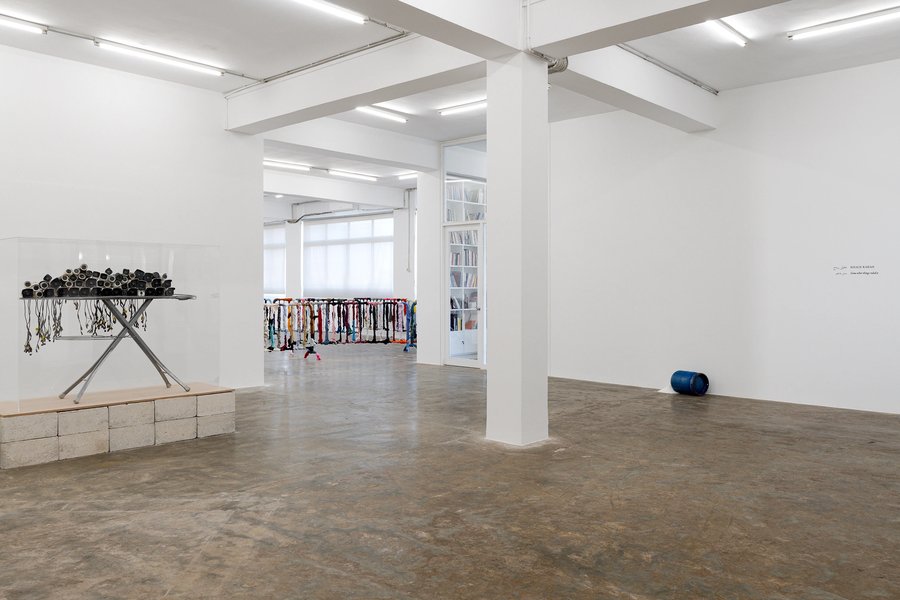
- Khalil Rabah returns to Lebanon after eight years with a two-part solo exhibition presented simultaneously across our Karantina and Downtown spaces. Bringing together new works and new iterations of ongoing projects, the exhibition extends Rabah’s sustained inquiry into the politics of objects, materials, and forms.Description
Khalil RabahSome other things ruled it
Until 30 Dec 2026
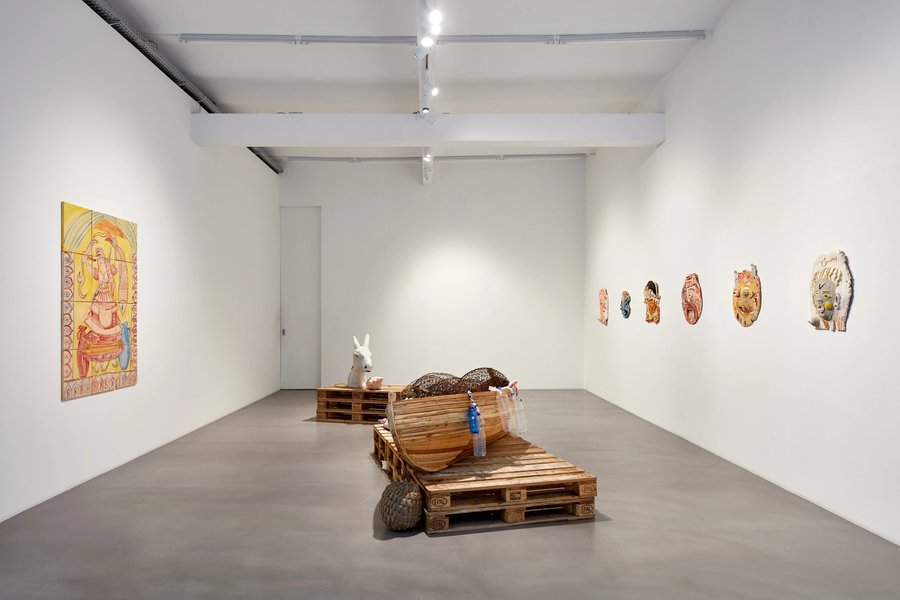
- Sfeir-Semler is proud to present Mounira Al Solh's third solo exhibition in our Hamburg spaces, comprising paintings, textiles, ceramics, works on paper, video and installation. Moving fluidly between media, Al Solh develops an expansive practice in which drawing, writing, embroidery, colors, film and objects bring personal narratives and collective histories into relation. Rather than adhering to distinct categories, she intertwines the intimate and the political, combines humor and tragedy, and blends fiction and testimony to retell stories of displacement, memory, resistance, and belonging. Often drawing on language and gesture, she creates a distinct register through which these narratives unfold.Description
Mounira Al SolhElyssa, ela, hela, Elyssa, I myth you more
Until 31 Dec 2026
Recent past exhibitions
- Sfeir-Semler Gallery is delighted to present Alia Farid’s first solo exhibition in our Hamburg spaces. Alia Farid (b.1985) lives and works in Kuwait and Puerto Rico. Her work, mostly moving image and sculpture, is interested in the ways modernity reconfigures collectivity and ritual. Farid's work follows multiple strands of investigation, including research on the impact of oil extraction on the communities and environment along the eastern Arabian coast. As part of this body of work, she has produced the film series Chibayish as well as a series of oversized water receptacles made of fiberglass reinforced polyester resin, a byproduct material derived from oil refinement. Expanding this inquiry further, Farid has created public art installations inspired by blue faience and protective amulets, reproducing ancient forms at monumental scale and in resin. She has also installed Palm Orchard, a grove of artificial palm trees on the terrace of the Whitney Museum of American Art for her participation at the Whitney Biennial 2022: Quiet As It’s Kept. In Hamburg, Farid presents her largest exhibition to date of Elsewhere, an ongoing research project that maps Arab and South Asian migrations to Latin America and the Caribbean. The installation is accompanied by a new video work that features archive material from the original investigation.Description
Alia Farid Elsewhere in Puerto Rico, República Dominicana & Cuba
Ended 15 Aug 2026
- Fifty years after the drawings were first made, Sfeir-Semler and the Aref el Rayess Foundation are launching a limited-edition series of 50 complete sets of prints. Concurrently with this launch, the gallery presents an exhibition of works on paper by the artist that underscores his versatility and his distinctive, chameleonic ability to shift from one mode of expression to another within the same period. Beginning in 1958, the exhibition brings together a series of gouaches on paper depicting fighters involved in the guerrilla warfare that erupted in the mountains that year. Works from the 1960s present the artist’s “Italian phase,” including experiments in mixed media. The early 1970s are marked by Rayess’s encounter with Hassan Fathy. Fascinated by the Egyptian architect’s work and the New Gourna Village project, Rayess produced a series of pastels on paper entitled Hommage aux bâtisseurs islamiques ( Tribute to Islamic Builders ) presented here. From this point onward, fantastic architecture frequently entered his paintings and drawings.Description
Aref El Rayess J'aime les fleurs comme les étoiles
Ended 14 Aug 2026
- The exhibition furthers Tabet’s ongoing investigation into the layered intersections of personal memory, collective trauma, political silence and the making of official histories. Across three hauntingly precise yet poignant works, he weaves together time and material, entrusting to the care of the objects he creates the stories and memories of the past. Through this meditation on aftermath the artist highlights that what remains is not only ruin, but also testimony, and the quiet insistence of survival. The Day After proposes that no ending is absolute. Every explosion, war, and collapse is followed by a day after, one in which the past is neither buried nor resolved but continually negotiated. One that is rife with possibility.Description
Rayyane Tabet The Day After
Ended 15 May 2026
- The show brings together new paintings and ceramics that further Kiwan’s investigation of the domestic spaces. Rather than foregrounding rupture, the artist lingers on moments of tenderness, minor details almost unnoticeable in their banality. Gestures of reckoning (bodies folded-over, eyes squeezed shut, hands raised to cheeks or heads) are met by soothing embraces, gentle strokes, or bodies lying closely together, revealing the quiet power of touch to sustain life. Dominated by reds and pinks, her figurative canvases capture scenes of fleeting sensual excess, set in the fragile moments when exhaustion has set in, realization is dawning, and both bodies and minds absorb the weight of the events that envelop them. Situated within the intimacy of living rooms and bedrooms, the works play with perspective and point of view, positioning the viewer as an unwitting witness to these unguarded moments. Inconspicuous everyday objects offer hints of narrative context, including a spoon left on a table, a newspaper carelessly tossed on a sideboard, the graphic on a T-shirt, a fading bouquet in a vase, or rumpled sheets.Description
Bayan Kiwan Intimate Trespasses
Ended 28 Mar 2026
- There was the generation of Walid Raad, Akram Zaatari, Marwan Rechmaoui, Wael Shawky, Taysir Batniji, Khalil Rabah, Yto Barrada and Rabih Mroué. There were also moments of renewed engagement with Arab modernism. Exhibitions dedicated to MARWAN, Etel Adnan, Aref el Rayess or Samia Halaby aligned with a growing interest among institutions and art historians in revisiting the region’s modernist legacy, one in which these artists now hold a central place. The gallery also turned its attention to a younger generation, including Lawrence Abu Hamdan, Mounira Al Solh, and Rayyane Tabet, and more recently artists like Dana Awartani, Alia Farid, Tarik Kiswanson, Sung Tieu, and Dineo Seshee Bopape. With this evolving roster, Sfeir-Semler has largely contributed to promoting, in the Arab world, artistic forms such as video, photography, and performance—moving beyond the traditional categories of painting and sculpture. This commitment to conceptual art and to expanding the field of artistic practices is not surprising, considering the gallery’s early programming choices, with artists like Robert Barry and Ian Hamilton Finlay, or later, Hans Haacke. Marking Sfeir-Semler’s 40th anniversary in Germany and 20th in Lebanon, The Shade unfolds at a particularly charged moment, when the tumult of global events is impossible to ignore. Traces of these realities resonate throughout the works on view, with most of the participating artists choosing to present recent works, never before shown in Beirut, that hold particular meaning for them today. Echoes of recent history surface in Wael Shawky’s Al Aqsa Park, a video centered on one of the most potent symbols of the Israeli-Palestinian conflict; in Rabih Mroué’s installation Again We Are Defeated, which grapples with the persistent violence across the region; and in Walid Raad’s Festival of Gratitude, a series of birthday cakes dedicated to dictators and tyrants like Saddam Hussein, Hafez al-Assad, and Recep Tayyip Erdoğan—gaudy confections drenched in color and cream. Yet the exhibition also gestures toward possible worlds. Marwan Rechmaoui’s tree evokes themes of rebirth and childhood, while Dana Awartani’s large-scale installation from the series Come Let Me Heal Your Wounds, Let Me Mend Your Broken Bones reflects on the destruction of heritage sites through a poetic act of repair. Dineo Seshee Bopape’s landscapes draw on the postcolonial memory of South Africa, engaging with identity, resilience and renewal. In Tarik Kiswanson’s video, Ode to Joy – the anthem of Europe - is reinterpreted by children from immigrant communities in the Parisian suburbs. Khalil Rabah’s Olive Trees series offers a vital vision of hope and continuity. And there is of course the poetry in Etel Adnan’s landscapes, which have accompanied us for many years. The title of the exhibition, The Shade, shrouds it in mystery. Shadows carry a wide range of symbolic meanings, shifting from one historical moment to another, from one culture to the next. They may suggest what is hidden or repressed, or what is investigated in secrecy. But here the reference draws from Carl Jung’s notion of the “shadow” as a space of untapped potential—an opportunity for transformation, where what has long been suppressed might finally emerge. In Renaissance painting, shadows played a crucial role in sublimating light, serving as a fundamental element of visual composition to capture the world.Description
The Shade
Ended 28 Feb 2026
- Dana Awartani b. 1987, Saudi Arabia This work is a requiem for the historical and cultural sites that have been destroyed in the Arab world during wars and by acts of terror, and which expands with each iteration to make room for newer documentation. This edition adds testimony to the devastation in Gaza and the sites that have been flattened indiscriminately through bombings and bulldozers, alongside seven other Arab nations – Saudi Arabia, Syria, Tunisia, Libya, Iraq, Egypt, Palestine, Lebanon and Yemen. Awartani tears nearly 400 holes across yards of silk, each rip marking a heritage site that has faced acts of terror and destruction. Then she darns—a fading practice far more intimate than patchwork but no longer valued—each gash tenderly as a gesture for healing; the scars a representation of the physical and emotional ones left behind in the real world. The fabric is dipped in around 50 herb and spice-based natural dyes that carry medicinal value, utilising the sacred healing properties embedded in traditional textile dyeing practices of Kerala, which Awartani spent time learning. The panels, together, are borderless representations of annihilated cultural heritage. In the face of ongoing destruction as well as polluting effects of big industries, the work is both a plea to safeguard ancient civilisation in the Arab world as well as a bid to recall and rejoice in the collective history of artisanship, the knowledge of healing plants, and the venerable tradition of repairing and revering objects.Description
The Shade Groupshow
Ended 21 Feb 2026
- The exhibition furthers Tabet’s ongoing investigation into the layered intersections of personal memory, collective trauma, political silence and the making of official histories. Across three hauntingly precise yet poignant works, he weaves together time and material, entrusting to the care of the objects he creates the stories and memories of the past. Through this meditation on aftermath the artist highlights that what remains is not only ruin, but also testimony, and the quiet insistence of survival. The Day After proposes that no ending is absolute. Every explosion, war, and collapse is followed by a day after, one in which the past is neither buried nor resolved but continually negotiated. One that is rife with possibility.Description
The Day After
Ended 6 Feb 2026