München
SPERLING
On now
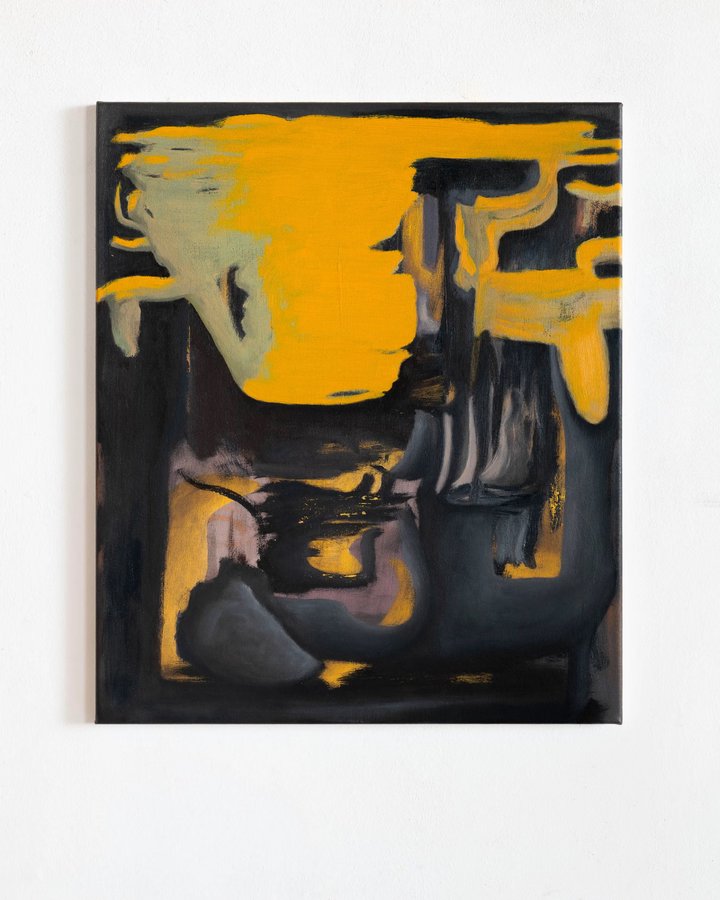
- As you look around, nature is undeniably present in Veronika Hilger’s paintings.[1] We can soon spot the curve of a hill or a plant, the sky in that peculiar shade of violet-grey, the setting sun or the rising moon. There are also some buildings and figures, in various constellations, and those sounds of someone working alone in an upper room. But the weather, the weather is never quiet. Her paintings have all the strangeness of shuttered heat. As the temperatures rise in our darkened flats, catastrophe looms above us like a mudslide. Her paintings have been described as ambiguous, and there are still many ambiguities to be found here, in this latest series of work. In one, moonlight seems to glisten on a drooping form, casting a shadow to the right. But this form is rooted in a flat space that both withdraws and reasserts its presence. A third form impossibly overlaps the second, a weightless mass of scraped-away paint. These ambiguities are not found but developed over long periods of time. Veronika Hilger begins her paintings with a loose set of gestures, by blocking out the major colour areas. She then examines each canvas closely for these strange moments when painting can be one thing or another and slowly tightens them until they are contained within the strict parameters of her frame. The ambiguity of her paintings has to do with the nature in them, participating in the deception Adorno ascribed to natural beauty.[2] Fifty years ago, Adorno could still claim that our relationship to nature is primarily one of domination and that only culture's indirect acknowledgment of this unequal power dynamic can bring about future reconciliation. For while the experience of natural beauty recalls a world without domination, there is no real freedom to be found here, as his example of the blackbird so memorably shows. He writes, very few are not moved by a blackbird’s song after the rain. Yet its song is unsettling precisely because it is not a song - the bird acts under the spell of its instincts. No wonder we find the sight of migratory flocks vaguely threatening. For Adorno, art as a cultural entity extricates itself from instinctive behaviour and breaks away from nature’s spell, creating a space in which nature can be experienced more freely. And now we know it is not enough. While we continue to deceive ourselves by taking pleasure in the trim hills of the Bavarian landscape, very few of us would consider this environment natural. This is the world of Veronika Hilger’s paintings: landscapes steeped in human activity. But she never imposes order on nature’s chaotic multiplicity. Rather, in a gesture borrowed from surrealism, she introduces an element of chaos into our overly smooth world, like those petri dishes in which new bulbous life-forms replicate and grow. If a sense of unmastered nature erupts unexpectedly from her landscapes, it is because Veronika Hilger pursues this quality ruthlessly and relentlessly, inDescription
Veronika Hilger: Strange Weather
Until 31 Oct 2026
Recent past exhibitions
- This summer at Sperling, we are proud to present Mathew Hale’s new suite of free drawings*, FACTS OF LIFE, in its entirety. The four hundred pictures will be pinned up directly on the gallery walls allowing the visitor to enjoy them all at once, and echoing the creative environment of Hale’s studio. Facts of Life are a series of spontaneously generated images made by an adult in relation to their childhood. Emptying his head, the artist begins to draw, and this is what has appeared; not truth, or innocence, but beautiful and disturbing surprises grown in the soil of truth and innocence. To quote the artist Bruno Schultz: “To you I can reveal the secrets of these drawings. I always doubted that it was I who drew them. Sometimes they seem like unintentional plagiarisms. Something that was whispered to me, that reached my ear … as though a stranger had used my inspiration for purposes unknown, for I confess I have discovered the ‘real thing’.” A publication entitled FACTS OF LIFE: Drawn from forgetfulness by Mathew (and Mummy), featuring texts by Rye Dag Holmboe and Julie Mehretu, is forthcoming from X Artists’ Books (Los Angeles/Berlin). * “Free drawing” is the term coined by the psychoanalyst, writer and artist Marion Milner in her book On Not Being Able to Paint, when theorizing her practice of sitting down to draw with no prior image in her head, only to be led by her hand, eye and mind to produce something that was naturally significant, because not preconceived. Mathew Hale was Marion Milner’s assistant and friend from 1990–1998, the last eight years of her life.Description
Mathew Hale: Spontaneous Generation (Facts of Life)
Ended 5 Sept 2026
Anousha Payne: Triangle reshapes the O of my mouth
Ended 4 Jul 2026
- Temporal Detours moves through temporal digressions, feedback loops, and displacements in which history does not appear as something concluded and visions of the future become fragile. In the video work Darkness, filmed in the former salt mine of Altaussee, Geiger conducts an imaginary conversation with darkness itself. The site is historically charged: in the final months of the Second World War, the Nazi regime stored more than 6,500 looted artworks here. Darkness becomes a conversational partner and poses fundamental questions: Is it merely an accomplice to the crimes, a passive witness, or does it hold the potential to preserve memory by making absence and void visible? Between present and past, a multilayered dialogue unfolds about concealment, forgetting, and responsibility. In the adjacent room, a series of monotypes is presented in which Geiger has transferred excerpts of the dialogue with darkness onto paper. Monotype is a printmaking technique in which each impression is unique and the ink is transferred directly onto the paper. Traces of movement, pressure, and gesture thus remain visible. In Geiger’s works, black pigment becomes the carrier of questions and answers that seem to emerge directly from darkness itself. In the gallery basement, the second video performance 25 Years Too Late is on view. Structured as a guided tour of the former Expo 2000 site in Hanover, Geiger places visitors in a paradoxical temporal position: the point of reference is not the year 2025, but the year 2000. The tour sketches an image of a world on the brink of departure, shaped by digital euphoria and the vision of a sustainable future. Yet the reality on site tells a different story. Abandoned structures, vacant lots, and repurposed buildings characterize the area and stand in stark contrast to the former promise of the future. This deliberate discrepancy between narrative and reality raises new questions: What kind of future do we imagine today? And what are our present-day utopias? The works come together in Temporal Detours as an investigation of time as a non-linear structure. Geiger employs historical detours, imagined presents, and backward-looking visions of the future to expose the fragility of memory, responsibility, and narratives of progress. Past and future appear not as fixed points, but as unstable systems of reference that continually challenge our present.Description
Thomas Geiger: Temporal Detours
Ended 30 Apr 2026