Berlin
Galerie Tanja Wagner
On now
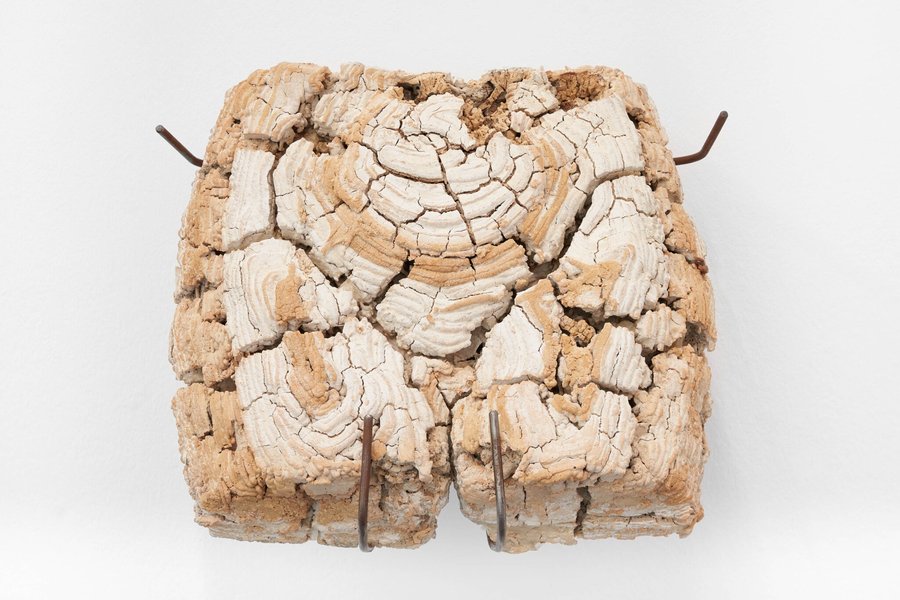
- Western culture has long relied on the notion that the world is made up of fixed, enduring substances. Matter is stable, its contours conveniently discrete, so that it can be measured, tested, and proven. This worked like a spell, one that cast the West’s hegemony over the rest of the world, enabling extraordinary scientific achievement as well as immense ecological destruction.Description
The Seed Is the Tree Is the House
Until 31 Oct 2026
Kapwani Kiwanga – Pollen
Until 1 Jan 2027
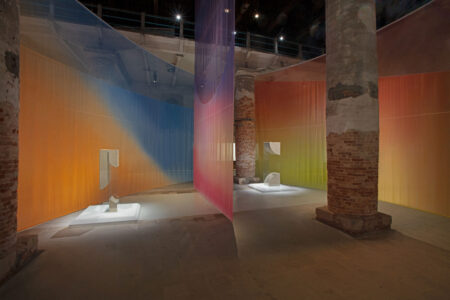
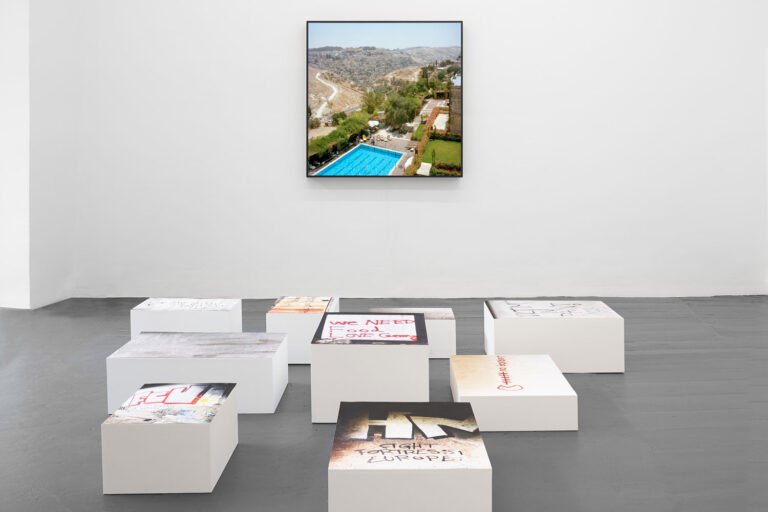
- On the occasion of the exhibition’s closing, Šejla Kamerić will be joined by Boris Buden and Hana Ćurak on October 18th for a conversation on the topic of RETROSPECTING as a radical practice. RETROSPECTING is Šejla Kamerić ’s seventh solo exhibition at Galerie Tanja Wagner. Works produced over a span of two decades present resources the artist mobilized from the past to give radical shape to a future she requests, anticipates, and imagines. Kamerić revisits her iconic piece, EU/Others, first exhibited in 2000 at Manifesta 3. A new, reinterpreted version, EU/Others – Spin (2022), stands alongside archive works such as Frei (2004) and We were chilling by the pool when the war started (2006). Considering the positionality of her artistic interventions and herself, and subjecting both to non-linear temporal interrogation, the artist presents the urgency of addressing repeating political conditions. “It is 2022, and we find ourselves in a time of historical loops – with old and new wars reverberating, border regimes producing ‘new’ newcomers, and capital governing the mobility of people and ideas. In RETROSPECTING, Šejla Kamerić reinstates these topics through old and new work, while also reflecting on the vexed relationship between art and the market, which demands constant and new production. The pushback against this anxious demand is the asking of old questions, now heavier with urgency; asking them anew, in their resounding demand.” – states Milica Trakilović, thereby signaling Kamerić’s poignant tracing of a radically different future. Kamerić’s work Letters from the Frontiers (2022) particularly encapsulates this endeavor and serves as a conclusion of her own otherness and “a revision of the very architecture of power, knowledge, being, gender, and perception” (Tlostanova, 2019). In concurrence with RETROSPECTING, Kamerić’s Bosnian Girl makes an appearance at The Artothek at the Neue Berliner Kunstverein during their Berlin Art Week exhibition, where visitors will be encouraged to take a poster home with them. In describing the “essential quality” of Kamerić’s Bosnian Girl, Boris Buden (2021) states that it “takes its political meaning beyond the scope of the so-called struggle for recognition that has become the paradigm of post-modern politics; a politics in which various cultural identities feature as both the main agencies and stakes of political mobilization, while cultural differences provide the fault lines along which today’s major political conflicts unfold.” The works presented in RETROSPECTING reinvigorate this position, reflecting the multitude of media the artist uses in her practice. With a particular focus on images and text, RETROSPECTING is simultaneously a living archive and an immediate political warning powerfully placed in a particular historical moment. This is also reflected upon in Kamerić’s artworks that are currently on view at the TATE Modern, as part of their permanent collection, and at Manifesta 14. Šejla Kamerić (Sarajevo, 1976) lives and works in Berlin, Istria and Sarajevo. She studied at the Academy of Arts in Sarajevo. She deals with themes that emerge from non-linear historicalDescription
Šejla Kamerić - Artist Talk with Šejla Kamerić, Boris Buden and Hana Ćurak
Until 17 Jan 2027
Coming soon
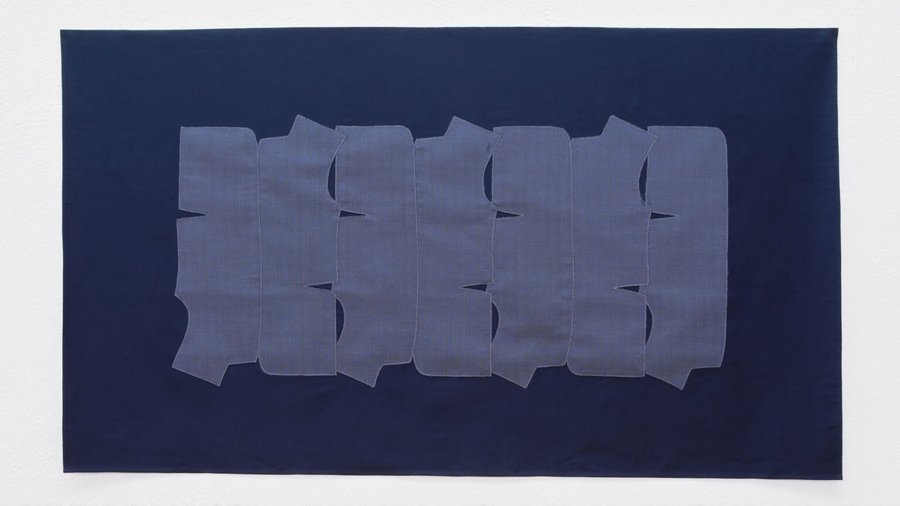
Kapwani Kiwanga, Carry Me / Carry On
20 Nov 2026 – 22 Jan 2027
Recent past exhibitions
Šejla Kamerić - EX YOU
Ended 19 Apr 2026
Kapwani Kiwanga - In Conversation with Carolin Köchling
Ended 31 Mar 2026
Anna Witt – Spielräume
Ended 29 Mar 2026
- (A thought spiral) ꩜ At some point, s t o r y became h i s t o r y. Text had much to do with this development. We wrote down what we observed, fixing things in time in order to measure and assess them. We wrote books of all kinds. We read, revised, and built upon them, writing new books in turn. A straight line emerged, connecting past to present and propelling humanity into the future. We called it progress. Before history, time was less a line than a circle, or rather, a spiral. Life was anchored in cycles of growth and decay, marked by the seasons and the phases of the moon. What if we are returning to the spiral? ꩜ (Inhale for a count of three Exhale for a count of six—) A Spiral, a Mouth, a Horn and a Halo foregrounds forms of meaning-making that are mutable, relational, and recursive. Oral forms—myths, fairy tales, fables, and songs—were optimised for intergenerational transmission, relying on affective resonance and an ability to forge connections between people. How can art mobilise storytelling as a tool for thinking about the present? The hyper-speed of innovation in communication media and digital technologies has transformed the ways we relate to knowledge and truth, such that a shared reality or linear timeline can no longer be assumed. Those in power today know that the pull of a compelling story outweighs the authority of fact. The stakes are no longer only what is true, but how reality itself is narrated, and by whom. A Spiral, a Mouth, a Horn and a Halo takes this instability as a point of departure. The exhibition considers how digital life reshapes our relationship to the past, now accessible as a vast, flattened archive, and explores the limits of language, memory, and communication under contemporary conditions. The sound piece Dornröschens Staub (Sleeping Beauty’s Dust), written by Olga Hohmann and composed by Yannick Wittmann, is structured by a breathing rhythm used to calm the nervous system: inhaling for a count of three, exhaling for a count of six. Hohmann’s text takes inspiration from a remark by Georges Bataille, who points out a curious omission in the classic fairy tale: upon waking from her hundred-year sleep, Sleeping Beauty would have been covered in dust. Made largely of shed skin cells, this dust is a trace of her past selves. Since the cells in our bodies constantly die and are replaced, we are, in a sense, ever-changing beings. The notion of a fixed, enduring self—foundational to Western thought—is softened by recognising the body as a continuous cycle of becoming and passing away. Hohmann’s voice loops and overlaps in a polyphonic inner dialogue. Linking bodily cycles, (cellular renewal, sleep and wakefulness) to those of time itself, she cites Mark Twain: “history doesn’t repeat itself, but it rhymes.” In This broken city sky like butane on my skin, Shuang Li magnifies a smartphone case to monumental scale. Wall-mounted and cast in iridescent gasoline-pink, the imposing object reads as a shrine: a protective frame meant for devotion. A vertical indentation runs through the centre of the surface decorated with star and moon motifs. It is crossed by hollow oval shapes, or saint-less halos. This vertical line recalls a magic wand or an antenna, forms associated with transmission and connection. A second large-scale sculpture by Li, installed on the floor, takes the form of a massive maroon seashell with a glossy metallic finish. Studded with cartoonish spines and decorated with squiggle shapes it references anime aesthetics that shaped the artist’s childhood visual world. Both works were developed during the same period, when Li arrived in Berlin shortly before the outbreak of the pandemic and was unable to return home to China. In this context, the phone case and the shell function as parallel figures of housing and protection. In Wie-yi T. Lauw ’s large hand woven tapestry, Fleeting Universe, anachronistic juxtapositions take centre stage. Digital interfaces, anime and video-game imagery, and references to art history coexist without hierarchy, woven into a single flattened pictorial field. In the centre, we see a screen displaying an architectural modelling program. A manga-style female warrior stands alongside a dragon, while two disembodied hands hover, one robotic, the other a reference to classical sculpture. The work draws from the artist’s own multicultural heritage, shaped by migration while also reflecting the experience of being online today, a condition of total archival access in which fragments of global history, popular culture, and personal memory circulate side by side. Annabel Daou ’s The Last Word is a vertically suspended wall piece made of countless, meticulously cut layers of paper, each bearing the sentence: “OUR SKIN LAID BARE AND OUR EYES BEARING WITNESS.” The phrase comes from a response Daou received to the question, “What’s left of us?” Repetition is central to the artist’s practice, a ritual that adds weight and lets meaning sink in. However, here, meaning is partially obscured through repetition. As the sentence descends, the overlapping strips fall unevenly, blurring the text and making it increasingly difficult to read. Rendered in white on a white wall, the work is deliberately subdued. The phrase evokes the bodily act of bearing witness, rooted in seeing and sensing. It underscores the limits of perception and the challenge of rendering experience communicable in a world where even what we observe with our own eyes is routinely questioned. Elisa Giardina Papa ’s presents two white ceramic sculptures shaped like thick, rope-like braids, part of her project U Scantu: A Disorderly Tale. One braid emerges from the wall through a circular opening, while the other rests on a metal armature. The works draw on the Sicilian myth of the donne di fora : supernatural female figures who embodied contradictory qualities; benevolent and vengeful, human and otherworldly, feminine and masculine. The project combines folklore and archival research, drawing on songs and stories passed down by the artist’s grandmother alongside sixteenth- and seventeenth-century Inquisition records documenting the persecution of women accused of being donne di fora. Presented alongside a poem by Megan Fernandes that adopts the language of fairy-tales, the works foreground forms of knowledge that have been marginalised, disqualified, or rendered illegible by dominant systems of order. Bethan Hughes ’s installation features hand-cast rubber boots mounted in and along tall, tool-like metal spears. The objects lean casually against the wall, as if recently used in the field. A print nearby shows a dandelion, Taraxacum koksaghyz, the Kazakh rubber-producing dandelion, filtered through orange glass. These works are part of Hughes’s long-term project Hevea, which reconstructs the stories of women who planted these dandelions during the Second World War, whose lives were enmeshed with the cycles of the plants as well as the military-industrial complex. Drawing on archival documents, letters, telegrams, scientific records, and oral histories, Hughes traces the movement of the dandelion across contexts, from the Soviet Union to Nazi-occupied Poland, wartime Germany, and the United States.Description
A Spiral, a Mouth, a Horn and a Halo
Ended 28 Mar 2026
- One of the discoveries from our exhibition »Echtzeit« is the painter Grit Richter. She has found a way to bring emotion onto the canvas, developing a visual language that answers the question of figuration versus abstraction in a distinctly personal way. Her paintings are constructions inspired by a wide range of aesthetic elements – from the smooth surfaces of Pop Art to the semantic ambiguity of Surrealism.Description
Grit Richter - Soft Power
Ended 1 Mar 2026
Šejla Kamerić – Echo
Ended 8 Feb 2026