Ixelles - Elsene
Xavier Hufkens
On now
- Xavier Hufkens is pleased to present a major exhibition of new work by Tatiana Trouvé, her first solo exhibition in Brussels. Occupying three levels of the gallery, The Auxiliaries unfolds through an ever-expanding practice encompassing sculpture, drawing, and installation. Trouvé’s works inhabit an intermediate zone where multiple realities coexist, each interlinked within a practice that is both generative and regenerative. ‘All the elements that make up worlds connected to each other through affinities, echoes, reminiscences, and how these liaisons map out a shared wandering, without origin or end, in a completely open ecosystem’, Tatiana Trouvé notes. The exhibition opens with L’Inventario [The Inventory] (2026), a provisional-looking shelving structure resembling cardboard cast in aluminium. Combining still-life compositions with empty shelves, the installation alludes to the artist’s storage and the studio as a place of transformation, where objects and their relationships exist in a state of perpetual becoming. Rather than suggesting accumulation, the work evokes absence and depletion. As Trouvé observes: ‘The idea is to get into a space where a few elements still survive, but where the essentials are already gone.’ Les Colliers des villes [City Necklaces] are composed of objects collected by the artist during her travels. Cast in bronze, brass, steel or aluminium before being painted, these fragments become condensed itineraries carrying traces of encounters and lived experience, recalling the interconnected journeys of Italo Calvino’s Invisible Cities (1972). Travel and temporality likewise shape the latest iteration of I cento titoli [A Hundred Titles], a work whose title changes every year over one hundred years (1968—2068). Cast in bronze, the ‘dis-adjusted’ suitcase floats between a temporal and a conceptual journey. Travelling, movement, mapping and circularity also underpin On the Eve of Never Leaving (2026), a work based on sound pollution measurements taken around the Boulevard Périphérique that encircles Paris. Here, sounds become lines, movements become structures, and an invisible phenomenon acquires material presence. Composed of truncated loops and segments, the sculpture echoes the continuous circuit of the ring road, while the adjoining plaster panel, a fragment of Trouvé studio’s wall, recalls the acoustic barriers lining the motorway, linking the artist’s studio life to the murmuring of the world. In the basement, Sitting Sculptures (2026), from the series Les Ouvrières invisibles [The Invisible Workers], foregrounds the auxiliary materials that enable sculptures to exist: mattresses, blankets, pillows and foams used to drag heavy and fragile objects around the studio, transport pallets, lifting straps, silicone taken from casting moulds, fragments, casts, residues, and discarded materials all reappear in new forms. Retaining traces of their histories even as they assume new identities, these elements reveal the movement and the hidden labour embedded within sculptural practice. Upstairs, the porous relationship between drawing and sculpture comes to the fore through a selection from the Les Dessouvenus [The Unremembered] series, begun in 2013, alongside a new series of drawings, Les Auxiliaires [The Auxiliaries]. Across both series, Trouvé’s practice oscillates between chance operation and construction, orientation and disorientation: worlds emerge through chemically altered surfaces, while drawings originate in the chance event of a hair falling across a canvas, preserved beneath tracing paper, its meandering path evoking routes, cables and trajectories. As the boundaries between studio and exhibition, drawing and sculpture, process and finished work dissolve, Tatiana Trouvé’s works emerge not as fixed entities but as temporary constellations within an exhibition as an open network of transformations. Across shifting relations between objects, materials, gestures and places, works continually change status as they move from one form to another, generating new affinities, echoes and trajectories. Rather than resolving into stable meanings, they remain suspended within an ecosystem without origin or end, where different worlds coexist and continually give rise to one another.Description
Tatiana Trouvé The Auxiliaries
Until 31 Oct 2026
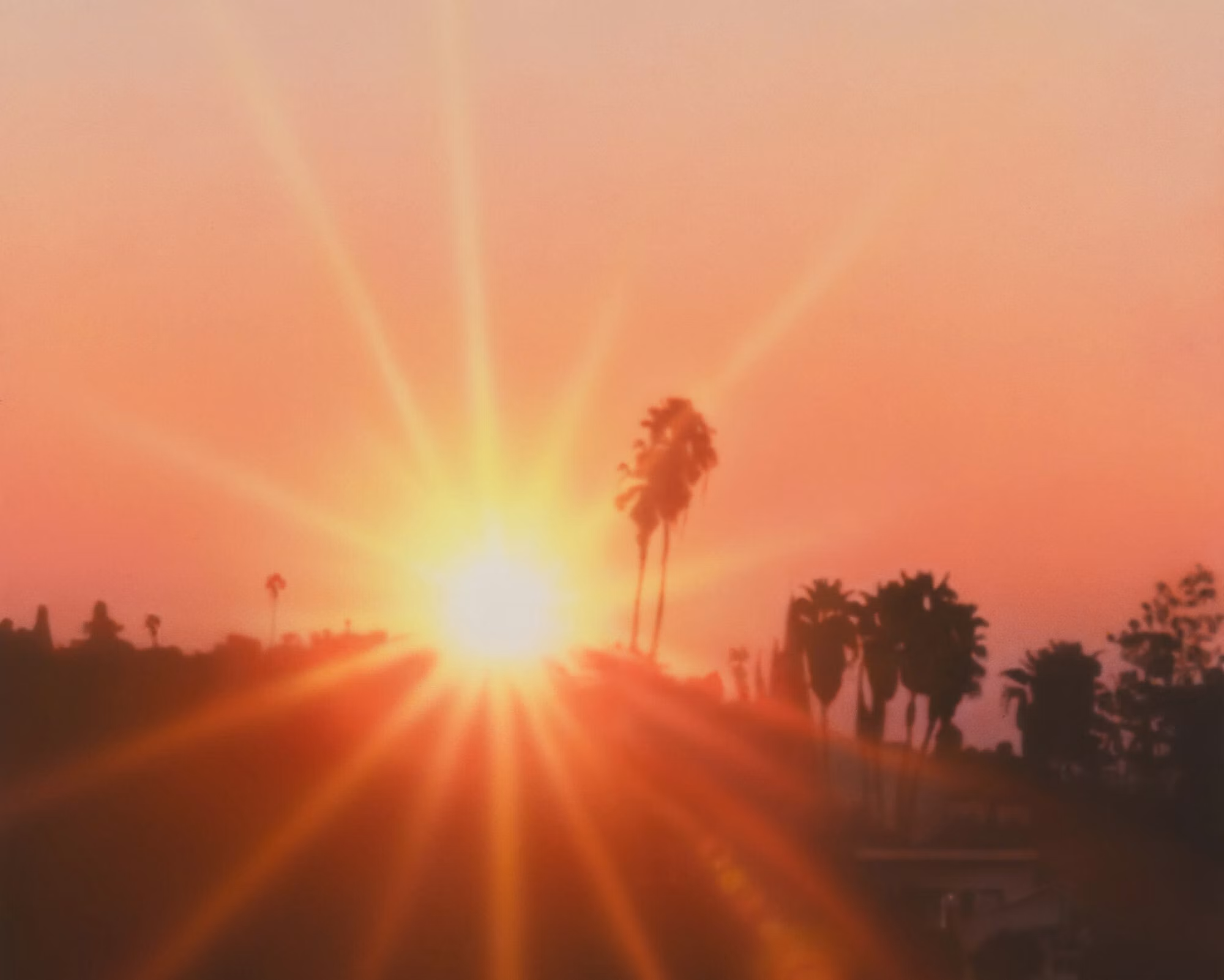
- Sim City, Sayre Gomez’s third exhibition at Xavier Hufkens, brings together a new body of paintings, figurative sculptures, and works on paper that continue his engagement with the urban framework of Los Angeles and the mechanisms of image making. Employing various strategies of constructing and manipulating images, Sim City wrestles with representations of a city that is itself a symbol of artifice, presenting Los Angeles emerging as a cultural construction—a protagonist and backdrop, home and fantasy, paradise and myth. At the core of Gomez’s practice lies a sustained interest in examining the foundations and history of how images are made, reproduced, dissected, reanimated and how they function in contemporary culture. His photorealistic works are painted from composite sources, borrowing from personal cell phone photos, stock photography, and found images that are often intentionally distorted with digital artefacts, and analogue camera effects such as sunbursts and the blur of a soft-focus lens. There is a repetitive folding, a push and pull, in Gomez’s paintings that embraces the liminal space between fiction and documentation within the constructed image. The works consequently produce scenes that speaks truths more representative of the socio-political structures of inequity that recur throughout his work. The final manual reproduction – an airbrushed painting – returns the image to the realm of painting through techniques borrowed from commercial photo retouching and Hollywood set painting, practices historically positioned outside the conventions of fine art. The exhibition begins with an opening tableau of two child-sized sculptures sitting on playground swings hanging from the ceiling of the gallery. Modelled after the artist’s young children, the figures assume the guise of Precious Moments figurines, the saccharine, doe-eyed miniatures popularised in the 1980s. Their sentimental, cartoon-like forms are rendered uncanny through the addition of real hair and his own children’s clothing. The introduction of these figures in Gomez’s recent work reflects his growing preoccupation with fatherhood and coming of age at this particular moment in time, within the urban realities that have long shaped his work. Behind them sits a large-scale painting depicting an incandescent orange sun setting over a city skyline. The sunset is rendered strangely indeterminate; its saturation and scale slip the scene into something foreboding. Set against this backdrop, the sculptures function as doubles – simultaneously fictional and deeply personal – occupying an uneasy space between innocence, prescience, and lived reality.Description
Sayre Gomez Sim City
Until 28 Nov 2026
Recent past exhibitions
- Next spring, Tracey Emin will open A Second Life, a survey exhibition at the Tate Modern that will bring together more than 90 works spanning a 40 year practice. It will include painting, video, textile, neon, sculpture and installation, some of Emin’s most famous works and never-before-seen pieces. A Second Life will mark the most significant exhibition of Emin’s career, tracing the key life events that have shaped her journey.Description
Tracey Emin A Second Life
Ended 31 Aug 2026
- The traveling exhibition Get in the Game: Sports, Art, Culture previously held at SF Moma, San Francisco (2024) and Crystal Bridges Museum of American Art, Bentonville (2025), explores the dynamic interplay between athletic performance and artistic expression. Coinciding with major international sporting events taking place in Miami—the Miami Open, the Formula 1 Grand Prix, and the FIFA World Cup, the exhibition positions Pérez Art Museum Miami (PAMM) as a site where global audiences converge to reflect on the cultural impact of sport. In a city shaped by exchange and diversity, the exhibition underscores how games and competitions create common ground across traditions, identities, and rivalries.Description
Joan Semmel in Get in the Game
Ended 23 Aug 2026
- The Stedelijk Museum hosts a solo exhibition by conceptual artist Danh Vō (born 1975, Vietnam; lives in Mexico City, and on his farm Güldenhof situated north of Berlin). Over the past two decades Vō gained critical acclaim for his exhibitions that share a unique sense of space and choreography. Danh Vō, untitled, 2025 The artist often takes contexts from life and exhibits them. He likes to consider the formation and dissolution of power structures, from individuals to empires. Rather than tell binary tales of perpetrators and victims, he surfaces the ways that power enacts itself on the subject, through pleasure and pain, seduction and assimilation. Vō’s installations explore how our lives and self-image are shaped by both collective history and personal experiences, embodying the shifting nature of contemporary life. For his exhibition at the Stedelijk, Vō develops new work that furthers his interest in the workings of history, religion, freedom, and eroticism. The collection of the Stedelijk holds two works by the artist and in 2008 the museum presented one of Vō’s first institutional exhibitions.Description
Danh Vō Danh Vō
Ended 2 Aug 2026
- The Stedelijk Museum hosts a solo exhibition by conceptual artist Danh Vō (born 1975, Vietnam; lives in Mexico City, and on his farm Güldenhof situated north of Berlin). Over the past two decades Vō gained critical acclaim for his exhibitions that share a unique sense of space and choreography. Danh Vō, untitled, 2024 The artist often takes contexts from life and exhibits them. He likes to consider the formation and dissolution of power structures, from individuals to empires. Rather than tell binary tales of perpetrators and victims, he surfaces the ways that power enacts itself on the subject, through pleasure and pain, seduction and assimilation. Vō’s installations explore how our lives and self-image are shaped by both collective history and personal experiences, embodying the shifting nature of contemporary life. For his exhibition at the Stedelijk, Vō develops new work that furthers his interest in the workings of history, religion, freedom, and eroticism. The collection of the Stedelijk holds two works by the artist and in 2008 the museum presented one of Vō’s first institutional exhibitions.Description
Danh Vō πνεῦμα (Ἔλισσα)
Ended 2 Aug 2026
- In a society obsessively seeking eternal youth, Museum van Bommel van Dam is presenting the first major exhibition on aging. From January 24 to June 14, 2026, the art museum presents the group exhibition Grey! Art on Aging. Featuring work by international contemporary artists, the exhibition explores the perspective and experience of aging in an aging society: from ageism and image formation to the beauty of the changing body and the relationship between generations. Through photographs, videos, paintings, installations, and drawings by renowned artists, Grey! paints a rich picture of one of the most important challenges of our time.Description
Joan Semmel in Gray! Art on Aging
Ended 26 Jul 2026
- Swiss-born artist Nicolas Party works across a wide range of different media. Primarily known for his colour-saturated paintings and murals, he also makes painted sculptures, pastels, installations, prints and drawings, and works as a curator. Party often paints landscapes, portraits and still lifes of everyday objects, which he strips of all extraneous detail. Rather than creating faithful depictions from nature, he uses these seemingly innocuous subjects as springboards for an exploration into the art of painting itself. His concerns lie, therefore, less in the accurate depiction of nature, and more in its translation and transformation through colour, materials and composition. Painterly precision, a vibrant colour palette and a keen eye for composition coalesce into works that are accessible and seductive but, at the same time, continue a long standing art-historical dialogue between observation and the imagination. Party is also interested in the power of paint to alter our perception of the built environment and, within a gallery context, how we experience art. To this end, he regularly paints murals, either as stand-alone works or as carefully orchestrated settings for his paintings. Nicolas Party (b. 1980, Lausanne, Switzerland) lives and works in New York. His work has been exhibited internationally including recent solo exhibitions at the Currier Museum of Art, Manchester, NY, USA (2025); Holburne Museum, Bath, England, UK (2025); Hoam Museum of Art, Yongin, South Korea (2024); The Warehouse, Dallas, TX, USA (2024); The Green Family Art Foundation, Dallas (2023); The Frick Collection, New York (2023); Museum Frieder Burda, Baden-Baden (2023), Montreal Museum of Fine Arts, Montreal (2022); Le Consortium, Dijon (2021); MASI Lugano (2021); FLAG Art Foundation, New York (2019); M WOODS, Beijing (2018-2019); and Magritte Museum, Brussels (2018). [LINK text='Download full biography' href='https://xavierhufkens.imgix.net/documents/PART_2026-01-17-113941_jmhl.pdf'] Updated 17 January 2026Description
Nicolas Party
Ended 25 Jul 2026
Walter Swennen
Ended 25 Jul 2026
- Co-organized with the Fundació Joan Miró in Barcelona, Miró and the United States explores the vibrant exchanges between Catalan artist Joan Miró (1893-1983) and the burgeoning American art scene in a pivotal moment of 20th-century art. This little-known yet decisive period of connection between Miró and American artists—including Alexander Calder, Louise Bourgeois, Lee Krasner, Norman Lewis, Jackson Pollock, Helen Frankenthaler, and Adolph Gottlieb—was influential in the development of post-war art on both sides of the Atlantic. For Miró, the United States represented new audiences and creative freedom. He had retrospectives at the Museum of Modern Art in New York in 1941 and 1959, and traveled to the US seven times between 1947 and 1968, during which he met artists in their studios, collaborated on prints and architectural projects, and closely followed exhibitions at galleries and museums. Featuring 75 works by more than 30 artists, this exhibition reframes Miró’s legacy, revealing how his dream-like pictures evolved through artistic dialogue and experimentation with his American counterparts.Description
Louise Bourgeois in Miró and the United States
Ended 5 Jul 2026
- Xavier Hufkens and Alexander Gray Associates present Continuities, an exhibition of recent paintings by Joan Semmel (b. 1932). Conceived with the artist as a single presentation across Brussels and New York, the exhibition’s structure mirrors the paintings’ own logic, playing with doubling and immediacy to extend the act of seeing across continents. Semmel paints her own body as an authored image—internalized rather than observed. In her nineties, that act carries weight. While the aging female form is routinely edited from view, these canvases place it squarely at the center, without apology or disguise. Her compositions do not treat the body as symbol, memory, or ideal. Works such as Here I Am (2025) reject any impulse to memorialize or prettify. Saturated hues move across flesh in broad passages; contours blur and reassert themselves. In Red Breast (2025), bold strokes and thin washes keep figure and ground in continual exchange as Semmel’s body emerges from and dissolves into its surroundings. These paintings draw on strategies that have long shaped Semmel’s work—the cropping and emotive color of her 1970s canvases and the multiple figures of her Overlays (1992–1996) and Shifting Image compositions (2006–2013). In works such as Partners (2024) and Fleshed Out (2025), layering allows more than one version of the figure to remain visible, as if the body echoes across the surface. In others, color and paint handling create that sense of movement without doubling the form outright. “The earlier images are still present for me,” Semmel has said. “They’re something I can move through, not something I’m revisiting.” Presenting this work simultaneously in Brussels and New York gives the paintings’ structure a physical dimension. Viewers encounter related compositions in two distinct locations. That simultaneity extends the paintings’ insistence on multiplicity and presence. The dual presentation also acknowledges the long dialogue between Europe and America that has shaped feminist thought and visual culture for more than half a century, insisting on connection and the sustaining power of cultural exchange. Rather than positioning the two venues in opposition, Continuities treats them as continuous. What emerges is a single experience spanning two cities: installations that mirror one another, doubling made physical, and presence that reaches across the ocean to meet itself.Description
Joan Semmel Continuities
Ended 27 Jun 2026
- Louise Bourgeois (1911–2010) is widely regarded as one of the most important artists of the past century. Her work with sculpture, installation, painting, drawing, printmaking, and fabric moved fluidly between the abstract, the ambiguous, and the concrete. Much of her work is deeply personal, rooted in her own experiences and memories, exploring powerful themes such as childhood, femininity, sexuality, and the body. The exhibition is the first solo presentation of the artist in Mid-Norway. An in-depth publication including new scholarship by the curator and other scholars will accompany the show.Description
Louise Bourgeois Echo of the Morning
Ended 31 May 2026
- This exhibition explores the dynamic evolution of British art from the late 1980s to the early 2000s. After going through the Thatcher era (1979–1990), a charged and uncertain social climate gave rise to a new generation of artists who challenged traditional norms and embraced bold, experimental practices. Many of the newer generation of artists who came to prominence in the 1990s were referred to in the art and popular media under the title Young British Artists (YBAs). Alongside other artists active at the time, these artists explored themes such as popular culture, personal identity, and shifting social structures. They worked across a diverse range of media, including painting, sculpture, photography, video, and installation. Featuring around 100 works by approximately 60 artists, the exhibition traces the radical creativity and groundbreaking approaches that redefined British art in the 1990s.Description
Tracey Emin in Tate Britain – YBA & BEYOND: 90s British Art That Changed the World
Ended 11 May 2026
- Like many artists before him, notably Picasso, the Minotaur has long fascinated Houseago. In Greek mythology, this supernatural creature — half man, half bull — dwells at the heart of the Labyrinth, the maze designed by Daedalus for King Minos of Crete. More than a monster, it has long symbolized humanity’s primal fears and repressed instincts: the ‘shadow self’ hidden in the maze of the psyche. This division also reappears in works such as Shadow (downstairs gallery): an image of dissociation that also evokes Janus, the two-faced Roman god of change and transition. As such, the Minotaur embodies the tension between reason and animal impulse, the journey of self-confrontation, and the consequences of hubris and chaos. Downstairs, Houseago presents new egg-shaped works in wood and plaster. One of these, in plaster, hemp and rebar, Large Egg (For Lovers), 2025, resembles a cocoon, with just enough space to accommodate two people. Here, Houseago alludes to the cosmic egg, a motif found in creation stories across cultures. In these myths, a primordial egg hatches to form the universe or a first living being. Its shell becomes the heavens and its yolk the earth. Rooted in the life-giving qualities of an egg, the motif symbolizes birth, both fragility and protection, and the origin of all things. It too has a rich art-historical tradition, one that stretches from antiquity to the works of Brancusi, Magritte and Warhol. Yet Houseago’s eggs are cleft, sometimes sliced open or perforated, presenting a messier, less perfect vision of life. A new suite of monochrome paintings depicting skulls, a familiar motif in Houseago’s oeuvre, can be found in the uppermost gallery. In contrast to his earlier canvases on this theme, which were filled with controlled, angular lines in almost maze-like compositions, the new works are pulsating with an organic, raw, expressive energy. Skulls now float in a dark void, wherein drops of paint shimmer like stars. The motif recalls Dutch still life vanitas paintings, a warning that life is fleeting and transient. Houseago says: “Death. Everything leads to death. Everything is impermanent. Everything is being made and unmade at the same time. And there’s a tremendous fragility in that; there’s a beauty in that.” In the making of these recent works, the skull takes on more generative than morbid connotations, emerging through a repetitive process of appearance and erasure — drawing, covering up, and putting to rest — until the accumulated layers reach a point of simultaneity and calm. Houseago’s ambitious installation Cosmic Snail (Shell Temple), 2025, fills the first floor and invites visitors to step inside the work itself — an exploration of form and space that unfolds as a deeply personal and contemplative experience. Snails are often seen as spiritual messengers, symbolizing patience, perseverance and protection. Their spiral shells, associated with the Fibonacci sequence, evoke cycles of growth and transformation, making the creature a beguiling symbol of inner reflection and evolution. By virtue of its size and complexity, Cosmic Snail (Shell Temple) invites us to share in the artist’s inner journey, while simultaneously offering a space for private introspection.Description
Thomas Houseago Journey
Ended 30 Apr 2026
- Michel François [TITLE CLASS='o-rich-text c-exhibition-header__title-name' TEXT='Rotopaintings and Yawning Stones'] Resisting a fixed style, [LINK text='Michel François' href='https://www.xavierhufkens.com/artists/michel-francois'] ’s practice unfolds through a sustained engagement with process, material behaviour, and transformation. Spanning sculpture, installation, and — more recently — painting, the works in this exhibition are formally diverse yet connected by recurring concerns: the tension between control and spontaneity, the experience of time and duration, and processes of change, repetition, and contingency. Often emerging from simple gestures — folding, cutting, casting, dripping or bending — François allows chance, instability and impermanence to actively shape his work. He frequently works with utilitarian or industrial materials, including sand, rubber, metal, paper, glass, wax and found objects. In François’s practice, small interventions or adjustments will trigger significant — often transformative — effects that can generate complex meanings. Painting is a relatively new pursuit, one that connects to his late father, an amateur artist who repeatedly painted the same landscape. Reflecting on this act of repetition over time led François to develop his ‘roto’ technique as a reverse response to the endeavour: fast, mechanical, and non-observational, with a horizon endlessly replicated — always the same, yet subtly different; mechanical in process, yet still guided by the artist’s hand. The Rotopaintings are created using a fast-moving machine of the artist’s own design, fitted with industrial sandpaper belts. Unlike conventional painting, where the canvas is static and the artist moves, here the opposite occurs: the surface rotates at high speed, while François remains largely still, briefly touching a stick of oil pigment to the moving surface. Friction produces horizontal bands of colour that accumulate in strata, evoking landscapes and distant horizons, but also bands of static interference. Classical in appearance, the works are generated through relentless motion and erosion: the sandpaper rapidly grinds down the oil stick, visibly consuming the pigment as the image comes into being. Trimmed diagonally along the cutting lines of the industrial sheets, the paintings take the form of parallelograms. Lines — both controlled and uncontrolled — recur throughout François’s oeuvre, and the title Rotopaintings subtly situates the works within a tradition of artists who have used mechanical processes to question authorship, perception and the primacy of the hand, such as Marcel Duchamp’s Rotoreliefs or Piero Manzoni’s Linee. The Rotopaintings find a material counterpart in To erode (Sand) (2013-2026), the latest iteration in a series of works in which form emerges through erosion and loss. Through a minimal intervention — pushing a compacted cube of sand (itself an anomaly) across the ground — François activates erosion as an inevitable process. Edges soften, matter diminishes, and the geometric, three-dimensional block gradually disintegrates into flat, organic patterns on the floor. The Scribble Lamp — an example of an uncontrolled line — transforms an involuntary form into spatial presence: electrical cabling that spools and coils as it falls, evoking both speed and movement, as well as off-the-cuff drawings or scribbles. Its capricious shape stands in sharp contrast to the geometry of the cube and the parallelogram. Here, the arrest of motion creates a subtle doubling: the cable is both the source of the form and literally at its core, running through the hollow plaster from power source to bulb. Involuntary forces are also at play in the Yawning Stones (2025), a collaboration between Michel François and the Brussels-based British artist Douglas Eynon (b. 1989). These sculptures take the form of boulders with gaping, mouth-like openings. Partly inspired by Yawning Man (c. 1563), a painting attributed to Pieter Bruegel the Elder in the collection of the Royal Museums of Fine Arts of Belgium (KMSKB), the works also resonate with a long art-historical lineage of yawners, from Messerschmidt and Joseph Ducreux’s Self-Portrait, Yawning (1783) to Degas’s Women Ironing (1884-86). Here, a physiological automatism — the yawn — is translated into an enduring mineral form. Typically lasting only a few seconds, the involuntary gesture is petrified, quite literally, as if arrested mid-motion. Stripped of expression, the yawn becomes a void: an opening that suggests fatigue, boredom and a momentary collapse of agency. The motif has long preoccupied François, who also explored it in the early 1990s in a black-and-white photographic wallpaper. Across the exhibition, François consistently draws attention to moments where agency gives way to automatism, form emerges through loss, and images arise from contact rather than control. Movement operates as both a visible and invisible force — simultaneously method and result. It may be fast and vital, as in the Rotopaintings and the ‘scribble’ lamp, or slow, as in a yawn or a block of sand pushed across the floor. A subtle irony ripples throughout the exhibition, particularly where speed or stillness generate opposing dynamics. Stone yawns, sand erodes, pigment disappears. Through these processes, the artist invites contemplation of vitality and enervation, duration, and the transformations — both fleeting and protracted — that shape bodies and matter alike.Description
Michel François Rotopaintings and Yawning Stones
Ended 25 Apr 2026
- Bringing one of the world’s leading collections of time-based art to a city defined by moving images sparks a rare conversation across disciplines. It dissolves the boundaries between visual art and cinema, museum and theater, white cube and black box. In doing so, it traces the evolution of visual storytelling over the past century, highlighting both the universality of human concerns and the shifting perspectives that shape their representation. What a Wonderful World presents a wide range of groundbreaking works by artists such as Marina Abramović, Cyprien Gaillard, Arthur Jafa, or Lu Yang, alongside cinematic milestones by Luis Buñuel, Walt Disney, Alice Guy-Blaché, Winsor McCay, and Georges Méliès. Together, these works form a panoramic and layered portrait of humanity and history across 120 years: altogether ironic, sincere, critical and compassionate. What a Wonderful World will unfold as an explorative journey, a cinematic mystery tour, a soul-stirring experience. It invites visitors to confront the secrets and fragilities of humanity while holding up a mirror to the state of the world todayDescription
Paul McCarthy in What a Wonderful World: An Audiovisual Poem
Ended 20 Mar 2026
- Since 2015, Anne Teresa De Keersmaeker has been bringing dance from the black box into the white cube: from opening The Tanks at Tate Modern with F ase, Four Movements to the Music of Steve Reich, and Work/Travail/Arbeid at WIELS, Centre Pompidou, Tate Modern, and MoMA, to Dark Red at Fondation Beyeler and Neue Nationalgalerie, Forêt at the Louvre, and many more. From 5 to 14 February 2026, De Keersmaeker will present the exhibition As you wish at Xavier Hufkens together with visual artist Steven Fillet—the first in a series of collaborations between the two artists. The exhibition will feature collaborative paintings and works on paper, accompanied by a series of solo performances entitled Insomnia by De Keersmaeker. The exhibition title As You Wish —from the Latin quodlibet, literally meaning “whatever you want”—takes its name from Johann Sebastian Bach’s Goldberg Variations BWV 988, which not only provide the overarching framework for this project but also reflect the rhythms, structures, and sensibilities through which life and work are intertwined for both artists. Bach’s final, thirtieth variation bearing the same name: an unexpected ending to one of the most remarkable keyboard works ever written. Two folk songs (“Ich bin so lang nicht bei dir g’west…” and “Kraut und Rüben haben mich vertrieben hätt’ mein’ Mutter Fleisch gekocht, so wär’ ich länger geblieben…”)¹ dance over the foundational bass line. It is as if everything that came before dissolves into something lighter and more familiar—a kind of homecoming. Some see in this a glimpse into the Bach household, where music was never segregated, but a constant, ever-present fact of life. The Goldberg Variation s were originally composed by Bach for harpsichord: an aria with thirty variations written between 1741 and 1745. According to Bach’s first biographer, Johann Nikolaus Forkel, the work was commissioned by Count Hermann Carl von Keyserling, the Russian ambassador to Saxony, who employed the young Johann Gottlieb Goldberg to play “delicate, spirited music” at night to ease his insomnia. The context inspired the title Insomnia for the performances with De Keersmaeker and Franco at the gallery, which strongly emphasizes the ideas of horizontality and verticality, suggesting a choreography that emerges from horizontal to vertical in relation to the paintings. On canvas and on paper, echoes can be heard of the Goldberg Variations. More than a musical score, Bach’s work is a blueprint for De Keersmaeker’s entire oeuvre: a system of repetition and differentiation, in which choreographic labour unfolds as a continuous circling around the same (meta)physical questions and (ma)thematical figures. Geometry, long central to De Keersmaeker’s research, is more than a visual concern for her. The line appears in her work not as representation; it is choreography in its most concentrated form—the bearer of time and space. The twelve canvases that form the heart of the exhibition As you wish arise from the geometries of the dance floor. Here, lines unfold—precise and affirmative—as chromatic trajectories through space. The result is an abstract geometry that is at once functional, referential, and poetic. Steven Fillet introduces a quiet restlessness. His oeuvre is one of freedoms bound up in contradictions. Like a chameleon, he slips between positions. Forms refuse conclusion; they linger in hesitation. In the encounter between the two artists, a shift takes place. The certainty of form gives way. What appears is a temporary instability. Geometry shifts from a closed system to an open field. What happens when order begins to waver? Two shifts emerge. The first appears technical: the rotation from horizontal to vertical. Yet this movement signals an epistemic rupture —a change in how we see and interpret. The floor is the realm of labour, co-existence, and co-creation; lifting the canvas onto the wall situates the work within the tradition of painting. Horizontal experience transforms into vertical representation. This pivot becomes a hinge moment: a movement from action to contemplation, an attempt to let the geometry itself speak. At the same time, a second gesture emerges—intentionally accidental. The figures fragment according to the logic of their support, no longer aligned with their origin. They press against the frame, spill over its edges, while weathered canvases fray along the boundary of the recognisable. They act like imprints—reminiscent of the Shroud of Turin: traces of an absent body, images that preserve only a hint. In the basement, a series of new, small drawings is displayed. They are not meant to be seen from a distance; they demand closeness and intimacy. For De Keersmaeker, drawing is an immediate, bodily form of thinking, where thought and gesture converge—a sensory reasoning in which hand tremor, movement, and the resistance of paper remain visible and tangible. Though private in nature, the drawings form both a key link in the creative process and an autonomous pictorial entity within the oeuvre. For this series, De Keersmaeker collaborated again with Steven Fillet. The drawings act as a companion score to the structure of the Goldberg Variations : compact yet layered fields, dense with texture and meaning. Running in parallel with the physical exhibition, De Keersmaeker and Fillet also present [LINK text='Bist du bei mir' href='https://www.xavierhufkens.com/exhibitions/bist-du-bei-mir'], an online exhibition showcasing how their immediate surroundings resonate in their artistic process—both on a micro level, in the impressions and gestures of daily life, and on a macro level, in the larger rhythms of nature.Description
Anne Teresa De Keersmaeker and Steven Fillet Bist du bei mir
Ended 14 Feb 2026