Paris
Galerie Xippas
On now
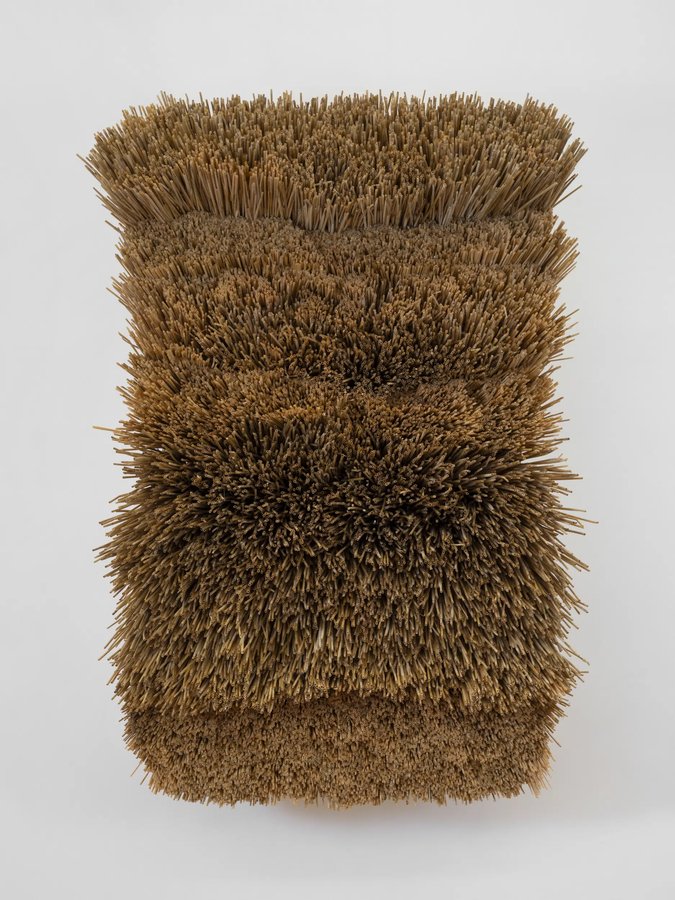
- For his second solo exhibition in Geneva, Xippas presents Une réalité insolite, an exhibition by Olaf Holzapfel bringing together paintings and works made of straw. Through these bodies of work, the artist continues an inquiry he has pursued for several decades into the ways images constitute space and how matter, in turn, determines its forms. In Holzapfel’s work, the line is never simply drawn. It can be painted, calculated, assembled, or found within the very structure of a material. In his straw works, each stalk is simultaneously material and line. Its length, resistance, and irregularities directly contribute to the composition. Surfaces emerge that appear by turns flat and deep, abstract and almost architectural. The image does notDescription
Olaf Holzapfel – Une réalité insolite
Until 31 Oct 2026
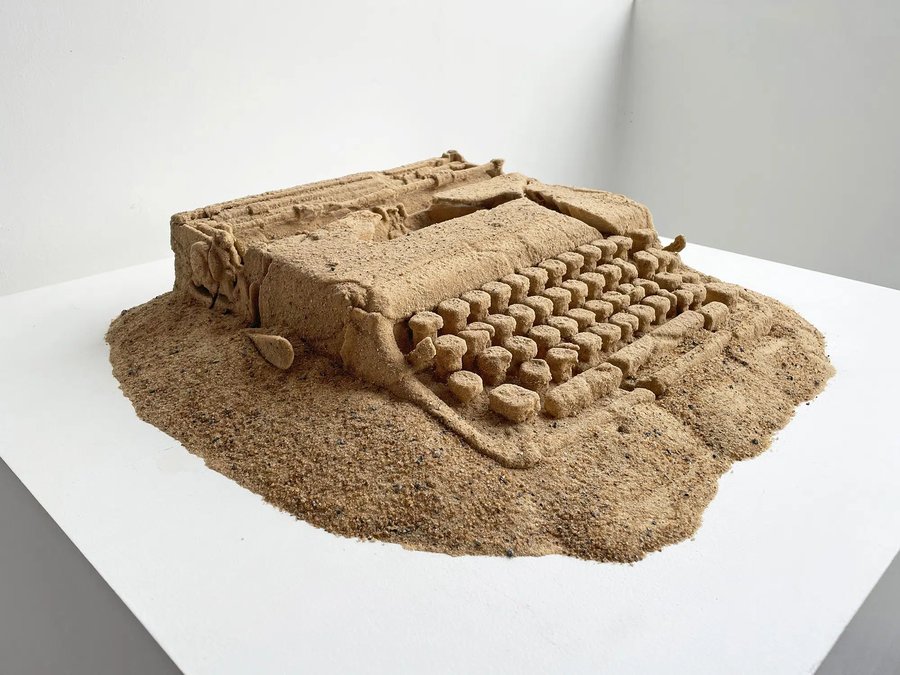
- Xippas gallery, in partnership with GALLERIA CONTINUA, is pleased to present, for the first time in France, Classroom, an installation by Argentinian artist Leandro Erlich, at the Xippas Paris space. Following his exhibition at the Grand Palais, Leandro Erlich takes over the gallery space with a selection of works, including several previously unseen pieces. The exhibition opens with a suspended house, uprooted from the ground: Pulled by the roots BOG. Our roots, our points of attachment – these could serve as the guiding thread of the exhibition, which continues with a series of works entitled Draft-Bazza : various models of typewriters covered with sand and cracked, displayed beneath glass domes as though they had only just been unearthed. Like fragile relics from another era, buriedDescription
Leandro Erlich – Entre temps
Until 14 Nov 2026
Recent past exhibitions
- For the 10th edition of the Biennale Images Vevey, dedicated to the theme "We are family!", Vik Muniz participates with his series Album. For this series, the artist collected numerous family archives belonging to anonymous individuals, found at flea markets, categorized them by subject matter, and meticulously assembled them into entirely new, large-scale compositions. The installation nostalgically recalls the practice of pasting photos into albums, guardians of memory and fosters the passing of memory between generations.Description
Vik Muniz at Biennale Images Vevey
Ended 27 Sept 2026
- Peter Halley will be showcasing his works at the Casal Solleric in Palma de Mallorca from 22 March to 25 May 2025.Description
Peter Halley and Santídio Pereira in the Inaugural exhibition
Ended 23 Aug 2026
Marie José Burki in the group exhibition More Light Video in Art
Ended 17 May 2026
- Xippas Punta del Este is pleased to present Oscillations, a solo exhibition by the renowned artist Pablo Reinoso. The exhibition brings together a selection of recent works that continue the artist’s reflection on central notions of his artistic practice: the relationship between form, function, and spatiality, as well as between energy and matter, the living and the inert. Within this group of sculptures, drawn from diverse series such as the ‘Spaghetti Benches,’ the ‘Frames,’ ‘Fire,’ the ‘Trees,’ and the ‘Harmony Chairs,’ the artist multiplies materials and formal solutions. The works engage in dialogue with one another and share a common language, while articulating distinct narratives. Wood and metal, central to Pablo Reinoso’s production, unfold here through multiple configurations: in the bench colonized by intertwined branches in Retorno vegetal, or in the vegetal expansions of Late talk left; as tongues of fire consuming themselves in Fire; in the sinuous geometries of the Desenmarcado series; or in the ‘Trees,’ where wood becomes bronze while preserving the expressive memory of its previous existence. Through these multiple movements, the works trace the trajectory of the artist’s thought. Working from wood or metal, Pablo Reinoso explores their full range of possibilities, interrogates, extends, and transforms matter to open pathways toward new formal and conceptual territories. This approach also extends to objects. While one may recognize chairs, benches, or frames in these sculptures, they constantly transcend their function to activate a network of relationships that exceeds the logic of utility. The artist thus questions the object as a system: his works inscribe themselves within a tradition and surpass it, flourishing in the multiplicity of interactions they generate, in the physical and symbolic displacements they provoke. Retorno vegetal is exemplary in this regard. This wooden seat is entirely enveloped by branches that grow, intertwine, and expand into space. The object is thus colonized, subjected to the power of vegetal life: the wood emancipates itself from the slats and the bench’s structure to recover its organic movement—a growth previously interrupted. Belonging to the ‘Spaghetti Benches’ series, central to the artist’s production, this work fully embodies its meaning. Often presented in natural or urban environments, these sculptures constitute above all a tribute to the ‘intelligence of plants,’ following the formulation of Stefano Mancuso. The curves traced by the artist in wood or metal unfold like the many paths taken by the natural world to ensure its growth and survival. In the ‘Trees,’ the artist extends this reflection, this time working from fallen tree branches recovered from the undergrowth. These are subsequently molded and cast in bronze, forming the trunk of sculptures in which steel loops outline the tree’s canopy: these metallic lines, composed of interlacings and voids, suggest an abstract and open canopy. The artist thus traces a new symbolic space onto which vegetal life is projected: he imagines an afterlife, an extension of organic life in which the tree continues its existence. The relationship to space is also fundamental in Pablo Reinoso’s work, as it is our perception and experience that are altered when encountering his sculptures. With the Desenmarcado series, wood inscribes itself within a geometric frame only to immediately escape it. Here, the artist turns toward a fundamental object in the history of art and perception. He preserves its structural function only to ultimately transcend it, carving curves that detach from the frames, propagate into space, and trace expansive movements that once again recall the growth of branches and roots. The work Inner Harmony continues in this vein. The backrest of the seat rises vertically beyond any structural necessity and then curves, once again following the undulations of the natural world. These sculptures address the viewer directly, subtly destabilizing them. Taken as a whole, the works evoke life that grows and pulses, but also decline—the end of a cycle that opens onto another. It is between these polarities that the works unfold, as suggested by the sculpture Fire. Here, wood becomes flame: the fire that burns is the very image of its own end. Our relationship with the natural world is omnipresent in these sculptures, which testify both to the force of life and to the exhaustion of resources. In this context, Pablo Reinoso suggests possibilities, alternative paths, while underscoring the bonds that unite all forms of life. His works propose balances that they immediately call into question: between tensions and resolutions, they trace alternating movements that unequivocally affirm the power of life.Description
Pablo Reinoso - Oscillations
Ended 30 Apr 2026
- The second Hermetic principle, which establishes a relationship between opposite extremes, is the most popular formula in the book The Kybalion. This important esoteric publication, which presents knowledge, doctrines or rituals reserved for initiates or secret groups, was published in Chicago at the beginning of the twentieth century and gathers the teachings of the mythical Hermes Trismegistus, related to both the classical and modern Hermetic tradition. This secret aphorism, which has transcended the passage of time, reminds us in its moral that opposites are connected through a deep dependence that keeps them closely united. The exhibition Heaven and Earth does not seek to materialize or disseminate through a selection of works by contemporary artists any type of esoteric thought; rather, it seeks to project the sensation of a concordance between what is different or distinct, something that the poetic image of the correspondence between heaven and earth seems to perfectly embody. In this sense, the relationship between heaven (that which is above) and earth (that which is below) serves as a poetic platform to present a series of artists diverse in their projects, discourses, strategies, forms and materialities, who in some way are interested in these two elements so different yet intimately connected. We understand earth as the planet we inhabit, but the word also designates a material substance or, according to Empedocles in classical tradition, one of the four roots, or one of the five elements according to Aristotle. Later, this classification was used in the medicine of Hippocrates, as well as in esotericism and astrology. Likewise, heaven, which could be related to the element or root of air, is projected as its perfect opposite: if earth is hard and dark, heaven is light and transparent. However, from a scientific point of view, the holistic dimension between these opposites is evident, since what we call heaven is defined by the atmosphere, that is, the layer of gases (generically called air) that surrounds our planet and makes possible, thanks to its protective action, the existence and development of life on it. In this sense, the relationship between this system of gases and its dynamics, which constitute the atmosphere, directly influence nature and human life in its multiple cultural aspects such as the economy and politics.Description
Heaven and Earth
Ended 30 Apr 2026
- The first group presents clusters of faces emerging from a dense pictorial field. Each canvas reveals a small society of figures that overlap, conceal and merge with one another. The portraits arise from a surface of smeared, poured or knife-spread paint, where the figure appears only to waver again, caught within a material that seems both to reveal and to engulf it. Each face is constructed from nine black circles of varying size, often overlapping, which form the elements of the face. This structure echoes Dante’s Divine Comedy, where both Paradise and Hell are organised into nine spheres. In Dante, these orbs are inhabited by saints and sinners; in Tušek’s paintings, each face appears to contain its own mixture of vices and virtues. While each figure possesses its own complexion, all share the same space, that of the canvas, and the same structural logic, that of the circle. This coexistence can be related to the concept of biocenosis formulated by the biologist Karl Möbius. In his studies of oyster beds in the nineteenth century, Möbius showed that one must consider not an isolated species but the entire community of organisms sharing and interacting within a given environment. The faces painted by Tušek thus form a kind of pictorial ecosystem, a network of individual presences coexisting within the same visual field and structured by their relationships. Mitja Tušek (born in 1961 in Maribor, Slovenia) is a Slovenian artist who became a Swiss citizen and has been based in Brussels since the early 1990s. He studied at the École supérieure d’art visuel in Geneva in the 1980s and developed a demanding painterly practice that explores the limits between figuration and abstraction. Through processes of layering and erasure, he constructs dense surfaces in which the image emerges, disappears and transforms. His work has been presented internationally since the early 1990s. He exhibited at Galerie Nelson in Paris in 1991, participated in documenta IX in Kassel in 1992, and presented the exhibition Quelconque at the Fundació Joan Miró in Barcelona in 1993. He later exhibited at the Museum of Modern Art Oxford in 1998 and at Kohn Turner Gallery in Los Angeles in 2000. More recently he presented Wait and See at La Centrale for Contemporary Art in Brussels in 2025. His works are held in major public collections including FRAC Poitou-Charentes, FRAC Bretagne, MAMCO Geneva, the Dhondt-Dhaenens Museum in Belgium and the Bonnefantenmuseum in the Netherlands.Description
Mitja Tušek Avec omega, pomme, haricot, cornichon, rien, bouteille
Ended 25 Apr 2026
- Xippas Gallery is pleased to present a solo exhibition by French artist Yvan Salomone, bringing together a selection of recent works. Mastering the watercolor technique with great precision, the artist transforms peri-urban sites into shifting landscapes of constant format. Presented in a rigorous hanging, the works create a space for reflection, inviting the viewer’s gaze to wander. "A man moves by bicycle, by car, on foot. He roams through ports, outskirts, dunes, holiday residences, industrial zones. Sometimes he stops. A wall, a platform, a shed, a façade, or an isolated tree holds his attention. He experiences, delineates, traverses, and distills reality. A water tower cutting through the landscape like an aluminum vertebra, a faded toy-truck made monumental, a glass curtain invaded by a plant, two houses under construction becoming messengers of an intimate echo, a surface crushed by the autumn sun, dark despite its brilliance. These are simple objects, visible to all. Yet this ordinariness cracks, turns into a threshold, an enigma, a tipping point. It asserts itself. Before these blocks, ancient images rise up: battles, a flood, a tomb, a prayer, a hunting myth. The present scene changes status. Under the gaze it becomes a retention, a late variant of peripheral images. What is seen is caught in a chain. The watercolor work begins there. The format is always the same. The surface opens, yet remains measured. Certain areas are left bare. Rectangles, planes, paper reserves. Color advances patiently in successive layers. The chaos of the motif is held back, allowing another to appear, simpler, more legible. Light comes from what has been spared. The ‘I’ circulates: a child in a distant colony, a grandson in a kitchen, a reader of a book, an adult at the edge of a roundabout, a port, a beach, a parking lot. Memories of films and music cling to objects. At times, humor surfaces. Elsewhere, unease: flood, darkened horizon. Nothing is resolved. Objects remain partly mute. Images incomplete. Painting does not close the enigma. It merely organizes a space where reality, memory, light, and darkness meet, without conclusion." Y.S.Description
Yvan Salomone quand même
Ended 18 Apr 2026
- Erlich’s installations resemble stage sets where familiar, everyday spaces – an elevator, a classroom, a train ride – suddenly start to behave in unexpected ways. The exhibition moves from quiet wonder to active participation: the viewer is not just a bystander but an essential part of the artworks. Illusions that defy the rules of architecture, gravity, and perspective unsettle our sense of reality and raise questions: Can we trust our senses? And what about the things we believe to be true? The journey begins with the dreamlike work Cloud and continues through Sidewalk, Lost Garden, and Elevator Maze, culminating in the iconic Bâtiment where a Helsinki Art Nouveau façade turns into a surreal playground. Here, people appear to float weightlessly and walk on walls – and eventually, the viewer becomes part of this magical scene. From the artist’s perspective, these works can be seen as a collection of short stories, each with its own narrative. Erlich explores reality through the lenses of seeing, perception, and interaction, creating installations that challenge us to look at the familiar with fresh eyes. In the exhibition, these stories intertwine into a whole that transforms our understanding of what the world around us could be. It offers space for wonder, play, and imagination and reminds us that reality can sometimes be stranger than fiction.Description
Leandro Erlich's exhibition at Amos Rex, Helsinki
Ended 6 Apr 2026
- The National Museum of Modern Art in Madrid is dedicating an exhibition to Pablo Reinoso, curated by José Jiménez. This major exhibition offers an extensive overview of the last twenty-five years of the artist’s practice. Along the exhibition trail, we encounter a variety of works that trace the path of his life: overflowing benches, tools that take on new functions, frames that detach, and sculptures born from a reflection on Thonet chairs. Installed across the Museum’s first two floors, the exhibition creates a dialogue between the artist’s sculptures and the Museum’s permanent collection, reflecting his ongoing exploration around the notions of function, materiality and space, inviting viewers to reconsider their ways of interacting with art and experiencing their environment.Description
Pablo Reinoso solo show
Ended 15 Mar 2026
- The Iberê Camargo Foundation is dedicating a major solo exhibition to Marco Maggi, unfolding across all levels of the institution and engaging in a dialogue with the iconic building designed by Álvaro Siza Vieira. Curated by Patricia Betancur, The Economy of Attention is a reflection on the ways in which attention is constructed and directed. Maggi’s works form a visual system of minimal, almost imperceptible structures. They feature micro cuts in paper, and incisions on acrylic or graphite, which only seem to exist thanks to intangible light and shadow. In his proposals, both the exhibition titles and those of his works usually conceal a meta-meaning. The ambiguity of the title of this installation is not a lack of clarity but a critical tool situated on a threshold of deliberate meaning. On one hand, it evokes circulation, management, and the exchange of a scarce resource (economy); on the other, perception, sensitivity, and the capacity to focus (attention). The experience of the exhibition unfolds in the intermediate terrain between these two poles. It does not designate univocally but opens a field of tensions that each visitor must negotiate along their path. The exhibition is accompanied by a catalog.Description
Marco Maggi solo show
Ended 15 Mar 2026
- An exhibition by Matthias Sohr. "There are desires of mine at work that other people might regard as contradictory. On the one hand, my wish is not to add much to things that already exist. On the other hand, I want to author. I consider this contradiction as constitutive of my drive to operate small changes within existing social tissues that I have access to. My coming out as an author hasn’t made as many waves as other coming outs, for instance, being gay or being an artist. It’s a history of gradual changes, not unlike queering things, myself, texts, contexts. Not adding much to things that already exist is, for example, simply presenting the names of the artists participating in the exhibition "Access All Areas" that I am putting together for Xippas Geneva. Operating small changes means making more of the ground floor of the Geneva branch of Xippas accessible to more persons with and without reduced mobility. Please note that the gallery’s restroom is not accessible to persons with reduced mobility." – Matthias SohrDescription
"Access All Areas"
Ended 7 Mar 2026
- Xippas is pleased to present Magenta, a solo exhibition by Belgian artist Alain Biltereyst (b. 1965), bringing together a selection of recent works. Magenta, the title of the exhibition, refers to the Boulevard de Magenta in Paris, which the artist passes on his way to the gallery. Drawing inspiration from the visual environment of the city, Biltereyst translates familiar elements—such as signage, logos, grids, and markings—into abstract compositions on wooden panels. These components form the basis of a distinctive visual language, articulated through geometric forms and a restrained palette of vivid, primary colors. The exhibition brings together thirty small-format works, presented with careful precision. Each piece stands on its own, yet together they read like a visual record — an alphabet of moments. Magenta also refers to a key color in the artist’s practice. Magenta is often applied as the first layer, subtly causing the overlying color to shine. Layered surfaces, traces of tape, and visible brushstrokes reveal the artist’s process, emphasizing gesture and materiality. Working with no more than two or three colors at a time, Biltereyst frequently alludes to the omnipresence of logos and commercial imagery, reflected in his recurring use of blue. The relationship to the city is further explored in a video included in the exhibition. Composed as a sequence of still images, the video assembles fragments of the urban landscape—advertising panels, subway graphics, ventilation grids, and markings on the ground—captured as visual notes. These everyday forms, drawn from the world of design, bear traces of modernist influence and circulate endlessly within contemporary consumer culture. By transforming this familiar imagery into abstract forms, Biltereyst reveals how it subtly infiltrates our lives, offering serenity and assuming a role once reserved for landscape painters. At the same time, his work takes a democratic approach to making art, bringing everyday images into painting and breaking down the traditional gap between ‘high’ art and daily life. Although his paintings may formally recall modernist abstract movements concerned with pure form, they remain closely connected to everyday reality.Description
Alain Biltereyst Magenta
Ended 28 Feb 2026
- These paintings continue to explore spaces of ambiguity and uncertainty. Although certain visual elements or the presence of some forms may suggest a renewed possibility of representing nature, the landscape, or the density of the native forest, once again nothing truly seems to confirm that figurative intention. All that exuberant unfolding of forms and colors never quite crystallizes into elements that might suggest a narrative we could somehow unravel or analyze. These works seem to fold in on themselves, absorbing every word that attempts to describe them, while at the same time projecting a kind of beauty that language is incapable of articulating. Though the artist continues to explore the materiality of painting, her use of the ancient technique of tempera allows her to create a subtly mineral surface that also becomes a metaphor for the tireless pursuit of balance. Everything these works display escapes the written word. The paintings produced by Rita Fischer in recent years appear as a natural promise: that in the future we will invent a new language containing the most precise and equitable synonyms. In that sense, perhaps everything written up to this point seems a vain exercise in rhetoric; nevertheless, so as not to surrender to the defeat and impotence of writing, let us recall Michel Foucault’s formula: the relationship between language and painting is an infinite one. To make up for language’s inadequacy in relation to these paintings, we once again turn to the equally inexhaustible tradition of ekphrasis, where everything is pure narrative fiction. Thus, this text could end by returning to its beginning: the deep and hermetic beauty of these works unfolds as an infinite offering—a universe where beauty, morally perfect, is equitable because it is the perfect image of nature, that is, of biological geography, where life and death are eternally intertwined and where culture, with its destructive language, cannot enter. An undefined space, without sky or earth, inhabited by the infinite pulse of existence that endlessly renews itself—offering us, in this way, the ultimate experience of the Sublime. Nature as a despotic yet humble divinity, eternally awaiting us in silence.Description
Rita Fischer Open Skies
Ended 21 Feb 2026