Berlin
Zilberman Gallery
On now
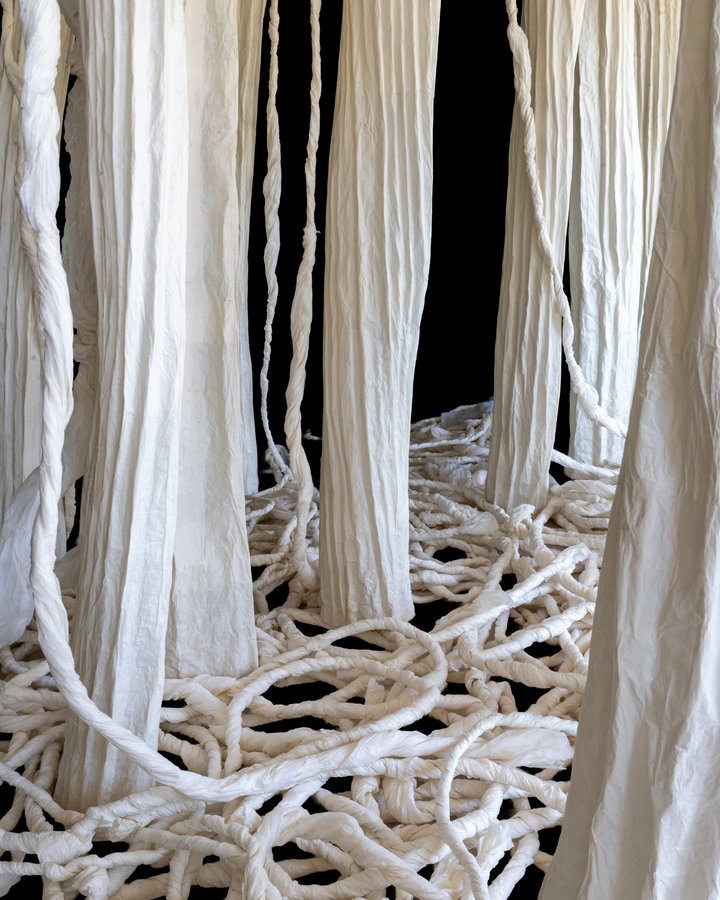
- For this exhibition, the artist has created large-scale installations using paper, wire, and light. Transcending cultural and geographic boundaries, she addresses subjects ranging from historical and mythological references to issues of the present day. Over the course of several decades, her working materials have evolved from heavy terracotta to delicate paper, from stuffed bodies to empty shells. Her new works revolve around various questions touching on how relationships emerge, where they lead, and what is transmitted or altered within them. Such pathways intertwine on the micro- as on the macro-scale, in offshoots and nerve tracts, in thoughts and cultural traditions. They reach out in multiple directions. Semantic ambivalences and shifts open Köker’s work up to diverse interpretations. Materials, forms and significances remain in motion and enter into ever-evolving relationships. Azade Köker borrowed her exhibition title, Stolon, from botany. A stolon is an offshoot of the mother plant that grows, not into the earth, but along the ground. From its nodes grow roots and new stems. The stolon nourishes the young plant until it is mature enough to provide itself with water and light; then dies. Reed corals also build stolon-like webs on the ocean floor, and from these new polyps emerge. Plants like corals remain tied to their place in the earth, yet extend beyond it into their surroundings. For Köker, this suggests associations with notions of sharing, branchings and life in a group. Her exhibition investigates the ambivalence of ties. They support but also grip tight. The word "hold" can mean either of these things. But things that hold are also permeable: a net consists more of holes than of knots or intersections. Self-definition and gender, work and social ties, the entanglements of human life and nature, all belong to the spectrum of themes that have surfaced again and again in Azade Köker’s work for five decades now. In her early terracotta sculptures, we see the figure of the woman as a recurring motif – abstracted in Frau mit Schleier (Woman with Veil, 1978) and with societal-critical features in Akkordarbeiterin (Woman employed for Piece-Work, 1987), where a female worker’s fragmented body merges with machine-like elements. This sculpture turns our attention to the conditions faced by women recruited in Turkey for firms in West Berlin. Köker has worked with paper since the 1990s, and describes it as a skin, permeable and vulnerable. Crumpled and folded, it stores the traces of its making. The body itself is absent; what remains is a transparent, light shell, whose innards must be supplied by the viewer. In the first room of the exhibition stands the installation Schwankende Säulen (Tottering Columns, 2025–26), a forest of thirteen tall paper columns. The paper is wound around the columns like bark, and vertical folds suggest fluting. Transparent threads attach them to the ceiling, and they move with every breath of air. From the top of each column, a long strand of twisted paper falls to the ground and intertwines with the others to form a web. The column, for Azade Köker, is a double image, trunk and figure. For a long time already, she has explored the caryatid, the female figures bearing beams in architecture. Their burden there appears all elegance and posture; the effort of weight-bearing remains invisible. Köker’s columns support no roof. At the place where a capital would normally shoulder its weight, the strand of paper growing out of the column eludes it and, like a stolon, tries to render new life possible on the floor. With this image, nurturing takes its place alongside bearing as a bodily and social work, which, while essential, often goes unnoticed. The burden has not vanished, it has only changed its form. The bearing figure has become one tied in to its neighbors: a form which supports through its relationship to others, while these relationships also tie it down. Works made of wire and light pick up on this web. Köker uses a web of wire, such as is employed in manufacturing coops, fences, and garden elements – a material that contains und separates. The artist shapes it into synapse-like branchings, which recall the points of contact among nerve cells. The wire lends stability to fragile forms, while itself retreating into near invisibility. For strips of light traverse the room and illuminate the darkness. That which is microscopic in the body fills the space; at the same time, the structure recalls a web of offshoots, which spread out, branch off, and create new relationships. In Im Netz des Ich (In the Web of the Self, 2025–26) hangs a large ball of paper in a net of intertwined strips of paper. The ball bears a red inscription spelling "ICH" (I or ego or self). The net holds it, and holds it tight. Without the net, it would fall. Our language knows both nets – the safety net that catches and saves from harm, as well as the trap net that captures and won’t let go. Society’s net can be both. "Caught" and "Captured" here lie right next to one another. The video work Stagnant Motion (2013) shows the feet and legs of a woman from behind, as well as the red seam of her skirt. Her steps venture falteringly forward, then back and to the side, without fixing on a direction. The title names both the stagnancy and the motion, and the work leaves open the question of which prevails in the moment. Stolons, too, move in this way. They do not take off running, they shift. Azade Köker’s small-format collages show frontal figures constructed of patterned paper. Arms and bodies reach out in branches and roots, faces appear in the fabric, threads are loosely sewn on. Titles such as Der Spinnenbaum (The Spider Tree, 2026), Krabbenfrau (Crab Woman, 2026) and Im Flug mit den Vögeln (Flying with the Birds, 2026) associate human beings, animals, and plants. The figures are not contained within clear contours, they bleed into each other. None of the beings exists in and of itself, each one is in a state of evolution connected with others. Azade Köker’s exhibition shows a body of work in motion. Every form is held and tied in – but by what it is often hard to see. The forms do not end on their edges, but reach out, like steps that explore the floor, or offshoots that keep growing.Description
Stolon
Until 14 Nov 2026
Recent past exhibitions
- A site-specific body of work that engages with the decorative surface of a tile stove in an old-Berlin building. The artist recasts one of the tiles and reinterprets it, leaving casting seams visible and creating peep-holes that reveal fragmentary views of bodies in bondage and broken skin.Description
Done with evil-doing
Ended 3 May 2026
- Zilberman Dialogues, which seeks to establish a connection between the gallery’s exhibition spaces in Istanbul and Berlin, is pleased to announce There and Now, and After?, presented in parallel with İz Öztat’s solo exhibition Vorbei mit der Übeltäterei / Done with evil-doing at Zilberman | Berlin. A selection of Öztat’s recent works presented in the Berlin exhibition, will be on view from February 14 to April 22, 2026, on the second floor of Mısır Apartment. In the selection of works exhibited in Istanbul, Öztat engages with traditional genres and themes of German-language literature, such as Kasperle puppet theater and the Faust myth, to explore how they are anchored in collective memory, co-opted by national ideologies, and continue to shape norms and modes of conduct in the present day. In so doing, she raises questions about artistic agency and complicity, obedience and disobedience, as well as demonization and punishment. The triptych Studies for Faustian Bargain (2026) draws upon historical engravings and wood-cuts on the Faust legend, in particular illustrations to Goethe’s Faust. The various panels show the scholar in his study, as well as Mephisto, devils, and other allegorical motifs. Various hands intervene in the scenes – pointing, seducing, directing – as in a theatre of marionettes, thus representing Faust’s actions as directed from above and without agency. Faust moves between a thirst for knowledge, a vulnerability to influence, and abettal. Characteristic of a particular iconography that İz Öztat has developed over the years, red geometric forms appear. They establish viewing axes, allow for political associations, and frame Faust as a figure with limited leeway for discretion. The red triangle re-appears in the video Here and Now, and After? (2025), in a humorous way, as the red, inverted triangle nose of a disobedient puppet. As a puppet play for the camera, this work deals with national narratives, emphasizing what they leave out and repress. Conventions from the Kasperle theatre, which has historically been a site of political satire, as well being instrumentalized as a pedagogical and ideological medium, are intertwined with elements of Karagöz shadow plays. The show’s action develops from the playing out of three contractual relationships: the Faustian pact with the devil, the artist’s pact with the state, and the negotiation of the desire to become a puppet. In these exchanges, consent, refusal, and negotiation – and thus questions relative to artists’ power to act, the institutional conditions of their work, and their accountability – become visible. While certain figures enter into agreements, others refuse to comply and demand justice on their own terms. Öztat also produces site-specific works, responding to the bourgeois setting of the gallery in Berlin, located in a turn-of-the-century building. İz Öztat engages with the decorative surface of the tile stove found on site, by recasting one of the tiles and exhaustively reinterpreting it. From this site-specific body of work, a selection of tiles is exhibited in Istanbul. In this series, titled Exorcism, Kasperle and devil puppets, which the audience encounter also in other exhibited works, emerge from within the decorative surface. A catalogue will be published in conjunction with the exhibition in Berlin, featuring an essay by Banu Karaca. *Adapted from the text written by Lotte Laub for the exhibition in Berlin. Translation from German to English: Darrell Wilkins İz Öztat (born 1981 in Istanbul, lives and works in Berlin) studied Fine Arts and Visual Communication Design (MA) at Sabancı University, Istanbul, and Studio Art (BA, with honors) at Oberlin College, Ohio. She was a fellow of the Berlin Artistic Research Programme (2024–25). Her institutional exhibitions include Near East, Far West, 6th Kyiv Biennial, MSN, Warsaw (2025); these walls are not here to defend us, OFF-Biennale Budapest (2025); Self-Determination: A Global Perspective, Irish Museum of Modern Art, Dublin (2023), where her work is also part of the collection; The Colony, Schwules Museum, Berlin (2018); Sharjah Biennial 13 (2017); Land without Land, Heidelberger Kunstverein (2016); and the 14th Istanbul Biennial (2015). Öztat has been an artist-in-residence at the Swiss Institute Saha Residency (2025), the Istanbul–Berlin Residency Program (2022), and SAHA Studio, Istanbul (2021). She has worked at the intersection of art and education in self-organized, institutional, and academic settings. Her academic articles, essays, and fictional texts have been published in various media.Description
There and Now, and After?
Ended 22 Apr 2026
- Zilberman | Berlin: Goethestr. 82, 10623 Berlin, 2nd floor Zilberman | Berlin is delighted to announce the solo exhibition Groundless of Neriman Polat. Following Merciless (2018) and Roofless (2023), Groundless presents the third part of an exhibition trilogy. Its parts are linked by a common suffix –less – referring to an absence: without mercy, without a roof, without land. Neriman Polat investigates in this series the progressive loss of protection, structure, and stability – physical, social, legal, and existential. Her work speaks of freedom and its endangerment, of cracking foundations, of inequality, democracy, and the attempt to gain new ground in the midst of ecological and economic crises. Neriman Polat has been active in collaborations since the 1990s – at first with the group Sanat Tanımı Topluluğu (STT), and later as co-founder of the female artist group Arada (“In Between”, with Gül Ilgaz, Nancy Atakan, and Gülçin Aksoy). She was also a member of the collective Hafriyat, a term borrowed from the construction industry, meaning “excavation” and referring to processes that reveal. In Groundless, too, Polat draws upon this practice of collective action. Her title describes not only the absence of land, but also the loss of common ground. Working collectively, sharing responsibility, and searching for new forms of togetherness shape her artistic practice. In Groundless, the walls are concrete gray, as if the outside had transposed itself to the interior. On one wall, we find a balcony, a protruding space between inside and outside, between privacy and the public sphere. The balcony attaches the house to the street, spills intimacy into the collective, and refers to the risk-fraught step out into the open, the step onto instable ground. A rose-patterned fabric hangs down from the railing – the motif of draping textiles is one that recurs in numerous photographs in the exhibition. The rose-patterned fabric, died in black and gray tones, transforms the Romantic motif into an image of loss, violence, and memory. In Polat’s works Kaybolan (Vanishing) and Unutma beni (Forget-me-not), it stands for murdered women – as an expression of mourning, but also of tenacity and hope. Hanging from the balcony, the rose becomes a resistant sign of the feminine power to act; becomes a silent monument to lives extinguished and voices silenced. Printed on one of the tulle fabrics, we can read: “sel gizli gizli, yol gizli gizli, dil gizli gizli” (secret is the flood, secret is the path, secret is the language). The words are borrowed from the folk song Gönül Dağı by Neşet Ertaş (1938–2012), a central figure of the Anatolian Abdal musician tradition, which is closely connected to Alevi-Bektashi poetry and music. Polat has added the words “yas gizli gizli” (“secret, secret is the lamentation”). The recurring rhythm of gizli – “secret” – evokes what is concealed and not expressed, an element characteristic of Polat’s work. Here, too, what is concealed is not unveiled; rather, it just shines through – as a light echo of pain, memory, and tenderness. The motif of the threshold reappears in the photograph Kayıp (Lost). A red children’s jacket hangs from a branch that reaches out over a wall into the neighboring courtyard. Our gaze falls into a narrow interior courtyard, surrounded by high walls and the rear facades of buildings with enclosed balconies and bay windows. The bright red down jacket, which once provided warmth, recalls intimacy and touch. The branch that holds it makes as it were a feeling gesture, a quiet expression of solicitude in the midst of separation and stasis. This image, too, refers to the attempt to hold onto ties, where borders appear impossible to cross. Many of the fabrics that Polat employs in Groundless come from markets – they are industrially manufactured, globally distributed materials, which promise comfort and happiness and thus betray their own emptiness. By sewing, painting over, and darkening them, Polat transforms them into vessels of lived experience. The process of darkening, as the artist says, also involves revealing. In works like Ey Özgürlük (O Freedom) or Açık Görüş (Open Visit), overpainted grid patterns recall windows, but also cells – images of isolation, but also of togetherness: every square stands alone, yet is linked in the whole. Other works refer to ecological and economic crises. In Döşemelik (Upholstery), a nearly five-meter-long black-painted ribbon of fabric unfurls from the wall into the room – an image for the sinking of the ground, for the loss of stability and of the basis of our livelihoods. In Kırık (Cracked), Polat translates the veins of a marbled fabric into dark lines: aridity, cracks, the traces of an earth that threatens to disintegrate. The images of drought, water scarcity, forest fires, and earthquakes stand for a landscape in a state of emergency. Boş filenin düşüşü (The Fall of the String Bag) and İki mendil (Two Handkerchiefs) draw upon commonplace materials – shopping nets, handkerchiefs, everyday textiles. They evoke economic inequalities, human intimacy, and crises of supplies. They bear the traces of quiet forms of resistance. In Yolda (On the Road), Polat herself embodies the Grim Reaper, a female figure of death, wandering through a wide-open, barren, almost mythical landscape in western Anatolia. At a distance, we see her walking down a path towards us, accompanied by the insistent chirping of cicadas – loud as the Furies. Death here appears as a figure of retribution and return, in a landscape that is both remembrance and premonition, haunted by the ghosts of past and future injustice. Polat’s work is characterized by the way it addresses societal power relationships, gender roles, and the conditions of visibility. It reveals how power, loss, and memory are inscribed in material traces and domestic surfaces and turns vulnerability into resistance. Her practice is shaped by caring and precision, borne by empathy and the search for collective forms of responsibility.Description
Groundless
Ended 7 Feb 2026