Strasbourg
CENTRE EUROPÉEN D’ACTIONS ARTISTIQUES CONTEMPORAINES (CEAAC)
À voir actuellement
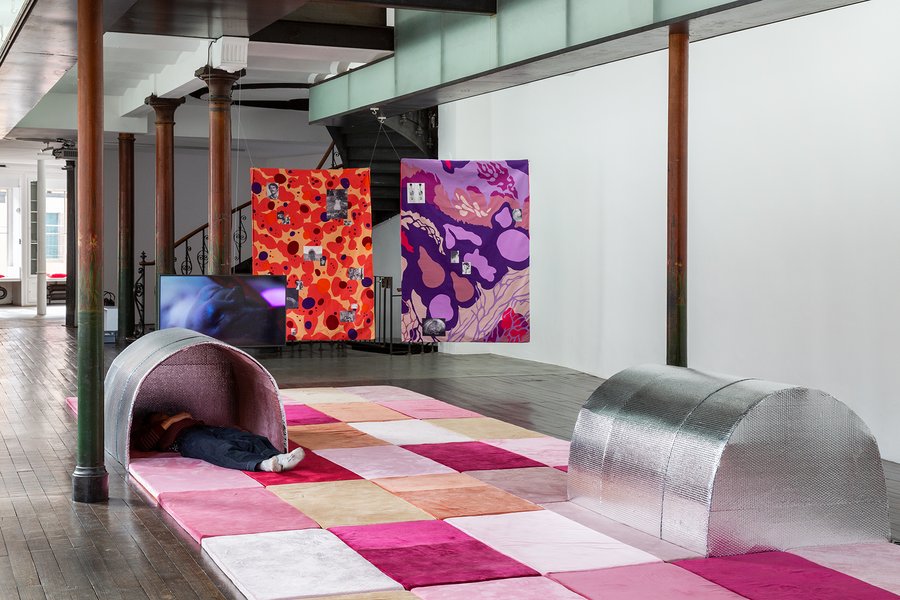
- The CEAAC, in partnership with the Musica festival, presents Crabe Chorus, a solo exhibition by artist Violaine Lochu and curated by Vanessa Desclaux. Designed as the second chapter in a programme exploring public health issues, the exhibition occupies the entire art centre. Taking its title from a body of work created in 2023, Crabe Chorus brings together pieces produced between 2018 and 2026, including a major new body of work developed in Strasbourg specifically for the CEAAC in collaboration with local volunteers. Violaine Lochu’s practice encompasses a wide variety of media: performance, drawing, video, sound works and photography, which interact within immersive installations. The works gathered at the CEAAC reflect the artist’s distinct journey through the experience of cancer, approached both from an intimate perspective and through the collective voices of those affected by the illness. In Strasbourg, through a partnership with two oncology care providers – the oncology department at Clinique Sainte Anne and Strasbourg Oncologie Libérale (SOL) – alongside an open call shared by the Haute école des arts du Rhin (HEAR), the artist engaged in dialogue with patients, caregivers and healthcare staff through individual interviews and group sessions. Outside of the medical setting, discussions and workshops focusing on the body and voice – hosted by the CEAAC and Théâtre Jeune Public (TJP) – furthered these encounters. This collaborative process culminated in a collective performance centred on the concept of protection, activated during the exhibition opening. Here, the exhibition invokes the motif of the chorus: an ensemble uniting a plurality of members and a multiplicity of voices, resisting the urge to reduce the experience of illness to an isolated ordeal or a purely medical concern. Crabe Chorus offers a multifaceted, sensitive and political reflection on cancer and its unfolding temporalities, situated along the thresholds between conventional notions of health and illness.Description
Crabe Chorus
Jusqu’au 7 févr. 2027
Expositions récentes terminées
- The CEAAC is partnering with the Aubette 1928 to present a dual exhibition by artist Florian Fouché, marking the first stage in a programme devoted to public health issues. The exhibition builds on Fouché’s ongoing artistic research project entitled Manifeste assisté (Assisted Manifesto), a broad perceptual inquiry initiated in 2020 around what the artist calls ‘assisted life’. Since 2024, he has developed this research into a multi-chapter exhibition series titled SÉCURITÉ SOCIALE PRÉLUDE, which offers an oblique exploration of the history and current transformations of public healthcare. Rather than presenting a strictly documentary reading of these themes, Florian Fouché stages the devices, architectures, and imaginaries that concretely organize assistance, accessibility, or the exclusion of bodies in public space. The fourth chapter of this series, SÉCURITÉ SOCIALE PRÉLUDE La rampe PèreMèRe, brings together installations, sculptures, films, and documents to examine how the institutional forms of care are organized for both bodies and objects in today’s society. At the CEAAC, the exhibition takes the form of an immersive installation that engages in dialogue with the Art Nouveau architecture of the building, a listed monument, addressing a central issue raised by the artist: the site’s inaccessibility for people with reduced mobility. Here, the artist deploys a reworked version of the visual language of the Aubette 1928 within a phantasmagorical scenario. The Père Cuillère, represented as both miraculous and in a state of gestation, is a central sculptural figure in the exhibition. The character evolves through an environment of inclined coloured planes, ramps, and sculptures deriving from Nicole Parent’s ‘Inclipan’ method of gymnastics and the theory of ‘oblique living’ developed by her brother Claude Parent. In this unstable landscape, somewhere between accessibility device and obstacle, bodies, whether wheeled or upright, appear caught in a paradoxical system of assistance, effort, and constraint. Nearby, in the spaces of the Aubette 1928, amid the coloured surfaces designed by Sophie Taeuber-Arp, her husband Hans Arp, and Theo van Doesburg—which were subsequently covered over in 1938 and restored for reopening to the public in 2006—the exhibition continues with the first presentation of the 2026 film Mort assistée (Assisted Death). Commissioned and produced by the Centre Pompidou – Musée national d’art moderne in Paris in the context of its closure for renovation, the film offers a phantasmagorical vision of a museum under maintenance. Through a series of filmed actions, Florian Fouché explores how cultural institutions organize the preservation, disappearance, or transformation of their artworks. The film is accompanied by sculptures, drawings, and documents related to its production, extending the reflection on forms of ‘assistance’ applied to institutions and artworks. By linking these two Strasbourg heritage sites, the exhibition creates a tension between architecture, art history, and contemporary policies of public assistance. Between impossible accessibility, bodies in motion, partial reconstructions, and suspended cultural institutions, Florian Fouché proposes a critical and poetic exploration of the visible and invisible infrastructures that organize both assisted life and, sometimes, assisted death.Description
Sécurité Sociale Prélude La Rampe Pèremère
Terminée le 6 sept. 2026
- Traduttore, traditore is an exhibition by Alexandre Caretti at the CEAAC in Strasbourg in 2026. The exhibition features a series of photographs capturing various aspects of the artist's work and creative process.Description
Visite commentée de l’exposition Traduttore, traditore
Terminée le 6 sept. 2026
- À deux occasions, la visite du premier week-end du mois se transforme en double-visite entre le CEAAC et l’Aubette 1928, en compagnie de Florian Fouché. Une belle opportunité de voir comment l’artiste a investi ces deux lieux et d’appréhender la manière dont les deux parties de l’exposition dialoguent l’une avec l’autre.Description
Doubles-visites CEAAC x Aubette 1928
Terminée le 5 sept. 2026
- Clément Bedel (né en 1993 à Strasbourg) est un peintre français basé à Vienne, en Autriche. Après avoir obtenu un Master en 2017 à l’École Nationale Supérieure d’Art de Nancy, il a poursuivi sa formation à l’Université des Arts de Belgrade, où il a vécu et travaillé de 2016 à 2020. Ses expositions personnelles récentes incluent la Galerie Kandlhofer, Vienne (2025) ; le WUK, Vienne (2024) ; Eisenwerk Frauenfeld, Suisse (2023) ; et la Galerie Hestia, Belgrade (2023); U10ArtSpace (2021). Clément Bedel a participé à de nombreuses expositions collectives en France, en Allemagne et en Serbie, et a effectué des résidences à Istanbul (2020) et à Leipzig (2019). Pendant sa résidence, Clément Bedel prendra l’architecture de Prague et de la République tchèque comme point d’ancrage pour nourrir sa peinture fondée sur la réécriture et les traces du temps et de notre passage.Description
Clément Bedel
Terminée le 8 mai 2026
- Curator: Camille Richert (https://ceaac.org/en/artiste/camille-richert/) With the artists: Claude Dugit-Gros (https://ceaac.org/en/artiste/claude-dugit-gros/) , Julie Luzoir (https://ceaac.org/en/artiste/julie-luzoir-3/) and Pascaline Morincôme (https://ceaac.org/en/artiste/pascaline-morincome/) The exhibition Hope for change. Hackney Flashers, from London to Strasbourg is held in celebration of the 50th anniversary of the formation of the London feminist collective Hackney Flashers. Founded in 1975, the group of nine women from Hackney and the surrounding area set out to highlight the gender pay gap, the lack of public childcare facilities in England and the sexist stereotypes perpetuated by the media and advertising, which reinforced the marginalised, passive and essentialised position of women. Through a series of posters and slides, the Hackney Flashers aimed to denounce inequalities and clichés. To this end, they employed a variety of techniques borrowed from agitprop, such as photography, collages, photocollages, photomontages, drawing and slogans, to produce works in their spare time on a voluntary basis. Their projects employed strategies that were ethical and political, but also critical of modern art: single-sex practice, unsigned works, refusal to accept the status of artwork, displays confined to public spaces and venues dedicated to defending social rights. The exhibition at the CEAAC draws on the collective’s guiding principles to examine the situation of women and mothers in Strasbourg today. For this purpose, three artist-researchers – Claude Dugit-Gros, Julie Luzoir and Pascaline Morincôme – were invited to continue the Hackney Flashers’ visual investigation and create new work that focuses on the current situation of women’s employment in Strasbourg, public policies in favour of parents, and visual and discursive representations of women. The aim is to demonstrate the continued relevance of the Hackney Flashers’ work, whose subjects of criticism and revolt remain topical in 2025.Description
Hope for change. Hackney Flashers, from London to Strasbourg
Terminée le 8 mars 2026
- Lauréats 2024 du programme d’échange entre le CEAAC, MeetFactory et l’Institut français de Prague, Kévin Blinderman (1994) et Flora Citroën (1990) collaborent régulièrement depuis leur rencontre en 2013 à l’École nationale supérieure d’arts de Paris-Cergy. Aujourd’hui, Flora Citroën est artiste et chercheuse et vit à Paris, tandis que Kévin Blinderman, artiste et commissaire, partage son temps entre Berlin et Paris. En 2023, les artistes entament leur collaboration à la résidence de Lindre-Basse du CAC – la synagogue de Delme. Si leurs pratiques sont bien distinctes, iels se rejoignent autour d’un intérêt commun pour les figures littéraires et artistiques marginalisées, ainsi qu’une sensibilité pour les trajectoires de vies marquées par le déplacement, l’exil et le drame personnel. C’est le cas de Milena Jesenská (1896, Prague-1944, Ravensbrück), figure du journalisme en Tchécoslovaquie dans les années 1920, à laquelle iels s’intéressent pendant leur résidence de trois mois à Prague, en nourrissant l’objectif de tenter d’en dresser un portrait au-delà des zones d’ombre laissées par l’histoire. En s’appuyant sur les archives existantes de la vie de Milena Jesenská, les artistes ont également exploré les interstices du récit, laissant peu à peu place à la fiction. À l’occasion de leur exposition au CEAAC, Kévin Blinderman et Flora Citroën présentent Milena Jesenská. La Voie de la Simplicité, un titre qui renvoie à la traduction française du premier recueil d’écrits (sur l’amour, le mariage, l’amitié, la fidélité, la mode, l’émancipation et même le sens de l’existence) publié en 1926 par Milena Jesenská, mais aussi à sa transposition par les artistes sous la forme d’un long-métrage. La durée du film coïncide avec celle de la lecture intégrale du livre, brouillant ainsi les frontières entre spectateur·ice et lecteur·ice et inscrivant l’œuvre dans un geste de traduction élargi. La mise en abyme créée par les images du tournage lui-même en train d’être filmé renforce cette dynamique de déconstruction, de reconstruction et de transmission du récit, tandis qu’une jeune femme et une petite fille rejouent l’histoire de Milena et de sa fille Jana.Description
Milena Jesenská, La Voie de la Simplicité
Terminée le 8 mars 2026
- Chaque premier week-end du mois, l’équipe de médiation du CEAAC vous propose une visite commentée de l’exposition Hope for change . Venez découvrir le collectif féministe Hackney Flashers et comment leur travail a inspiré les artistes invitées Claude Dugit-Gros, Julie Luzoir et Pascaline Morincôme. Tout public, gratuit, sans réservation Durée : 1h environDescription
Visites commentées
Terminée le 1 mars 2026
- Chaque premier week-end du mois, l’équipe de médiation du CEAAC vous propose une visite commentée de l’exposition Hope for change. Venez découvrir le collectif féministe Hackney Flashers et comment leur travail a inspiré les artistes invitées Claude Dugit-Gros, Julie Luzoir et Pascaline Morincôme. Tout public, gratuit, sans réservation Durée : 1h environDescription
Visites commentées avec la commissaire
Terminée le 1 mars 2026
- Après avoir découvert l’exposition Hope for change , les enfants sont invités à explorer les thématiques développées par les Hackney Flashers et par les artistes Claude Dugit-Gros, Julie Luzoir et Pascaline Morincôme au cours d’un atelier de pratique artistique. Celui-ci permet d’approfondir la visite par le geste et offre une approche ludique de l’art contemporain.Description
Ateliers enfants (6 – 12 ans)
Terminée le 25 févr. 2026
- © Graphisme : Julie Luzoir À la manière des Hackney Flashers, Julie Luzoir s’amuse à détourner un incontournable jeu de hasard : le bingo ! Ici, aucun numéro mais pas moins de 90 tâches domestiques non rémunérées que l’artiste a récolté autour d’elle. Laissez tourner la roue, remplissez les grilles de ce drôle de Bingo et gagnez un maximum de lots ! Tout public, gratuit, sur réservation : public@ceaac.org Dans la limite des places disponibles (max. 50 personnes) Tarif des grilles : Grille de riche = 5€ ou plus Grille classe moyenne = 3€ Grille galère = prix libre Les bénéfices finaux (non réinvestis dans des lots) seront reversés à une association.Description
Le BINGO de la double journée
Terminée le 21 févr. 2026