Wolfsburg
Kunstmuseum Wolfsburg
À voir actuellement
- Was bedeutet Zuhause und wo finden wir es? Dieser Frage widmet sich die Ausstellung Home Beyond Places. Perspectives of the Young Generation, ehrenamtlich kuratiert von der Young Generation, dem jungen Freundeskreis des Kunstmuseum Wolfsburg. Sechs Künstler*innen erzählen durch Fotografie, Film, Mode und Installation von Erfahrungen des Ankommens und Weggehens, von familiären Erinnerungen, Zugehörigkeit und der Suche nach einem Ort, den man Zuhause nennen kann. "Heimat" verstehen sie dabei nicht als feststehenden geografischen Ort, sondern als etwas Persönliches und Verändliches. Sie kann in Erinnerungen liegen, in Beziehungen und Gemeinschaft, in Sprache oder in einer selbst gewählten Identität. Mit Celine Ajmone Berisha, Bade Fuwa, GELA, Reyhan Kolosoglu, Ninna Laçin und Amin Poorarzhangy versammelt die Ausstellung Perspektiven aus dem Kosovo, Iran, Kurdistan, Georgien, der Türkei und Nigeria.Description
Ausstellung: Home Beyond Places. Perspectives of the Young Generation
Jusqu’au 22 nov. 2026
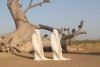
- Cristina de Middel Hierve el Agua are petrified waterfalls and sulfuric spring source located in the state of Oaxaca. Despite the growing affluence of tourists, it remains a sacred place for natives. Mexico , 2019 © Cristina De Middel/Magnum PhotosDescription
Tell Me Where Home Is
Jusqu’au 17 janv. 2027
Expositions récentes terminées
- Infos In a world at a tipping point, where the desire for destruction and the destructive is once again being celebrated quite openly, reality seems to be increasingly perceived through the filter of one’s own emotions. Political and social tensions are plunging people into a collective state of nervousness and vulnerability. On the threshold between delusion and reality, between the self and the external world, the exhibition On Nervous Grounds explores the moment when ambivalent emotions arise. According to the sociologist Eva Illouz, most emotions are a dialogue we conduct with the world. But how can such a dialogue be consciously initiated, and how can an emotional state be made visible? The artist Ariel Reichman engages intensively with human vulnerability and, through his interactive light installation I AM (NOT) SAFE, has found a way to give expression to individual experience. The light of the shifting neon lettering points to the fact that emotions are always fleeting and unstable. The artists Heinkuhn Oh and Sylvain Couzinet-Jacques remind us that emotions are mostly social in nature. They generally relate to other people or to one’s own self and manifest with particular intensity during times of existential change. The two artists offer insight into the emotional state of a young generation that feels isolated and disconnected in the face of societal militarization or a perceived lack of prospects. Their works make us compassionate by evoking empathy. Not only real situations, but also fictional or imagined ones can trigger intense emotions. The photographically staged realities of Cindy Sherman and Jeff Wall are composed in such a way that the unease of the depicted scenes is transferred to the viewers: The stylized moments, reminiscent of familiar film scenes, create an inner restlessness. The installations by Rebecca Horn and Mithu Sen leave even more room for the viewer’s own imagination. Far removed from our usual horizon of experience, they appear particularly excessive, theatrical, and, at the same time, sensually poetic. In this way, they generate a strong emotional tension and simultaneously make ambivalent emotions tangible. However, emotions are not merely an expression of vulnerability; they are also a way of dealing with it. Through radical and often ecstatic actions, artists such as Christian Falsnaes and Gilbert & George not only create unsettling situations but also expose themselves to unfamiliar experiences within their performances and consciously make themselves vulnerable. Half a century ago, Jürgen Klauke already challenged this vulnerability by transcending gender categories and traditional notions in his art. Without interpreting reality, On Nervous Grounds uses art from the 1970s to the present to explore the sensibilities of our highly emotionalized present and the place where emotions arise. Curator Elena Engelbrechter Curatorial Assistant Linus JantzenDescription
On Nervous Grounds Between Delusion and Reality
Terminée le 27 sept. 2026
On Nervous Grounds: Rebecca Horn, Kapwani Kiwanga, Heinkuhn Oh, Christian Falsnaes
Terminée le 1 sept. 2026
- Mit der Ausstellung Iryna Vorona. Im Angesicht des Krieges ist ab dem 27. Februar 2026 eine eindringliche künstlerische Position in Berlin zu sehen, die sich mit den unmittelbaren Auswirkungen des russischen Angriffskrieges auf die Ukraine auseinandersetzt. Die Ausstellung entsteht in Kooperation mit dem Kunstmuseum Wolfsburg und wird in der Kommunalen Galerie Berlin präsentiert. Zuvor war die Ausstellung im Kunstmuseum Wolfsburg zu sehen. Dort bildete sie einen zentralen Beitrag zur Auseinandersetzung mit zeitgenössischer Kunst im Kontext politischer und gesellschaftlicher Gegenwart. Die Präsentation in Berlin knüpft nun an diese Station an und führt die Ausstellung in einem neuen räumlichen und städtischen Kontext fort. Die ukrainische Künstlerin Iryna Vorona arbeitet überwiegen mit Zeichnung. In Kohle auf Papier entstehen Porträts von Kindern, Frauen und alten Menschen aus Kyjiw, ihrer Heimatstadt. Die Werke basieren auf persönlichen Begegnungen und Erlebnissen und entwickeln sich zu einem visuellen Tagebuch des Krieges. Vorona richtet ihren Blick nicht auf militärische Ereignisse, sondern auf deren Folgen für den Alltag der Zivilbevölkerung. Die Zeichnungen zeichnen sich durch eine große emotionale Dichte aus. Feine Linien wechseln sich mit expressiven, verdichteten Flächen ab. Gesichter erscheinen verletzlich, angespannt und erschöpft, zugleich aber präsent und würdevoll. Die Arbeiten vermeiden Pathos oder symbolische Überhöhung und bleiben nah an den individuellen Schicksalen der dargestellten Menschen. Gerade in dieser Zurückhaltung entfalten sie ihre eindringliche Wirkung. Neben den unmittelbaren Kriegserfahrungen thematisiert die Ausstellung auch erzwungene Migration und das Ankommen in neuen Lebensumständen. Voronas Arbeiten erzählen von Verlust, Entwurzelung und Unsicherheit, aber ebenso von Zusammenhalt, Widerstandskraft und der Hoffnung auf Frieden. Die Zeichnungen eröffnen persönliche Perspektiven, die jenseits tagesaktueller Berichterstattung liegen. Kurz nach dem vierten Jahrestag des völkerrechtswidrigen russischen Angriffskrieges auf die Ukraine setzt die Ausstellung ein bewusst stilles Zeichen. Sie versteht sich nicht als politische Analyse, sondern als künstlerische Annäherung an eine Realität, die bis heute anhält und zahlreiche Menschen betrifft. Eine vertiefende Perspektive bietet die Eröffnungsrede des Direktors des Kunstmuseum Wolfsburg, die auf seiner Rede zur Ausstellungseröffnung basiert und in aktualisierter Form im begleitenden Katalog erscheint. → [LINK text='Link zur Eröffnungsrede (PDF)' href='https://www.kunstmuseum.de/wp-content/uploads/2026/02/Beitin_Vorona_Berlin_Feb2026_ok.pdf'] Die Ausstellung wird am 26. Februar 2026 um 18 Uhr in der Kommunalen Galerie Berlin eröffnet. Zur Einführung spricht der Kunsthistoriker Christoph Tannert. Die Ausstellung ist bis zum 10. Mai 2026 zu sehen, der Eintritt ist frei.Description
Aus dem Kunstmuseum Wolfsburg nach Berlin: Iryna Voronas Ausstellung Im Angesicht des Krieges
Terminée le 15 mai 2026
- The exhibition 'Midnight Zone' by Julian Charrière explores the relationship between humans and the natural world, focusing on the impact of human activities on remote and seemingly untouched environments. The works in the show range from photographs and sculptures to large-scale installations, inviting viewers to reflect on the complex interplay between nature and culture.Description
Ausstellungseröffnung: Julian Charrière. Midnight Zone
Terminée le 15 mai 2026
- Mit der Ausstellung Enjoy the Science – Makroaufnahmen zwischen Ästhetik und Erkenntnis zeigen das Kunstmuseum Wolfsburg und das phaeno Science Center Wolfsburg erstmals ein gemeinsames Projekt. Vom 10. Februar bis 30. April 2026 ist die Ausstellung in der frei zugänglichen Lounge des Kunstmuseum Wolfsburg zu sehen. Im Zentrum stehen großformatige Fotografien des Wolfsburger Fotografen Tom Tautz. Seine Makroaufnahmen richten den Blick auf Exponate, Oberflächen und Strukturen aus dem Inneren des phaeno. Dabei lösen sie die wissenschaftlichen Objekte aus ihrem erklärenden Kontext und eröffnen neue, abstrakte Perspektiven auf Form, Farbe und Materialität. Die Fotografien bewegen sich bewusst im Spannungsfeld zwischen Ästhetik und Erkenntnis. Was im phaeno üblicherweise dem Verstehen, Experimentieren und Erklären dient, wird hier zu Bild, Fläche und Struktur. Die extreme Nähe der Kamera lässt bekannte Dinge fremd erscheinen und schafft Raum für eine sinnliche Annäherung jenseits von Funktion und Zweck. Als Kooperationsprojekt verbindet die Ausstellung zwei Wolfsburger Institutionen, die sich auf unterschiedliche Weise mit Neugier, Wahrnehmung und Erkenntnis beschäftigen. Kunst und Wissenschaft treten in einen Dialog, der weniger Antworten liefert als vielmehr neue Fragen eröffnet. Für das phaeno bedeutet das Projekt einen bewussten Perspektivwechsel. Kunst wird hier nicht als Ergänzung verstanden, sondern als eigenständige Form des Denkens, die das naturwissenschaftliche Forschen erweitert. Auch für das Kunstmuseum Wolfsburg markiert die Ausstellung eine Öffnung hin zu neuen thematischen Schnittstellen und eine Stärkung der institutionellen Zusammenarbeit in der Stadt.Description
Enjoy the Science – Makroaufnahmen zwischen Ästhetik und Erkenntnis
Terminée le 30 avr. 2026
- Infos Family, community, solidarity, and self-empowerment, as well as exclusion and persecution, are the defining themes in the work of the artist Małgorzata Mirga-Tas (born 1978 in Zakopane, Poland). Through her textile “paintings,” she connects the past and the present and tells a different, alternative story of unseen and marginalized people. Małgorzata Mirga-Tas focuses on the lives of the Romani people, Europe’s largest ethnic minority, who have been marginalized, discriminated against, and persecuted in Europe since the fourteenth century—and often still are today. Through her visually powerful combination of different textiles and patterns, she paints an intimate picture of the everyday life of the Romani, often linked to historical narratives that frequently perpetuate stereotypes as external representations. Mirga-Tas contrasts her powerful and sensitive images with the negative and stereotypical perceptions of Romani people that still prevail today. In doing so, she brings to the fore voices and stories that are otherwise rarely heard. For Małgorzata Mirga-Tas, the perspective of women in particular plays an important role—in the sense of a herstory. Thus, well-known public figures from the Romani community frequently appear in her work. Mirga-Tas, a Romani activist herself, also devotes herself intensively to the women in her immediate environment, including her friends and family members, such as her aunts and grandmother. Małgorzata Mirga-Tas’s works, some of which are large-format, are created in a collective process that begins with the material itself. The artist uses clothing and household textiles, such as curtains and towels, that she collects from her surroundings. She works with mostly used fabrics that already carry the stories of their previous owners. This lends her pictures a certain double authenticity. Together with other women from her community, Mirga-Tas carefully assembles the textiles to create her colorful works. With this exhibition, the Kunstmuseum Wolfsburg is showing the work of this extraordinary artist on this scale for the first time in Germany, including almost the entire cycle Re-enchanting the World, with which Małgorzata Mirga-Tas caused an international sensation since her appearance in the Polish Pavilion at the 2022 Venice Biennale. There, she became the first Romani artist to exhibit in a national pavilion. The exhibition was created in close collaboration with Małgorzata Mirga-Tas and is an international cooperation with the Kunstmuseum Luzern (Switzerland) and the Henie Onstad Kunstsenter (Norway). Curator Andreas Beitin Curatorial Assistant Veronika MehlhartDescription
Małgorzata Mirga-Tas. An Alternative Story
Terminée le 15 mars 2026