Lisbon
GALERIA FILOMENA SOARES
Nu te zien
- "Bread and Circuses," or "panem et circenses," is an expression attributed to the poet Juvenal that appears in his work "Satires", written between the 1st and 2nd centuries A.D. in Ancient Rome. Juvenal describes the lower classes of Roman society as corrupt, apathetic, and dependent on the bread and circuses provided by the Roman Empire. In those days, the emperor’s administration became known for distributing wheat to feed the people, while also providing spectacles for their entertainment. The expression "bread and circuses" came to be associated with politicians’ manipulation of the population, encouraging those with little interest in social issues to focus on simple pleasures such as food and entertainment. It is believed that the Roman aristocracy harbored a strong contempt for the lower classes, and the divide between the different social strata was very pronounced. The Roman amphitheater served as a stage for gladiators to combat, glorifying violence and the struggle between individuals. The state promoted various forms of entertainment, such as games, combat, and other spectacles, manipulating both the participants and the audience to promote ideals such as courage, pride, identity, and strength. These values became a means of social advancement for the people, while safeguarding and concealing the values and powers of the ruling elite. The amphitheater becomes the arena, the public space that serves the state’s authoritarianism, and the place where theater will later develop as a space for fantasy and the projection of the individual. The arena and the amphitheater thus also become spaces for political and ethical demands, and the arena is the place where barbarism is assimilated. When staged—even though it is real—it becomes distant because it happens to others and not to us. Western culture and art still exist within this arena, and are at a critical juncture for questioning themselves in the face of imminent ecological and social collapse and the transformation of their empires.Beschrijving
Pedro Barateiro | Pão e Circo / Bread & Circus
Tot 14 nov 2026
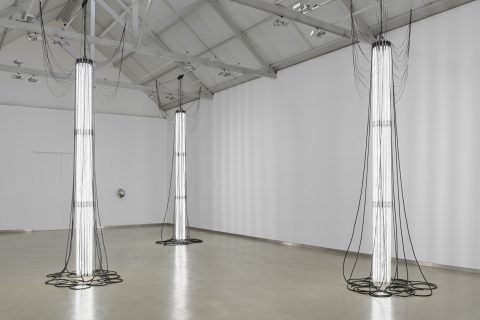
- The present exhibition by Sandra Baía brings together a group of works that, contrary to what is common in artistic practices, possess neither a formal identity nor an apparent theme that unites them. Some of the works stem from lines of inquiry that the artist has developed recurrently and systematically, such as the chromatic and mirrored wall sculptures or the polished steel sculptures ( Palma and Cabeça de Cão, both 2026), which coexist with a new group of sculptures incorporating fluorescent lights — in fact, LEDs — and rubber tubes ( Vetores Invisíveis, 2026), pointing towards a different imaginary, perhaps closer to an industrial aesthetic, both through the repetition of elements and through the industrially manufactured origin of their components. This construction of the exhibition as a divergent ensemble is, however, only apparent, because the different works stem from an interest in the way an intuitive rationale, grounded in the experience of a place, may be either a memory of the artist or the very place in which the works are installed. This ensemble can, however, be aesthetically translated into a language that is foreign to that very place. To say that this body of work revolves around Sandra Baía’s experience on the island of Príncipe tells us nothing about the meaning of the works, but it does reflect upon her working process and, consequently, upon its meaning — that of the process itself, rather than of the works in themselves; and at the centre of this process is translation, the conversion of one language into another: of a situation into an object, of one reference into something else, of the experience of a place into a constructive possibility. What remains, evidently, concealed is the process of conversion, of mutation — that is, how a sensation of a place or a memory is transformed into an object which, in turn, evokes other memories and references.Beschrijving
Sandra Baia | Cabeça de Cão
Tot 14 nov 2026
Recente afgelopen tentoonstellingen
- The term “heterotopia” was coined by the French philosopher Michel Foucault to describe spaces that contain multiple layers of meaning within themselves. What characterizes heterotopias is their ability to connect different spaces and temporalities. They can encompass overlapping realities that are often contradictory or incompatible, bringing together diverse social, cultural, and historical dimensions within a single place. Heterotopic spaces are simultaneously real and imaginary, material and symbolic. By questioning established orders and boundaries, they open up alternative spaces for thought and experience. They challenge dominant structures and norms, thereby creating spaces for reflection, shifts in perspective, and transformation. In the context of today’s world, these ideas gain particular relevance in light of growing geopolitical tensions, where competing narratives and power structures collide within shared global spaces. The climate crisis similarly produces heterotopic conditions, as different temporalities, urgent future scenarios and delayed political action, overlap and compete with one another. At the same time, exponentially accelerating technological developments, particularly in the field of artificial intelligence, are generating new hybrid spaces that integrate numerous new layers of meaning while simultaneously erasing older ones. Recent advances in space technology are opening up a new heterotopic orbit. Future space stations and possible settlements on the Moon or Mars may emerge as radically new liminal spaces, places where earthly orders, political systems, and cultural imaginaries continue in altered form or are renegotiated from the ground up. Outer space thus becomes a dimension in which the familiar and the unknown, the real and the imaginary converge in unprecedented ways. The works presented in the exhibition all revolve around moments of transition and states of in-betweenness: a collapsing glacier; a rocket launching from the jungle; dome habitats in a Mars-like landscape; a lunar crater equipped with technological infrastructure; a humanoid robot standing at the edge of the sea; an erupting volcano shaping a new landscape; a spacecraft departing into the cosmos from a romantic landscape painted at the beginning of the nineteenth century. Nothing has truly arrived anywhere. Everything is in transition; everything is leaning toward transformation. Turbulence is omnipresent. The exhibition brings together selected works from Michael Najjar’s internationally highly acclaimed series “outer space” and “cool earth,” which have never before been shown in Portugal and are presented together in this constellation for the first time. Michael Najjar (Germany, 1966) is an internationally acclaimed visual artist, explorer, and future astronaut whose work operates at the intersection of art, science, and technology. Working across photography, video, and digital imaging, he investigates the impact of technological innovation on contemporary society, addressing themes such as artificial intelligence, biotechnology, financial markets, space exploration, and climate change. His practice combines interdisciplinary research, collaborations with scientists, and firsthand experiences in extreme environments, including astronaut training, to reflect on the possible futures of humanity in a world increasingly shaped by technology.Beschrijving
Michael Najjar: Heterotopic Turbulences
Afgelopen op 12 sep 2026
Works in Dialogue | A Selection of Artworks at Galeria Filomena Soares
Afgelopen op 21 mrt 2026