Sint-Jans-Molenbeek
iMAL
Nu te zien
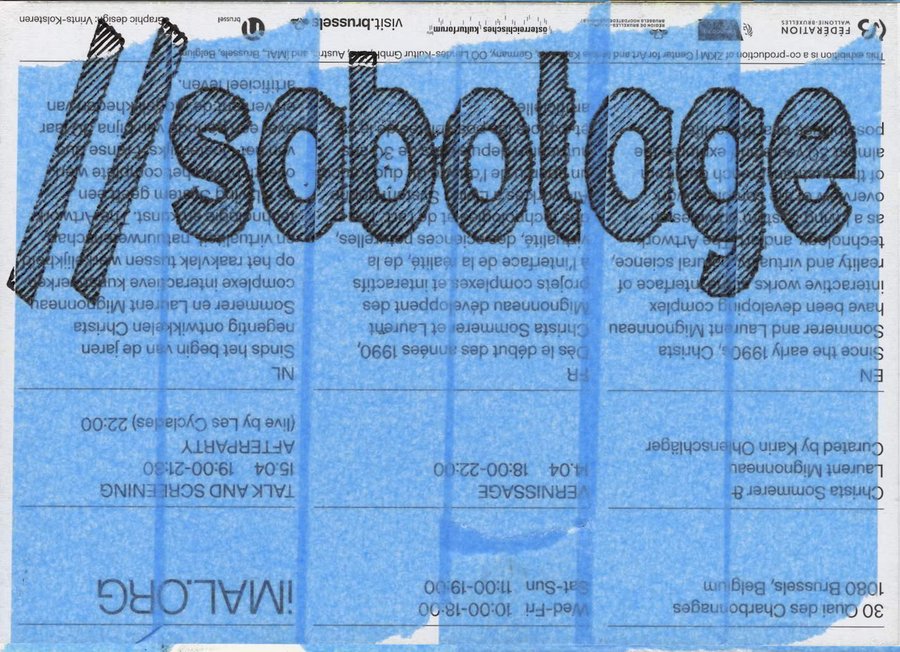
- At the turn of the 19th century, workers protested against unfair labour conditions by deliberately working badly, slowing down or degrading production, or putting machinery out of action. Today’s workers —whether they are warehouse staff or startup employees— deploy micro-resistance tactics to defy the algorithm-driven intensification of labour, exposing workplace abuses, outsmarting algorithms and organising collective pushback. Likewise, contemporary artists embrace sabotage as a tool to dismantle oppressive systems. For them, it’s a form of creative resistance, bridging historical labour struggles with modern battles against exploitation, marginalisation and democratic backsliding.Beschrijving
//sabotage
Tot 21 feb 2027
Recente afgelopen tentoonstellingen
- Toots Lab débute par un travail sur l’imaginaire de la rue, à travers le dessin individuel et collectif, puis se poursuit par la visite du mobilier déjà existant sur le quai. Les élèves développent ensuite leurs idées sous forme de maquettes en carton, frigolite ou bois, en intégrant progressivement des contraintes réelles: échelle, usage, résistance, matériaux, implantation dans l’espace public. Les ateliers ont lieu au fablab, à iMAL, où les élèves découvrent aussi les logiques de fabrication, le prototypage et certaines technologies numériques (découpe laser, impression 3D, fraisage numérique, plotters à dessin), toujours au service de leurs idées. L’accent n’est pas mis sur la menuiserie ou la technicité pure, mais sur la conception, l’utilité publique, les formes, les couleurs et les besoins réels des usagers et usagères. Des intervenant·e·s extérieurs – designers, collectifs de mobilier urbain, acteurs culturels et associatifs – viennent ponctuellement enrichir les séances par des présentations de projets existants, des retours d’expérience et des échanges avec les élèves. Ces rencontres permettent d’ouvrir le champ des possibles tout en sensibilisant aux contraintes propres au mobilier extérieur (durabilité, usage collectif, contexte urbain). Toots Lab est né d’un constat simple: les élèves occupent quotidiennement l’espace public sans toujours se l’approprier. En devenant acteurs et actrices de sa transformation, ils développent un regard plus conscient, responsable et critique sur leur environnement. En même temps et durant tout le processus, les élèves décident des éléments qu'ils et elles souhaitent proposer, ce qui leur permet de rester motivés et responsables, tout en se réappropriant la maîtrise de leur propre processus d'apprentissage. L’atelier est aussi encré dans le contexte local actuel, la nécessité du réaménagement des quais suite à des problèmes d’affaissement, et donc l'idée de son embellissement. Puisqu’une partie des quais est actuellement fermée aux voitures, de nouveaux usages peuvent y voir le jour. À terme, certains modules imaginés pourraient être produits et installés réellement le long des quais, en partenariat avec des acteurs institutionnels tels que Bruxelles Mobilité, faisant ainsi le lien entre pédagogie, création et espace public.Beschrijving
Toots Lab
Afgelopen op 17 jun 2026
- Initiated by werkleitz and co-funded by Creative Europe since 2018, the European Media Art Platform is a network of 15 leading European organisations working at the forefront of digital and media art, bio art, and robotic art. Through an annual open call, EMAP offers fully funded two-month residencies for artists. Each residency is designed as an intercultural and interdisciplinary exchange between artists and host organisations, providing an artist fee, travel support, production budget, free accommodation, and access to professional labs and facilities.Beschrijving
Fellowship Programme: call 2026
Afgelopen op 13 mrt 2026
- After Chapter I (2009), Nihil Ex Nihilo (2010) and Memory Lane (2016), Felix Luque Sanchez returns to iMAL with a new solo exhibition. Eight new creations – produced with his regular collaborators Vincent Evrard, Damien Gernay and Íñigo Bilbao Lopategui – explore different facets of our Automatic Society. Choreography and performance: Mercedes Dassy / Music: Le Motel & Ben Bertrand. "Have we not always had the deep-seated phantasy of a world that would go on without us? The poetic temptation to see the world in our absence, free of any human, all-too-human will?" — Jean Baudrillard – Why hasn’t everything already disappeared Industrial robots are designed to perform repetitive tasks with near-perfect precision. They operate without hesitation, exhaustion or loss of concentration. This is the mastery of automation, a synchronised symphony. From Taylorism to contemporary artificial intelligence, the utopia of automation has become increasingly prevalent. Having already transformed the world of industrial production, it has now taken hold of our thinking, judgement and memory. This is the age of La Société Automatique (The Automatic Society), the title of a Bernard Stiegler lecture describing the total automation of our lives. All areas of existence are merging into an invisible network of computations; digital utilitarianism is supplanting human decisions, imposing efficiency-driven logic that reduces our scope for action. Technology is becoming the invisible architect of our lives. An already dystopian present, where education that critically engages with these opaque systems is key in securing the democratic reappropriation of technology. The exhibition La Société Automatique depicts the anxiety of a post-anthropic world where machines – Sisyphuses devoid of weariness or rebellion – threaten to erase us. A universe of automatons carrying out their self-contained, cyclical work, with no human purpose.Beschrijving
La Société Automatique
Afgelopen op 15 feb 2026
- Manoah Camporini presents conveyor_contentio (2025), an in situ iteration of cognitivsculptur (2024). In this new version, the artist evokes Molenbeek's industrial past with an installation reduced to its functional minimum, where repetitive, pendular movement plays a central role. The imprecision and softness of the robotic device contrast with the expected logic of use in industrial production. What is at play here is the exploration of a different form of relationship with the machine: the relentless behaviour of the machine now coexists with humans in a mode of proximity. An interaction with the machine, rather than control over it.Beschrijving
conveyor_contentio (an iteration of cognitivsculptur)
Afgelopen op 15 feb 2026