Brussel
Galerie Michel Rein
Nu te zien
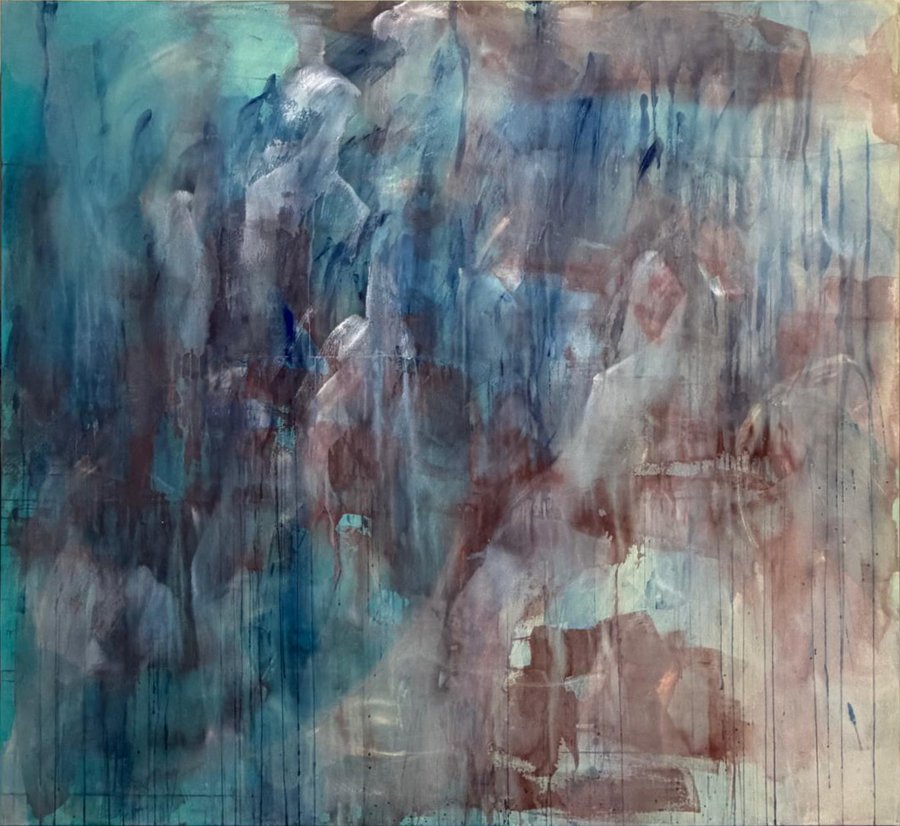
- Pour la première exposition personnelle de Nino Kapanadze à la galerie Michel Rein à Paris, des images, des formes et des questionnements qui traversent depuis plusieurs années la pratique de l’artiste géorgienne se trouvent ici inscrits dans une même trajectoire. Abstractions et figurations se côtoient dans un ensemble de peintures qui fait apparaître des continuités échappant à une lecture strictement sérielle ou chronologique, pour révéler plutôt une circulation souterraine des formes et des images, capables de se déplacer, de se transformer et d’infléchir sans cesse la direction du travail. Ici, Nino Kapanadze explore plus profondément les possibilités de la peinture, jusqu’à éprouver la nécessité d’en reformuler chaque fois le langage. Pourtant, considérées depuis la distance du présent, des recherches qui semblaient emprunter des directions distinctes laissent entrevoir une continuité plus profonde, comme si certaines images n’avaient jamais véritablement disparu, mais avaient continuer d’agir silencieusement sous la surface de la peinture, pour affleurer à nouveau, transformées, portant avec elles quelque chose duBeschrijving
Nino KAPANADZE - inertia
Tot 28 nov 2026
Recente afgelopen tentoonstellingen
- There is always, in Hugo Ruyant’s painting, a slight displacement. Nothing is demonstrative. Everything is a matter of thresholds. The forms remain recognisable, yet their apparent certainty begins to waver. The symbol is never simply stated. It emerges, almost imperceptibly. Colour structures this space of uncertainty. It does not accompany the subject; it transforms it. It generates its own force, a kind of mental light that distances the motifs from any descriptive reading. The history of painting is present throughout, but as a foundation, a substratum. It nourishes the gaze without ever imposing itself as quotation. Pastoral Melody unfolds within this logic of displacement. The pastoral motif belongs to the great narratives of Western painting. The shepherd leads, protects, gathers. The sheep follows. The lamb embodies innocence, sacrifice and redemption. For centuries, these figures have served to articulate ideas of order and the organisation of the world. Hugo Ruyant suspends this order. The shepherd disappears. The flock ceases to be a mass. Each sheep becomes a portrait. Each morphology asserts an irreducible singularity. The figures within the group also exist in and of themselves. Painting restores an identity to those who, for centuries, have so often been deprived of one. This displacement resonates with the present. Our societies continually produce new figures of authority, new beliefs, new narratives. Voices overlap. Certainties fragment. Perhaps the question is how each individual might exist within, and act upon, the collective when there is no longer a leader. Set against these earthly presences, paintings of star-filled skies emerge. Imaginary constellations. Maps without territories. They point towards no particular direction. Instead, they delineate a field of possibilities, a fragile cosmology in which every trajectory remains to be invented. The pastoral landscape thus opens onto another scale, somewhere between the intimate and the cosmic. This is how Hugo Ruyant’s painting operates: it takes ancient forms and strips them of their original function. It does not reactivate myths; it puts them to the test. Perhaps this is where lies the affinity he claims with Paul Thek: less in the visual appearance of their works than in this capacity to unsettle symbolic systems in order to recover, beneath them, a more direct, more uncertain experience of the world. Pastoral Melody does not tell a story. It asks an old question, made available once again: how do we continue to make images when the narratives that once guided us have lost their self-evidence? Björn Dahlström September 2026Beschrijving
Hugo Ruyant - Pastoral Melody
Afgelopen op 10 okt 2026
- Twenty-five years after the beginning of a valuable and enriching collaboration, Galerie Michel Rein is pleased to present Stefan Nikolaev’s tenth exhibition. The Innocent Eye introduces a tension between perception, memory, and the construction of vision. Borrowed from John Ruskin, the expression refers to the almost impossible idea of a gaze capable of seeing before naming—one entirely freed from the knowledge that conditions it. Stefan Nikolaev revisits this notion in order to reveal its limits today: in a world saturated with images and signs, looking is never an innocent act. Through a body of sculptures and paintings combining hammered copper, bronze, gold leaf, marble, neon, Murano glass, and, more recently, watercolor, Stefan Nikolaev continues his exploration of images and their persistence through time. References to art history, religious iconography, popular culture, illuminated signs, and everyday objects intertwine, giving rise to forms in which collective memory and personal experience merge, within an aesthetic where the precious and the familiar resonate with one another. This exhibition also marks an important evolution in Stefan Nikolaev’s practice. For many years, the artist claimed: “I confess a desire for painting while refusing to pick up a brush.” With The Innocent Eye, he embarks on a new body of work centered on watercolor, which he combines with his preferred materials and techniques. The fluidity and fragility of the medium enter into dialogue with the density of copper and neon, as though the image could now emerge in a more sensitive state, almost suspended. The exhibition confronts monumentality and fragility, permanence and disappearance. Patinated copper and bronze lend the works an almost archaeological dimension, while neon introduces a vibrant, animated light. By isolating motifs drawn from art history and the collective imagination, Stefan Nikolaev questions our contemporary ways of seeing. The works thus oscillate between sculpture, image, and object, between intimate memory and shared culture. As Rose Vidal writes: “Nikolaev is an artist of the heart and of offering, sincere and warm-hearted; if he laughs at things, his laughter is free of cynicism. [...] When Nikolaev presents painting and its codes as so many vain and fleeting things, earthly pleasures, and consumer objects, he in turn grants them access to that same affective eternity with which only memory knows how to endow things.” On the occasion of the exhibition, a monograph dedicated to Stefan Nikolaev will be published in June by Dilecta Editions, featuring a text by Rose Vidal and two interviews conducted by Christine Macel and Hans-Ulrich Obrist.Beschrijving
Stefan Nikolaev / The Innocent Eye
Afgelopen op 24 jul 2026
A glance over 4 decades
Afgelopen op 30 mei 2026
- With Clémentine Bruno, Nino Kapanadze, Augustin Katz, Arthur Marie, Kentato Okumura, Bernard Piffaretti, Nana Wolke, Coco Young. The liturgical function of painting is far behind its more recent developments. Yet it remains possible to work beyond knowledge, in a kind of dawn of truth or perhaps its mirage, within the contemporary regions of doubt: recalled, perceived, dreamed, fictional, fictive, forgotten, possible, yet to come. Indeed, once it is said that any painting, which is never just one single thing, is in principle all the things it is simultaneously, that is, a complete object, there, unified and full, but differently for each person, for as many eyes, but above all, memories, and thus with the incalculable pasts and futures that every painting calls forth, the ocean of connections that can be made upon it - something, in short, profoundly elusive and that history, philosophy, and sociology could only exhaust together—one may add that it is always this: the resting place of a belief. For there to be interaction with it, movement, for it to function—or better, to operate—it must be granted enough trust; one must subscribe, however slightly, even without being fully aware of it, to the vision of the world that it implies and of which it is the image. Painting, then, whether produced or viewed, as the individual formalization of a state of being in relation to the world, among others; structurally, as the way humanity still represents (itself and) its connections with what lies beyond knowledge, those persistent forms of belief of which recalled, perceived, dreamed, fictional, fictive, forgotten, possible, and yet to come are examples among others. Painting as a god of the imagination. Painting nonetheless as an instrument of knowledge: what does our mind see, how does it see? Painting above all as a place of embrace. Whether it turns here toward landscape (Coco Young) or, on the contrary, avoids it (Clémentine Bruno); whether it begins from an existing image—unconscious fragments of the mind (Augustin Katz), archetypal zones of visual culture (Nana Wolke), retinal impressions already brushing against memory (Kentaro Okumura)—or, conversely, never ceases to disguise it, and thus to return to it (Arthur Marie); whether, even when abstract, one senses the muted presence of the real (Nino Kapanadze), or whether abstraction, which first occupied the left half, is drawn freehand on the right half (Bernard Piffaretti)—that is to say, despite the endless sequence of differences between them, always a disposition of mind emerges. It concerns their shared way of existing, activating in different ways the necessity of adherence, of investment, in order to see something beyond what they formally are (landscape, portrait, abstraction or figuration; such place, face, object, image), and beyond what we are before them. Painting as an act—unceasingly transformative—of faith. Within this disposition of mind, it becomes clear that the paintings that inspire it in us, and painting as a principle, overflow their content, and that in truth we are not before them, but after them: that subjectivity exists only in the rebound, upon them and upon the world, from it—a Basketball Drawing by David Hammons would say it better. Perhaps this is what all painting, past or present, can teach us: to exist is, as we measure ourselves against it, to measure ourselves against reality; and to measure ourselves against it is already to exist; in the same movement, it is to believe. Guillaume Oranger is an art critic, researcher in contemporary art history, and curator based in Paris. He works primarily on modernist and contemporary painting, most recently on Pierre Soulages and Jonathan Lasker (Sorbonne Université). He has published studies on Robert Smithson and Jonathan Lasker (Cahiers du Musée national d’art moderne (Centre Pompidou)), Peter Halley and Jacqueline Humphries (Arcane), as well as on ML Poznanski, Maria Helena Vieira da Silva, Jackson Pollock, Robert Longo, Rudolf Stingel, and Neo Rauch (artpress).Beschrijving
Croire la peinture (cur. Guillaume Oranger)
Afgelopen op 23 mei 2026
Maria Thereza Alves
Afgelopen op 1 apr 2026
My Way
Afgelopen op 28 mrt 2026
- As a result of receiving funds from PAC — Piano per l'Arte Contemporanea, promoted by the Directorate-General for Contemporary Creativity of the Italian Ministry of Culture, Castello di Rivoli has acquired Mare con gabbiano (Sea with seagull), 1967, an important historical work by Piero Gilardi (Turin – Italy, 1942-2023). The work is one of the very first examples of Tappeti-natura, a series that wrote an important chapter in the history of art, anticipating the current focus on ecological themes. To profile this acquisition, the museum, in collaboration with the Fondazione Centro Studi Piero Gilardi, presents a room dedicated to the artist with additional works, including the rarely seen Macchina per discorrere (Machine to converse), 1963, as well as archival materials.Beschrijving
Piero Gilardi
Afgelopen op 28 feb 2026
- I draw details from European, particularly Italian, Renaissance artworks, relocating them into sparse, metaphysical spaces. Devoid of the iconographic recognizability of faces and emptied of bodies except for limbs, which extend empathy through gesture and movement, the figures I choose and reinterpret seem to dance in an indeterminate space. This transcendence of disciplinary boundaries traditionally framed by art history is heightened by the fall of mysterious spatial debris. Their restlessness celebrates the afterlife of classicism, born of the union between the Apollonian ethos and Dionysian pathos, thereby redefining historical images and their meanings within a contemporary dialectic. “Different epochs overlap like layers of various geological phases, ready to suddenly unearth an image long absent,” Warburg observed. I share this axiom with many 20th-century artists across various movements, and I use it as a springboard to chart a course toward an "unknown direction." My compositional choice to “reveal an image” aims to create a disorienting perception. By intertwining with mnemonic traces, I seek to engage in a dialogue with the viewer, appealing to their unconscious and memory. This ongoing cycle now includes 80 small-format paintings (50 x 40 cm and 40 x 30 cm) and a large triptych (three canvases, each 200 x 170 cm)." Michele Ciacciofera, 2025Beschrijving
Michele Ciacciofera - Pathosformel
Afgelopen op 21 feb 2026
- I draw details from European, particularly Italian, Renaissance artworks, relocating them into sparse, metaphysical spaces. Devoid of the iconographic recognizability of faces and emptied of bodies except for limbs, which extend empathy through gesture and movement, the figures I choose and reinterpret seem to dance in an indeterminate space. This transcendence of disciplinary boundaries traditionally framed by art history is heightened by the fall of mysterious spatial debris. Their restlessness celebrates the afterlife of classicism, born of the union between the Apollonian ethos and Dionysian pathos, thereby redefining historical images and their meanings within a contemporary dialectic. “Different epochs overlap like layers of various geological phases, ready to suddenly unearth an image long absent,” Warburg observed. I share this axiom with many 20th-century artists across various movements, and I use it as a springboard to chart a course toward an "unknown direction." My compositional choice to “reveal an image” aims to create a disorienting perception. By intertwining with mnemonic traces, I seek to engage in a dialogue with the viewer, appealing to their unconscious and memory. This ongoing cycle now includes 80 small-format paintings (50 x 40 cm and 40 x 30 cm) and a large triptych (three canvases, each 200 x 170 cm)." Michele Ciacciofera, 2025Beschrijving
Pathosformel
Afgelopen op 21 feb 2026